Questões de Concurso
Sobre interpretação de texto | reading comprehension em inglês
Foram encontradas 12.687 questões


Analise um plano de aula sobre a leitura fílmica do curta metragem “For The Birds” ministrada aos alunos do 9º ano do turno matutino na disciplina língua inglesa.
Plano de Aula
Sinopse: O curta For the birds, produzido pela Pixar, é mais um caso de produção voltada ao público infanto-juvenil que pode ser inspirador para o mundo adulto. Em seus poucos minutos de projeção sem diálogos, tem como elementos vitais a tolerância e a diversidade, retratando o preconceito que temos com pessoas diferentes de nós. Os pássaros rejeitam o outro de espécie diferente, mas no final tomam uma boa lição.
Objetivo: Trabalhar o preconceito contra o diferente através da leitura fílmica do curta metragem “For The Birds”, exibido no YouTube.
Material utilizado: celular, projetor e o curta metragem “For The Birds”.
I. Pre Viewing Questions:
1. What kind of movies do you like?
2.Have you ever watched any short film? If yes, which one?
II. Comprehension Questions:
1. Who are the characters?
2. Where is the scene?
3. What happened in the scenes you have just seen?
Teacher carry out a discussion with the students about these questions, helping them to answer these questions. She/He call students’ attention to prejudice against the different ones.
III. Post Viewing Questions:
Show the short film again and ask students, in small groups, to create a dialog where the Big Bird is included and role play it.
Sobre o plano de aula apresentado, considerando os pressupostos dos Parâmetros Curriculares Nacional de língua estrangeira, analise as assertivas e identifique com V as verdadeiras e com F as falsas.
( ) A interação é assimétrica.
( ) Há envolvimento discursivo dos alunos.
( ) Neste plano de aula, as tarefas não integram as dimensões internacional, linguística e cognitiva.
( ) Os conhecimentos prévios dos alunos são levados em consideração na elaboração do plano de aula.
A alternativa que contém a sequência correta, de cima para baixo, é
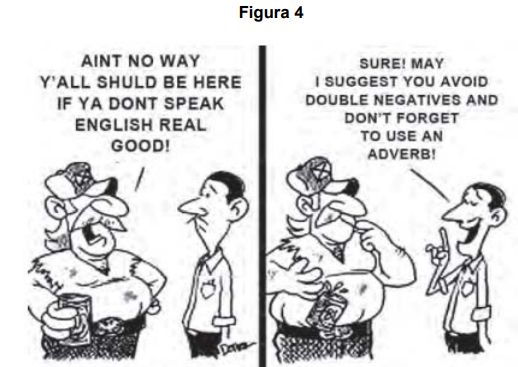
DONAR. Disponível em: <http://politicalgraffiti.wordpress.com>. Acesso em: 17 ago. 2011.
Considerando a relação entre linguagem e sociedade, analise o diálogo presente na charge (figura 4)
e assinale a alternativa que está em consonância com o que é descrito nos PCN de Língua Inglesa
sobre este tópico.
TEXT 8
“As far as practical conditions and educational relevance are concerned, virtually no major change has occurred in order to justify reframing our teaching. However, in what concerns social relevance, it is undeniable that the growth of the Internet has provided a new context for the use of the English language outside schools. For that reason, it is my belief that skills other than reading may now be taught in our classes without representing a return to a rationale that is alien to our schools. The teaching of writing in the context of Internet genres and practices is definitely necessary, if we want our students to have their own voice, becoming able to project their own local identities in global contexts.”
ALMEIDA, R. L. T. The teaching of English as a foreign language in the context of Brazilian regular schools: a retrospective and prospective view of policies and practices. Revista Brasileira de Linguística Aplicada, Belo Horizonte, v. 12, n. 2, 2012, p. 347.
Read the sentences below and decide which ones are in accordance with the ideas presented in the text. Mark the most adequate answer A-D.
I. The internet has introduced a new relevance for learning a foreign language.
II. Practical conditions and educational relevance have justified changes to teaching.
III. The use of the English language outside schools has always been considered relevant.
IV. The author claims that reading should be the focus of teaching English in schools.
V. Producing internet related texts may be a way to empower our students.
The correct option is
TEXT 6
“Probably the best-known and most often cited dimension of the WE (World Englishes) paradigm is the model of concentric circles: the ‘norm-providing’ inner circle, where English is spoken as a native language (ENL), the ‘norm-developing’ outer circle, where it is a second language (ESL), and the ‘norm-dependent’ expanding circle, where it is a foreign language (EFL). Although only ‘tentatively labelled’ (Kachru, 1985, p.12) in earlier versions, it has been claimed more recently that ‘the circles model is valid in the senses of earlier historical and political contexts, the dynamic diachronic advance of English around the world, and the functions and standards to which its users relate English in its many current global incarnations’ (Kachru and Nelson, 1996, p. 78).”
PENNYCOOK, A. Global Englishes and Transcultural Flows. New York: Routledge, 2007, p. 21.
According to the text, it is possible to say that the “circles model” established by Kachru
TEXT 5
“In other words, there are those among us who argue that the future of English is dependent on the likelihood or otherwise of the U.S. continuing to play its hegemonic role in world affairs. Since that possibility seems uncertain to many, especially in view of the much-talked-of ascendancy of emergent economies, many are of the opinion that English will soon lose much of its current glitter and cease to be what it is today, namely a world language. And there are those amongst us who further speculate that, in fifty or a hundred years’ time, we will all have acquired fluency in, say, Mandarin, or, if we haven’t, will be longing to learn it. […] Consider the following argument: a language such as English can only be claimed to have attained an international status to the very extent it has ceased to be national, i.e., the exclusive property of this or that nation in particular (Widdowson). In other words, the U.K. or the U.S.A. or whosoever cannot have it both ways. If they do concede that English is today a world language, then it only behooves them to also recognize that it is not their exclusive property, as painful as this might indeed turn out to be. In other words, it is part of the price they have to pay for seeing their language elevated to the status of a world language. Now, the key word here is “elevated”. It is precisely in the process of getting elevated to a world status that English or what I insist on referring to as the “World English” goes through a process of metamorphosis.”
RAJAGOPALAN, K. The identity of "World English”. New Challenges in Language and Literature. Belo Horizonte: FALE/UFMG, 2009, p. 99-100.
TEXT 5
“In other words, there are those among us who argue that the future of English is dependent on the likelihood or otherwise of the U.S. continuing to play its hegemonic role in world affairs. Since that possibility seems uncertain to many, especially in view of the much-talked-of ascendancy of emergent economies, many are of the opinion that English will soon lose much of its current glitter and cease to be what it is today, namely a world language. And there are those amongst us who further speculate that, in fifty or a hundred years’ time, we will all have acquired fluency in, say, Mandarin, or, if we haven’t, will be longing to learn it. […] Consider the following argument: a language such as English can only be claimed to have attained an international status to the very extent it has ceased to be national, i.e., the exclusive property of this or that nation in particular (Widdowson). In other words, the U.K. or the U.S.A. or whosoever cannot have it both ways. If they do concede that English is today a world language, then it only behooves them to also recognize that it is not their exclusive property, as painful as this might indeed turn out to be. In other words, it is part of the price they have to pay for seeing their language elevated to the status of a world language. Now, the key word here is “elevated”. It is precisely in the process of getting elevated to a world status that English or what I insist on referring to as the “World English” goes through a process of metamorphosis.”
RAJAGOPALAN, K. The identity of "World English”. New Challenges in Language and Literature. Belo Horizonte: FALE/UFMG, 2009, p. 99-100.
TEXT 2
“In spite of sharing Fairclough’s (1995/2010) view that the pedagogy of multiliteracies is situated in a critical language awareness perspective since its constructions parts from the problematization of work, citizenship and lifeworlds relations in the new global capitalism to propose the (re)design of meanings so as to account for the multiplicity of semiosis and lifestyles in contemporaneity, we can still notice that, in several aspects, the pedagogy designed by the New London Group legitimize some of the orders of discourse from this same capitalism it criticizes. Such a legitimation appears, for instance, in the comparison between teachers and managers used to define the notion of designer. It can also be noticed in the emphasis the Group places on the preparation for the labor market, even though the development of a metalanguage able to raise critical awareness about every practice is also emphasized. It is also worthwhile to highlight that the pedagogy of multiliteracies was thought as an educational alternative to respond to the “dramatic global economic change” we have been going through “as new business and management theories and practices emerge across the developed world” (NEW LONDON GROUP, 2000, p.10). Within this context, the fact of the multiliteracies pedagogy be constructed in the clash between legitimatizing and problematizing crystallized literacy practices from this developed world in the search of alternative life and educational designs becomes comprehensible.”
OLIVEIRA, M. B. F.; SZUNDI, P. T. C. Multiliteracies Practices at School: for a responsive education to contemporaneity.
Bakhtiniana, São Paulo, v. 9, n. 2, Jul./Dec. 2014, p. 202, 203.
According to the text, we may say that
Santos (2012) points out that a sociointeractional approach to learning occurs from the development of a context in which a more competent partner gives the learner the necessary support in the learning process, emphasizing the idea that the learning process is always mediated. Such mediation involves the interaction between teachers, students, resources and teaching materials. Still, on the relevant aspects of the sociointeractional approach to learning, the author mentions Vygotsky's notion that language is the most important mediating tool. Therefore, thinking, reading, writing, and talking about a specific topic have an important impact on our understanding of the world.
Thus, regarding the teaching and learning of reading from a sociointeractional perspective and the role strategies have in that process, it is possible to draw some conclusions. Read the conclusions below, decide which ones are in accordance with that approach and mark the most adequate answer A – D.
I. Developing learner strategies in the foreign language reading class implies that the learner will be at the centre and in control of the use of strategies, being the agent of his/her strategic decisions.
II. Since the 1990s, reading has come to be understood as a complex and dynamic activity that involves not only bottom-up and top-down cognitive processes, but also other contextual elements such as the reader's experience with other texts, the medium in which the text is written and the reader's decisions, as well as the reading strategies that he/she uses.
III. Successful readers often focus their attention on the general meaning of the text, but always use the dictionary when they encounter unfamiliar words. They also seek to break up word groups into single words to improve their comprehension.
IV. Activation of the student's prior knowledge of a subject, attention to the title of the text, its images, as well as typographic marks (font type, bold, italics, etc.) and identification of the textual genre are important pre-reading strategies that can lead the learner to formulate successful hypotheses about the text, making it easier to understand.
The correct option is
TEXT 1
School for sexism
By Deborah Cameron (Oxford University)
This week, it was announced that schools in England are being issued with new guidelines on combatting sexism and gender stereotyping. This initiative follows research conducted for the Institute of Physics (IoP), which found that most schools took sexism less seriously than other kinds of prejudice and discrimination. […]
The IoP’s main concern—one it shares with the government, which co-funded the research—is that girls are being deterred from studying science subjects by the sexist attitudes they encounter in school. Language is only one of the issues the report urges schools to tackle. […] But language was the main theme picked up in media reporting on the new guidelines, with many news outlets dramatically proclaiming that children ‘as young as five’ were going to be ‘banned’ from using certain words.
[…] I think we can guess why these newspapers were so keen on the language angle. They’ve known since the heyday of ‘political correctness gone mad’ that nothing stirs up the wrath of Middle England like a story about someone trying to ban words. Never mind that no sane parent permits total free expression for the under-fives […].
This reporting only underlined the point that sexism isn’t taken as seriously as other forms of prejudice. […] Rather than being outraged by the idea of telling primary school children to watch their words, shouldn’t we be asking why ‘children as young as five’ are using sexist language in the first place?
We may not want to think that this is happening among children still at primary school, but unfortunately the evidence says it is. […] Girl Guiding UK publishes an annual survey of girls’ attitudes: the 2015 survey, conducted with a sample of nearly 1600 girls and young women aged between 7 and 21, found that in the week before they were questioned, over 80% of respondents had experienced or witnessed some form of sexism, much of which was perpetrated by boys of their own age, and some of which undoubtedly occurred in school. 39% of respondents had been subjected to demeaning comments on their appearance, and 58% had heard comments or jokes belittling women and girls. […]
By the time they go to secondary school, girls are conscious of this everyday sexism as a factor which restricts their freedom, affecting where they feel they can go, what they feel able to wear and how much they are willing to talk in front of boys. In the Girl Guiding UK survey, a quarter of respondents aged 11-16 reported that they avoided speaking in lessons because of their fear of attracting sexist comments.
So, the Institute of Physics isn’t just being perverse when it identifies sexist ‘banter’ as a problem that affects girls’ education. It’s to the organization’s credit that it’s saying this shouldn’t be tolerated—and it’s also to its credit that it’s offering practical advice. Its recommendations are sensible, and its report contains many good ideas for teachers to consider. […]
When the Sunday Times talks about ‘boys and girls cheerfully baiting each other in the playground’, the implication is that we’re dealing with something reciprocal, a ‘battle of the sexes’ in which the two sides are evenly matched. But they’re not evenly matched. What can a girl say to a boy that will make him feel like a commodity, a piece of meat? What popular catchphrase can she fling at him that has the same dismissive force as ‘make me a sandwich’? […]
The IoP report does not seem to grasp that there is more to sexism than gender stereotyping. It falls back on the liberal argument that stereotyping harms both sexes equally: it’s as bad for the boy who wants to be a ballet dancer as it is for the girl who dreams of becoming an astrophysicist. But sexism doesn’t harm boys and girls equally, just as racism doesn’t harm white people and people of colour equally. It is the ideology of a system based on structural sexual inequality: male dominance and female subordination. You can’t address the problem of gender stereotyping effectively if you don’t acknowledge the larger power structure it is part of.
Disponível em: https://debuk.wordpress.com. Acesso em: 20 out. 2019.
Select the sentence that best paraphrases the excerpt:
“Language is only one of the issues the report urges schools to tackle. […] But language was the main theme picked up in media reporting on the new guidelines”.
TEXT 1
School for sexism
By Deborah Cameron (Oxford University)
This week, it was announced that schools in England are being issued with new guidelines on combatting sexism and gender stereotyping. This initiative follows research conducted for the Institute of Physics (IoP), which found that most schools took sexism less seriously than other kinds of prejudice and discrimination. […]
The IoP’s main concern—one it shares with the government, which co-funded the research—is that girls are being deterred from studying science subjects by the sexist attitudes they encounter in school. Language is only one of the issues the report urges schools to tackle. […] But language was the main theme picked up in media reporting on the new guidelines, with many news outlets dramatically proclaiming that children ‘as young as five’ were going to be ‘banned’ from using certain words.
[…] I think we can guess why these newspapers were so keen on the language angle. They’ve known since the heyday of ‘political correctness gone mad’ that nothing stirs up the wrath of Middle England like a story about someone trying to ban words. Never mind that no sane parent permits total free expression for the under-fives […].
This reporting only underlined the point that sexism isn’t taken as seriously as other forms of prejudice. […] Rather than being outraged by the idea of telling primary school children to watch their words, shouldn’t we be asking why ‘children as young as five’ are using sexist language in the first place?
We may not want to think that this is happening among children still at primary school, but unfortunately the evidence says it is. […] Girl Guiding UK publishes an annual survey of girls’ attitudes: the 2015 survey, conducted with a sample of nearly 1600 girls and young women aged between 7 and 21, found that in the week before they were questioned, over 80% of respondents had experienced or witnessed some form of sexism, much of which was perpetrated by boys of their own age, and some of which undoubtedly occurred in school. 39% of respondents had been subjected to demeaning comments on their appearance, and 58% had heard comments or jokes belittling women and girls. […]
By the time they go to secondary school, girls are conscious of this everyday sexism as a factor which restricts their freedom, affecting where they feel they can go, what they feel able to wear and how much they are willing to talk in front of boys. In the Girl Guiding UK survey, a quarter of respondents aged 11-16 reported that they avoided speaking in lessons because of their fear of attracting sexist comments.
So, the Institute of Physics isn’t just being perverse when it identifies sexist ‘banter’ as a problem that affects girls’ education. It’s to the organization’s credit that it’s saying this shouldn’t be tolerated—and it’s also to its credit that it’s offering practical advice. Its recommendations are sensible, and its report contains many good ideas for teachers to consider. […]
When the Sunday Times talks about ‘boys and girls cheerfully baiting each other in the playground’, the implication is that we’re dealing with something reciprocal, a ‘battle of the sexes’ in which the two sides are evenly matched. But they’re not evenly matched. What can a girl say to a boy that will make him feel like a commodity, a piece of meat? What popular catchphrase can she fling at him that has the same dismissive force as ‘make me a sandwich’? […]
The IoP report does not seem to grasp that there is more to sexism than gender stereotyping. It falls back on the liberal argument that stereotyping harms both sexes equally: it’s as bad for the boy who wants to be a ballet dancer as it is for the girl who dreams of becoming an astrophysicist. But sexism doesn’t harm boys and girls equally, just as racism doesn’t harm white people and people of colour equally. It is the ideology of a system based on structural sexual inequality: male dominance and female subordination. You can’t address the problem of gender stereotyping effectively if you don’t acknowledge the larger power structure it is part of.
Disponível em: https://debuk.wordpress.com. Acesso em: 20 out. 2019.
The following quote from Cameron’s article presents a standard passive construction, according to Parrott (2010): “This week, it was announced that schools in England are being issued with new guidelines on combatting sexism and gender stereotyping.”
Among the sentences below, choose the only one that follows a different pattern from standard passive constructions.
TEXT 1
School for sexism
By Deborah Cameron (Oxford University)
This week, it was announced that schools in England are being issued with new guidelines on combatting sexism and gender stereotyping. This initiative follows research conducted for the Institute of Physics (IoP), which found that most schools took sexism less seriously than other kinds of prejudice and discrimination. […]
The IoP’s main concern—one it shares with the government, which co-funded the research—is that girls are being deterred from studying science subjects by the sexist attitudes they encounter in school. Language is only one of the issues the report urges schools to tackle. […] But language was the main theme picked up in media reporting on the new guidelines, with many news outlets dramatically proclaiming that children ‘as young as five’ were going to be ‘banned’ from using certain words.
[…] I think we can guess why these newspapers were so keen on the language angle. They’ve known since the heyday of ‘political correctness gone mad’ that nothing stirs up the wrath of Middle England like a story about someone trying to ban words. Never mind that no sane parent permits total free expression for the under-fives […].
This reporting only underlined the point that sexism isn’t taken as seriously as other forms of prejudice. […] Rather than being outraged by the idea of telling primary school children to watch their words, shouldn’t we be asking why ‘children as young as five’ are using sexist language in the first place?
We may not want to think that this is happening among children still at primary school, but unfortunately the evidence says it is. […] Girl Guiding UK publishes an annual survey of girls’ attitudes: the 2015 survey, conducted with a sample of nearly 1600 girls and young women aged between 7 and 21, found that in the week before they were questioned, over 80% of respondents had experienced or witnessed some form of sexism, much of which was perpetrated by boys of their own age, and some of which undoubtedly occurred in school. 39% of respondents had been subjected to demeaning comments on their appearance, and 58% had heard comments or jokes belittling women and girls. […]
By the time they go to secondary school, girls are conscious of this everyday sexism as a factor which restricts their freedom, affecting where they feel they can go, what they feel able to wear and how much they are willing to talk in front of boys. In the Girl Guiding UK survey, a quarter of respondents aged 11-16 reported that they avoided speaking in lessons because of their fear of attracting sexist comments.
So, the Institute of Physics isn’t just being perverse when it identifies sexist ‘banter’ as a problem that affects girls’ education. It’s to the organization’s credit that it’s saying this shouldn’t be tolerated—and it’s also to its credit that it’s offering practical advice. Its recommendations are sensible, and its report contains many good ideas for teachers to consider. […]
When the Sunday Times talks about ‘boys and girls cheerfully baiting each other in the playground’, the implication is that we’re dealing with something reciprocal, a ‘battle of the sexes’ in which the two sides are evenly matched. But they’re not evenly matched. What can a girl say to a boy that will make him feel like a commodity, a piece of meat? What popular catchphrase can she fling at him that has the same dismissive force as ‘make me a sandwich’? […]
The IoP report does not seem to grasp that there is more to sexism than gender stereotyping. It falls back on the liberal argument that stereotyping harms both sexes equally: it’s as bad for the boy who wants to be a ballet dancer as it is for the girl who dreams of becoming an astrophysicist. But sexism doesn’t harm boys and girls equally, just as racism doesn’t harm white people and people of colour equally. It is the ideology of a system based on structural sexual inequality: male dominance and female subordination. You can’t address the problem of gender stereotyping effectively if you don’t acknowledge the larger power structure it is part of.
Disponível em: https://debuk.wordpress.com. Acesso em: 20 out. 2019.
Assuming a sociointeractional viewpoint, Giesel (in FERREIRA, 2012) argues that all forms of discourse can be understood as a social product, since they are present in the experiences of students.
Regarding the position presented above, choose the quote below from Cameron’s text which might support the idea that language teachers should approach aspects of sexist language and gender stereotyping in their lessons.
TEXT 1
School for sexism
By Deborah Cameron (Oxford University)
This week, it was announced that schools in England are being issued with new guidelines on combatting sexism and gender stereotyping. This initiative follows research conducted for the Institute of Physics (IoP), which found that most schools took sexism less seriously than other kinds of prejudice and discrimination. […]
The IoP’s main concern—one it shares with the government, which co-funded the research—is that girls are being deterred from studying science subjects by the sexist attitudes they encounter in school. Language is only one of the issues the report urges schools to tackle. […] But language was the main theme picked up in media reporting on the new guidelines, with many news outlets dramatically proclaiming that children ‘as young as five’ were going to be ‘banned’ from using certain words.
[…] I think we can guess why these newspapers were so keen on the language angle. They’ve known since the heyday of ‘political correctness gone mad’ that nothing stirs up the wrath of Middle England like a story about someone trying to ban words. Never mind that no sane parent permits total free expression for the under-fives […].
This reporting only underlined the point that sexism isn’t taken as seriously as other forms of prejudice. […] Rather than being outraged by the idea of telling primary school children to watch their words, shouldn’t we be asking why ‘children as young as five’ are using sexist language in the first place?
We may not want to think that this is happening among children still at primary school, but unfortunately the evidence says it is. […] Girl Guiding UK publishes an annual survey of girls’ attitudes: the 2015 survey, conducted with a sample of nearly 1600 girls and young women aged between 7 and 21, found that in the week before they were questioned, over 80% of respondents had experienced or witnessed some form of sexism, much of which was perpetrated by boys of their own age, and some of which undoubtedly occurred in school. 39% of respondents had been subjected to demeaning comments on their appearance, and 58% had heard comments or jokes belittling women and girls. […]
By the time they go to secondary school, girls are conscious of this everyday sexism as a factor which restricts their freedom, affecting where they feel they can go, what they feel able to wear and how much they are willing to talk in front of boys. In the Girl Guiding UK survey, a quarter of respondents aged 11-16 reported that they avoided speaking in lessons because of their fear of attracting sexist comments.
So, the Institute of Physics isn’t just being perverse when it identifies sexist ‘banter’ as a problem that affects girls’ education. It’s to the organization’s credit that it’s saying this shouldn’t be tolerated—and it’s also to its credit that it’s offering practical advice. Its recommendations are sensible, and its report contains many good ideas for teachers to consider. […]
When the Sunday Times talks about ‘boys and girls cheerfully baiting each other in the playground’, the implication is that we’re dealing with something reciprocal, a ‘battle of the sexes’ in which the two sides are evenly matched. But they’re not evenly matched. What can a girl say to a boy that will make him feel like a commodity, a piece of meat? What popular catchphrase can she fling at him that has the same dismissive force as ‘make me a sandwich’? […]
The IoP report does not seem to grasp that there is more to sexism than gender stereotyping. It falls back on the liberal argument that stereotyping harms both sexes equally: it’s as bad for the boy who wants to be a ballet dancer as it is for the girl who dreams of becoming an astrophysicist. But sexism doesn’t harm boys and girls equally, just as racism doesn’t harm white people and people of colour equally. It is the ideology of a system based on structural sexual inequality: male dominance and female subordination. You can’t address the problem of gender stereotyping effectively if you don’t acknowledge the larger power structure it is part of.
Disponível em: https://debuk.wordpress.com. Acesso em: 20 out. 2019.
Infants and Toddlers Eat Too Much Sugar, Researchers Say
1 - Using C.D.C. data, researchers found that 98 percent of toddlers and 60 percent of infants consumed added sugar in sweetened drinks, baked goods and snacks.

2 - Nearly all American toddlers about two-thirds of infants onsume added sugar, despite nutritionists’ recommendations that children avoid the sweetener, according to a government study released this week.
3 - Researchers, using data from the Centers for Disease Control and Prevention, found that from 2011 to 2016, 98 percent of toddlers ages 12 to 23 months consumed added sugar in fruit drinks, baked goods, candy and ready-to-eat cereals. Black toddlers ate the most added sugar — about eight teaspoons a day — while toddlers of Asian descent consumed the least, about 3.7 teaspoons a day.
4 - “The most important thing to take away is that added sugars are everywhere,” said the study’s lead investigator, Kirsten Herrick, who now works at the National Cancer Institute’s cancer control and population sciences division. “What is surprising is how added sugar quickly exceeds the recommended daily amounts.”
5 - The researchers also found that about 60 percent of infants up to 11 months old consumed added sugar in yogurt, baby snacks and flavored milk, among other foods — about one teaspoon of sugar per day. The study size was too small to make scientific conclusions about race, Dr. Herrick said. The findings were published on Thursday in The Journal of the Academy of Nutrition and Dietetics.
6 - Added sugars include any sweetener, including cane sugar and high-fructose corn syrup, that does not occur naturally in food. The American Heart Association advises that toddlers and infants
7 - In 2016, the American Cancer Society released dietary guidelines that said adults should limit
added sugar to 10 percent of their daily calories. In particular, it suggested people reduce the number
of sugar-sweetened drinks, including fruit and sports drinks, they consume. Sugar is associated not
only with weight gain, but also with many types of cancer, the society said.
8 - Dr. Herrick said the consumption of sugar in teenagers and older children has been linked to cavities, asthma, obesity and high blood pressure. Amid news of the alarming amount of sugar consumption, though, she said researchers also observed that sugar consumption in infants was declining over all.
9 - Dr. Herrick warned that exposing children to sugary foods when they are young could impact taste preferences when they are older.
10 - “There is no reason to provide sugar-sweetened beverages” to toddlers and infants, she said. “They need nutrient-dense foods.”
https://www.nytimes.com/2019/11/14/science/sugar-toddlers-infants.html
Infants and Toddlers Eat Too Much Sugar, Researchers Say
1 - Using C.D.C. data, researchers found that 98 percent of toddlers and 60 percent of infants consumed added sugar in sweetened drinks, baked goods and snacks.
2 - Nearly all American toddlers about two-thirds of infants onsume added sugar, despite nutritionists’ recommendations that children avoid the sweetener, according to a government study released this week.
3 - Researchers, using data from the Centers for Disease Control and Prevention, found that from 2011 to 2016, 98 percent of toddlers ages 12 to 23 months consumed added sugar in fruit drinks, baked goods, candy and ready-to-eat cereals. Black toddlers ate the most added sugar — about eight teaspoons a day — while toddlers of Asian descent consumed the least, about 3.7 teaspoons a day.
4 - “The most important thing to take away is that added sugars are everywhere,” said the study’s lead investigator, Kirsten Herrick, who now works at the National Cancer Institute’s cancer control and population sciences division. “What is surprising is how added sugar quickly exceeds the recommended daily amounts.”
5 - The researchers also found that about 60 percent of infants up to 11 months old consumed added sugar in yogurt, baby snacks and flavored milk, among other foods — about one teaspoon of sugar per day. The study size was too small to make scientific conclusions about race, Dr. Herrick said. The findings were published on Thursday in The Journal of the Academy of Nutrition and Dietetics.
6 - Added sugars include any sweetener, including cane sugar and high-fructose corn syrup, that does not occur naturally in food. The American Heart Association advises that toddlers and infants
7 - In 2016, the American Cancer Society released dietary guidelines that said adults should limit
added sugar to 10 percent of their daily calories. In particular, it suggested people reduce the number
of sugar-sweetened drinks, including fruit and sports drinks, they consume. Sugar is associated not
only with weight gain, but also with many types of cancer, the society said.
8 - Dr. Herrick said the consumption of sugar in teenagers and older children has been linked to cavities, asthma, obesity and high blood pressure. Amid news of the alarming amount of sugar consumption, though, she said researchers also observed that sugar consumption in infants was declining over all.
9 - Dr. Herrick warned that exposing children to sugary foods when they are young could impact taste preferences when they are older.
10 - “There is no reason to provide sugar-sweetened beverages” to toddlers and infants, she said. “They need nutrient-dense foods.”
https://www.nytimes.com/2019/11/14/science/sugar-toddlers-infants.html
Infants and Toddlers Eat Too Much Sugar, Researchers Say
1 - Using C.D.C. data, researchers found that 98 percent of toddlers and 60 percent of infants consumed added sugar in sweetened drinks, baked goods and snacks.
2 - Nearly all American toddlers about two-thirds of infants onsume added sugar, despite nutritionists’ recommendations that children avoid the sweetener, according to a government study released this week.
3 - Researchers, using data from the Centers for Disease Control and Prevention, found that from 2011 to 2016, 98 percent of toddlers ages 12 to 23 months consumed added sugar in fruit drinks, baked goods, candy and ready-to-eat cereals. Black toddlers ate the most added sugar — about eight teaspoons a day — while toddlers of Asian descent consumed the least, about 3.7 teaspoons a day.
4 - “The most important thing to take away is that added sugars are everywhere,” said the study’s lead investigator, Kirsten Herrick, who now works at the National Cancer Institute’s cancer control and population sciences division. “What is surprising is how added sugar quickly exceeds the recommended daily amounts.”
5 - The researchers also found that about 60 percent of infants up to 11 months old consumed added sugar in yogurt, baby snacks and flavored milk, among other foods — about one teaspoon of sugar per day. The study size was too small to make scientific conclusions about race, Dr. Herrick said. The findings were published on Thursday in The Journal of the Academy of Nutrition and Dietetics.
6 - Added sugars include any sweetener, including cane sugar and high-fructose corn syrup, that does not occur naturally in food. The American Heart Association advises that toddlers and infants
7 - In 2016, the American Cancer Society released dietary guidelines that said adults should limit
added sugar to 10 percent of their daily calories. In particular, it suggested people reduce the number
of sugar-sweetened drinks, including fruit and sports drinks, they consume. Sugar is associated not
only with weight gain, but also with many types of cancer, the society said.
8 - Dr. Herrick said the consumption of sugar in teenagers and older children has been linked to cavities, asthma, obesity and high blood pressure. Amid news of the alarming amount of sugar consumption, though, she said researchers also observed that sugar consumption in infants was declining over all.
9 - Dr. Herrick warned that exposing children to sugary foods when they are young could impact taste preferences when they are older.
10 - “There is no reason to provide sugar-sweetened beverages” to toddlers and infants, she said. “They need nutrient-dense foods.”
https://www.nytimes.com/2019/11/14/science/sugar-toddlers-infants.html
De acordo com o parágrafo 1 e 2 do texto, é correto afirmar que:
( ) Bebês e crianças deveriam comer mais açúcar devido ao seu crescimento.
( ) Os dados dos pesquisadores mostram que 98% dos bebês e 60% dos adultos consumiam açúcar misturado com bebidas lácteas.
( ) Os nutricionistas recomendam que as crianças evitem.
( ) Cerca de dois terços das crianças deixaram de consumir açúcar.


 Conheça nossos planos