Questões de Concurso
Sobre interpretação de texto | reading comprehension em inglês
Foram encontradas 12.687 questões


Julgue as sentenças abaixo como VERDADEIRAS ou FALSAS.
(__) A estratégia Reading for Detail busca obter uma visão geral e rápida do conteúdo.
(__) A estratégia Skimming busca compreender profundamente o conteúdo, prestando atenção a detalhes específicos.
(__) A estratégia Scanning busca localizar informações específicas.
A sequência CORRETA é:
Leia a tira de Calvin e Hobbes.

(https://medium.com/@calebwsl_/the-politics-of-calvin-and-hobbes-b032239025cc)
A fala do tigre no último quadrinho menciona “putting prices on the priceless”. Exemplo de algo “priceless” é encontrado na alternativa:
Read the text to answer question.
No one who speaks English has any difficulty understanding the meaning of a sentence like ‘It’s warm in here’. We all recognise that it is a comment on the temperature in some place or other. But why it is being said, and what the speaker wishes to convey by saying it, depends entirely on two things: the context in which it is said and what the speaker wants people to understand (...) The meaning of language depends on where it occurs within a larger stretch of discourse, and thus the relationship that the different language elements have with what comes before and after them. In other words, speakers and writers have to be able to operate with more than just words and grammar; they have to be able to string utterances together.
Our ability to function properly in conversation or writing depends not only on reacting to the context in which we are using the language, but also on the relationship between words and ideas in longer texts.
Words can also mean more than one thing, for example, ‘book’ (= something to read, to reserve, a list of bets, etc.), ‘beat’ (= to win, to hit, to mix, e.g. an egg, the ‘pulse’ of music/a heart) and ‘can’ (= ability, permission, probability – and a container made of metal). Notice that, in these examples, not only can the same form have many meanings, but it can also be different parts of speech.
With so many available meanings for words and grammatical forms, it is the context the word occurs in which determines which of these meanings is being referred to. If we say, ‘I beat him because I ran faster than he did’, ‘beat’ is likely to mean won rather than physically assaulted or mixed (though there is always the possibility of ambiguity, of course).
(Harmer, 1998. Adaptado)
Read the text to answer question.
No one who speaks English has any difficulty understanding the meaning of a sentence like ‘It’s warm in here’. We all recognise that it is a comment on the temperature in some place or other. But why it is being said, and what the speaker wishes to convey by saying it, depends entirely on two things: the context in which it is said and what the speaker wants people to understand (...) The meaning of language depends on where it occurs within a larger stretch of discourse, and thus the relationship that the different language elements have with what comes before and after them. In other words, speakers and writers have to be able to operate with more than just words and grammar; they have to be able to string utterances together.
Our ability to function properly in conversation or writing depends not only on reacting to the context in which we are using the language, but also on the relationship between words and ideas in longer texts.
Words can also mean more than one thing, for example, ‘book’ (= something to read, to reserve, a list of bets, etc.), ‘beat’ (= to win, to hit, to mix, e.g. an egg, the ‘pulse’ of music/a heart) and ‘can’ (= ability, permission, probability – and a container made of metal). Notice that, in these examples, not only can the same form have many meanings, but it can also be different parts of speech.
With so many available meanings for words and grammatical forms, it is the context the word occurs in which determines which of these meanings is being referred to. If we say, ‘I beat him because I ran faster than he did’, ‘beat’ is likely to mean won rather than physically assaulted or mixed (though there is always the possibility of ambiguity, of course).
(Harmer, 1998. Adaptado)
Read the text to answer question.
No one who speaks English has any difficulty understanding the meaning of a sentence like ‘It’s warm in here’. We all recognise that it is a comment on the temperature in some place or other. But why it is being said, and what the speaker wishes to convey by saying it, depends entirely on two things: the context in which it is said and what the speaker wants people to understand (...) The meaning of language depends on where it occurs within a larger stretch of discourse, and thus the relationship that the different language elements have with what comes before and after them. In other words, speakers and writers have to be able to operate with more than just words and grammar; they have to be able to string utterances together.
Our ability to function properly in conversation or writing depends not only on reacting to the context in which we are using the language, but also on the relationship between words and ideas in longer texts.
Words can also mean more than one thing, for example, ‘book’ (= something to read, to reserve, a list of bets, etc.), ‘beat’ (= to win, to hit, to mix, e.g. an egg, the ‘pulse’ of music/a heart) and ‘can’ (= ability, permission, probability – and a container made of metal). Notice that, in these examples, not only can the same form have many meanings, but it can also be different parts of speech.
With so many available meanings for words and grammatical forms, it is the context the word occurs in which determines which of these meanings is being referred to. If we say, ‘I beat him because I ran faster than he did’, ‘beat’ is likely to mean won rather than physically assaulted or mixed (though there is always the possibility of ambiguity, of course).
(Harmer, 1998. Adaptado)
Read the text to answer question.
No one who speaks English has any difficulty understanding the meaning of a sentence like ‘It’s warm in here’. We all recognise that it is a comment on the temperature in some place or other. But why it is being said, and what the speaker wishes to convey by saying it, depends entirely on two things: the context in which it is said and what the speaker wants people to understand (...) The meaning of language depends on where it occurs within a larger stretch of discourse, and thus the relationship that the different language elements have with what comes before and after them. In other words, speakers and writers have to be able to operate with more than just words and grammar; they have to be able to string utterances together.
Our ability to function properly in conversation or writing depends not only on reacting to the context in which we are using the language, but also on the relationship between words and ideas in longer texts.
Words can also mean more than one thing, for example, ‘book’ (= something to read, to reserve, a list of bets, etc.), ‘beat’ (= to win, to hit, to mix, e.g. an egg, the ‘pulse’ of music/a heart) and ‘can’ (= ability, permission, probability – and a container made of metal). Notice that, in these examples, not only can the same form have many meanings, but it can also be different parts of speech.
With so many available meanings for words and grammatical forms, it is the context the word occurs in which determines which of these meanings is being referred to. If we say, ‘I beat him because I ran faster than he did’, ‘beat’ is likely to mean won rather than physically assaulted or mixed (though there is always the possibility of ambiguity, of course).
(Harmer, 1998. Adaptado)
The following conversation takes place in the context of two people getting ready for their party:
Jack: “We can leave the ice here till we need it.”
Ben: “It’s warm in here.”
Taking context into account, the probable correct final comment by Jack that makes sense in the situation would be
Read the text to answer question.
No one who speaks English has any difficulty understanding the meaning of a sentence like ‘It’s warm in here’. We all recognise that it is a comment on the temperature in some place or other. But why it is being said, and what the speaker wishes to convey by saying it, depends entirely on two things: the context in which it is said and what the speaker wants people to understand (...) The meaning of language depends on where it occurs within a larger stretch of discourse, and thus the relationship that the different language elements have with what comes before and after them. In other words, speakers and writers have to be able to operate with more than just words and grammar; they have to be able to string utterances together.
Our ability to function properly in conversation or writing depends not only on reacting to the context in which we are using the language, but also on the relationship between words and ideas in longer texts.
Words can also mean more than one thing, for example, ‘book’ (= something to read, to reserve, a list of bets, etc.), ‘beat’ (= to win, to hit, to mix, e.g. an egg, the ‘pulse’ of music/a heart) and ‘can’ (= ability, permission, probability – and a container made of metal). Notice that, in these examples, not only can the same form have many meanings, but it can also be different parts of speech.
With so many available meanings for words and grammatical forms, it is the context the word occurs in which determines which of these meanings is being referred to. If we say, ‘I beat him because I ran faster than he did’, ‘beat’ is likely to mean won rather than physically assaulted or mixed (though there is always the possibility of ambiguity, of course).
(Harmer, 1998. Adaptado)
Read the Exchange below:
Customer: “Waiter, will the pancakes be long?”
Waiter: “No, sir. Round.”
The part of language that accounts for this type of joke is
Read the text to answer question.
No one who speaks English has any difficulty understanding the meaning of a sentence like ‘It’s warm in here’. We all recognise that it is a comment on the temperature in some place or other. But why it is being said, and what the speaker wishes to convey by saying it, depends entirely on two things: the context in which it is said and what the speaker wants people to understand (...) The meaning of language depends on where it occurs within a larger stretch of discourse, and thus the relationship that the different language elements have with what comes before and after them. In other words, speakers and writers have to be able to operate with more than just words and grammar; they have to be able to string utterances together.
Our ability to function properly in conversation or writing depends not only on reacting to the context in which we are using the language, but also on the relationship between words and ideas in longer texts.
Words can also mean more than one thing, for example, ‘book’ (= something to read, to reserve, a list of bets, etc.), ‘beat’ (= to win, to hit, to mix, e.g. an egg, the ‘pulse’ of music/a heart) and ‘can’ (= ability, permission, probability – and a container made of metal). Notice that, in these examples, not only can the same form have many meanings, but it can also be different parts of speech.
With so many available meanings for words and grammatical forms, it is the context the word occurs in which determines which of these meanings is being referred to. If we say, ‘I beat him because I ran faster than he did’, ‘beat’ is likely to mean won rather than physically assaulted or mixed (though there is always the possibility of ambiguity, of course).
(Harmer, 1998. Adaptado)
Read the text to answer question.
No one who speaks English has any difficulty understanding the meaning of a sentence like ‘It’s warm in here’. We all recognise that it is a comment on the temperature in some place or other. But why it is being said, and what the speaker wishes to convey by saying it, depends entirely on two things: the context in which it is said and what the speaker wants people to understand (...) The meaning of language depends on where it occurs within a larger stretch of discourse, and thus the relationship that the different language elements have with what comes before and after them. In other words, speakers and writers have to be able to operate with more than just words and grammar; they have to be able to string utterances together.
Our ability to function properly in conversation or writing depends not only on reacting to the context in which we are using the language, but also on the relationship between words and ideas in longer texts.
Words can also mean more than one thing, for example, ‘book’ (= something to read, to reserve, a list of bets, etc.), ‘beat’ (= to win, to hit, to mix, e.g. an egg, the ‘pulse’ of music/a heart) and ‘can’ (= ability, permission, probability – and a container made of metal). Notice that, in these examples, not only can the same form have many meanings, but it can also be different parts of speech.
With so many available meanings for words and grammatical forms, it is the context the word occurs in which determines which of these meanings is being referred to. If we say, ‘I beat him because I ran faster than he did’, ‘beat’ is likely to mean won rather than physically assaulted or mixed (though there is always the possibility of ambiguity, of course).
(Harmer, 1998. Adaptado)
Read the text to answer question.
No one who speaks English has any difficulty understanding the meaning of a sentence like ‘It’s warm in here’. We all recognise that it is a comment on the temperature in some place or other. But why it is being said, and what the speaker wishes to convey by saying it, depends entirely on two things: the context in which it is said and what the speaker wants people to understand (...) The meaning of language depends on where it occurs within a larger stretch of discourse, and thus the relationship that the different language elements have with what comes before and after them. In other words, speakers and writers have to be able to operate with more than just words and grammar; they have to be able to string utterances together.
Our ability to function properly in conversation or writing depends not only on reacting to the context in which we are using the language, but also on the relationship between words and ideas in longer texts.
Words can also mean more than one thing, for example, ‘book’ (= something to read, to reserve, a list of bets, etc.), ‘beat’ (= to win, to hit, to mix, e.g. an egg, the ‘pulse’ of music/a heart) and ‘can’ (= ability, permission, probability – and a container made of metal). Notice that, in these examples, not only can the same form have many meanings, but it can also be different parts of speech.
With so many available meanings for words and grammatical forms, it is the context the word occurs in which determines which of these meanings is being referred to. If we say, ‘I beat him because I ran faster than he did’, ‘beat’ is likely to mean won rather than physically assaulted or mixed (though there is always the possibility of ambiguity, of course).
(Harmer, 1998. Adaptado)
Leia o texto para responder à questão.
In foreign language education, the teaching of culture remains a hotly debated issue. What is culture? What is its relation to language? Which and whose culture should be taught? What role should the learners’ culture play in the acquisition of knowledge of the target culture? How can we avoid essentializing cultures and teaching stereotypes? And how can we develop in the learners an intercultural competence that would shortchange neither their own culture nor the target culture, but would make them into cultural mediators in a globalized world? This paper explores these issues from the perspective of the large body of research done in Australia, Europe and the U.S. in the last twenty years. It links the study of culture to the study of discourse (see, e.g., Kramsch 1993, 1998, 2004) and to the concept of translingual and transcultural competence proposed by the Modern Language Association (e.g., Kramsch, 2010).
(https://files.eric.ed.gov/fulltext/EJ1127430)
Leia o texto para responder à questão.
In foreign language education, the teaching of culture remains a hotly debated issue. What is culture? What is its relation to language? Which and whose culture should be taught? What role should the learners’ culture play in the acquisition of knowledge of the target culture? How can we avoid essentializing cultures and teaching stereotypes? And how can we develop in the learners an intercultural competence that would shortchange neither their own culture nor the target culture, but would make them into cultural mediators in a globalized world? This paper explores these issues from the perspective of the large body of research done in Australia, Europe and the U.S. in the last twenty years. It links the study of culture to the study of discourse (see, e.g., Kramsch 1993, 1998, 2004) and to the concept of translingual and transcultural competence proposed by the Modern Language Association (e.g., Kramsch, 2010).
(https://files.eric.ed.gov/fulltext/EJ1127430)
According to some authors, one of the reasons we can communicate successfully, especially in writing, is because we have some understanding of genre. The characteristics of the text above are consistent with
Leia o quadrinho:
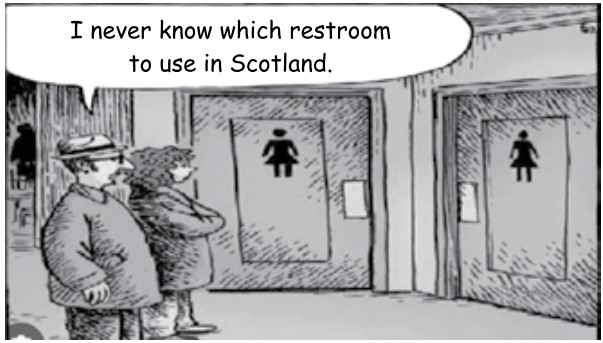
(https://theeconomyofmeaning.com/2019/11/03/
funny-on-sunday-when-in-schotland/)
As palavras do personagem mostram que ele
Leia o texto para responder à questão.
Building on the professional consensus that no method could claim supremacy, Prabhu (1990) asks why there is no best method. He suggests that there are three possible explanations: (1) different methods are best for different teaching / learning circumstances; (2) all methods have some truth or validity; and (3) the whole notion of what is a good or a bad method is irrelevant. Prabhu argues for the third possibility and concludes that we need to rethink what is “best” such that classroom teachers and applied linguists can develop shared pedagogical perceptions of what real-world classroom teaching is.
H.D. Brown (2002), in his critique of methods, adds the following two observations: (1) so-called designer methods seem distinctive at the initial stage of learning but soon come to look like any other learner centered approach; and (2) it has proven impossible to empirically (i.e., quantitatively) demonstrate the superiority of one method over another. Brown (2002) concludes that classroom teachers do best when they ground their pedagogy in “well-established principles of language teaching and learning” (p.17).
So what are these well-established principles that teachers should apply in the post methods era? One of the early concrete proposals comes from Kamaravadivelu (1994), who offers a framework consisting of 10 macro strategies, some of which are summarized below:
– Maximize learning opportunities. The teacher’s job is not to transmit knowledge but to create and manage as many learning opportunities as possible.
– Facilitate negotiated interaction. Learners should initiate classroom talk (not just respond to the teacher’s prompts) by asking for clarification, by confirming, by reacting, and so on, as part of teacher-student and student-student interaction.
– Activate intuitive heuristics. Teachers should provide enough data for learners to infer underlying grammatical rules, since it is impossible to explicitly teach all rules of the L2.
– Integrate language skills. The separation of listening, reading, speaking, and writing is artificial. As in the real-world, learners should integrate skills: conversation (listening and speaking), note-taking (listening and writing), self-study (reading and writing), and so on.
– Raise cultural consciousness. Teachers should allow learners to become sources of cultural information so that knowledge about the culture of the L2 and of other cultures (especially those represented by the students) becomes part of classroom communication.
– Ensure social relevance: acknowledge that language learning has social, political, economic, and educational dimensions that shape the motivation to learn the L2, determine the uses to which the L2 will be put, and define the skills and proficiency level needed in the L2.
(Celce-Murcia, M. 2001. Adaptado)
Read the following comment from a teacher:
To ensure that both educators and learners continue to utilize the target language, educate learners how to ask for help or clarification in the target language such as What exactly do you mean by .....? How do you pronounce ....? I’m not sure what you mean. Can you say it again?
This way of acting falls into Kamaravadivelu’s (1994) macro strategy named
Leia o texto para responder à questão.
Building on the professional consensus that no method could claim supremacy, Prabhu (1990) asks why there is no best method. He suggests that there are three possible explanations: (1) different methods are best for different teaching / learning circumstances; (2) all methods have some truth or validity; and (3) the whole notion of what is a good or a bad method is irrelevant. Prabhu argues for the third possibility and concludes that we need to rethink what is “best” such that classroom teachers and applied linguists can develop shared pedagogical perceptions of what real-world classroom teaching is.
H.D. Brown (2002), in his critique of methods, adds the following two observations: (1) so-called designer methods seem distinctive at the initial stage of learning but soon come to look like any other learner centered approach; and (2) it has proven impossible to empirically (i.e., quantitatively) demonstrate the superiority of one method over another. Brown (2002) concludes that classroom teachers do best when they ground their pedagogy in “well-established principles of language teaching and learning” (p.17).
So what are these well-established principles that teachers should apply in the post methods era? One of the early concrete proposals comes from Kamaravadivelu (1994), who offers a framework consisting of 10 macro strategies, some of which are summarized below:
– Maximize learning opportunities. The teacher’s job is not to transmit knowledge but to create and manage as many learning opportunities as possible.
– Facilitate negotiated interaction. Learners should initiate classroom talk (not just respond to the teacher’s prompts) by asking for clarification, by confirming, by reacting, and so on, as part of teacher-student and student-student interaction.
– Activate intuitive heuristics. Teachers should provide enough data for learners to infer underlying grammatical rules, since it is impossible to explicitly teach all rules of the L2.
– Integrate language skills. The separation of listening, reading, speaking, and writing is artificial. As in the real-world, learners should integrate skills: conversation (listening and speaking), note-taking (listening and writing), self-study (reading and writing), and so on.
– Raise cultural consciousness. Teachers should allow learners to become sources of cultural information so that knowledge about the culture of the L2 and of other cultures (especially those represented by the students) becomes part of classroom communication.
– Ensure social relevance: acknowledge that language learning has social, political, economic, and educational dimensions that shape the motivation to learn the L2, determine the uses to which the L2 will be put, and define the skills and proficiency level needed in the L2.
(Celce-Murcia, M. 2001. Adaptado)
Leia o texto para responder à questão.
Building on the professional consensus that no method could claim supremacy, Prabhu (1990) asks why there is no best method. He suggests that there are three possible explanations: (1) different methods are best for different teaching / learning circumstances; (2) all methods have some truth or validity; and (3) the whole notion of what is a good or a bad method is irrelevant. Prabhu argues for the third possibility and concludes that we need to rethink what is “best” such that classroom teachers and applied linguists can develop shared pedagogical perceptions of what real-world classroom teaching is.
H.D. Brown (2002), in his critique of methods, adds the following two observations: (1) so-called designer methods seem distinctive at the initial stage of learning but soon come to look like any other learner centered approach; and (2) it has proven impossible to empirically (i.e., quantitatively) demonstrate the superiority of one method over another. Brown (2002) concludes that classroom teachers do best when they ground their pedagogy in “well-established principles of language teaching and learning” (p.17).
So what are these well-established principles that teachers should apply in the post methods era? One of the early concrete proposals comes from Kamaravadivelu (1994), who offers a framework consisting of 10 macro strategies, some of which are summarized below:
– Maximize learning opportunities. The teacher’s job is not to transmit knowledge but to create and manage as many learning opportunities as possible.
– Facilitate negotiated interaction. Learners should initiate classroom talk (not just respond to the teacher’s prompts) by asking for clarification, by confirming, by reacting, and so on, as part of teacher-student and student-student interaction.
– Activate intuitive heuristics. Teachers should provide enough data for learners to infer underlying grammatical rules, since it is impossible to explicitly teach all rules of the L2.
– Integrate language skills. The separation of listening, reading, speaking, and writing is artificial. As in the real-world, learners should integrate skills: conversation (listening and speaking), note-taking (listening and writing), self-study (reading and writing), and so on.
– Raise cultural consciousness. Teachers should allow learners to become sources of cultural information so that knowledge about the culture of the L2 and of other cultures (especially those represented by the students) becomes part of classroom communication.
– Ensure social relevance: acknowledge that language learning has social, political, economic, and educational dimensions that shape the motivation to learn the L2, determine the uses to which the L2 will be put, and define the skills and proficiency level needed in the L2.
(Celce-Murcia, M. 2001. Adaptado)
Leia o texto para responder à questão.
Building on the professional consensus that no method could claim supremacy, Prabhu (1990) asks why there is no best method. He suggests that there are three possible explanations: (1) different methods are best for different teaching / learning circumstances; (2) all methods have some truth or validity; and (3) the whole notion of what is a good or a bad method is irrelevant. Prabhu argues for the third possibility and concludes that we need to rethink what is “best” such that classroom teachers and applied linguists can develop shared pedagogical perceptions of what real-world classroom teaching is.
H.D. Brown (2002), in his critique of methods, adds the following two observations: (1) so-called designer methods seem distinctive at the initial stage of learning but soon come to look like any other learner centered approach; and (2) it has proven impossible to empirically (i.e., quantitatively) demonstrate the superiority of one method over another. Brown (2002) concludes that classroom teachers do best when they ground their pedagogy in “well-established principles of language teaching and learning” (p.17).
So what are these well-established principles that teachers should apply in the post methods era? One of the early concrete proposals comes from Kamaravadivelu (1994), who offers a framework consisting of 10 macro strategies, some of which are summarized below:
– Maximize learning opportunities. The teacher’s job is not to transmit knowledge but to create and manage as many learning opportunities as possible.
– Facilitate negotiated interaction. Learners should initiate classroom talk (not just respond to the teacher’s prompts) by asking for clarification, by confirming, by reacting, and so on, as part of teacher-student and student-student interaction.
– Activate intuitive heuristics. Teachers should provide enough data for learners to infer underlying grammatical rules, since it is impossible to explicitly teach all rules of the L2.
– Integrate language skills. The separation of listening, reading, speaking, and writing is artificial. As in the real-world, learners should integrate skills: conversation (listening and speaking), note-taking (listening and writing), self-study (reading and writing), and so on.
– Raise cultural consciousness. Teachers should allow learners to become sources of cultural information so that knowledge about the culture of the L2 and of other cultures (especially those represented by the students) becomes part of classroom communication.
– Ensure social relevance: acknowledge that language learning has social, political, economic, and educational dimensions that shape the motivation to learn the L2, determine the uses to which the L2 will be put, and define the skills and proficiency level needed in the L2.
(Celce-Murcia, M. 2001. Adaptado)

 Conheça nossos planos