Questões de Concurso
Sobre formação de palavras (prefixos e sufixos) | word formation (prefix and suffix) em inglês
Foram encontradas 329 questões


Leia o texto para responder à questão.
Building on the professional consensus that no method could claim supremacy, Prabhu (1990) asks why there is no best method. He suggests that there are three possible explanations: (1) different methods are best for different teaching / learning circumstances; (2) all methods have some truth or validity; and (3) the whole notion of what is a good or a bad method is irrelevant. Prabhu argues for the third possibility and concludes that we need to rethink what is “best” such that classroom teachers and applied linguists can develop shared pedagogical perceptions of what real-world classroom teaching is.
H.D. Brown (2002), in his critique of methods, adds the following two observations: (1) so-called designer methods seem distinctive at the initial stage of learning but soon come to look like any other learner centered approach; and (2) it has proven impossible to empirically (i.e., quantitatively) demonstrate the superiority of one method over another. Brown (2002) concludes that classroom teachers do best when they ground their pedagogy in “well-established principles of language teaching and learning” (p.17).
So what are these well-established principles that teachers should apply in the post methods era? One of the early concrete proposals comes from Kamaravadivelu (1994), who offers a framework consisting of 10 macro strategies, some of which are summarized below:
– Maximize learning opportunities. The teacher’s job is not to transmit knowledge but to create and manage as many learning opportunities as possible.
– Facilitate negotiated interaction. Learners should initiate classroom talk (not just respond to the teacher’s prompts) by asking for clarification, by confirming, by reacting, and so on, as part of teacher-student and student-student interaction.
– Activate intuitive heuristics. Teachers should provide enough data for learners to infer underlying grammatical rules, since it is impossible to explicitly teach all rules of the L2.
– Integrate language skills. The separation of listening, reading, speaking, and writing is artificial. As in the real-world, learners should integrate skills: conversation (listening and speaking), note-taking (listening and writing), self-study (reading and writing), and so on.
– Raise cultural consciousness. Teachers should allow learners to become sources of cultural information so that knowledge about the culture of the L2 and of other cultures (especially those represented by the students) becomes part of classroom communication.
– Ensure social relevance: acknowledge that language learning has social, political, economic, and educational dimensions that shape the motivation to learn the L2, determine the uses to which the L2 will be put, and define the skills and proficiency level needed in the L2.
(Celce-Murcia, M. 2001. Adaptado)
Read the poem:
Colors
By Shell Silverstein
My skin is kind of sort of brownish
Pinkish yellowish white.
My eyes are greyish blueish green,
But I'm told they look orange in the night.
My hair is reddish blondish brown,
But it's silver when it's wet.
And all the colors I am inside
Have not been invented yet.
The suffix -ish added to the words in the poem suggests an idea of:
Consider the following set of words:
unhappiness;
disagreement;
reclassification;
remotivation;
disloyalty.
Which of the following best describes the common morphological process observed in the formation of these words?
I. Independent.
II. Inlegible.
III. Inmoral.
The use of the prefix –in is correct in the item(ns):
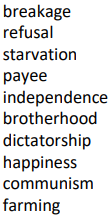
In the sentence below, identify the correctly analyzed morphological structure of the suffixed words:
"The happiness of the children was reflected in their joyful laughter."
Analyze strips I, II and II below:
I 
Disponível em: https://garfield-comic-strips.fandom.com/wiki/2024. Acesso em: 10 out. 2024.
II 
Disponível em: https://garfield-comic-strips.fandom.com/wiki/2024. Acesso em: 10 out. 2024.
III 
Disponível em: http://pt.jikos.cz/garfield/2024/3/. Acesso em: 10 out. 2024.
What verb tenses are in strips I, II and III, respectively?
INSTRUCTION: Read the following text to answer question.
When life feels chaotic, less is more
When the feeling of pandemonium takes over, our instinct is often to try to regain control through sweeping personal change. We’ll jump in with grand plans to overhaul our routines, transform our homes, or tackle every to-do we’ve neglected. But inevitably, when the enthusiasm fades, anxiety spirals further, or real life gets in the way, our plans fall apart.
This cycle of starting big and stalling out leaves people feeling more discouraged than before. When we’re overwhelmed, our mental bandwidth is limited, and ambitious plans become just one more thing to manage. That’s where the magic of micro wins comes in. They might not look impressive or overtly ambitious, but they provide a sense of accomplishment, momentum (even pride?), and gradually shift our environment and mindset, especially during times of mass madness.
Source: https://time.com/7172611/little-winsbenefits-essay/
Accessed on November 13, 2024. [Adapted fragment]
“Instinct” is replaced by its adjective form that means “behaving or reacting naturally and without thinking” in the sentence: “(...) our instinct is often to try to regain control through sweeping personal change.”
Considering only the word itself and disregarding the change in meaning of the sentence, the correct spelling of the adjective will be:
INSTRUCTION: Read the following text to answer question.
Do Leveled Books Have Any Place in the Classroom?
“The little turtle can see the grass. The little turtle can see the trees. The little turtle can see the flowers”. These are the opening lines to one popular reading program’s leveled books: short, predictable texts designed for beginning readers. The patterned sentence structure – centered on the phrase “the little turtle can see" – invites students to rely on repetition and context clues to identify words they can’t sound out.
Leveled books have been a staple in early elementary reading instruction for more than two decades. But as the “science of reading” movement has spread, leveled books have come under fire. Initially, they encourage students to guess at words rather than use their phonics skills, researchers say, which can prevent children from mapping the letter-sound connections that allow them to become fluent readers.
A second problem is how they sort students into levels. Studies have shown that leveling systems are frequently inaccurate. These systems are usually created by the books’ publishers, which purport to match students with books that have a just-right alignment with their reading comprehension abilities.
In classrooms that are switching to a science of reading approach, educators are now wary of leveled books, because of the damage that they did, said Wiley Blevins, an educational consultant. In his opinion, when children are still learning the code of written language, it is required a “tight connection” between the letter-sound correspondences they’re learning and the text they’re reading, so that they have opportunities to practice. But leveled texts can’t do this job. Blevins said that the textdifficulty levels also don’t offer much practical use because they don’t tell educators what skills students still need to master – which doesn’t necessarily mean kids can’t ever pick up these books.
But what are leveled texts anyway? In many of the most popular reading programs of the last decade, leveled readers were some of the main texts that children worked with. Teachers used books for instruction, grouping students by their level and assigning them reading strategies to practice in the text. They have also been used for assessment since teachers listened to students read these books aloud, keeping a running record of their errors.
Publishers claimed that the text-leveling system could match students with books that were just right for their abilities – challenging enough to help them practice new skills, but not so challenging as to be frustrating or inaccessible. This idea is based on outdated theories about how children learn. Studies show that students can read books that are above their level with teacher and peer-provided support. They also indicate that restricting students to text at lower reading levels can actually widen achievement gaps.
However, other research has found that the leveling system isn’t even that accurate. A 2014 study showed that data from leveling assessments correctly predicted students’ reading ability only about 50 percent of the time.
The big problem with these books, though, is that they don’t help students develop their decoding skills, that is, their ability to sound out words by connecting letters to spoken sounds, said Kari Kurto, the National Science of Reading Project director at The Reading League – a group that advocates for evidence-based reading policy and classroom practice. Kurto complemented by saying that many of the words in these books aren’t written with constrained sound-spelling patterns, so “there’s no other strategy that a kid can use other than guessing,” Kurto said.
With all of this being said, one question pops up: how teachers can repurpose leveled readers?
As some districts have shifted their reading instructional practice, they have moved from leveled to decodable text – books written to give students practice with the letter-sound correspondences that they are learning in phonics lessons. However, decodable books shouldn’t be the only books that students ever see because at some point they will have to move on to more complex literature, said Blevins. In his point of view, teachers shouldn’t worry about matching students with a particular level, but rather see if they can find books that include some phonics patterns children know.
But can leveled texts build background knowledge? Some educators have repurposed leveled texts in a different way, using them to help students develop content knowledge about a subject. Research shows that students’ background knowledge is a key component of their reading comprehension ability.
According to Kurto, having more books available that might tap into kids’ different interests is valuable. Still, she draws the attention to the fact that many leveled books are written with simple themes and basic vocabulary and syntax. She said, “a lot of the leveled texts are just a little fluffy. If all [students are] getting beyond decodable text is leveled text, then it’s likely that they’re not being exposed to high-quality language and language structures.”
Although the debate about this matter is extensive and opinions are diverse, one thing is worth keeping in mind: what students read in class really matters.
Source: https://www.edweek.org/teaching-learning/doleveled-books-have-any-place-in-the-classroom/2024/10 Accessed on November 13, 2024. [Adapted]
“These systems are usually created by the books’ publishers, which purport to match students with books (…)”.
As regards it, mark the following statements as (C) if Correct, or (I) if Incorrect.
( ) “Purport” is a verb that means “to claim to be or do a particular thing when this claim may not be true”.
( ) If “oddly” replaces “usually”, the meaning of the sentence will remain the same.
( ) In the word “created”, -ed is a bound morpheme.
The statements are, from up to down, respectively:
As questão diz respeito ao texto. Leia-o atentamente antes de respondê-la.

Word formation refers to the processes employed to create new words with resources already available within a language enabling its users to enhance lexicon and discourse possibilities. Concerning the words listed, proper content is met in:
brand-new
laptop
salad dressing
into
meatball
editor-in-chief
black eye
hot dog
babysit
cannot
Read Text II and answer question
University Degree Sill Best Way into Good Job
How do you get a good job? It might literally be a milliondollar question. And researchers from Georgetown University in the US have an answer: the best way is still to get a college education, even if you're a little late. That's their simple answer – one they came up with after looking at US government data for more than 8,000 Americans who were born in the early 1980s. They found that getting a bachelor's degree by the age of 26 gave people a 56% chance of getting a good job by the age of 30. For their study, the researchers defined a "good job" as one paying at least $ 38,000 for workers under the age of 45.
According to The Wall Street Journal, the research didn't focus on people who went straight to college after finishing high school because they already have a high chance of getting a good job. Instead, it looked at different pathways that people who didn't go straight to college after high school could take to increase their chances of getting a good job. For example, even just beginning a bachelor's degree by age 22 increased the likelihood of getting a good job by 16 percentage points, according to the report. But despite this evidence, according to a separate Wall Street Journal survey, more than half of people don't feel that doing a four-year degree is worth the cost, because students may finish without specific job skills and with a large amount of debt.
According to US News, in the academic year that ended in the summer of 2023, the average cost of going to an American university for a year started at about $ 10,000 for a public university, and went as high as almost $ 40,000 for a private school. And Zach Mabel, one of the authors of the Georgetown report, admits that although a university education is likely to be beneficial, for financial reasons "the risk of pursuing higher education is higher than it's ever been."
Source: https://engoo.com.br/app/daily-news/article/study-university-degree-stillbest-way-into-good-job/crbIxBR3Ee6ComdOtgdXYw
Text IV
Diversity and Inclusive Teaching
Teaching to engage diversity, to include all learners, and to seek equity is essential for preparing civically engaged adults and for creating a campus and society that recognizes the contributions of all people. Teaching for diversity refers to acknowledging a range of differences in the classroom. Teaching for inclusion signifies embracing difference. Teaching for equity allows the differences to transform the way we think, teach, learn and act such that all experiences and ways of being are handled with fairness and justice. These ideas complement each other and enhance educational opportunities for all students when simultaneously engaged. […]
Inclusive teaching strategies are intended to ensure that all students feel supported such that they freely learn and explore new ideas, feel safe to express their views in a civil manner, and are respected as individuals and members of groups. Intentionally incorporating inclusive teaching strategies helps students view themselves as people who belong to the community of learners in a classroom and university.
Adapted from https://ctal.udel.edu/resources-2/inclusive-teaching/

 Conheça nossos planos