Questões de Concurso
Sobre formação de palavras (prefixos e sufixos) | word formation (prefix and suffix) em inglês
Foram encontradas 329 questões


Text III
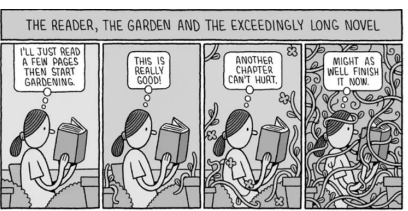
From: https://streetlibrary.org.au/reading-in-the-garden-tom-gauld-cartoon/
“The professional of Teaching English as a Foreign Language”
Author: Anderson Francisco Guimarães Maia
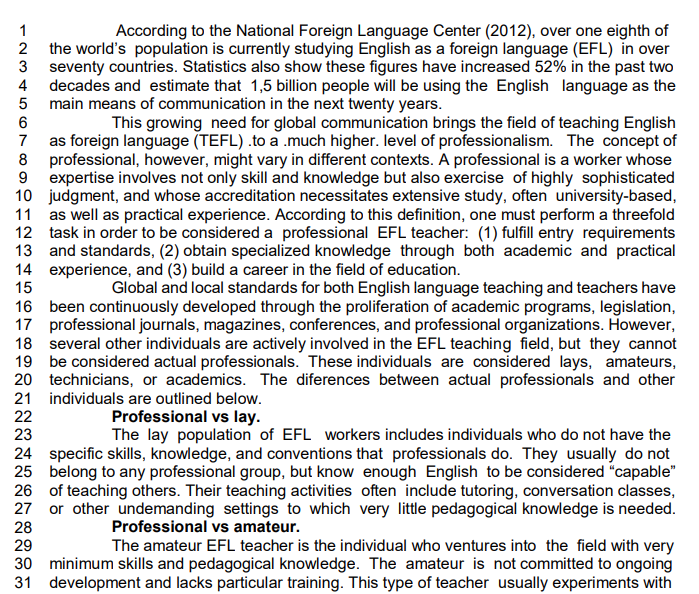
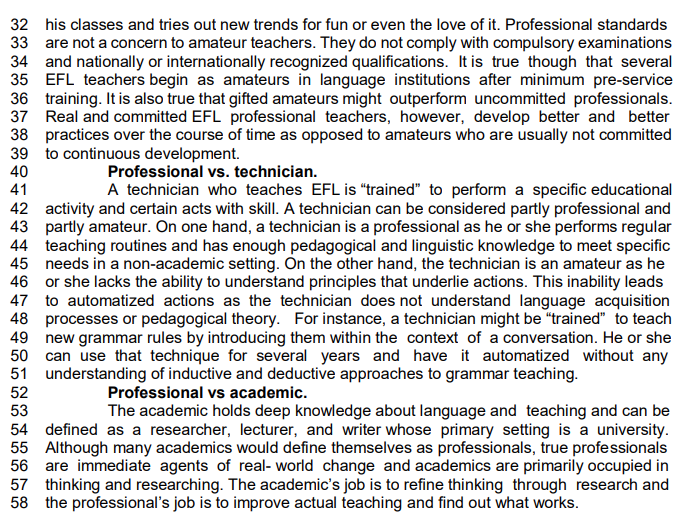
I. has one bound and two free morphemes. II. has one free and two bound morphemes. III. is a countable concrete noun.
The following statement(s) is/are true
“The professional of Teaching English as a Foreign Language”
Author: Anderson Francisco Guimarães Maia
Learning Portuguese-English cognates is a great way to build vocabulary fast! It’s basically using what you already know to get a jump-start.
Cognates are simply words that are very similar in both languages, usually due to a common root.
Below, you can explore some of the typical spelling patterns for English → Portuguese cognates, with examples for each one. Remember that these patterns do not apply every time. But they are a convenient way to help you notice more cognates as you continue to learn English!
Observe os padrões de sufixo abaixo e complete as lacunas indicadas.
ph → f
Ex: telephone → telefone
tion → -ção
Ex: nation → nação
ty → ____________
Ex: society → ____________
fy → ____________
Ex: identify → ____________
(...)
Practice Portuguese. Portuguese-English Cognates. Practice Portuguese, 2024. Disponível em: https://www.practiceportuguese.com/learning-notes/portugueseenglish-cognates/. Acesso em: 12 jul. 2024. Adaptado.
Em sequência, os termos que completam corretamente essas lacunas são:
CONTEXT CLUES TO DEFINE NEW WORDS
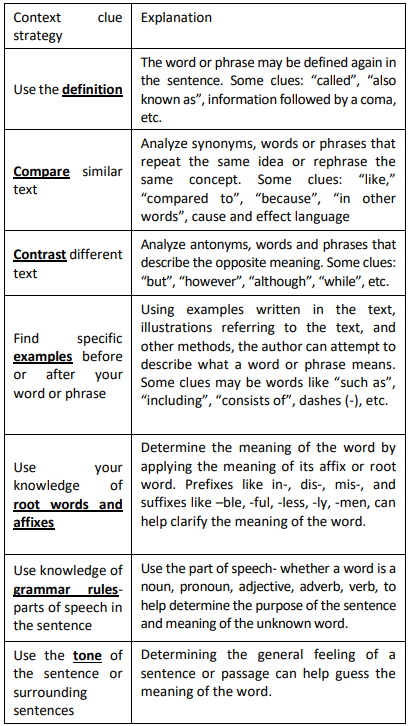
Model teaching. Reading Comprehension Strategy Tools. Model teaching, 2016. Disponível em: https://www.modelteaching.com/education-articles/reading-ela-instruction/readingcomprehension-strategy-tools. Acesso em: 12 jul. 2024. Adaptado.
Em uma atividade de leitura do texto “Bigger Isn’t Always Better: Narrow Traffic Lanes Make Cities Safer”, os alunos tiveram dificuldade de interpretação do último período por não saberem o sentido do termo ‘narrower’. Sobre isso, analise as estratégias:
I. Procurar a definição do termo em um dicionário inglêsportuguês.
II. Procurar por dicas na imagem que acompanha o artigo.
III. Identificar o sentido dos termos ‘bigger’ e ‘wider’.
IV. Identificar a classe gramatical do termo e o sentido do sufixo -er.
Com base na tabela fornecida, para que os alunos possam entender o sentido do termo (‘narrower’) pelo contexto, o professor deve orientar que eles adotem as seguintes estratégias:
Affixes consist of one or more letters that are added to the beginning or end of a word, which can be:
prefixes: when they are added to the beginning of words. For example: ir, in meaning not (irregular; incapable); -
suffixes: when they are added to the end of words. For example: ed, er meaning past of regular verbs and person that does (walked; writer).
ZANATTA, Melissa Marchiani Palone et al. Teaching Reading Techniques and Strategies English Language. Disponível em: https://www.dpublication.com/wpcontent/uploads/2021/01/11-300.pdf. Acesso em: 11 jul. 2024. Adaptado.
O conhecimento sobre formação de palavras pode ser bastante útil no aprendizado da língua inglesa. Para que um estudante depreenda corretamente o sentido da palavra undeniably, é preciso que, além do radical, ele reconheça nela a presença de
O texto seguinte servirá de base para responder a questão.
HVAC Contractors Need to Adapt to Repair Market
Repair or replace is a question homeowners often need to answer, and it greatly impacts an HVAC contractor's business. During COVID, the residential HVAC industry saw a replacement market boom. But in 2023 and now the beginning of 2024, there has been a shift to a repair market that HVAC contractors need to be aware of as they run their businesses.
According to numbers from the Air-Conditioning, Heating and Refrigeration Institute (AHRI), shipments of unitary air conditioners and heat pumps were down 16.7% in 2023, compared to 2022. Gas furnaces were down 23%.
"The replacement market is performing worse when you strip out new construction," said industry leader Matt Michel. "Housing starts were down around 5%, according to the St. Louis Federal Reserve, so the replacement market for unitary air conditioners and heat pumps was down in the low 20s."
Distributors are seeing similar numbers, according to the Heating, Air-conditioning, & Refrigeration Distributors International (HARDI).
"We definitely are seeing a shift here. And that shift has actually been visible for some time," said Tim Fisher, HARDI director of market intelligence.
HARDI receives data from FieldEdge on the invoice and quote trends exhibited by their users. Invoices reflect work that has been completed, whereas quotes reflect potential future work and are most often provided for new system installations. HARDI has found that, over time, the ratio of new invoices to new quotes is a useful indicator of whether a market is trending more toward repair than replace and vice versa.
The numbers show the annual growth rate bottomed out in the spring of 2022 but remained negative through most of the year, indicating that replacement trends were broadly higher in 2022 than in 2021. That figure increased through 2023, peaking in May but generally remaining positive for most of the year. While the three-month growth rate has slowed in recent months — an encouraging sign — they don't expect much of a negative drift in 2024, meaning that repair versus replace trends will broadly remain similar to where they were in 2023.
So why is this change happening? It can't be attributed to any single factor but rather a combination of items. Certainly, higher costs of both HVAC systems and housing in general play a role.
"Adapting to the economy is something contractors need to do. We can't just assume people are going to reach into their pocket and replace," said ACCA CEO Bart James. "Contractors need to help customers get through the current need. People are slowing down on their spending. People are worried about what is coming and how they are preparing for it. Wages and other things are not keeping up with how fast prices are going up."
James said reading the numbers shows there is a shift in the home improvement market.
"Just look at the Walmart and Home Depot quarterly projections. Walmart did well with more visits but had smaller purchases, while Home Depot did not hit their numbers. That tells you that people are handling investments into housing differently. That will catch up with HVAC, too. "Contractors need to prepare by making investments in their team to meet the needs of the customer. And that need is not always a replacement option but also can be a repair option," James continued.
The sluggish home resale market is another reason for the shift towards a repair market. "Home improvement spending, in aggregate, tends to follow existing home sales totals nationally," Fisher said. "People invest more in their homes prior to selling to boost its value, and new homeowners spend more in their first year of moving than homeowners who stay put. This has major implications for HVAC replacement demand, which, historically, peaks when existing home sales are at their highest and falls off when existing home sales decline.
"Both the 3-month and 12-month growth rates bottomed out earlier in 2023, and while still negative, have slowed significantly," he continued. "We believe that home sale totals are at or nearing their trough, and over the duration of 2024 should steadily improve and finish at or ahead of 2023 totals."
The final reason is the cyclical nature of HVAC. It reflects the shipment cliff from 15 years ago, when the industry contracted 40% after peak shipments in 2005. Contractors cannot replace what was never installed.
How do HVAC contractors deal with this shift? Michel believes they should embrace the repair market.
"The money is better in replacements," he said. "It always has been and always will be. However, margins are better in service. For the next couple of years, anyway, contractors should focus on building up their service business and making money on it."
Since service involves more labor, and labor carries more overhead than equipment and material, keeping a close watch on overhead expenses is a must.
"Contractors need to build the service base, watch your marketing expenses drop, and down the road, the replacement margins and close rates to a satisfied service base will rise," Michel said. "Once we get past the shipment cliff, the replacement market will begin a decade-long run with every year being better than the year before it. We know this because it's what happened in the past, and when it comes to replacements, the past truly is a prologue."
Contractors in most parts of the country are already feeling the pinch of a slower market, and their experiences in 2024 are unlikely to be much different from their experiences in 2023 though rebounds from the milder temperatures we saw during peak months last year would go a long way in improving demand in 2024.
HARDI advises contractors should consider the following six tactics in '24:
- •Offer financing options: Any homeowner considering a new system is likely going to feel some sticker shock if it's been a few years since they
- last bought a system. Financing a new system helps to alleviate that shock, making the big sticker prices much more palatable monthly payments.
- •Protect margins: Work to ensure that your pricing for jobs is consistent with market trends, and attempt to pass through as much of the higher system costs as possible. Likewise, now is a critical time to manage operating expenses closely. Together, good cost management and smart pricing can help protect business margins in 2024.
- •Educate homeowners: Many homeowners may not fully understand the long-term benefits of replacing their HVAC system versus frequent repairs. Offer educational materials, such as blog posts, videos, or pamphlets, explaining the advantages of a new system
- in terms of energy efficiency, lower maintenance costs, and improved IAQ. Also, be sure to make clear to your customers which incentives they may qualify for through IRA or other state-level rebate/incentive programs.
- •Focus on value proposition: Emphasize the value proposition of a new HVAC system, highlighting its reliability, longevity, and performance. Help homeowners understand that investing in a replacement now can save them money and hassle in the long run.
- •Offer maintenance packages: Create maintenance packages that bundle regular servicing with discounts on repairs or replacements. This can encourage homeowners to invest in preventive maintenance and build a long-term relationship with your company.
- •Diversify services: Explore diversifying your services beyond just HVAC installations and repairs. For example, you could offer IAQ assessments, smart thermostat installations, or energy audits to provide additional value to homeowners and generate new revenue streams.
https://www.achrnews.com/articles/154324-hvac-contractors-need-to-ad apt-to-repair-market
pickpocket-pullover-seaside-barefoot-rundown-spoonfeed-overshadow-into
happiness-quickly-excitement-appointment-fondness-business-mainly

Suffixation is a derivation process in which an affix is added to the beginning and end of an existing word.


Available at: https://www.weforum.org/agenda/2024/06/businesses
-are-moving-beyond-sustainability-welcome-to-the-age-ofregeneration/. Retrieved on: Jun 14, 2024. Adapted.
FÁBREGAS, A. Morphology in Linguistics. In International Encyclopedia of the Social & Behavioral Sciences, 2015.
Com base na informação fornecida, assinale a alternativa que apresenta um morfema derivacional.
The Reasons Why We Dance
- As a choreographer, I get asked to share my opinion about a myriad of dance-related
- topics, from the practical, like “How can dance help you get in shape?” to the existential, like “Is
- my dancing a projection of my self-image?”. But the question I think matters most is: why do
- people dance? What is about moving our bodies to a song we love that is so joyfully Pavlovian?
- Why do we watch videos and take lessons on something that could be labeled as trivial? Why do
- we love it so?
- There are the obvious answers. We dance for physical fitness, mental clarity, emotional
- stability, and other such pluses. However, all these benefits could be attained by other means –
- though I confess I have yet to find a better alternative than a great “cha cha”* to lift both one’s
- heart rate and spirits. There must be something glorious about dancing that is more than just
- intangible. We cannot seem to explain it, yet we all know it so well that we do not hesitate to
- tap our feet to a Gershwin melody or pulse with the percussion of a samba rhythm.
- Perhaps dance is the way we express ourselves when words are insufficient. The joy we
- feel over newfound love, the determination we have in the face of great sorrow or adversity, the
- passionate fire of our youth, and the peacefulness of our softer and more graceful years – maybe
- they are never expressed more fully than through a waltz, or a tango, or a jive. We all want to
- be understood, and if we could truly speak the words that describe our feelings, how deep and
- powerful they would surely be. But alas, those words never seem to come to us just right. Maybe
- dance is simply a translator for the human heart.
- Perhaps dance is the medium through which we show the world who we truly are and who
- we can be. All of us, if we are honest, believe deep down that we are not ordinary. We know
- ourselves to be wonderfully unique, with many layers of personality and talent woven in such a
- way that no one on earth could possibly have our same make-up. We know it. We just do not
- always know how to prove it. Maybe dance gives us the opportunity. And perhaps dance is how
- we choose to remember, how we hold on to the past. It is how we relive __ fun-filled days of
- our youth or __ time we looked into their eyes and knew they were the one. It is our tribute to
- the heroes of yesterday who jitterbugged like carefree boys and girls, when tomorrow they would
- march as men and women to defend freedom’s cause. It is the chance to be __ princess again,
- waiting for __ outstretched hand and the call to __ romance that is graceful, true, and not as
- forgotten as the cynics say. When we dance, we can remember them all a little better, feel the
- butterflies once again, and if only for a moment, return to the purest part of our lives when time
- was of no matter…for we were dancing.
- Why do we dance? Every answer will be different, and that is as it should be. Perhaps the
- better question is, “Why would we not?”
*Cha Cha: an energetic modern dance.
(Available in: https://dancewithmeusa.com/why-we-dance-the-reasons/ – text especially adapted for this test).
In the image below we see a man who is taking dancing lessons and a woman who is saying “There are only two things stopping you from being a good dancer, Mr. Jones. Your feet!”
The word “dancer” is formed by adding a suffix to the verb “dance.” Which of the words below does NOT take the suffix -er when used as a noun describing professions?
Having analysed the words in the group, and taking into account words’ formation processes, there is correct data applicable to all of the group components in:
endanger- kilometre-outnumber-telescope-polyglot-misunderstood-prewar-
maltreat-photosynthesis-archbishop-deforestation-enable-rewind-absent
Read Text | and answer questions 05 to 13.
Netflix is trying to prove to the world that it's all grown up
Netflix is trying to persuade Wall Street that it is now all grown up. After squeezing out millions of additional subscribers via its password sharing crackdown and through the introduction of cheaper advertiser-supported plans, the streamer knows that its growth spurts are coming to an end — and now it wants investors to stop obsessing over those pesky membership numbers and instead focus on other metrics.
"In our early days, when we had little revenue or profit, membership growth was a strong indicator of our future potential. But now we're generating very substantial profit and free cash flow. We are also developing new revenue streams like advertising and our extra member feature, so memberships are just one component of our growth", Netflix told shareholders as it reported quarterly earnings.
To that end, Netflix said that it will no longer report quarterly subscriber numbers, starting in 2025. Alas, the metric that Wall Street has forever judged Netflix on — the metric that prompted legacy media companies to burn endless piles of cash in their bids to compete with the streamer — will be retired. The decision to shut off transparency on the metric represents a significant turning point in the streaming revolution. For years, Netflix has prided itself on being extraordinarily transparent. Now it is aiming to hold its cards closer to its chest. And given that streaming giant is the trendsetter in the space, one could expect that other media companies will be inspired by the company's move and also opt to cease reporting such data.
To be fair, what Netflix is saying isn't necessarily off base either. As the company shifts its business model away from subscriptions and toward advertising and other revenue streams, it makes sense to consider how much time users are spending on the service. The more content a user consumes on Netflix, the more likely they are to continue paying for the service, and the more money Netflix then makes from that single subscriber. "We're focused on revenue and operating margin as our primary financial metrics — and engagement (i.e. time spent) as our best proxy for customer satisfaction,” Netflix underscored in its letter to shareholders.
Regardless, less transparency in an already opaque industry is not ideal. The walled garden of streaming already lacks the same detailed viewership data that Nielsen collects on linear television broadcasters. Now, visibility into the streaming world will get even dimmer.
The announcement from Netflix managed to overshadow its otherwise stellar quarter. The company handily beat expectations and added a staggering 9.3 million subscribers, meaning it now boasts nearly 270 million in total. Netflix also beat analyst expectations on both earnings and revenue. However, it wasn't all good news. Netflix forecasted its subscriber growth to be lower in quarter two, chalking it up to “typical seasonality.” That led the stock to slide nearly 5% in after-hours trading.
Whether "typical seasonality” is solely to blame, or whether the streamer is simply starting to hit a ceiling, is hard to tell. Perhaps it is a mix of both. Whatever the cause, the stock sliding on the less-than-ideal outlook is a prime example of why Netflix wants Wall Street to stop focusing on its subscriber numbers. And, in one year's time, investors won't have a choice.
Adapted from: https://edition.cnn.com/2024/04/19/media/netflix-subscription-numbers/index.html
In “(..) Netflix told shareholders as it reported quarterly earnings", the suffix -ed in the word in italics is:
We can use as an example of morphology conversion in English the words: teapot, armchair.
When adding prefixes to the beginning of words: Impossible, Extraterrestrial, Autobiography we transform them into words with opposite meanings from the originals.

 Conheça nossos planos