Questões de Concurso
Sobre formação de palavras (prefixos e sufixos) | word formation (prefix and suffix) em inglês
Foram encontradas 329 questões


Text for question
Hero boy swims for four hours to save his family (9th February 2026)
A 13-year-old Australian boy has been hailed a hero after an epic swim that saved his family. The boy, Austin Appelbee, and his family were on a beach holiday in Western Australia. They were kayaking and paddleboarding in shallow water when strong winds pushed them farther offshore. They ended up over four kilometres away from land, and the daylight was fading. Austin decided to kayak to shore to get help. However, the waves had damaged his kayak, which had taken in water and flipped over. He said he then lost an oar and knew he was in trouble. He decided he had no alternative but to swim back to land. He swam through shark-frequented waters to raise the alarm.
Austin made it to the beach and phoned for help. This sparked a huge rescue operation, which resulted in coastguards finding the teenager's mother and two younger sisters. The boy said: "I hit the bottom of the beach and I just collapsed, and then, after that, I had to “ sprint two kilometres to get to the phone." Rescuers called his efforts "superhuman". One rescuer said Austin's actions could not "be praised highly enough." He added that the teenager's "determination and courage ultimately saved the lives of his mother and siblings." Austin's mother Joanne, 47, told reporters: "The wind picked up. We lost oars, and we drifted out further. It was an absolute nightmare."

TEXT FOR QUESTION
"In the contemporary classroom, the teacher’s role has shifted from being the sole provider of knowledge to a facilitator of LITERARY LITERACY. This approach encourages students to engage deeply with texts, moving beyond literal decoding to a critical understanding of the social and cultural nuances embedded in the language."
(__)The Present Perfect tense is used to describe actions that happened at a specific time in the past, always requiring the use of precise dates like 'last Friday at 2 PM'.
(__)Prefixes and suffixes are used in English to change the meaning or the word class of a base word, such as adding '-ness' to an adjective to form a noun.
(__)The use of modal verbs like 'can', 'must' and 'should' allows the speaker to express different degrees of possibility, obligation and advice in a conversation.
(__)Passive voice is formed by using the verb 'to be' and the past participle of the main verb, focusing more on the action itself than on the person who performed it.
After the analysis, choose the alternative that presents the correct sequence:
Leia o texto a seguir para responder à questão:
The term “language practice” refers to activities which involve repetition of the same language point or skill in an environment which is controlled by the framework of the activity. The purpose for language production and the language to be produced are usually predetermined by the task or the teacher. The intention is not to use the language for communication but to strengthen the ability to manipulate a particular language form or function.
Activities centered on “language use”, on the other hand, involve the production of language in order to communicate. The purpose of the activity might be predetermined but the language which is used is determined by the learners.
(TOMLINSON, B. (ed). Material Development in Language Teaching. Cambridge: CUP. 1998/2011. Adaptado)
O sufixo -en assume vários papéis e significados na língua inglesa.
A palavra que segue o mesmo processo de formação verificado em strengthen, no primeiro parágrafo do texto, é:
Because she was correcting homework and planning lessons, Britany went to bed late – and then she overslept!
She had a quick shower but she didn’t have ________ 1 time to put on her makeup. Luckily, she doesn’t wear much anyway, but she had wanted to put on some lipstick at least. Too bad! She made herself a coffee and checked the mail. But ________ 2 , it seemed, had remembered her birthday – except for John and Clare whom she had invited for dinner later in the day.
At school, ________ 3 of her colleagues seemed to have remembered that it was her birthday either and that made her miserable, but at least the children in her second grade class were in a happy mood. It cheered her up, and so every time one of them did ________ 4 good or gave her a correct answer, she gave them a gold star. They loved that. Luckily, she had enough stars so ________ 5 went home with at least one!
When she got home, Britany was still tired, so she lay down to have a bit of rest but she didn’t get much sleep because her parents rang from the UK to wish her a happy birthday. At least _________ 6 had remembered! When she finished the call there was ________ 7 time left for sleeping. She had to get dinner ready.
A few minutes later the doorbell rang. She opened the door. There were a lot of people outside. All of them were wearing party hats! A few of them were carrying plates of food. Most of them were colleagues from her school, but there were many others, too. And then they started to sing ‘Happy Birthday …’.
In: HARMER, Jeremy. Teacher Knowledge: core concepts in English language teaching. Pearson Education limited. Essex, UK: 2012
I. São palavras formadas pela justaposição de elementos (prefixos + substantivos) cujos componentes formadores geralmente têm origem em outras línguas (latim, grego etc.). II. São palavras formadas por composição – Compound words –, tal como a palavra ‘sunflower’ (sun + flower), em que a combinação das partes dá o sentido geral da união. III. São palavras originais, básicas da língua inglesa, que dão origem a novos vocábulos ou podem agregar novos significados com a junção de prefixo, sufixo ou de outro radical. IV. São todos substantivos formados pelo processo de composição – Compounding –, sendo homework an ‘uncountable noun’, isto é, não faz a forma regular do plural.
Está CORRETO o que se afirma apenas em
I.Derivational suffixes like "-ly" often change adjectives into adverbs, modifying the syntactic function of the base word.
II.Inflectional morphemes in English, such as the "-ed" in "walked," change the core meaning of the verb to create an entirely new lexical entry.
III.Compounding is the process of combining two free morphemes to create a new word, which can be written as one word, two words, or hyphenated.
Which statements are correct:
Choose the correct word formed from the base word “happy” to complete the sentence:
“Despite the bad weather, she remained ______ and cheerful throughout the trip.
( ) “Carelessly” is formed by adding suffixes to the base word care.
( ) The suffix -less in “carelessly” indicates absence or lack.
( ) The suffix -ly changes a noun directly into an adverb in “carelessly”.
( ) The word careless represents an intermediate stage in the formation of “carelessly”.
( ) “Carelessly” is an adjective formed from the noun care.
I.Back-formation is the process of reducing a word to a shorter version which belongs to a different word class, often by removing a supposed affix, such as forming the verb "to edit" from the noun "editor".
II.Blending involves combining two separate words to produce a single new term that shares the meaning of both, but unlike compounding, parts of the original words are usually deleted, as in "smog" (smoke + fog).
III.Both processes are strictly restricted to informal slang and are not recognized in standard English dictionaries or academic writing, being considered grammatical errors.
Is it correct what is stated in:
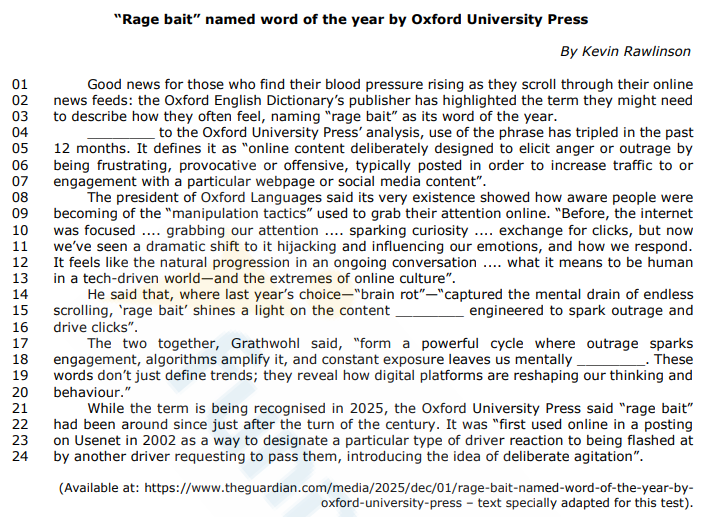
I. In “reshaping” (l. 19), re- is a prefix meaning again, the same as in “recognize”.
II. The modal verb “might” (l. 02) expresses certainty that people will use the term “rage bait” to describe how they feel.
III. The sentence “‘rage bait’ had been around since just after the turn of the century” (l. 21-22) uses the past perfect to indicate that the term already existed before another point in the past.
Which ones are correct?
(__) O sufixo "-ment" é um afixo que muda a classe gramatical, normalmente transformando verbos em substantivos (por exemplo, develop → development).
(__) O prefixo "un-" altera a classe gramatical da palavra-base (por exemplo, transformando um adjetivo em verbo).
(__) O sufixo "-ize" (ou "-ise") é utilizado para derivar verbos a partir de substantivos ou adjetivos (por exemplo, modern → modernize).
(__) Em inglês, os prefixos geralmente alteram a classe da palavra, enquanto os sufixos geralmente alteram apenas o significado.
A sequência correta de cima para baixo é:
(__)Monosyllabic words ending in a single vowel followed by a single consonant double the final consonant before a vowel suffix (e.g., run -> runner).
(__)Words ending in a silent 'e' generally drop the 'e' before adding a suffix beginning with a vowel (e.g., write > writing).
(__)Words ending in 'y' preceded by a consonant keep the 'y' unchanged when adding the suffix '-ed' (e.g., study-> studyed).
(__)Words ending in 'l', such as 'travel', always double the 'l' in American English spelling before adding suffixes like '-ing' or '-ed'.
Choose the alternative that presents the correct sequence:
texto seguinte servirá de base para responder à questão.
CNN Health Exhausted? The reason may be how you're using technology
Analysis by Kara Alaimo
Oct 7, 2025
Kara Alaimo is a professor of communication at Fairleigh Dickinson University. Her book "Over the Influence: Why Social Media Is Toxic for Women and Girls — And How We Can Take It Back" was published in 2024 by Alcove Press.
You may think you're exhausted because, like me, you have too many things on your plate. But there's another reason, according to a new book.
Case in point: While | was writing this piece, | responded to dozens of emails from colleagues and students, got a huge medical bill, replied to a text about a home repair, and learned that my older daughter needs to wear white to school next Monday while the younger one is supposed to wear the colors of fall.
This relentless barrage of interruptions and switching between thoughts and technology platforms is leaving us utterly exhausted, says Paul Leonardi, department chair and Duca Family Professor of Technology Management | at the University of California, Santa Barbara.
He explains how this happens in his new book, "Digital Exhaustion: Simple Rules for Reclaiming Your Life."
| spoke to Leonardi about what's making us all so tired | and what we can do about it.
CNN: You say one reason we're so exhausted is that we keep switching between platforms. How does that make us exhausted?
Paul Leonardi: Every tool we use requires some amount of cognitive focus. We have to learn the tool we're enmeshed in. When we switch, we have to disengage | and reengage in another area of focus, and we also have to switch how we're using that tool. Our brains do not do a good job of switching that quickly. The main issue is that we haven't evolved to make the switches as quickly as we do today. It leaves us feeling exhausted.
CNN: You found that we often don't realize we're getting exhausted from all this digital switching. Why?
Leonardi: It comes back to the way our bodies have evolved over time. We have good sensory feedback to show us when we're physically tired. Otherwise, we could collapse, and that's dangerous. So, our body knows to send signals to our brain to say stop. But we didn't evolve to sit in an office in front of a computer, so our brain doesn't know to tell itself it's tired. We can just keep taxing ourselves, but that residue builds up over time. Then we feel like we've been hit by a semitruck
CNN: What can we do to address that exhaustion?
Leonardi: Think about reducing the kinds of switches we make throughout the day.
In the book | talk about three kinds of switches. Switching between modalities is switching across tools. Think about the different videoconferencing platforms you use. You might use Zoom and then switch to Microsoft Teams. They seem like they're roughly the same. But how many times have you been in a meeting and thought, "I need to share my screen. How do | do that on this platform?" And those little changes are enough to really wear us out when they accumulate over time
The second type is what | call switches between domains, and that's when we're working on one task, get interrupted and then switch to a different task. The unplugging and then re-plugging into the other task take quite a bit of effort. It's a tremendous tax that we pay.
The third type is switching between different areas of life. How many times in your day are you getting a quick text from your kid's school? Or the plumber calls to tell you they're going to be late and wants to talk about the problem in your house. Those switches across really big domains are even more exhausting because they pull us completely out of our thought process in one area, and then we have to get back.
CNN: You say social media is the most exhausting type of platform to use. Why?
Leonardi: | talk about three forces that exhaust us. One is attention. On social media we're constantly switching between things because apps are pushing us different notifications. First somebody liked something, and then there's an ad. The second force of exhaustion is making inferences. We get a snippet of data, and it's not quite enough to tell us the whole picture. So, we have to fill in the blanks, and that takes effort. On social media we're constantly different apps and making inferences. We see somebody is on a trip, and we're like, they must have a lot of money. And they're having the time of their life. We're filling in the blanks.
The last is emotion. When our emotions get piqued, whether for good or for bad, that's also exhausting. On social media we do social comparisons, so we get jealous that somebody else is doing something we wish we were doing. Or we get annoyed that we see a bunch of friends hanging out and we're not part of the group.
Social media is so exhausting because it maximizes all three of these forces.
CNN: You say it's especially hard for people who work from home to avoid this kind of exhaustion. Why is that? Leonardi: One of the big reasons remote workers experience exhaustion even more than people in the office — or it feels more acute — is that it's very difficult to create separation between work and home. They're constantly trying to manage that boundary, and that's so exhausting.
They also are more dependent on tools for everything, so they don't get a break. If you're in the office and you have an in-person meeting, you don't have to switch onto your Zoom platform. You actually get a break for a little bit when you're talking to somebody in the hallway. You don't get that on these tools.
You're also managing your presence when you're working from home. You need to make sure people know you're available because it matters for people's perception of your work performance. So, you're putting on a sort of act that's also exhausting
CNN: You recommend turning off the video of ourselves in meetings. Why?
Leonardi: | think it's a good idea sometimes. We tend to fixate on ourselves, and doing that creates a feeling of self-consciousness. It also creates more effort for us to manage our presentation to others.
Imagine if you were talking to friends, or you're in a meeting, and you have a mirror in front of your face the entire time. You're like, oh my gosh, how do | look right now? There are bags under my eyes, and | can't believe | made that stupid facial expression. We don't do that in regular life.
These extra little activities accumulate to wear us out over time.
Communicating in person instead of texting, when possible, can reduce digital exhaustion and create richer relationships.
CNN: What's your best advice for parents who are exhausted from keeping up with endless group chats about car pools and soccer games?
Leonardi: | never intended to write about that in my book, but it came up so often in the interviews | did.
One strategy | heard that was quite effective was calculating whether a car pool is actually worth the time you're putting into coordinating it. If you add up all the time you're spending texting with other people, sometimes it adds up to the same amount of time it would take to just drive your kid yourself.
Another strategy people used was reducing those communications by trying to coordinate in person. When they see each other at the soccer game, they have a long conversation about the plan for the next week. A lot of folks find they're developing richer relationships because that discussion about the car pool is just the entrée to a deeper conversation. Those are much more fulfiling relationships than the transactions taking place via text
CNN

 Conheça nossos planos