Questões de Concurso
Sobre ensino da língua estrangeira inglesa em inglês
Foram encontradas 2.339 questões


Regarding Instrumental English, judge the following item.
English for Specific Purposes (ESP) is focused on teaching grammar and linguistic structure, without emphasis on the practical needs of students in specific fields such as business or science.
Regarding Instrumental English, judge the following item.
English proficiency, as the focus is solely on specialized vocabulary.
Regarding Instrumental English, judge the following item.
One of the defining characteristics of ESP is that it uses the same general content and teaching approach regardless of the student's area of expertise or field of study.
Regarding Instrumental English, judge the following item.
In ESP, the teaching materials and methods are often drawn from the specific contexts in which students will be using English, such as scientific articles, business reports, or technical manuals.
Read the text, and analyse the assertives that are introduced.
The field of English language instruction for non-native speakers, commonly referred to as Teaching English as a Second Language (ESL), has experienced significant changes in recent times, due to the emergence of technology and the use of novel pedagogical methods. Conventional approaches, characterised by a focus on memorization and repeated grammar drills, are being replaced by dynamic and interactive methodologies that accommodate a wide range of learning preferences.
The integration of technology has emerged as a prominent transformation in the field of ESL instruction. Digital platforms, such language learning applications and online courses, provide customised learning experiences that may adjust to the unique pace and skill level of each individual learner. The utilisation of gamification is employed to transform the process of language acquisition into an enjoyable and captivating endeavour. In addition, the utilisation of online forums and virtual classrooms enables individuals to engage in real-time communication with native speakers, therefore providing them with valuable opportunities for meaningful language practise.
Content-Based Instruction (CBI) is an increasingly prominent pedagogical technique that has garnered significant attention and recognition. This approach facilitates the integration of English language acquisition with content-based instruction, so students acquire English proficiency by actively interacting with academic topics such as science, history, or literature. The implementation of contextual learning not only enhances the relevance and engagement of the language learning process, but also facilitates the organic acquisition of intricate vocabulary and concepts by students.
Task-Based Learning (TBL) places emphasis on the utilisation of language as a means to achieve certain objectives. Within Task-Based Language (TBL) classes, the conventional approach of introducing a language element followed by practise and production is substituted with the use of activities that require students to employ English in a genuine manner. This may encompass the resolution of problems, the execution of tasks, or the enactment of role-playing scenarios. These activities possess a high level of motivation and accurately reflect the usage of language in real-world contexts.
Flipped Classrooms is a pedagogical approach that combines online and in-person learning, wherein students are assigned to review instructional materials, often in the form of video courses, outside of the classroom, and subsequently participate in interactive activities during class time to consolidate their understanding. This technique facilitates increased engagement during classroom sessions and affords educators the chance to deliver focused assistance in areas requiring the greatest attention.
Cultural Immersion programmes, which involve placing students in English-speaking situations, have been demonstrated to significantly enhance language competence. This approach facilitates learners' exposure to the language within authentic contexts, fostering the acquisition of colloquial idioms and idiomatic use, which are frequently omitted in conventional instructional materials.
In summary, the contemporary approaches to ESL instruction are distinguished by a transition towards enhanced authenticity, interactivity, and individualization in the learning process. Through the use of technology and the implementation of novel pedagogical approaches, educators have enhanced capabilities to adequately equip students for practical English communication in real-life scenarios, making the learning experience more efficacious and pleasant, and at the same time recognising the cultural context meaning in the process of language acquisition.
(Available in: https://www.skylineuniversity.ac.ae/knowledge-update/from-different-corners/. Adapted.)
I. Students’ learning precedences have substantiated and pinpointed the emergence of novel pedagogic methods.
II. Flipped Classrooms foster student independence and also promote undertaking responsibility for their learning process.
III. Cultural Immersion programmes proffer great scope for native-like acquisition.
There is accuracy in what is stated in
Having as reference what is disposed in the Lei de Diretrizes e Bases da Educação Nacional-LDB concerning the teaching and learning of the English language, it is truthfull that:
“The professional of Teaching English as a Foreign Language”
Author: Anderson Francisco Guimarães Maia
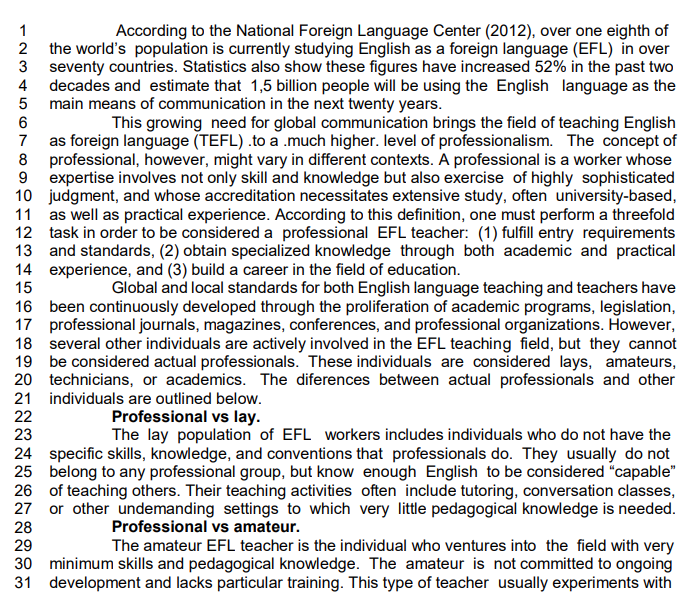
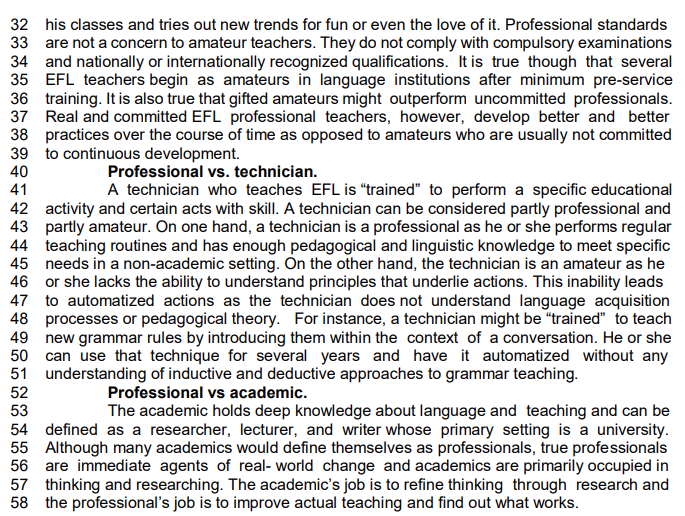
“The professional of Teaching English as a Foreign Language”
Author: Anderson Francisco Guimarães Maia
“The professional of Teaching English as a Foreign Language”
Author: Anderson Francisco Guimarães Maia
“The professional of Teaching English as a Foreign Language”
Author: Anderson Francisco Guimarães Maia
“The professional of Teaching English as a Foreign Language”
Author: Anderson Francisco Guimarães Maia
“The professional of Teaching English as a Foreign Language”
Author: Anderson Francisco Guimarães Maia
“The professional of Teaching English as a Foreign Language”
Author: Anderson Francisco Guimarães Maia
Em uma atividade de sala, a professora pediu aos alunos que marcassem em suas agendas seus planos para a semana seguinte. Em seguida, eles deveriam sentar-se com um colega e simular um diálogo. Para realizar a atividade, ela escreveu na lousa o seguinte diálogo, a partir do qual os alunos deveriam usar corretamente um repertório linguístico aprendido para preencher a lacuna.
Aluno A: What __________ (do) on Monday/Tuesday/Wednesday…?
Aluno B: I ____________ (play soccer/go dancing/do my homework…) on Monday/Tuesday/Wednesday…
Para que os alunos sejam bem-sucedidos nessa atividade, é preciso que eles saibam usar corretamente qual tempo verbal?
A Well Respected Man
The Kinks
'Cause he gets up in the morning
And he goes to work at nine
And he comes back home at five-thirty
Gets the same train every time
'Cause his world is built 'round punctuality
It never fails
And he's oh, so good
And he's oh, so fine
And he's oh, so healthy
In his body and his mind
(…)
And his mother goes to meetings
While his father pulls the maid
And she stirs the tea with councilors
While discussing foreign trade
And she passes looks, as well as bills
At every suave young man (…)
DAVIES, Ray. A well respected man. Disponível em: https://lyrics.lyricfind.com/lyrics/the-kinks-a-well-respected-man. Acesso em: 12 jul. 2024. Adaptado.
Letras de música podem ser ótimos recursos para desenvolver uma habilidade exigida pelo currículo escolar. A letra de “A well respected man” poderia ser mais bem usada para trabalhar qual habilidade dos estudantes?
How do most teachers use micro-dictations?
However ‘small’ they are, micro-dictations have great value! They can help students notice connected speech, which is what usually blocks their understanding in a listening lesson. The teacher reads the sentences or plays the recording. They repeat each sentence a few times. Example: He must have gone out.
Students listen and write what they hear.
The teacher now writes the sentence on the whiteboard and asks students to compare it to theirs.
Finally, the teacher asks: which part was difficult to understand and why?
TSATERI, Rachel. World of better learning. Disponível em: https://www.cambridge.org/elt/blog/2023/06/11/using-micro-dictations-to-helpstudents-notice-connected-speech/. Acesso em: 12 jul. 2024. Adaptado.
O texto acima discorre sobre como os professores podem usar micro-dictations. Qual das estratégias abaixo corresponde a uma técnica de micro-dictation?

 Conheça nossos planos