Questões de Concurso
Sobre ensino da língua estrangeira inglesa em inglês
Foram encontradas 2.182 questões


Mark the correct option about Methods and Approaches.
A morpheme is the smallest unit of grammar with meaning making up all words in the English language. Because learning morphemes unlocks the structure and significance within words, analyse the word group to choose the appropriate option.
Fun - night - dog - but - shake - girl - after - ball - play - joke - the - fish - book - run - happy - she - free - kiss - time - milk
Depending upon the purpose, different texts have specific styles and structure. The communicative purpose and genre
conventions present in the text that follows make it a:

(Available in: https://www.theguardian.com/childrens-books-site. Acessed: July, 2024)
( )Written English is more complex grammatically than spoken English, with longer and more complex sentences, fewer contractions, and more subordinate clauses.
( ) Spoken English is more likely to be face-to-face communication, while written English is more likely to be communication through the written word.
( ) Spoken English is more fixed and stable than written English, which is more fleeting.
( ) Spoken English is usually more organized and carefully formulated than written English.
( ) Written English is typically more structured and forms a monologue rather than a dialogue, while spoken English is more likely to be a dialogue.
( ) Written English communicates across time and space for as long as the medium exists and the language is understood. Spoken English is more immediate.
( ) Spoken English normally uses a generally acceptable standard variety of the language, whereas written English may sometimes be in a regional or other limited-context dialect.
( ) In Spoken English, the content is presented much more densely. In written English, the information is “diluted” and conveyed through many more words: there are a lot of repetitions, glosses, “fillers”, producing a text is noticeably longer and with more redundant passages.
( A ) Flipped classroom. ( B ) Project-based learning. ( C ) Case studies. ( D ) Peer teaching. ( E ) Gamification. ( F ) Inquiry-based learning.
( ) Students learn from each other through pairing and sharing learning objectives. It is an effective way to encourage collaboration and communication, and can help students retain information.
( ) It involves the use of game elements in non-game situations to increase motivation and learning. It can also be used in the classroom to increase student engagement, motivation, and knowledge retention while helping them to develop a positive attitude towards learning.
( )Students find solutions to problems mainly by themselves, and then present their findings to the class. It is an active approach that encourages students to become self-directed learners. It also emphasizes contextual and experiential approaches to learning.
( ) Students apply their knowledge to real-world problems, often open-ended. They also work on projects over an extended period of time – from a week up to a semester – that engage them in answering a complex question.
( ) Students are placed in an active learning role, promoting research, problem-solving, and highlevel cognitive skills. It challenges students to think critically and creatively to develop solutions.
( ) It focuses on problem solving and learning activities in the classroom, while content transmission happens outside of the classroom. Students learn content at home through readings, videos, or other activities before class. In class, students participate in activities like practice, application exercises, discussions, and team-based learning.
( A ) GRAMMAR-TRANSLATION METHOD ( B ) DIRECT METHOD ( C ) ORAL APPROACH ( D) AUDIOLINGUALISM METHOD
( ) Grammatical rules are not presented formally and the texts used for reading and writing activities are no longer literary since this method is based on certain principles, such as: selection, gradation and presentation.
( ) Learning is associated with syntactic, morphological and phonological structures which are learned from a system of stimulus, response and reinforcement.
( ) In this method, the writing skill is also developed, but not with a communicative purpose.
( ) Adopting the monolingual principle, this method involves the use of objects, gestures and images to explain the meanings of words, since the students' native language is prohibited from being used.
( ) Language learning would be associated with the formation of readers and the intellectual development of students.
( ) This method involves automatic correction and immediate assessment of students' mistakes by teachers in order to prevent the students from forming or acquiring bad habits and behaviors during the learning process.
( ) As a theoretical systematization of foreign language teaching, its objective would be the development of students' oral skills as the vocabulary and grammatical structures they have learned would be controlled in terms of frequency of occurrence.
( ) In this method, learning must be directly connected to the target language without going through the process of translation into the students' native language.
( ) The language to be taught is the spoken language and the new elements of the language are practiced situationally as the grammatical items are proposed gradually, that is, from the simplest to the most complex forms.
( ) In this method, language is both seen and considered as a behavior, for it is a means of oral communication.
I. Identificar o assunto de um texto, reconhecendo sua organização textual e palavras cognatas. II. Explorar ambientes virtuais e/ou aplicativos para construir repertório lexical na língua inglesa. III. Mobilizar conhecimentos prévios para compreender um texto oral. IV. Identificar argumentos principais e as evidências/exemplos que os sustentam. V. Escrever palavras e frases simples, utilizando um modelo e vocabulário estudado previamente.
Considerando que o Documento Curricular elaborado tem a preocupação de progressão didática para o desenvolvimento das competências e habilidades do aprendizado de Língua Inglesa, assinale a alternativa que representa as habilidades pensadas para os Anos Finais.
I. Audiolingual Approach está baseada em uma concepção estruturalista de linguagem e na visão behaviorista de aprendizagem (estímuloresposta). Sua técnica inclui exercícios orais de ouvir e repetir para se alcançar um nível de precisão das formas e padrões linguísticos. II. Communicative Language Teaching (CLT) é uma abordagem centrada no desenvolvimento da competência comunicativa, ou seja, desenvolver a competência comunicativa dos alunos em todas as quatro habilidades. III. Natural Approach é uma abordagem usada para preparar os alunos para leitura de textos. Seu método e técnica dão pouca ênfase na fala, consistindo no aprendizado de regras gramaticais e lista de vocabulário aplicadas à tradução escrita de textos. IV. Content and Language Integrated Learning (CLIL) é uma abordagem que combina a aprendizagem de um assunto específico com a aprendizagem da língua-alvo. As atividades buscam integrar as quatro competências, levando o aluno ao uso significativo da linguagem e ao desenvolvimento de competências transferíveis para utilização no mundo real. V. Dogme é uma abordagem baseada na noção de que a linguagem compreende unidades lexicais (partes, frases fixas, colocações). Seu método concentra-se no aprendizado de vocabulário e quadros linguísticos em nível de frase que podem ser manipulados pelo aluno realizando substituições e adaptações.
Fonte: https://tefl-toolkit.com (adaptado).
Assinale a alternativa CORRETA.
[…]
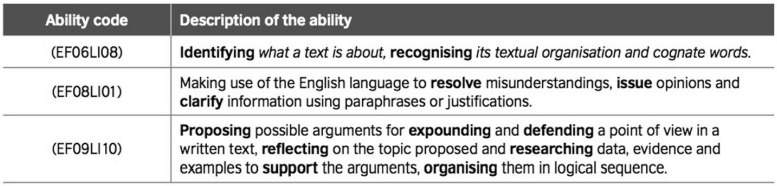
Available at: https://www.britishcouncil.org.br/sites/default/files/leitura_critica_bncc_-_en_-_v4_final.pdf. [Fragment]. Accessed on May 6, 2024.
To develop the BNCC ability of identifying what a text is about and recognising its textual organization and cognate words, English teachers are recommended to exploit different textual genres in the language classroom. Examples of such texts range from a menu, a text message or a poem to a book review.
To develop the BNCC ability EF06LI08, which includes identifying what a text is about, an English teacher should make use of
“A lesson plan is a set of notes that helps us think through what we are going to teach and how we are going to teach. It also guides us during and after the lesson. We can identify the most important components of a lesson plan by thinking carefully about what we want our learners to do and how we want them to do it. So, it helps the teacher before the lesson (writing down the aims and procedures for each stage of the lesson), during the lesson (timing each stage) and after the lesson (using the plan and notes to help plan the next lesson)”.
(THORNBURY, 2005, p. 91-92)
Considering Thornbury’s (a very famous applied linguistics in the early 2000s) quotation, put the numbers 1 – 5 in the correct place in the following lesson plan:
Lesson plan headings |
Teacher’s note |
Level and number of learners |
15 – intermediate level |
Timetable fit |
( ) |
Main aim(s) |
( ) |
Subsidiary aim(s) |
To listen for detail to a model story |
Personal aim(s) |
( ) |
Assumptions |
Students can already form tenses accurately |
Anticipated language problems |
Students may use present tenses |
Possible solution |
( ) |
Teaching aids |
Storytelling prompts, dvd |
Procedures |
( ) |
Timing |
15 min. |
Interaction patterns |
Ss – ss |
Homework |
Write a story |
1. To enable students to use past tenses accurately and put events in order in simple narratives.
2. Students listen to the model story, then, in groups, plan and write their own stories.
3. Use gestures to remind students to use past tenses.
4. To follow on from work on past tenses and to prepare for the storytelling project.
5. To make sure that board writing is clear and readable.
Choose the CORRECT sequence.

 Conheça nossos planos