Questões de Concurso
Sobre aspectos linguísticos | linguistic aspects em inglês
Foram encontradas 1.025 questões
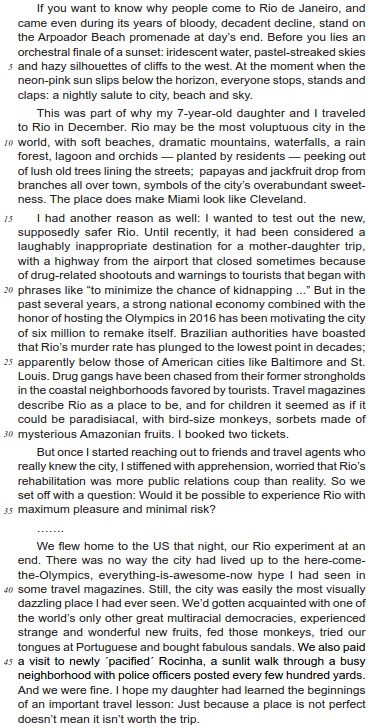
the term “spark” (l.8) is used in its connotative meaning.
A música “Hunting High and Low” foi um dos grandes sucessos da banda norueguesa A-ha na década de 80. Leia a letra da canção e responda a questão.
Hunting High and low
(Paul Waaktaar-Savoy)
Here I am
And within the reach of my hands
She sounds asleep
And she's sweeter now
Than my wildest dream
Could have seen her.
And I watch her sleeping away
But I know I'll be
Hunting high and low
Ah, there's no end
To the lengths I'll go to
Find her again
Upon this my dreams are depending
Through the dark
I sense the pounding of her heart
Next to mine
She's the sweetest love
I could find
So I guess I'll be
Hunting high and low
Do you know what it means
To love you
I'm hunting high and low
And now she's telling me
She's got to go away
I'll always be hunting high and low
Only for you
Watch me tearing myself to pieces,
Oh, for you I'll be hunting high and low
(Extraído do site www .vagalume.com.br)
Based on TEXT 2, a fictional blog, answer question
TEXT 2
I do realize that in the world of technology there are early and late adopters. I’m not the earliest of cutting-edge early TESL adopters, but I do like to try out new technology and incorporate it into my teaching. This list is a handful of technologies that are established enough not to be too problematic, user-friendly enough that just about anyone can start using them quickly, and useful enough that you’ll soon wonder how you got along without them. In short, this is a list of tech that just about everyone can (and maybe even should) be using in 2010.
1. Wikipedia – It has become popular to question its accuracy. Wikipedia has become a real knowledge bank on the internet. Once we figure out what it is (a compilation of all referenced knowledge) many of these criticisms fall down. Access to all this information means a reorganization of learning.
2. Google – No, I don’t just mean search, but all the other stuff: maps, docs, calendar, etc. It’s never been so easy to collaborate with other people.
3. Twitter – A year ago, I taught a course through Twitter with mixed results. This microblog is almost exclusively interactive, but my ESL students found it tough to collaborate within Twitter because of its constraints on length. The email by contrast, is very simple – it is equally interactive but it is constraint free. So, you should use it and you should see interesting results !
Can you learn the language by using the above alone? Of course not! But they are a good springboard and I hope they lead you to discover all other media available out there (ebooks, blogs, YouTube videos, music, movies, etc.).
More web in the pipeline. Please post a comment.
Based on TEXT 2, a fictional blog, answer question
TEXT 2
I do realize that in the world of technology there are early and late adopters. I’m not the earliest of cutting-edge early TESL adopters, but I do like to try out new technology and incorporate it into my teaching. This list is a handful of technologies that are established enough not to be too problematic, user-friendly enough that just about anyone can start using them quickly, and useful enough that you’ll soon wonder how you got along without them. In short, this is a list of tech that just about everyone can (and maybe even should) be using in 2010.
1. Wikipedia – It has become popular to question its accuracy. Wikipedia has become a real knowledge bank on the internet. Once we figure out what it is (a compilation of all referenced knowledge) many of these criticisms fall down. Access to all this information means a reorganization of learning.
2. Google – No, I don’t just mean search, but all the other stuff: maps, docs, calendar, etc. It’s never been so easy to collaborate with other people.
3. Twitter – A year ago, I taught a course through Twitter with mixed results. This microblog is almost exclusively interactive, but my ESL students found it tough to collaborate within Twitter because of its constraints on length. The email by contrast, is very simple – it is equally interactive but it is constraint free. So, you should use it and you should see interesting results !
Can you learn the language by using the above alone? Of course not! But they are a good springboard and I hope they lead you to discover all other media available out there (ebooks, blogs, YouTube videos, music, movies, etc.).
More web in the pipeline. Please post a comment.
Based on TEXT 2, a fictional blog, answer question
TEXT 2
I do realize that in the world of technology there are early and late adopters. I’m not the earliest of cutting-edge early TESL adopters, but I do like to try out new technology and incorporate it into my teaching. This list is a handful of technologies that are established enough not to be too problematic, user-friendly enough that just about anyone can start using them quickly, and useful enough that you’ll soon wonder how you got along without them. In short, this is a list of tech that just about everyone can (and maybe even should) be using in 2010.
1. Wikipedia – It has become popular to question its accuracy. Wikipedia has become a real knowledge bank on the internet. Once we figure out what it is (a compilation of all referenced knowledge) many of these criticisms fall down. Access to all this information means a reorganization of learning.
2. Google – No, I don’t just mean search, but all the other stuff: maps, docs, calendar, etc. It’s never been so easy to collaborate with other people.
3. Twitter – A year ago, I taught a course through Twitter with mixed results. This microblog is almost exclusively interactive, but my ESL students found it tough to collaborate within Twitter because of its constraints on length. The email by contrast, is very simple – it is equally interactive but it is constraint free. So, you should use it and you should see interesting results !
Can you learn the language by using the above alone? Of course not! But they are a good springboard and I hope they lead you to discover all other media available out there (ebooks, blogs, YouTube videos, music, movies, etc.).
More web in the pipeline. Please post a comment.
Answer question according to TEXT 1 below, adapted from http://news.bbc.co.uk/2/hi/americas/8606466.stm (accessed on April 7th, 2010) .
TEXT 1
At least 200 people have died in the Brazilian state of Rio de Janeiro after another storm. This is arguably the worst torrential rain for decades, causing flooding and landslides. Our website readers in Rio de Janeiro have been sharing their experiences.
Comment 1 - I’ve never seen such chaos. We weren’t prepared for this, even though we were warned that a big storm was about to come. Newspapers are saying that the reason for the catastrophe is the garbage. Well it may have been. We need to teach recycling at schools and community groups, otherwise we will have more disasters like this. (Lia, Niterói)
Comment 2 - Today I witnessed Rio de Janeiro on the brink of collapse. I ventured out around midday, just as the electric power blacked out in my neighbourhood. Three hours later, looking out of my office window, the city still reminded me of a war zone. “What´ve we done to deserve this?”, I thought. It’s night time now and I haven’t been able to return home. I might do so tomorrow. (José, Rio)
Comment 3 - Worldwide, we are seeing more and more
climate instability. The deserts of central Asia are growing,
while areas of the US (and now Rio) are drenched. The lakes
in Minnesota have never thawed this early, at any time in the
recorded record. The icecaps will be history, and islands
around the world are disappearing under the surf. The oceans
are warming, the coral reefs are dying. How much more
evidence do we need of global warming? (João, Brasília)
Answer question according to TEXT 1 below, adapted from http://news.bbc.co.uk/2/hi/americas/8606466.stm (accessed on April 7th, 2010) .
TEXT 1
At least 200 people have died in the Brazilian state of Rio de Janeiro after another storm. This is arguably the worst torrential rain for decades, causing flooding and landslides. Our website readers in Rio de Janeiro have been sharing their experiences.
Comment 1 - I’ve never seen such chaos. We weren’t prepared for this, even though we were warned that a big storm was about to come. Newspapers are saying that the reason for the catastrophe is the garbage. Well it may have been. We need to teach recycling at schools and community groups, otherwise we will have more disasters like this. (Lia, Niterói)
Comment 2 - Today I witnessed Rio de Janeiro on the brink of collapse. I ventured out around midday, just as the electric power blacked out in my neighbourhood. Three hours later, looking out of my office window, the city still reminded me of a war zone. “What´ve we done to deserve this?”, I thought. It’s night time now and I haven’t been able to return home. I might do so tomorrow. (José, Rio)
Comment 3 - Worldwide, we are seeing more and more
climate instability. The deserts of central Asia are growing,
while areas of the US (and now Rio) are drenched. The lakes
in Minnesota have never thawed this early, at any time in the
recorded record. The icecaps will be history, and islands
around the world are disappearing under the surf. The oceans
are warming, the coral reefs are dying. How much more
evidence do we need of global warming? (João, Brasília)
Answer question according to TEXT 1 below, adapted from http://news.bbc.co.uk/2/hi/americas/8606466.stm (accessed on April 7th, 2010) .
TEXT 1
At least 200 people have died in the Brazilian state of Rio de Janeiro after another storm. This is arguably the worst torrential rain for decades, causing flooding and landslides. Our website readers in Rio de Janeiro have been sharing their experiences.
Comment 1 - I’ve never seen such chaos. We weren’t prepared for this, even though we were warned that a big storm was about to come. Newspapers are saying that the reason for the catastrophe is the garbage. Well it may have been. We need to teach recycling at schools and community groups, otherwise we will have more disasters like this. (Lia, Niterói)
Comment 2 - Today I witnessed Rio de Janeiro on the brink of collapse. I ventured out around midday, just as the electric power blacked out in my neighbourhood. Three hours later, looking out of my office window, the city still reminded me of a war zone. “What´ve we done to deserve this?”, I thought. It’s night time now and I haven’t been able to return home. I might do so tomorrow. (José, Rio)
Comment 3 - Worldwide, we are seeing more and more
climate instability. The deserts of central Asia are growing,
while areas of the US (and now Rio) are drenched. The lakes
in Minnesota have never thawed this early, at any time in the
recorded record. The icecaps will be history, and islands
around the world are disappearing under the surf. The oceans
are warming, the coral reefs are dying. How much more
evidence do we need of global warming? (João, Brasília)
Answer question according to TEXT 1 below, adapted from http://news.bbc.co.uk/2/hi/americas/8606466.stm (accessed on April 7th, 2010) .
TEXT 1
At least 200 people have died in the Brazilian state of Rio de Janeiro after another storm. This is arguably the worst torrential rain for decades, causing flooding and landslides. Our website readers in Rio de Janeiro have been sharing their experiences.
Comment 1 - I’ve never seen such chaos. We weren’t prepared for this, even though we were warned that a big storm was about to come. Newspapers are saying that the reason for the catastrophe is the garbage. Well it may have been. We need to teach recycling at schools and community groups, otherwise we will have more disasters like this. (Lia, Niterói)
Comment 2 - Today I witnessed Rio de Janeiro on the brink of collapse. I ventured out around midday, just as the electric power blacked out in my neighbourhood. Three hours later, looking out of my office window, the city still reminded me of a war zone. “What´ve we done to deserve this?”, I thought. It’s night time now and I haven’t been able to return home. I might do so tomorrow. (José, Rio)
Comment 3 - Worldwide, we are seeing more and more
climate instability. The deserts of central Asia are growing,
while areas of the US (and now Rio) are drenched. The lakes
in Minnesota have never thawed this early, at any time in the
recorded record. The icecaps will be history, and islands
around the world are disappearing under the surf. The oceans
are warming, the coral reefs are dying. How much more
evidence do we need of global warming? (João, Brasília)
Answer question according to TEXT 1 below, adapted from http://news.bbc.co.uk/2/hi/americas/8606466.stm (accessed on April 7th, 2010) .
TEXT 1
At least 200 people have died in the Brazilian state of Rio de Janeiro after another storm. This is arguably the worst torrential rain for decades, causing flooding and landslides. Our website readers in Rio de Janeiro have been sharing their experiences.
Comment 1 - I’ve never seen such chaos. We weren’t prepared for this, even though we were warned that a big storm was about to come. Newspapers are saying that the reason for the catastrophe is the garbage. Well it may have been. We need to teach recycling at schools and community groups, otherwise we will have more disasters like this. (Lia, Niterói)
Comment 2 - Today I witnessed Rio de Janeiro on the brink of collapse. I ventured out around midday, just as the electric power blacked out in my neighbourhood. Three hours later, looking out of my office window, the city still reminded me of a war zone. “What´ve we done to deserve this?”, I thought. It’s night time now and I haven’t been able to return home. I might do so tomorrow. (José, Rio)
Comment 3 - Worldwide, we are seeing more and more
climate instability. The deserts of central Asia are growing,
while areas of the US (and now Rio) are drenched. The lakes
in Minnesota have never thawed this early, at any time in the
recorded record. The icecaps will be history, and islands
around the world are disappearing under the surf. The oceans
are warming, the coral reefs are dying. How much more
evidence do we need of global warming? (João, Brasília)
Internet: <coursel .winona.edu> (adapted).
Judge the following item, according to the text.
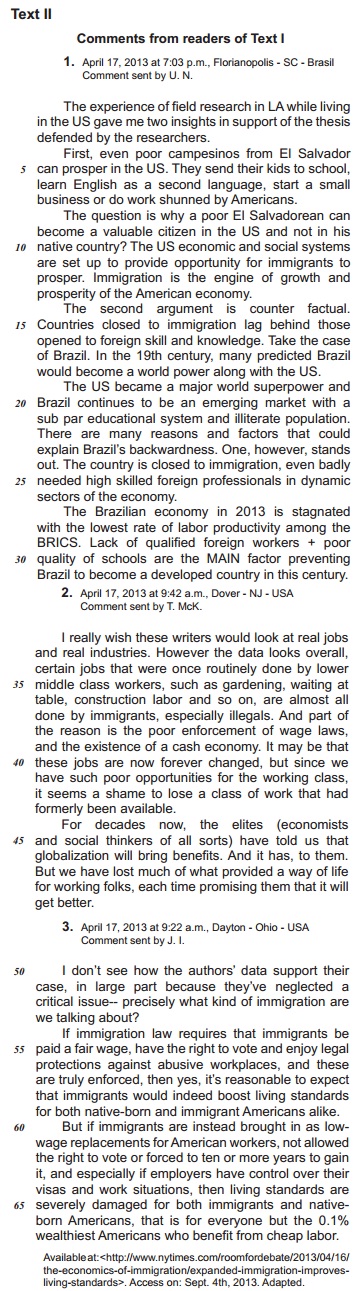
The word “whether” (L.23) means if.
Internet: <coursel .winona.edu> (adapted).
Judge the following item, according to the text.
The word “thus” (L.18) means in this manner.
Internet: <www.msnbc.msn.com> (adapted).
Judge the following item, according to the text.
The word “ Instead” (L.20) expresses the idea of addition.
Internet: <www.msnbc.msn.com> (adapted).
Judge the following item, according to the text.
The conjunction “but” (L.5) expresses the idea of contrast.

All of the following language features are found in the fragment and could be highlighted by the teacher to help students grasp the form and meaning of this passage, but for
Let's talk about User Account Control ? the Windows
Vista security element that was a prominent example for
everything that bothered people about that OS. UAC aimed to
prevent rogue software from tampering with your PC by
endlessly prompting you to approve running applications or
changing settings. The experience was so grating that many
users preferred to turn UAC [PARTICLE] and [VERB] their
chances with Internet attackers. Those who left it active risked
slipping into the habit of incautiously clicking through every
prompt, defeating whatever value the feature might have had.
Whereas Vista's notorious User Account Control gave
users no control over the feature other than to turn it off,
Windows 7's version of UAC lets users choose from two
intermediate notification levels between 'Always notify' and
'Never notify'.
Windows 7 gives you control over UAC, in the form of a
slider containing four security settings. As before, you can
accept the full-blown UAC or elect to disable it. But you can also
tell UAC to notify you only when software changes Windows
settings, not when you're tweaking them yourself. And you can
instruct it not to perform the abrupt screen-dimming effect that
Vista's version uses to grab your attention.
If Microsoft had its druthers, all Windows 7 users [TO
USE] UAC in full-tilt mode: The slider that you use to ratchet
back its severity advises you not to do so if you routinely install
new software or visit unfamiliar sites, and it warns that disabling
the dimming effect is "Not recommended."
, Redmond: Ihave every intention of recommending the intermediate settings
to most people who ask me for advice, since those settings
retain most of UAC's theoretical value without driving users
bonkers.
(Adapted from
http://www.pcworld.com/article/172602/windows_7_review.html)