Questões de Concurso
Sobre aspectos linguísticos | linguistic aspects em inglês
Foram encontradas 1.058 questões


Leia as afirmativas a seguir:
I. Está correta a grafia do trecho a seguir: he made a clean breast of it.
II. Está correta a grafia do trecho a seguir, em inglês: do not shout like that (não grite tanto).
Marque a alternativa CORRETA:
Leia as afirmativas a seguir:
I. Na frase “he eats him out of house and home”, o verbo 'eats' pode ser melhor traduzido como reformar.
II. O trecho a seguir, em inglês, está corretamente grafado: to have im kypimg (guardar, custodiar).
Marque a alternativa CORRETA:
Leia as afirmativas a seguir:
I. Estão corretas a grafia e a tradução do seguinte trecho, em inglês: to take leave (despedir-se, partir).
II. Estão corretas a grafia e a tradução do seguinte trecho, em inglês: to keep smiling (não desanimar, sorrir sempre).
Marque a alternativa CORRETA:
Leia as afirmativas a seguir:
I. Está correta a grafia do trecho a seguir: I bought hin of.
II. No trecho "to be crawling with" ocorre um verbo cujo significado é "gerenciar" ou "comandar".
Marque a alternativa CORRETA:
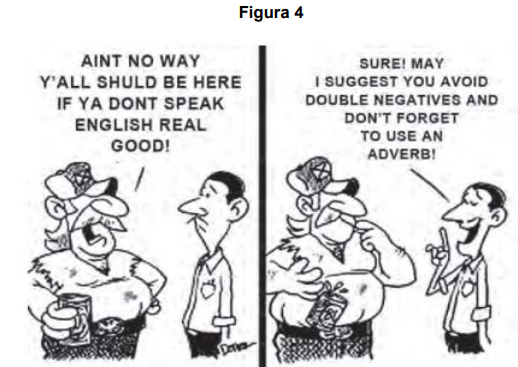
DONAR. Disponível em: <http://politicalgraffiti.wordpress.com>. Acesso em: 17 ago. 2011.
Considerando a relação entre linguagem e sociedade, analise o diálogo presente na charge (figura 4)
e assinale a alternativa que está em consonância com o que é descrito nos PCN de Língua Inglesa
sobre este tópico.
TEXT 7
“This, then, is the site of resistance, change, adaptation and reformulation. It is akin to what Canagarajah (1999) in his discussion of resistance to the global spread of English describes as a ‘resistance perspective’, highlighting the ways in which postcolonial subjects ‘may find ways to negotiate, alter and oppose political structures, and reconstruct their languages, cultures and identities to their advantage. The intention is not to reject English, but to reconstitute it in more inclusive, ethical and democratic terms.”
PENNYCOOK, A. Global Englishes and Transcultural Flows. New York: Routledge, 2007, p. 29.
The sentence that best preserves the meaning of the following excerpt “The intention is not to reject English,
but to reconstitute it.” is:
TEXT 5
“In other words, there are those among us who argue that the future of English is dependent on the likelihood or otherwise of the U.S. continuing to play its hegemonic role in world affairs. Since that possibility seems uncertain to many, especially in view of the much-talked-of ascendancy of emergent economies, many are of the opinion that English will soon lose much of its current glitter and cease to be what it is today, namely a world language. And there are those amongst us who further speculate that, in fifty or a hundred years’ time, we will all have acquired fluency in, say, Mandarin, or, if we haven’t, will be longing to learn it. […] Consider the following argument: a language such as English can only be claimed to have attained an international status to the very extent it has ceased to be national, i.e., the exclusive property of this or that nation in particular (Widdowson). In other words, the U.K. or the U.S.A. or whosoever cannot have it both ways. If they do concede that English is today a world language, then it only behooves them to also recognize that it is not their exclusive property, as painful as this might indeed turn out to be. In other words, it is part of the price they have to pay for seeing their language elevated to the status of a world language. Now, the key word here is “elevated”. It is precisely in the process of getting elevated to a world status that English or what I insist on referring to as the “World English” goes through a process of metamorphosis.”
RAJAGOPALAN, K. The identity of "World English”. New Challenges in Language and Literature. Belo Horizonte: FALE/UFMG, 2009, p. 99-100.
Ellipsis and substitution can be used as resources for avoiding repetition.
There are examples of ellipsis and substitution in the excerpt “And there are those amongst us who further speculate that, in fifty or a hundred years’ time, we will all have acquired fluency in, say, Mandarin, or, if we haven’t, will be longing to learn it.”.
Mark the alternative that contains an example of ellipsis only.
TEXT 4
“It must be fairly obvious from the discussion in the foregoing paragraphs that the very concept of ‘World Englishes’ throws a number of challenges at all those of us who are in one way or another involved in it. For ELT professionals all over the world, it means, among other things, having to take a fresh look at many of the things that have been taken for granted for long.
Consider, for instance, the following. World English is not the mother-tongue of anyone – and this includes even those who used to rejoice in their status as the ‘native-speakers’ of their own varieties of English. This is so because World English is a language that is in the making and, from the looks of it is bound to remain so for the foreseeable future. Incidentally, any temptation to consider World English a pidgin would be totally misguided in that it is not a make-shift language, nor one that is progressing towards a full-fledged language in its own right. Nor, for that matter, is it gathering a new generation of native speakers. Rather, it is resistant to the very terminology that the linguists resort to in describing conventional ‘natural’ languages.”
RAJAGOPALAN, K. The identity of "World English”: New Challenges in Language and Literature. Belo Horizonte: FALE/UFMG, 2009, p.104.

Leia a tira em quadrinhos e analise as afirmativas abaixo.
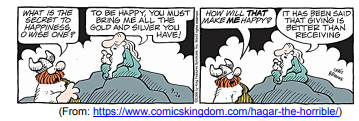
I. No primeiro quadrinho Hagar consultou o velho sábio para saber sobre o segredo da felicidade.
II. No segundo quadrinho as palavras that e me se referem, respectivamente, ao “velho sábio” e a “Hagar”.
III. As palavras do velho sábio no último quadrinho são de que é melhor dar que receber.
Assinale a alternativa correta.
Read the dialogue below.
A: Could I ask you the time, please?
B: No problem. It’s quarter past four.
Observing the function above as asking for something, it is correct to say that:
“Jack wants to be a soccer player and Julie wants to be a movie star. A palavra é:
I. Estão corretas a grafia e a tradução do trecho a seguir em inglês: the photograph has not come (a fotografia não saiu). II. Estão corretas a grafia e a tradução do trecho a seguir em inglês: he knows his own mind (ele sabe o que quer). III. Baseado nas ideias de Vygotsky, a aquisição de conhecimentos de Língua Inglesa não passa pela interação do sujeito com o meio.
Marque a alternativa CORRETA:
I. Comunicar-se na Língua Inglesa, por meio do uso variado de linguagens em mídias impressas ou digitais, reconhecendo-a como uma ferramenta que impede o acesso ao conhecimento, que reduz as perspectivas e as possibilidades para a compreensão dos valores e interesses de outras culturas e para o exercício do protagonismo social, é uma competência que pode ser desenvolvida pelo estudante de Língua Inglesa ao longo do Ensino Fundamental. II. No trecho "in full swing" ocorre um verbo cujo significado é "inspecionar" ou "revisar". III. A avaliação em Língua Inglesa não deve possibilitar observar a transferência das aprendizagens em contextos diferentes.
Marque a alternativa CORRETA:
I. Em linhas gerais, a aprendizagem de Língua Inglesa deve diminuir o conhecimento sobre linguagem que o aluno construiu sobre sua língua materna, por meio de comparações com essa língua estrangeira em vários níveis. II. Estão corretas a grafia e a tradução do trecho a seguir em inglês: that comes in useful (isto chega em boa hora).
Marque a alternativa CORRETA:
I. Está correta a grafia do trecho a seguir em inglês: kite a buzines (não é tão fácil). II. A avaliação em Língua Inglesa não deve ser realizada com o auxílio de tabelas ou do diário de classe.
Marque a alternativa CORRETA:
Read the two cartoons and answer questions.



 Conheça nossos planos