Questões de Concurso
Sobre aspectos linguísticos | linguistic aspects em inglês
Foram encontradas 1.058 questões


(Avaliable in: https://theplaylist.net/matrix-4-keanu-reeves-script-20200608/ – text adapted specially
for this test).
I. The verb “do” is in the infinitive form. II. The verb “do” is in the gerund form. III. The noun “reason” must be followed by “to”.
Which statements are correct?
Find the mistakes and choose the option that best corrects the sentence:
“The Amazon were the world’s most large
tropical rainflorest. It covers 2.1 million
square miles for land, primarily in Brazil,
Peru, and Colombia.”
Find the mistakes and choose the option that best corrects the sentence:
“Many Pirates in the Caribbean Sea was
sponsored by foreign goverments who
hoped to discrupt the trade empires of
Spain and Portugal’’
Choose the option that is grammatically correct:
1. It take me a long time after college to adapt to life in the office.
2. She cannot stands the thought of losing him
3. What you’re working on besides the research project?
4. We do not want to heard the policies
one more time.
Choose the option that is grammatically correct:
1. Do you have any other questions?
2. I prefer the other one.
3. My boss and your boss really hate one another.
4. We need to think of one other possible
solution.
5. We _____ it would be fun. 6. _____ I want to go, I really can’t leave right now. 7. I know life is _____, but we survive. 8. The group walked _____ the park.
Leia as afirmativas a seguir:
I. Está correta a grafia do trecho a seguir: he brougiht down the house.
II. Está correta a grafia do trecho a seguir: to cut a long story short.
Marque a alternativa CORRETA:
Leia as afirmativas a seguir:
I. Está correta a grafia do trecho a seguir: he made a clean breast of it.
II. No trecho "to go hungry" ocorre um verbo cujo significado é "correr".
Marque a alternativa CORRETA:
Instructions: answer question based on the following text
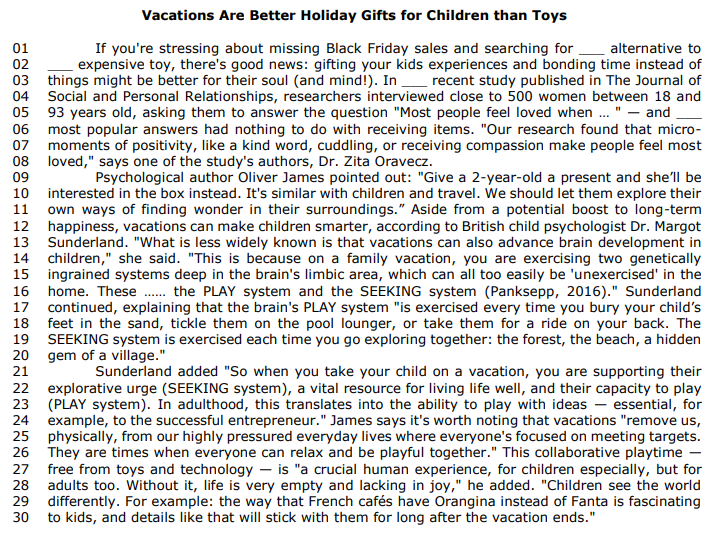
(Avaliable in: https://people.com/parents/vacations-better-than-toys-holiday-gifts-kids/ – text specially
adapted for this test.)
Instructions: answer question based on the following text
(Avaliable in: https://people.com/parents/vacations-better-than-toys-holiday-gifts-kids/ – text specially
adapted for this test.)
Read the following article and answer question
Can Allergies Cause Coughing — Or Is It Just A Cold?
Important q: Is it phlegmy or dry?
BY CASSIE SHORTSLEEVE
No matter why it's happening, a cough is always annoying—it's loud, it's uncomfortable, and it never fails to garner unwanted attention.
But what's really behind that cough? Can allergies cause coughing — or do you just have an annoying cold?
Well, turns out, there are some pretty distinct differences between allergy coughs and cold coughs...
Just curious: Why do we cough, anyway? "The purpose of a cough is to help us," says Monica Lee, MD, an otolaryngologist at Massachusetts Eye and Ear. It’s your body’s way of trying to expel something it perceives as a threat in the airway, she says.
Those perceived threats can be a bunch of different things: a piece of food stuck in your throat, pollen, air pollution, or swelling or drainage from extra mucus in your throat. All those things irritate the sensory fibers in your airway, which then stimulate a cough.
As for what exactly happens in your body during a cough? It's kind of complex, says Dr. Lee. Basically, your vocal chords close briefly to generate pressure in the lungs. Once enough pressure is built up, your vocal chords open back up, and air flows quickly through your voice box, which generates that coughing sound. Kinda cool, huh?
7So...can allergies cause coughing? Give it to me straight. In short, yes. Usually, allergies create dry coughs (it’s a direct reaction to something you’re sensitive or allergic to in the airways). If that's the case, you’ll likely have other symptoms (think: itchy, watery eyes; a runny nose; an itchy throat; and sneezing, says Dr. Lee). Headaches and wheezing often come with allergies, too, according to the American College of Allergy, Asthma, and Immunology.
Remind Me: When Is Allergy Season?
Timing's also a factor. If you're allergic to pollen (or your BFF's new adorable kitten), for example, you’ll likely notice symptoms (including your cough) almost immediately, or within an hour of being exposed. And those symptoms could last for hours after you've been exposed — even after the allergen isn't nearby anymore.
Coughs related to allergies are also dependent on patterns, so doctors always try to look at the big picture. Say you get a cough every single March. That could be a sign you're actually suffering from allergies, instead of the common cold. "You need to look at everything that's going on," says Paul Bryson, MD, an otolaryngologist at the Cleveland Clinic.
Your best defense for a cough from allergies? Antihistamines like Allegra, Claritin, and Zyrtec, which are all available over-the-counter. Other options include steroid nasal sprays and immunotherapy shots, which can work to regulate your body's response to allergens, instead of just relieving the symptoms.
How do I know my cough is from a cold?
You know how allergy coughs are typically on the drier side? Coughs from colds (or the flu) tend to be on the wetter side (that "wetness" is actually mucus your body which is trying to move out of your body, says Dr. Lee).
Coughs that come along with a cold usually come along with stuffiness, along with postnasal drip (a.k.a., mucus running down the back of your throat), which can cause a sore throat or chest discomfort. A low-grade fever may also signal a cold instead of allergies.
Colds aren't as immediate as allergies. Instead, they tend to develop over the course of a few days, says Dr. Bryson.
You can try a few different things to help relieve a cough. Decongestants can work for, well, congestion. And ingredients like dextromethorphan (found in many multi-symptom products like Vicks NyQuil Cold & Flu Nighttime Relief) can help ease the coughing itself. Just make sure you take any products as-directed. It should be said, however, that a dry cough isn't always allergies, just like a wet cough isn't always a cold. Allergies can plague your nose, for example, causing post-nasal drip (a wet cough), while mild colds might not leave you stuffed up enough to produce any phlegm.
Do I ever need to worry about a cough?
Something important to remember: A cough — no matter its cause — shouldn’t be your norm. Colds usually run their course within a couple of weeks, which means a cough associated with a cold should go away in about three weeks time (though some can linger on for as long as eight weeks), according to the U.S. National Library of Medicine. The length of an allergy-related cough will vary depending on how (if) you're treating it. But if you notice you’re still barking after two months of symptoms, see your doc. You could either be dealing with an allergy you’re not aware of (this is where an allergy test could come into play) or potentially suffering from another issue such as asthma (especially if you notice shortness of breath with any of your symptoms), reflux, pneumonia, or bronchitis, says Dr. Bryson. And if something (allergies or a pesky cold) is bothering you enough to disrupt your life, don't put off getting it checked out. If nothing else, seeing a doc will give you peace of mind and maybe even speed up your recovery time.
SOURCE:https://www.womenshealthmag.com/health/a26289646/co ughing-from-allergies-or-cold/. Access: 02/12/2019
Match the columns according to the meanings for the words in the article and mark the option which contains the correct sequence:
I. Garner
II. Briefly
III. Wheezing
IV. Itchy
( ) noun – whistling sound produced by difficulty to breathe
( ) adjective – irritating cutaneous sensation
( ) adverb – lasting for a short time
( ) verb – to call; to gather
Text 1:
How being bilingual can boost your career
Whether you’re fresh out of college or a seasoned executive, insiders agree that fluency in a second language can not only help you stand out among prospective employers, it can also open doors to opportunities that those without foreign language skills might miss.
In today’s global economy, the ability to communicate in another language has become a significant advantage in the workforce. Research has found that people who speak at least one foreign language have an average annual household income that’s $10,000 higher than the household income of those who only speak English. And about 17 percent of those who speak at least one foreign language earn more than $100,000 a year.
A recent survey found that nearly 9 out of 10 headhunters in Europe, Latin America, and Asia say that being at least bilingual is critical for success in today’s business environment. And 66 percent of North American recruiters agreed that being bilingual will be increasingly important in the next 10 years.
“In today’s global economy you really have to understand the way business is done overseas to maximize your potential. A second language equips you for that,” says Alister Wellesley, managing partner of a Connecticut-based recruiting firm. “If you’re doing business overseas, or with someone from overseas, you obtain a certain degree of respect if you’re able to talk in their native language.”
Language skills can also be key for service industries. At the Willard InterContinental Washington, a luxury hotel a few blocks from the White House, a staff of about 570 represents 42 nations, speaking 19 languages. The Willard’s front-of-house employees such as the concierge speak at least two languages. Bilingualism is not an absolute requirement, but it is desirable, according to Wendi Colby, director of human resources.
Workers with skills in a second language may have an edge when it comes to climbing Willard’s professional ladder. “The individual that spoke more languages would have a better chance for a managerial role, whatever the next level would be,” Colby says. “They are able to deal with a wide array of clients, employees.”
So which languages can give you a leg up on the job market? Insiders agree the most popular – and marketable – languages are Spanish, German, French, Italian, Russian and Japanese, with a growing emphasis on Mandarin, given China’s booming economy. So let’s learn Mandarin!
“We see demand from a full range of industries,” says Wellesley. “Actually it depends on which company you’re working for and the country in which they’re located.”
Adapted from: LATHAM-KOENIG, Christina & OXENDEN,
Clive. American English File 5. 2nd edition. Oxford: OUP,
2018.
Text 1:
How being bilingual can boost your career
Whether you’re fresh out of college or a seasoned executive, insiders agree that fluency in a second language can not only help you stand out among prospective employers, it can also open doors to opportunities that those without foreign language skills might miss.
In today’s global economy, the ability to communicate in another language has become a significant advantage in the workforce. Research has found that people who speak at least one foreign language have an average annual household income that’s $10,000 higher than the household income of those who only speak English. And about 17 percent of those who speak at least one foreign language earn more than $100,000 a year.
A recent survey found that nearly 9 out of 10 headhunters in Europe, Latin America, and Asia say that being at least bilingual is critical for success in today’s business environment. And 66 percent of North American recruiters agreed that being bilingual will be increasingly important in the next 10 years.
“In today’s global economy you really have to understand the way business is done overseas to maximize your potential. A second language equips you for that,” says Alister Wellesley, managing partner of a Connecticut-based recruiting firm. “If you’re doing business overseas, or with someone from overseas, you obtain a certain degree of respect if you’re able to talk in their native language.”
Language skills can also be key for service industries. At the Willard InterContinental Washington, a luxury hotel a few blocks from the White House, a staff of about 570 represents 42 nations, speaking 19 languages. The Willard’s front-of-house employees such as the concierge speak at least two languages. Bilingualism is not an absolute requirement, but it is desirable, according to Wendi Colby, director of human resources.
Workers with skills in a second language may have an edge when it comes to climbing Willard’s professional ladder. “The individual that spoke more languages would have a better chance for a managerial role, whatever the next level would be,” Colby says. “They are able to deal with a wide array of clients, employees.”
So which languages can give you a leg up on the job market? Insiders agree the most popular – and marketable – languages are Spanish, German, French, Italian, Russian and Japanese, with a growing emphasis on Mandarin, given China’s booming economy. So let’s learn Mandarin!
“We see demand from a full range of industries,” says Wellesley. “Actually it depends on which company you’re working for and the country in which they’re located.”
Adapted from: LATHAM-KOENIG, Christina & OXENDEN,
Clive. American English File 5. 2nd edition. Oxford: OUP,
2018.
Text 1:
How being bilingual can boost your career
Whether you’re fresh out of college or a seasoned executive, insiders agree that fluency in a second language can not only help you stand out among prospective employers, it can also open doors to opportunities that those without foreign language skills might miss.
In today’s global economy, the ability to communicate in another language has become a significant advantage in the workforce. Research has found that people who speak at least one foreign language have an average annual household income that’s $10,000 higher than the household income of those who only speak English. And about 17 percent of those who speak at least one foreign language earn more than $100,000 a year.
A recent survey found that nearly 9 out of 10 headhunters in Europe, Latin America, and Asia say that being at least bilingual is critical for success in today’s business environment. And 66 percent of North American recruiters agreed that being bilingual will be increasingly important in the next 10 years.
“In today’s global economy you really have to understand the way business is done overseas to maximize your potential. A second language equips you for that,” says Alister Wellesley, managing partner of a Connecticut-based recruiting firm. “If you’re doing business overseas, or with someone from overseas, you obtain a certain degree of respect if you’re able to talk in their native language.”
Language skills can also be key for service industries. At the Willard InterContinental Washington, a luxury hotel a few blocks from the White House, a staff of about 570 represents 42 nations, speaking 19 languages. The Willard’s front-of-house employees such as the concierge speak at least two languages. Bilingualism is not an absolute requirement, but it is desirable, according to Wendi Colby, director of human resources.
Workers with skills in a second language may have an edge when it comes to climbing Willard’s professional ladder. “The individual that spoke more languages would have a better chance for a managerial role, whatever the next level would be,” Colby says. “They are able to deal with a wide array of clients, employees.”
So which languages can give you a leg up on the job market? Insiders agree the most popular – and marketable – languages are Spanish, German, French, Italian, Russian and Japanese, with a growing emphasis on Mandarin, given China’s booming economy. So let’s learn Mandarin!
“We see demand from a full range of industries,” says Wellesley. “Actually it depends on which company you’re working for and the country in which they’re located.”
Adapted from: LATHAM-KOENIG, Christina & OXENDEN,
Clive. American English File 5. 2nd edition. Oxford: OUP,
2018.
Which figure of speech is represented on the sentence:
"I think our country sinks beneath the yoke;
It weeps, it bleeds. IV. iii 39-40. (Macbeth, Shakespeare)

 Conheça nossos planos