Questões de Concurso Sobre adjetivos | adjectives em inglês

Foram encontradas 743 questões

Q3768167 Inglês
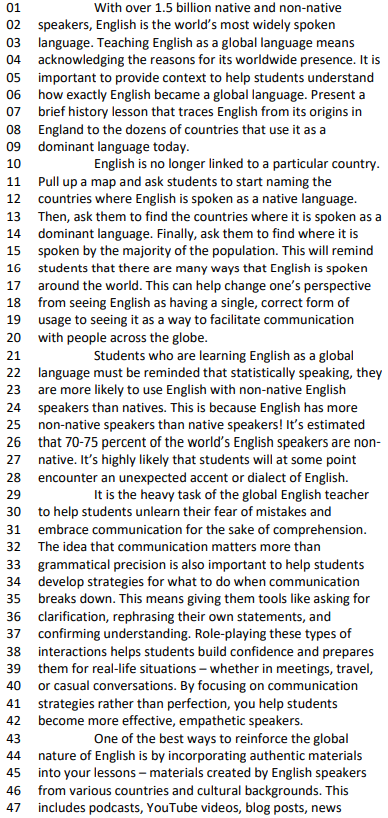
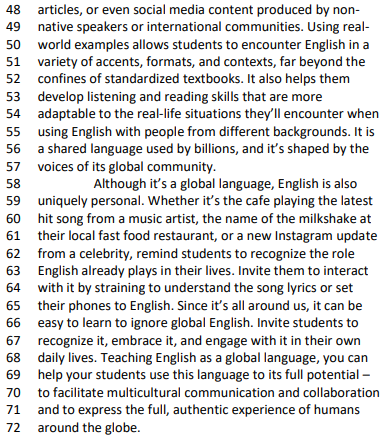
T E X T 1

Teaching English as a Global Language


Adapted from: https://bridge.edu/tefl/March 21, 2025


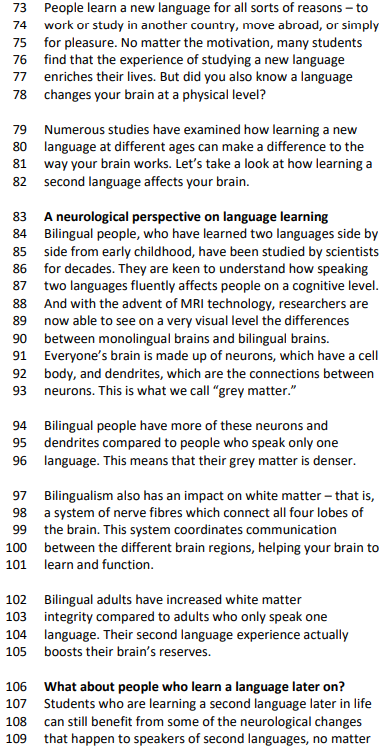
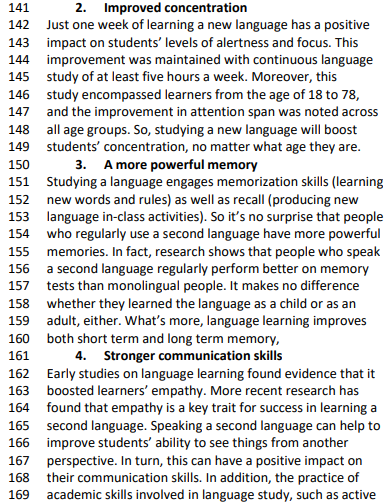
T E X T 2

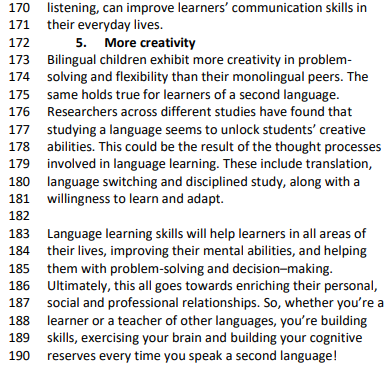
How learning a new language changes your brain


Adapted from: https://www.cambridge.org/elt/blog/2022/04/29. 
The sentences “One of the best ways to reinforce the global nature of English is by incorporating authentic materials into your lessons.” (lines 43-45) and “Whether it’s the cafe playing the latest hit song from a music artist…” (lines 59-60) contain adjectives that are, respectively, in their
Alternativas
Q3762120 Inglês
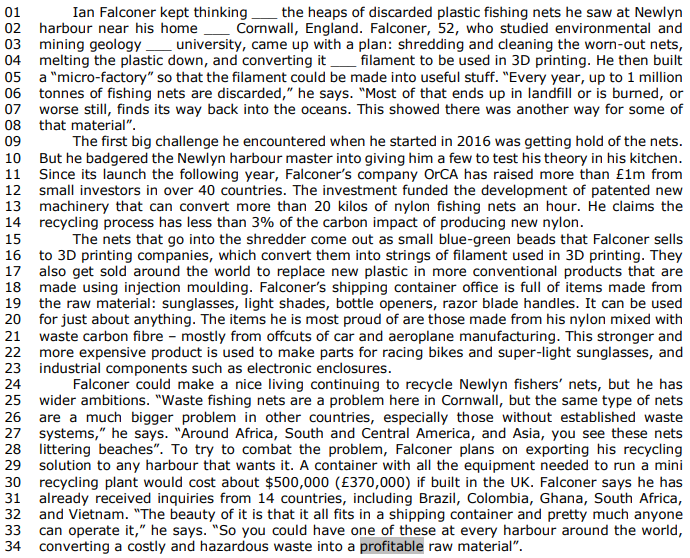
A One-Man Recycling Revolution on The Cornish Coast

By Rupert Neate


(Available at: www.theguardian.com/environment/2025/oct/16/fishing-nets-money-a-one-man-recyclingrevolution-on-the-cornish-coast – text specially adapted for this test). 
Mark the INCORRECT statement about the highlighted word “profitable” (l. 34).
Alternativas
Q3740364 Inglês
Choose the sentence that contains an error in the use of a comparative or superlative adjective. 
Alternativas
Q3740351 Inglês

Select the adjective form that best completes the sentence.


This street is ______ than the one we walked on yesterday. 

Alternativas
Q3739625 Inglês
A sentença em que os adjetivos comparativos estão usados corretamente é:
Alternativas
Q3719684 Inglês

Escolha a resposta correta quanto ao comparativo de superioridade.


Russia is much _________________________ Brazil.

Alternativas
Q3712118 Inglês
Which of the following sentences correctly use comparative or superlative adjectives?

I.This book is more interesting than the one I read last week.
II.She is the most smartest student in her class.
III.The weather today is colder than yesterday morning.
IV.He runs more faster than his brother.
V.This is the taller building in the city of Dubai.
Alternativas
Q3709331 Inglês
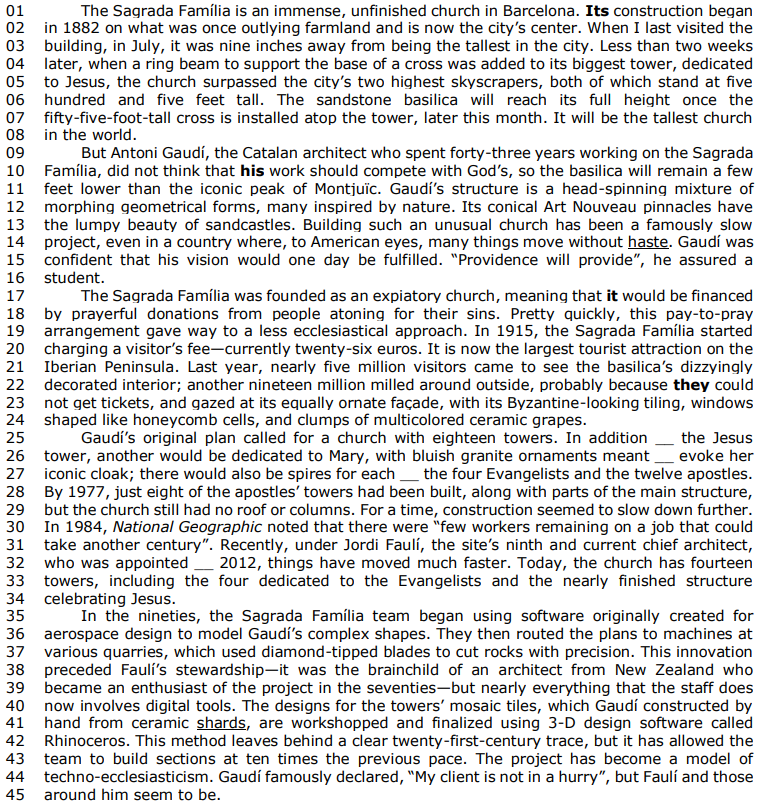
The Sagrada Família Takes Its Final Shape


Captura_de tela 2025-11-06 090237.png (764×807)


(Available at: https://www.newyorker.com/magazine/2025/09/22/is-the-sagrada-familia-amasterpiece-or-kitsch – text specially adapted for this test). 
Which of the following sentences shows a comparative structure rather than a superlative? 
Alternativas
Q3708631 Inglês
Read the text below and answer the next question:


Gaia Pope: Family appeals for art in memory of teenager


The family of teenager Gaia Pope are appealing for people to create and donate artwork to honour her memory a year after her death.

The 19-year-old was reported missing from Swanage on 7 November. Her body was found 11 days later near the Dorset coast path.

Her family said as the anniversary of her disappearance approached they were "asking people to make something to show she is not forgotten".

The artwork will be displayed online.

Miss Pope, from Langton Matravers, near Swanage, made an allegation she was raped two years before her death.

Her family claimed an alleged failed police investigation "severely affected Gaia's mental and physical state".

Art, particularly pyrography (woodburning), became a form of therapy for the teenager, her family said.

Her mother Natasha Pope said: "I don't speak about my daughter in the past tense - I utter her name as I always have because I know she is still with me, every moment, in all we're doing.

"Gaia's art and poetry, inspired by the beauty of nature and the strength of femininity, is her way of connecting with her true self. In spite of all she's been through she is not defined by that.

"Our Gaia would want to provide a forum for others to find their voice and create."

Miss Pope's cousin Marienna Pope-Weidemann added: "Some things are so big, run so deep, they can only be expressed through art. Our love and our grief for Gaia feels that way.

"The love we've felt from the community felt that way too. We want to honour that, make it visible, maybe do something to show other survivors, families who's lost someone too soon, that they are not alone."

The family said the project was inspired by the #JusticeForLB social media campaign and want people to share their art on Twitter via #JusticeForGaia.

The #JusticeForLB campaign was set up by Dr Sara Ryan - the mother of 18-year-old Connor Sparrowhawk, who had epilepsy and drowned in a bath after having a seizure in Oxford.

Dorset Police is being investigated over the way it handled the rape allegation and its response to Miss Pope's disappearance.


Source: https://www.bbc.com/news/uk-england-dorset45571415 
Imagine a continuation of the article stated: “The #JusticeForGaia campaign became more influential than many other local initiatives.” What is the grammatical function of the underlined structure?
Alternativas
Q3700276 Inglês
Identify the sentence with the correct use of comparatives or superlatives.
Alternativas
Q3694501 Inglês
Choose the sentence that CORRECTLY orders the adjectives describing the noun:
Alternativas
Q3693819 Inglês

A British Airways Pilot Was Sucked Out of An Airplane


Natalie Musumenci
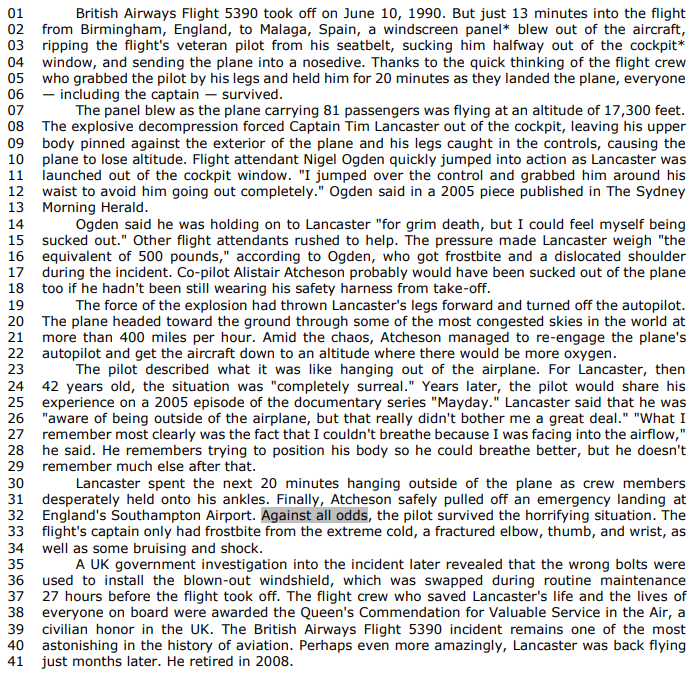


(Available at: https://www.businessinsider.com/british-airways-pilot-sucked-out-plane-mid-flight-survived2024-1 – text specially adapted for this test).

*Windscreen panel: it is the glass window at the front of the plane through which the pilots look.

*Cockpit: the front part of the plane where the pilot sits.

(Available at: www.collinsdictionary.com).

Which of the alternatives below presents a superlative structure like in “one of the most astonishing in the history of aviation”?
Alternativas
Q3686596 Inglês
O texto seguinte servirá de base para responder à questão.

Humanoid Robots in Hotels Stir Curiosity and Concern as Global Use Expands


Hotels around the world are increasingly embracing humanoid robots at check-in desks, lobby information points, and even for room service, but the trend is raising eyebrows among guests, researchers and hoteliers alike.

Last week, a viral TikTok video fromTokyo's Henn-na Hotel showed a startled guest stepping back from a humanoid check-in robot. As the machine offered instructions, she stammered, "Don't look at me," a moment that highlights discomfort with robots that mimic—but fail to fully replicate—human behavior. The reaction reflects the classic "uncanny valley" phenomenon, where lifelike machines produce a sense of unease, rather than delight.

Indeed, Henn-na itself has scaled back on its robot deployment: it retired more than half of its original roster of 240 androids by 2019, citing technical glitches and guest complaints. Still, not all experiences are negative. A 2023 survey from Boutique Hotelier found 61% of travelers had favorable reactions to service robots, even if nearly 29% admitted to feeling afraid to approach one.

Investment in hospitality robotics continues to escalate. The global market, valued at approximately $567 million in 2023, is projected to reach $2.2 billion by 2030, with a CAGR near 21.5%. While humanoid receptionists earn the spotlight, many hotels are quietly deploying delivery, luggage-handling, cleaning, and disinfection robots to streamline operations without overshadowing guests.

Major chains have taken note. Marriott and Hilton use Relay and Savioke robots to deliver amenities to guest rooms. Aloft and IHG properties in Asia deploy concierge bots like Connie, powered by IBM Watson. Meanwhile, Mandarin Oriental Las Vegas introduced a version of "Pepper" in 2017 as a lobby greeter, but today it fulfills more of an entertainment role than a functional one.

These varied experiments point to a shifting hospitality mindset. Robots are increasingly seen not as novelties, but as efficiency tools. In many properties, housekeeping tasks are now scheduled via AI-driven work order platforms, predictive maintenance prevents broken door locks before guests arrive, and dynamic pricing engines optimize revenue. Humanoid robots often serve as marketing headlines, while automation remains the real operational focus.

Henn-na's evolution encapsulates this balance. Opened in 2015 in Nagasaki and later franchising globally, the hotel scaled back after staffing and function issues became clear. Today, human staff handle most tasks, with robots reserved for novelty greetings and sample deliveries in select areas. The hybrid model highlights that technology is best embraced when it supports—not replaces—hospitality staff.

Engineers are working to soften the uncanny valley. SoftBank Robotics' latest machines, for instance, sport smoother motions, improved speech recognition, and context-aware gestures. Bt. Robotics, another emerging player, is working to enhance robots' ability to recognize individual guests and understand local cultural cues—a step toward more personalized service.

However, UC Berkeley roboticist Ken Goldberg's old adage still rings true: people are most comfortable when robots look and behave like robots. In hospitality, that means using bots to lift luggage, sanitize rooms, or whisk away towels, while leaving emotional intelligence to human staff. Technology can take on repetitive or hazardous tasks, but empathy and problem-solving remain firmly in the human domain.

That said, humanoid robots aren't disappearing. High-end resorts and tech-forward properties continue experimenting with sophisticated bots as part of their experience narrative. In South Korea, luxury hotels feature robot butlers that can draw a bath or set room ambiance. In China, hotel robots perform room service duties while broadcasting real-time translation for foreign guests.

The challenge for the industry lies in aligning form with function. A futuristic check-in robot may attract press, but if it breaks down mid-shift or stares blankly at guests, the novelty becomes irritation. Meanwhile, back-of-house bots that reliably deliver water bottles—or prevent maintenance issues—create consistent value that can actually enhance service quality.

Looking ahead, hoteliers who thoughtfully combine robotics and human labor with precision and purpose will lead the field. They will use robots not to replace staff, but to elevate them—by making service smoother, freeing human employees to engage deeper with guests, and resetting expectations of what hospitality can be in the contactless age.


https://hoteltechnologynews.com/2025/07/humanoid-robots-in-hotels-sti r-curiosity-and-concern-as-global-use-expands/ 
Considering the phrase "SoftBank Robotics' latest machines sport smoother motions, improved speech recognition, and context-aware gestures," which analysis correctly identifies the adjective classifications?
Alternativas
Q3680646 Inglês
In “Better safe than sorry”, the word “better” is used as:
Alternativas
Q3680632 Inglês

•Use Text I for question.


TEXT I


HOW TO COPE WITH THE SUNDAY SCARIES


by Chantelle Lee


    ________(1) Sunday night, and you’re feeling sad and anxious about going back to work in the morning.


    Say hello to the Sunday scaries 


   You’re not alone in your workweek dread: “They’re very, very common,” says Susanne Cooperman, a neuropsychologist and psychoanalyst at New York University Langone Huntington Medical Group. “There’s nothing wrong with a person if they feel sad that the weekend is over. It’s when it really interferes in your functioning—when you can’t focus, when you can’t sleep, when you feel yourself medicating with alcohol—then you need help.”


   Here’s why people get the Sunday scaries and the best ways to combat those thoughts of doom and gloom.


   __________(2) are the Sunday scaries? The Sunday scaries typically manifest in two ways: feelings of depression that the weekend is ending, feelings of anxiety about the week to come, or both. These feelings typically start on Sunday afternoon.


   “It could be that you feel sad and irritable and you have difficulty concentrating and fatigue,”


   Cooperman says. That collection of feelings is called anhedonia—basically a loss of enjoyment.


   If you feel more dread for the work week ahead, that’s called “anticipatory anxiety,” she says.


   Why people get them 


   The scaries strike for all kinds of reasons. They could be related to work—maybe you’re afraid of losing your job, or you’re dreading going to the office in person, or you’re simply having a hard time unplugging from work after hours, Cooperman says.


   Or, she adds, it could also be that you overbooked yourself during the week and feel exhausted by the time Sunday comes around.


   How to deal with the Sunday scaries


  One of the best ways to deal with the Sunday scaries is to mentally plant yourself firmly in the present. One way to achieve this is to try a mediation or relaxation app, even if it’s only for 10 or 15 minutes, Cooperman says. “I think that’s probably the best out of all the tips: stay in the moment, really try to curtail that catastrophizing into the future,” she says. There are other paths away from the scaries, too: Unplug from your phone or social media, maintain a good work-life balance, do some exercise, or get some fresh air. Make sure to schedule fun activities for Sunday afternoon and evening and do things that reliably make you feel better or help you “refuel [your] batteries,” Cooperman says. Just as important is allowing yourself downtime to relax and unwind, she adds. She also recommends trying to split up errands throughout the week so you don’t feel like you wasted your entire Sunday doing them.


   While the Sunday scaries are common, people should keep an eye on how they’re coping come the end of the weekend. “Use healthy, adaptive ways to self-soothe when you’re anxious and have the scaries,” Cooperman says. “A glass of wine is fine, but if it’s more than that and you need it every night, then that’s a problem.” If the scaries are so bad that it’s significantly impacting your life, Cooperman suggests talking about these feelings with a therapist or a psychologist. Some warning signs include being so anxious that it’s hard to get out of bed in the morning, having anxiety attacks, needing alcohol to calm down, not being able to focus or sleep, or failing to enjoy the weekend at all. “If you just can’t get out of that loop where you’re constantly unhappy, then I think you’re at a place where you should see a psychologist or a therapist,” Cooperman says. “Sometimes it’s hard to [deal with it] on your own. It’s good to talk to a professional.” 


LEE, Chantelle. How to cope with the Sunday scaries. Time, New York, 6 Apr. 2025. Available at: https://time.com/7275089/what-are-sunday-scaries/. Accessed on: 11 Aug. 2025.

Based on the excerpt “If you just can’t get out of that loop where you’re constantly unhappy,”, select the CORRECT alternative regarding the formation of the word “unhappy”.
Alternativas
Q3678488 Inglês

Identify the adjective in the following sentence from the text.


(5º§) "In retrospect, Ellie questioned how she this was normal."


Choose the correct alternative:

Alternativas
Q3678480 Inglês
O texto seguinte servirá de base para responder à questão abaixo:

(1º§) POSTNATAL depression is rife among parents, affecting more than one in 10 women within a year after they've given birth. But many mums hesitate before speaking out about their battles with mental health in what supposed to be a blissful period for them.

(2º§) Ellie Polly Killah, a YouTuber and mum of two boys aged six and two, said she'd ummed and ahhed about sharing her own experience for two years. In a video uploaded to her channel, she gave a raw account of her postnatal depression and the severe anxiety and intrusive thoughts it triggered in its aftermath. "I'm not gonna sugarcoat it, I'm just gonna say it how it is because it's not a pretty thing to deal with, to go through so I'm not going to try and make it so," she told viewers. "This is my story from the beginning till now and how I learned to live with it - I say live with it not overcome it because I don't think you ever do," the mum went on. She hoped the video might help anyone at the precipice of this process.

(3º§) Ellie said she had no history of mental health struggles when she gave birth to her first son Leo in 2017 at the age of 27. She was the first of her friends to have a kid she recalled feeling lonely. And Ellie became aware of her 'attachment issues' with Leo immediately after he was born. "People love to tell you that when your baby is born you have this immediate rush of love when you look at them," she explained. But Ellie said that isn't the case for everyone and it wasn't the case for her with her first child. "Obviously I was amazed when I saw him, sort of overwhelmed, couldn't believe he was here, but I don't remember feeling that complete love and awe of him."

(4º§) Ellie struggled to feel bonded to Leo, but thought there was just 'something really wrong' with her. "I would cry every day but a lot of the time in secret," she remembered, and the new mum said she locked herself in her room to do so whenever someone came round to visit. "I think I did it secretly because I was embarrassed or ashamed, or I thought if people knew I was struggling that they would just think I was this awful mother, or he'd get taken away from me." "Your brain sends you an all of these imaginary scenarios."

(5º§) In retrospect, Ellie questioned how she thought this was normal. Her fiance Clint went back to work when Leo was two weeks old and he'd often have to travel, meaning that Ellie was on her own a lot. She remembered ringing Clint and saying __ her son: "I feel like I don't like him." She told viewers it was painful to recall feeling that way, but it made her begin to realise something wasn't quite right. "This was the first baby for both of us, so we didn't really recognise post-partum depression or know what we were really looking for.

(6º§) At eight weeks old, Ellie's bond for her baby 'came on quite suddenly'. "I remember it hitting me like a wave, looking at him one day and being like: there it is," Ellie said.


Intrusive thoughts and OCD

(7º§) But the guilt of not experiencing that early attachment lead to the mum being 'extremely anxious' about her son. She explained: "The intense love and responsibility that I had to this baby lead me to constantly, constantly [think] he was going to die." Ellie would have 'hideous, morbid, intrusive thoughts' multiple times a day, particularly triggered when she was driving or Leo was in the bath: "It was intense."

(8º§) She started to get panic attacks and physical side effects from the anxiety she was experiencing, like like a tight chest, stomach pains, nausea and headaches. "I know now that OCD basically goes hand in had with severe anxiety," Ellie went on. At her worst, Ellie was convinced her home would catch fire in the night and would obsessively plan out an escape route in her head before sleeping. She also became gripped by the fear that she would die __ the night and leave her baby on his own.    

(9º§) Ellie asked her mum or fiance text her every morning in case this happened.The new mum had her wake-up call when she confessed this fear to her friends one evening and saw the horror on their faces. She booked a therapist appointment the next day.


What helped?

(10º§) Ellie said therapy was hugely helpful to her recovery journey, as was medication. The mum saw female therapist who specialised in anxiety, who taught her techniques that Ellie said she used to this day. A method deal with with her intrusive thoughts was to take a deep breath when she was taken over by one, soak it in and then weigh up the evidence it is true vs. the evidence it isn't. "The one or two minutes it takes for you to sum up that evidence for and against, you've completely calmed down," Ellie said.

(11º§) Three years later Ellie said she's realised how common her experience with postnatal depression is. "I'll worry about my kids forever, I'll probably always get these horrible thoughts and ideas, but I know how to deal with them so I just get on with it. It doesn't control me at all." She went on: "If you are in a dark place and feel like you need help, just talk to someone." Then it's best you get professional help, as these kinds of feelings are "really hard to master on your own". The mum ended on a happier note. "And if you had a bad experience and you're nervous about your second, let me tell you it was a completely different experience __ me second time round.

https://www.thesun.co.uk/health/22465978

Consider the excerpt below:


(11º§) "Three years later Ellie said she's realised how common her experience with postnatal depression is. 'I'll worry about my kids forever, I'll probably always get these horrible thoughts and ideas, but I know how to deal with them so I just get on with it. It doesn't control me at all.'       


Choose the correct option that demonstrates the proper use of adjective superlative and comparative forms in the text:

Alternativas
Q3674893 Inglês

Question must be answered based on the following excerpt.


Still floating on her back, Alex opened her eyes, disoriented by the quick hit of sun. She righted herself with a glance at the shore: she was farther out than she’d imagined. Much farther. How had that happened? She tried to head back in, toward the beach, but she wasn’t seeming to get anywhere, her strokes eaten up by the water.


Source: Cline, Emma.The Guest. Penguin Books, 2024.


According to Halliday’s Introduction to Functional Grammar (IFG) (1985), the highlighted words above are considered

Alternativas
Q3669787 Inglês
Consider the sentence below:

His____explanation of the complex scientific theory made it comprehensible even to those with limited knowledge in the field.

Choose the term that correctly completes the sentence above and accurately characterizes a person who communicates clearly and persuasively with concise language.
Alternativas
Q3669693 Inglês

Complete the dialogue with the appropriate comparative form:


A: This book is interesting, but the sequel is_____.


B: Really? I didn't know that. I'll have to read it.

Alternativas
Respostas
121: D
122: E
123: E
124: C
125: B
126: D
127: B
128: B
129: A
130: C
131: E
132: E
133: A
134: C
135: D
136: B
137: X
138: A
139: B
140: E