Questões de Concurso
Sobre adjetivos | adjectives em inglês
Foram encontradas 776 questões


Text for the item.


Internet: <https://hearinginfo.net>
According to the text, judge the item.
The word “best” (line 3) is the superlative of the
adjective good.
Considering the underlined words, they are classified as, respectively,
Instruction: answer the question based on the following text.
What Not to Do in Italy

(Available in: https://www.wanderherway.com/what-not-to-do-in-italy/ – text specially adapted for this test).

Analyse the statements below about the excerpt “I think that actually made it easier for us. We always write the quickest when we have a story or we're writing about something that's happened.” (l. 14-15).
I. “Easier” is a comparative form of the adjective “easy”, and it is written this way because the spelling rule for short adjectives ending in consonant + y is to drop the y and add ier.
II. “Quickest” is a comparative form of the adverb “quick”, and it is written this way because the spelling rule for short adverbs in general is to add est.
III. If “easier” were replaced by a long adjective like “beautiful,” its comparative form would be “more beautiful”.
Which statements are correct?
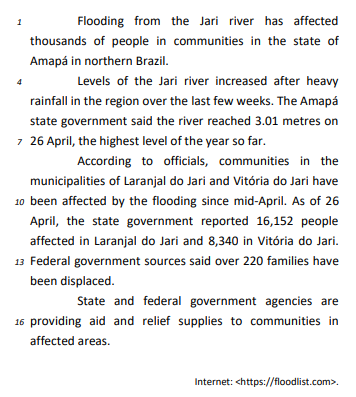
Judge the item
The word “highest” (line 7) is an example of superlative
adjective.
“In Japan, they call them ‘manga’; in Latin America, ‘histotietas’; in Italy, ‘fumetti’; in Brazil, ‘história em quadrinhos’; and in the U.S., ‘comics’.”; ” All of Mexico’s comic titles together.
The words in bold are respectively:
Choose the best sentence that fills in the blanks:
I have several friends. But the best ________ them is Selma. She's than me. Selma is very funny and interesting person. With Selma, you can talk on various topics.
I met Selma this summer ___________ I was restinginthe camp, she was sharing the room with me. When I saw her for the first time I did not like. After | talked to her, | found ________ she was my soul mate. We like the same music and we also do the same sport. I really want to see her again, but I can't because she lives far away from me. But she and I chat _________ the Internet.
Complete the following sentences with the appropriate adjective or adverb to make the correct comparisons or superlatives.
I’m a terrible singer. You can sing _______ than me (good).
Paul is the _______ person in his family (tall).
Fortaleza is the _______ capital in Brasil (danger).
Select the CORRECT answer.
Leia o trecho da canção “You Gotta Be” da cantora Des’ree e escolha a alternativa correta.
Listen as your day unfolds
Challenge what the future holds
Try and keep your head up to the sky
Lovers, they may cause you tears
Go ahead, release your fears
Stand up and be counted
Don't be ashamed to cry
You gotta be
You gotta be bad, you gotta be bold, you gotta be wiser
You gotta be hard, you gotta be tough, you gotta be
stronger
You gotta be cool, you gotta be calm, you gotta stay
together
All I know, all I know, love will save the day
Concerning the use of adjectives, Swan stablishes that the following sentences are correct or incorrect.
I. A fat old white horse.
II. A big grey woolen sweater.
III. New Italian boots.
IV. A little modern square brick house.
The correct alternatives are:
-ing forms (e.g. smoking, walking,) can be used not only as verbs, but also like adjectives or nouns.
Considering the use of -ING in the sentences bellow, mark T for the true sentences and F for the false ones:
I. ( ) You're smoking too much these days. (verb: part of present progressive)
II. ( )There was a smoking cigarette end in the ashtray. (adjective describing the cigarette end)
III. ( )Smoking is bad for you. (noun: subject of sentence)
The correct order of the answers for the sentences above, top down, is:
“One of these is the world’s largest land predator, the polar bear.”
Study the affirmatives below:
1. ‘these’ is a relative pronoun. 2. ‘largest’ is the comparative of superiority form of the adjective ‘ large’. 3. ‘world’s’ means ‘world is’. 4. ‘largest’ is the superlative of superiority form of the adjective ‘ large’. 5. ‘these’ is a demonstrative pronoun.
Choose the alternative which contains all the correct affirmatives.
Education
Education encompasses both the teaching and learning of knowledge, proper conduct, and technical competency. It thus focuses on the cultivation of skills, trades or professions, as well as mental, moral & aesthetic development.
Formal education consists of systematic instruction, teaching and training by professional teachers. This consists of the application of pedagogy and the development of curricula.
The right to education is a fundamental human right. Since 1952, Article 2 of the first Protocol to the European Convention on Human Rights obliges all signatory parties to guarantee the right to education. At world level, the United Nations’ International Covenant on Economic, Social and Cultural Rights of 1966 guarantees this right under its Article 13.
Educational systems are established to provide education and training, often for children and the young. A curriculum defines what students should know, understand and be able to do as the result of education. A teaching profession delivers teaching which enables learning, and a system of policies, regulations, examinations, structures and funding enables teachers to teach to the best of their abilities.
Primary (or elementary) education consists of the first
years of formal, structured education. In general, primary education consists of six or seven years of schooling starting at the age of 5 or 6, although this varies
between, and sometimes within, countries. Globally,
around 70% of primary-age children are enrolled in
primary education, and this proportion is rising.
In most contemporary educational systems of the world, secondary education consists of the second years of formal education that occur during adolescence. It is characterized by transition from the typically compulsory, comprehensive primary education for minors, to the optional, selective tertiary, “post-secondary”, or “higher” education (e.g., university, vocational school) for adults.
Higher education, also called tertiary, third stage, or
post secondary education, is the non-compulsory
educational level that follows the completion of a
school providing a secondary education, such as a
high school or secondary school. Tertiary education is
normally taken to include undergraduate and postgraduate education, as well as vocational education and
training. Colleges and universities are the main institutions that provide tertiary education. Collectively,
these are sometimes known as tertiary institutions.
Tertiary education generally results in the receipt of
certificates, diplomas, or academic degrees.
’Globally, around 70% of primary-age children are enrolled in primary education, and this proportion is rising.’
the underlined words are, respectively:

 Conheça nossos planos