Questões de Concurso
Sobre adjetivos | adjectives em inglês
Foram encontradas 776 questões


“Their findings point to something powerful: spending even a short amount of time with original artworks may reduce stress, improve emotional balance, and potentially contribute to a longer, healthier life. And the best part is that you do not need to be an art expert to benefit.”
Read the text below.
A train travels at 250 km/h, while another travels at 180 km/h.
Which sentence correctly compares the two trains?
Identify the correct comparative form:
My house is _____ than yours.
"This is ________ movie I have ever seen."
Proper storage of pharmaceutical products is essential to maintain their safety, quality, and effectiveness. Medicines must be kept under controlled environmental conditions, including appropriate temperature, humidity, and light exposure. Certain drugs require refrigeration, while others must be stored at room temperature according to manufacturer specifications.
Pharmacists and pharmacy technicians are responsible for monitoring storage conditions and ensuring that expired or compromised products are promptly removed from circulation. Failure to comply with storage standards may result in reduced therapeutic efficacy or potential risks to patients.
Additionally, access to medication storage areas should be restricted to authorized personnel only. Regular inspections and accurate documentation are necessary to ensure compliance with regulatory requirements.
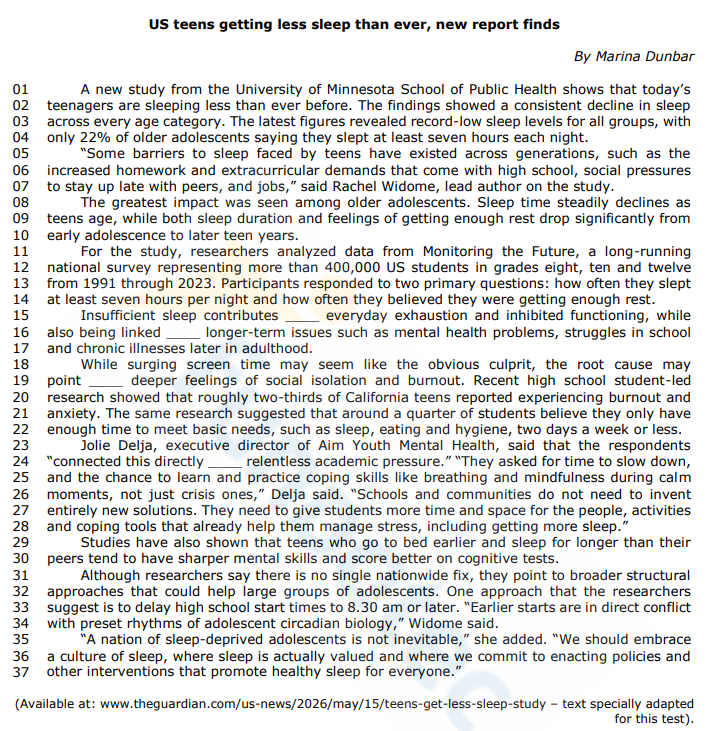
Considering the text and standard English usage, judge the following items.
California is Free of Drought for The First Time in 25 Years
By Clara Harter
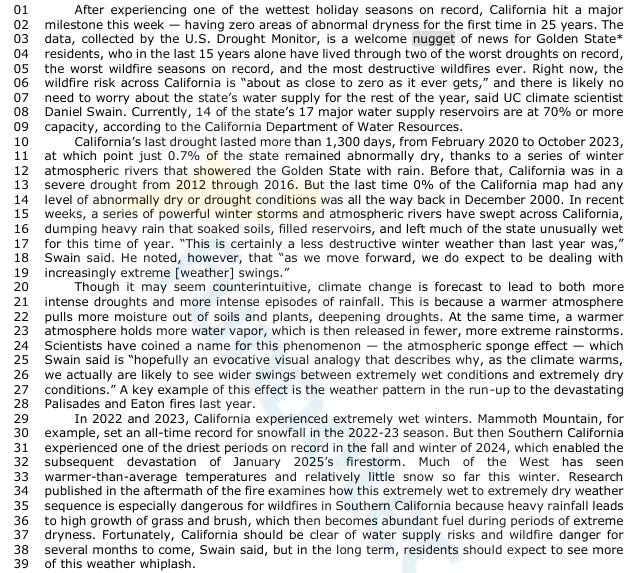
*California can be referred to as “The Golden State”.
(Available at: https://www.latimes.com/california/story/2026-01-09/california-has-no-areas-of-dryness-first- time-in-25-years – text specially adapted for this test).
I.The new research method is more efficient than the previous one used by the laboratory team.
II.Sarah presented the most detailed report during the international scientific conference.
III.The second proposal appeared cheaper than the original financial plan discussed yesterday.
IV.This is the most challenging project developed by the engineering department this year.
V.The blue vehicle seems faster than the transportation model acquired last semester.
Based on the sentences above, analyze the following statements.
(__)Sentences I, III, and V contain adjectives in the comparative form.
(__)Sentences II and IV contain adjectives in the superlative form.
(__)The adjective structure "more efficient than" expresses a comparison between two elements.
(__)The expression "the most challenging" indicates the lowest degree of comparison.
Choose the correct alternative:
Adjectives in English present specific forms in the comparative and superlative degrees, with construction rules linked to the number of syllables and to irregular cases. Regarding the comparative and superlative degrees in the English language, analyze the following statements.
I. Short adjectives of one syllable generally form the comparative with the addition of the suffix "-er" and the superlative with the suffix "-est", as in "tall − taller − tallest".
II. Adjectives of two or more syllables generally form the comparative with "more" and the superlative with "the most", as in "beautiful − more beautiful − the most beautiful".
III. The adjective "good" presents regular forms in the comparative and superlative degrees, with "gooder" for the comparative and "the goodest" for the superlative, following the pattern of one-syllable adjectives.
The correct statements are:
“The aviation authority is looking for several highly talented young candidates to fill the vacancies.”
Regarding the internal structure of the underlined noun phrase, which statement is grammatically and functionally CORRECT?

 Conheça nossos planos