Selecionar segmento
Estude com questões de diferentes segmentos
Atenção: Isso limpará todos os campos já preenchidos no filtro!
Foram encontradas 5.831 questões
Resolva questões gratuitamente!
Junte-se a mais de 4 milhões de concurseiros!


Q393296
Português
Texto associado
Leia o texto para responder à questão:
O tio Sabino, paramentado de rico, fez ainda sair da maleta de couro uma espécie de saco de lona com fechos de correias. Debaixo da cama, por esquecimento, tinham ficado as alpargatas do Carvalhosa. O tio Sabino calçou-as, as suas narinas palpitavam. Correu o fecho da porta cautelosamente, foi até ao escritório do Carvalhosa e sacou da gaveta do contador uns rolinhos de libras; de passagem pelo toilette arrecadou o cofre de joias, os anéis e a caixa de pó de arroz; de cima da banquinha de noite desapareceu a palmatória de prata dourada e tudo foi arrecadado no saco.
Fechou destramente o saco, tendo-lhe metido primeiro a camisa de chita que despira, a fim de não tinirem dentro os metais. E de chapéu à banda e cachimbo na boca saiu, o saco pendente, fechando a porta e tirando-lhe a chave. Ninguém estava no corredor; Maria do Resgate engomava na saleta; as crianças na cozinha cortavam papagaios, chilreando.
- Até logo, minha sobrinha, até logo.
Ela veio correndo, com o seu riso afetuoso.
- O jantar é às cinco, sim? Mas, querendo, dá-se ordem para mais tarde.
- Qual! Não temos precisão de incômodos. Às quatro e meia estou.
E com a mala pendente, o lenço escarlate fora do bolso do fraque e bengala debaixo do braço, desceu a escada cantarolando.
Eram seis horas da tarde e nada do tio Sabino.
Sete horas, e Maria do Resgate acaba de notar a porta da alcova fechada. Diabo...
No dia seguinte a polícia andava em campo para descobrir o larápio, que com tamanha pilhéria roubara a família Carvalhosa.
(Fialho de Oliveira, O Tio da América. Em: Contos. Adaptado)
O tio Sabino, paramentado de rico, fez ainda sair da maleta de couro uma espécie de saco de lona com fechos de correias. Debaixo da cama, por esquecimento, tinham ficado as alpargatas do Carvalhosa. O tio Sabino calçou-as, as suas narinas palpitavam. Correu o fecho da porta cautelosamente, foi até ao escritório do Carvalhosa e sacou da gaveta do contador uns rolinhos de libras; de passagem pelo toilette arrecadou o cofre de joias, os anéis e a caixa de pó de arroz; de cima da banquinha de noite desapareceu a palmatória de prata dourada e tudo foi arrecadado no saco.
Fechou destramente o saco, tendo-lhe metido primeiro a camisa de chita que despira, a fim de não tinirem dentro os metais. E de chapéu à banda e cachimbo na boca saiu, o saco pendente, fechando a porta e tirando-lhe a chave. Ninguém estava no corredor; Maria do Resgate engomava na saleta; as crianças na cozinha cortavam papagaios, chilreando.
- Até logo, minha sobrinha, até logo.
Ela veio correndo, com o seu riso afetuoso.
- O jantar é às cinco, sim? Mas, querendo, dá-se ordem para mais tarde.
- Qual! Não temos precisão de incômodos. Às quatro e meia estou.
E com a mala pendente, o lenço escarlate fora do bolso do fraque e bengala debaixo do braço, desceu a escada cantarolando.
Eram seis horas da tarde e nada do tio Sabino.
Sete horas, e Maria do Resgate acaba de notar a porta da alcova fechada. Diabo...
No dia seguinte a polícia andava em campo para descobrir o larápio, que com tamanha pilhéria roubara a família Carvalhosa.
(Fialho de Oliveira, O Tio da América. Em: Contos. Adaptado)
No contexto em que estão empregados os pronomes, destaca- dos nas passagens do segundo parágrafo – Fechou destramente o saco, tendo- lhe metido primeiro a camisa de chita que despira … – e – … fechando a porta e tirando- lhe a chave. –, eles podem ser substituídos, respectivamente, de acordo com a norma-padrão, por:
Q393295
Português
Texto associado
Leia o texto para responder à questão:
O tio Sabino, paramentado de rico, fez ainda sair da maleta de couro uma espécie de saco de lona com fechos de correias. Debaixo da cama, por esquecimento, tinham ficado as alpargatas do Carvalhosa. O tio Sabino calçou-as, as suas narinas palpitavam. Correu o fecho da porta cautelosamente, foi até ao escritório do Carvalhosa e sacou da gaveta do contador uns rolinhos de libras; de passagem pelo toilette arrecadou o cofre de joias, os anéis e a caixa de pó de arroz; de cima da banquinha de noite desapareceu a palmatória de prata dourada e tudo foi arrecadado no saco.
Fechou destramente o saco, tendo-lhe metido primeiro a camisa de chita que despira, a fim de não tinirem dentro os metais. E de chapéu à banda e cachimbo na boca saiu, o saco pendente, fechando a porta e tirando-lhe a chave. Ninguém estava no corredor; Maria do Resgate engomava na saleta; as crianças na cozinha cortavam papagaios, chilreando.
- Até logo, minha sobrinha, até logo.
Ela veio correndo, com o seu riso afetuoso.
- O jantar é às cinco, sim? Mas, querendo, dá-se ordem para mais tarde.
- Qual! Não temos precisão de incômodos. Às quatro e meia estou.
E com a mala pendente, o lenço escarlate fora do bolso do fraque e bengala debaixo do braço, desceu a escada cantarolando.
Eram seis horas da tarde e nada do tio Sabino.
Sete horas, e Maria do Resgate acaba de notar a porta da alcova fechada. Diabo...
No dia seguinte a polícia andava em campo para descobrir o larápio, que com tamanha pilhéria roubara a família Carvalhosa.
(Fialho de Oliveira, O Tio da América. Em: Contos. Adaptado)
O tio Sabino, paramentado de rico, fez ainda sair da maleta de couro uma espécie de saco de lona com fechos de correias. Debaixo da cama, por esquecimento, tinham ficado as alpargatas do Carvalhosa. O tio Sabino calçou-as, as suas narinas palpitavam. Correu o fecho da porta cautelosamente, foi até ao escritório do Carvalhosa e sacou da gaveta do contador uns rolinhos de libras; de passagem pelo toilette arrecadou o cofre de joias, os anéis e a caixa de pó de arroz; de cima da banquinha de noite desapareceu a palmatória de prata dourada e tudo foi arrecadado no saco.
Fechou destramente o saco, tendo-lhe metido primeiro a camisa de chita que despira, a fim de não tinirem dentro os metais. E de chapéu à banda e cachimbo na boca saiu, o saco pendente, fechando a porta e tirando-lhe a chave. Ninguém estava no corredor; Maria do Resgate engomava na saleta; as crianças na cozinha cortavam papagaios, chilreando.
- Até logo, minha sobrinha, até logo.
Ela veio correndo, com o seu riso afetuoso.
- O jantar é às cinco, sim? Mas, querendo, dá-se ordem para mais tarde.
- Qual! Não temos precisão de incômodos. Às quatro e meia estou.
E com a mala pendente, o lenço escarlate fora do bolso do fraque e bengala debaixo do braço, desceu a escada cantarolando.
Eram seis horas da tarde e nada do tio Sabino.
Sete horas, e Maria do Resgate acaba de notar a porta da alcova fechada. Diabo...
No dia seguinte a polícia andava em campo para descobrir o larápio, que com tamanha pilhéria roubara a família Carvalhosa.
(Fialho de Oliveira, O Tio da América. Em: Contos. Adaptado)
A leitura do texto revela uma narrativa em que
Q393294
Português
Texto associado
Leia o texto para responder à questão:
O tio Sabino, paramentado de rico, fez ainda sair da maleta de couro uma espécie de saco de lona com fechos de correias. Debaixo da cama, por esquecimento, tinham ficado as alpargatas do Carvalhosa. O tio Sabino calçou-as, as suas narinas palpitavam. Correu o fecho da porta cautelosamente, foi até ao escritório do Carvalhosa e sacou da gaveta do contador uns rolinhos de libras; de passagem pelo toilette arrecadou o cofre de joias, os anéis e a caixa de pó de arroz; de cima da banquinha de noite desapareceu a palmatória de prata dourada e tudo foi arrecadado no saco.
Fechou destramente o saco, tendo-lhe metido primeiro a camisa de chita que despira, a fim de não tinirem dentro os metais. E de chapéu à banda e cachimbo na boca saiu, o saco pendente, fechando a porta e tirando-lhe a chave. Ninguém estava no corredor; Maria do Resgate engomava na saleta; as crianças na cozinha cortavam papagaios, chilreando.
- Até logo, minha sobrinha, até logo.
Ela veio correndo, com o seu riso afetuoso.
- O jantar é às cinco, sim? Mas, querendo, dá-se ordem para mais tarde.
- Qual! Não temos precisão de incômodos. Às quatro e meia estou.
E com a mala pendente, o lenço escarlate fora do bolso do fraque e bengala debaixo do braço, desceu a escada cantarolando.
Eram seis horas da tarde e nada do tio Sabino.
Sete horas, e Maria do Resgate acaba de notar a porta da alcova fechada. Diabo...
No dia seguinte a polícia andava em campo para descobrir o larápio, que com tamanha pilhéria roubara a família Carvalhosa.
(Fialho de Oliveira, O Tio da América. Em: Contos. Adaptado)
O tio Sabino, paramentado de rico, fez ainda sair da maleta de couro uma espécie de saco de lona com fechos de correias. Debaixo da cama, por esquecimento, tinham ficado as alpargatas do Carvalhosa. O tio Sabino calçou-as, as suas narinas palpitavam. Correu o fecho da porta cautelosamente, foi até ao escritório do Carvalhosa e sacou da gaveta do contador uns rolinhos de libras; de passagem pelo toilette arrecadou o cofre de joias, os anéis e a caixa de pó de arroz; de cima da banquinha de noite desapareceu a palmatória de prata dourada e tudo foi arrecadado no saco.
Fechou destramente o saco, tendo-lhe metido primeiro a camisa de chita que despira, a fim de não tinirem dentro os metais. E de chapéu à banda e cachimbo na boca saiu, o saco pendente, fechando a porta e tirando-lhe a chave. Ninguém estava no corredor; Maria do Resgate engomava na saleta; as crianças na cozinha cortavam papagaios, chilreando.
- Até logo, minha sobrinha, até logo.
Ela veio correndo, com o seu riso afetuoso.
- O jantar é às cinco, sim? Mas, querendo, dá-se ordem para mais tarde.
- Qual! Não temos precisão de incômodos. Às quatro e meia estou.
E com a mala pendente, o lenço escarlate fora do bolso do fraque e bengala debaixo do braço, desceu a escada cantarolando.
Eram seis horas da tarde e nada do tio Sabino.
Sete horas, e Maria do Resgate acaba de notar a porta da alcova fechada. Diabo...
No dia seguinte a polícia andava em campo para descobrir o larápio, que com tamanha pilhéria roubara a família Carvalhosa.
(Fialho de Oliveira, O Tio da América. Em: Contos. Adaptado)
O texto mostra que tio Sabino agiu de forma
Q393293
Português
Texto associado
Leia o texto para responder à questão:
O tio Sabino, paramentado de rico, fez ainda sair da maleta de couro uma espécie de saco de lona com fechos de correias. Debaixo da cama, por esquecimento, tinham ficado as alpargatas do Carvalhosa. O tio Sabino calçou-as, as suas narinas palpitavam. Correu o fecho da porta cautelosamente, foi até ao escritório do Carvalhosa e sacou da gaveta do contador uns rolinhos de libras; de passagem pelo toilette arrecadou o cofre de joias, os anéis e a caixa de pó de arroz; de cima da banquinha de noite desapareceu a palmatória de prata dourada e tudo foi arrecadado no saco.
Fechou destramente o saco, tendo-lhe metido primeiro a camisa de chita que despira, a fim de não tinirem dentro os metais. E de chapéu à banda e cachimbo na boca saiu, o saco pendente, fechando a porta e tirando-lhe a chave. Ninguém estava no corredor; Maria do Resgate engomava na saleta; as crianças na cozinha cortavam papagaios, chilreando.
- Até logo, minha sobrinha, até logo.
Ela veio correndo, com o seu riso afetuoso.
- O jantar é às cinco, sim? Mas, querendo, dá-se ordem para mais tarde.
- Qual! Não temos precisão de incômodos. Às quatro e meia estou.
E com a mala pendente, o lenço escarlate fora do bolso do fraque e bengala debaixo do braço, desceu a escada cantarolando.
Eram seis horas da tarde e nada do tio Sabino.
Sete horas, e Maria do Resgate acaba de notar a porta da alcova fechada. Diabo...
No dia seguinte a polícia andava em campo para descobrir o larápio, que com tamanha pilhéria roubara a família Carvalhosa.
(Fialho de Oliveira, O Tio da América. Em: Contos. Adaptado)
O tio Sabino, paramentado de rico, fez ainda sair da maleta de couro uma espécie de saco de lona com fechos de correias. Debaixo da cama, por esquecimento, tinham ficado as alpargatas do Carvalhosa. O tio Sabino calçou-as, as suas narinas palpitavam. Correu o fecho da porta cautelosamente, foi até ao escritório do Carvalhosa e sacou da gaveta do contador uns rolinhos de libras; de passagem pelo toilette arrecadou o cofre de joias, os anéis e a caixa de pó de arroz; de cima da banquinha de noite desapareceu a palmatória de prata dourada e tudo foi arrecadado no saco.
Fechou destramente o saco, tendo-lhe metido primeiro a camisa de chita que despira, a fim de não tinirem dentro os metais. E de chapéu à banda e cachimbo na boca saiu, o saco pendente, fechando a porta e tirando-lhe a chave. Ninguém estava no corredor; Maria do Resgate engomava na saleta; as crianças na cozinha cortavam papagaios, chilreando.
- Até logo, minha sobrinha, até logo.
Ela veio correndo, com o seu riso afetuoso.
- O jantar é às cinco, sim? Mas, querendo, dá-se ordem para mais tarde.
- Qual! Não temos precisão de incômodos. Às quatro e meia estou.
E com a mala pendente, o lenço escarlate fora do bolso do fraque e bengala debaixo do braço, desceu a escada cantarolando.
Eram seis horas da tarde e nada do tio Sabino.
Sete horas, e Maria do Resgate acaba de notar a porta da alcova fechada. Diabo...
No dia seguinte a polícia andava em campo para descobrir o larápio, que com tamanha pilhéria roubara a família Carvalhosa.
(Fialho de Oliveira, O Tio da América. Em: Contos. Adaptado)
No penúltimo parágrafo, a frase – Diabo … – indica que M aria do Resgate
Q393292
Português
Texto associado
Leia o texto para responder à questão:
O tio Sabino, paramentado de rico, fez ainda sair da maleta de couro uma espécie de saco de lona com fechos de correias. Debaixo da cama, por esquecimento, tinham ficado as alpargatas do Carvalhosa. O tio Sabino calçou-as, as suas narinas palpitavam. Correu o fecho da porta cautelosamente, foi até ao escritório do Carvalhosa e sacou da gaveta do contador uns rolinhos de libras; de passagem pelo toilette arrecadou o cofre de joias, os anéis e a caixa de pó de arroz; de cima da banquinha de noite desapareceu a palmatória de prata dourada e tudo foi arrecadado no saco.
Fechou destramente o saco, tendo-lhe metido primeiro a camisa de chita que despira, a fim de não tinirem dentro os metais. E de chapéu à banda e cachimbo na boca saiu, o saco pendente, fechando a porta e tirando-lhe a chave. Ninguém estava no corredor; Maria do Resgate engomava na saleta; as crianças na cozinha cortavam papagaios, chilreando.
- Até logo, minha sobrinha, até logo.
Ela veio correndo, com o seu riso afetuoso.
- O jantar é às cinco, sim? Mas, querendo, dá-se ordem para mais tarde.
- Qual! Não temos precisão de incômodos. Às quatro e meia estou.
E com a mala pendente, o lenço escarlate fora do bolso do fraque e bengala debaixo do braço, desceu a escada cantarolando.
Eram seis horas da tarde e nada do tio Sabino.
Sete horas, e Maria do Resgate acaba de notar a porta da alcova fechada. Diabo...
No dia seguinte a polícia andava em campo para descobrir o larápio, que com tamanha pilhéria roubara a família Carvalhosa.
(Fialho de Oliveira, O Tio da América. Em: Contos. Adaptado)
O tio Sabino, paramentado de rico, fez ainda sair da maleta de couro uma espécie de saco de lona com fechos de correias. Debaixo da cama, por esquecimento, tinham ficado as alpargatas do Carvalhosa. O tio Sabino calçou-as, as suas narinas palpitavam. Correu o fecho da porta cautelosamente, foi até ao escritório do Carvalhosa e sacou da gaveta do contador uns rolinhos de libras; de passagem pelo toilette arrecadou o cofre de joias, os anéis e a caixa de pó de arroz; de cima da banquinha de noite desapareceu a palmatória de prata dourada e tudo foi arrecadado no saco.
Fechou destramente o saco, tendo-lhe metido primeiro a camisa de chita que despira, a fim de não tinirem dentro os metais. E de chapéu à banda e cachimbo na boca saiu, o saco pendente, fechando a porta e tirando-lhe a chave. Ninguém estava no corredor; Maria do Resgate engomava na saleta; as crianças na cozinha cortavam papagaios, chilreando.
- Até logo, minha sobrinha, até logo.
Ela veio correndo, com o seu riso afetuoso.
- O jantar é às cinco, sim? Mas, querendo, dá-se ordem para mais tarde.
- Qual! Não temos precisão de incômodos. Às quatro e meia estou.
E com a mala pendente, o lenço escarlate fora do bolso do fraque e bengala debaixo do braço, desceu a escada cantarolando.
Eram seis horas da tarde e nada do tio Sabino.
Sete horas, e Maria do Resgate acaba de notar a porta da alcova fechada. Diabo...
No dia seguinte a polícia andava em campo para descobrir o larápio, que com tamanha pilhéria roubara a família Carvalhosa.
(Fialho de Oliveira, O Tio da América. Em: Contos. Adaptado)
Carvalhosa e Maria do Resgate recebem em Portugal o tio Sabino, morador do Pará, no Brasil. Este, estando fora da atenção da sobrinha e das crianças,
Q393291
Português
Em relação a um post publicado – Celebridades mais inte ligentes que você –, dois leitores enviaram os seguintes comentários à revista em que ele circulou:
I. Vocês sabem meu QI pra dizer que eles são mais inteligentes que eu?
II. Por trás de mim, tem o sistema educacional público brasileiro. Daí já viu, né ?
(Superinteressante, abril de 2014)
Os comentários deixam evidente que
I. Vocês sabem meu QI pra dizer que eles são mais inteligentes que eu?
II. Por trás de mim, tem o sistema educacional público brasileiro. Daí já viu, né ?
(Superinteressante, abril de 2014)
Os comentários deixam evidente que
Q393290
Português
Texto associado
Leia o poema para responder à questão:
Pálida à luz da lâmpada sombria,
Sobre o leito de flores reclinada,
Como a lua por noite embalsamada,
Entre as nuvens do amor ela dormia!
Era a virgem do mar, na escuma fria
Pela maré das águas embalada!
Era um anjo entre nuvens d’alvorada
Que em sonhos se banhava e se esquecia!
Era mais bela! o seio palpitando
Negros olhos as pálpebras abrindo
Formas nuas no leito resvalando
Não te rias de mim, meu anjo lindo!
Por ti - as noites eu velei chorando,
Por ti - nos sonhos morrerei sorrindo!
(Álvares de Azevedo, Poesias Completas)
Pálida à luz da lâmpada sombria,
Sobre o leito de flores reclinada,
Como a lua por noite embalsamada,
Entre as nuvens do amor ela dormia!
Era a virgem do mar, na escuma fria
Pela maré das águas embalada!
Era um anjo entre nuvens d’alvorada
Que em sonhos se banhava e se esquecia!
Era mais bela! o seio palpitando
Negros olhos as pálpebras abrindo
Formas nuas no leito resvalando
Não te rias de mim, meu anjo lindo!
Por ti - as noites eu velei chorando,
Por ti - nos sonhos morrerei sorrindo!
(Álvares de Azevedo, Poesias Completas)
Se o eu lírico se dirigisse à mulher amada como Você, o verso – Não te rias de mim, meu anjo lindo! – assumiria, em norma- -padrão da língua portuguesa, a seguinte redação:
Q393289
Português
Texto associado
Leia o poema para responder à questão:
Pálida à luz da lâmpada sombria,
Sobre o leito de flores reclinada,
Como a lua por noite embalsamada,
Entre as nuvens do amor ela dormia!
Era a virgem do mar, na escuma fria
Pela maré das águas embalada!
Era um anjo entre nuvens d’alvorada
Que em sonhos se banhava e se esquecia!
Era mais bela! o seio palpitando
Negros olhos as pálpebras abrindo
Formas nuas no leito resvalando
Não te rias de mim, meu anjo lindo!
Por ti - as noites eu velei chorando,
Por ti - nos sonhos morrerei sorrindo!
(Álvares de Azevedo, Poesias Completas)
Pálida à luz da lâmpada sombria,
Sobre o leito de flores reclinada,
Como a lua por noite embalsamada,
Entre as nuvens do amor ela dormia!
Era a virgem do mar, na escuma fria
Pela maré das águas embalada!
Era um anjo entre nuvens d’alvorada
Que em sonhos se banhava e se esquecia!
Era mais bela! o seio palpitando
Negros olhos as pálpebras abrindo
Formas nuas no leito resvalando
Não te rias de mim, meu anjo lindo!
Por ti - as noites eu velei chorando,
Por ti - nos sonhos morrerei sorrindo!
(Álvares de Azevedo, Poesias Completas)
Assinale a alternativa em que se indica corretamente a relação estabelecida entre os versos transcritos.
Q393288
Literatura
Texto associado
Leia o poema para responder à questão:
Pálida à luz da lâmpada sombria,
Sobre o leito de flores reclinada,
Como a lua por noite embalsamada,
Entre as nuvens do amor ela dormia!
Era a virgem do mar, na escuma fria
Pela maré das águas embalada!
Era um anjo entre nuvens d’alvorada
Que em sonhos se banhava e se esquecia!
Era mais bela! o seio palpitando
Negros olhos as pálpebras abrindo
Formas nuas no leito resvalando
Não te rias de mim, meu anjo lindo!
Por ti - as noites eu velei chorando,
Por ti - nos sonhos morrerei sorrindo!
(Álvares de Azevedo, Poesias Completas)
Pálida à luz da lâmpada sombria,
Sobre o leito de flores reclinada,
Como a lua por noite embalsamada,
Entre as nuvens do amor ela dormia!
Era a virgem do mar, na escuma fria
Pela maré das águas embalada!
Era um anjo entre nuvens d’alvorada
Que em sonhos se banhava e se esquecia!
Era mais bela! o seio palpitando
Negros olhos as pálpebras abrindo
Formas nuas no leito resvalando
Não te rias de mim, meu anjo lindo!
Por ti - as noites eu velei chorando,
Por ti - nos sonhos morrerei sorrindo!
(Álvares de Azevedo, Poesias Completas)
Entre os temas do Romantismo, estão presentes no poema
Q393287
Português
Texto associado
Leia o poema para responder à questão:
Pálida à luz da lâmpada sombria,
Sobre o leito de flores reclinada,
Como a lua por noite embalsamada,
Entre as nuvens do amor ela dormia!
Era a virgem do mar, na escuma fria
Pela maré das águas embalada!
Era um anjo entre nuvens d’alvorada
Que em sonhos se banhava e se esquecia!
Era mais bela! o seio palpitando
Negros olhos as pálpebras abrindo
Formas nuas no leito resvalando
Não te rias de mim, meu anjo lindo!
Por ti - as noites eu velei chorando,
Por ti - nos sonhos morrerei sorrindo!
(Álvares de Azevedo, Poesias Completas)
Pálida à luz da lâmpada sombria,
Sobre o leito de flores reclinada,
Como a lua por noite embalsamada,
Entre as nuvens do amor ela dormia!
Era a virgem do mar, na escuma fria
Pela maré das águas embalada!
Era um anjo entre nuvens d’alvorada
Que em sonhos se banhava e se esquecia!
Era mais bela! o seio palpitando
Negros olhos as pálpebras abrindo
Formas nuas no leito resvalando
Não te rias de mim, meu anjo lindo!
Por ti - as noites eu velei chorando,
Por ti - nos sonhos morrerei sorrindo!
(Álvares de Azevedo, Poesias Completas)
Conforme apresentado no poema, o retrato da mulher amada
Q393286
Português
Texto associado
Leia o texto para responder à questão
Os leitores da revista podem achar estranhos os nomes Jorchual, Carkelys, Marvinia e Lourds. Mas todos eles são de pessoas que poderiam perfeitamente ter nascido no Brasil. São estudantes esforçados que sonham em seguir uma boa carreira. Donas de casa preocupadas com o bem-estar dos filhos. Profissionais liberais com garra para trabalhar. Por terem nascido e viverem na Venezuela, porém, mesmo para as coisas mais elementares, como comprar carne em um açougue ou expressar sua opinião pessoal, eles precisam batalhar. Desde fevereiro, centenas de milhares de venezuelanos como eles foram às ruas protestar, na maioria das vezes pacificamente, contra o governo. O presidente Nicolás Maduro reagiu colocando todas as forças de segurança do Estado, além de milícias paramilitares, para reprimir as manifestações e espalhar o terror entre os cidadãos que ousam se organizar para lutar por seus direitos.
(Veja, 16.04.2014. Adaptado)
Os leitores da revista podem achar estranhos os nomes Jorchual, Carkelys, Marvinia e Lourds. Mas todos eles são de pessoas que poderiam perfeitamente ter nascido no Brasil. São estudantes esforçados que sonham em seguir uma boa carreira. Donas de casa preocupadas com o bem-estar dos filhos. Profissionais liberais com garra para trabalhar. Por terem nascido e viverem na Venezuela, porém, mesmo para as coisas mais elementares, como comprar carne em um açougue ou expressar sua opinião pessoal, eles precisam batalhar. Desde fevereiro, centenas de milhares de venezuelanos como eles foram às ruas protestar, na maioria das vezes pacificamente, contra o governo. O presidente Nicolás Maduro reagiu colocando todas as forças de segurança do Estado, além de milícias paramilitares, para reprimir as manifestações e espalhar o terror entre os cidadãos que ousam se organizar para lutar por seus direitos.
(Veja, 16.04.2014. Adaptado)
Na última oração do texto – … para lutar por seus direitos. –, o pronomes seus refere-se
Q393285
Português
Texto associado
Leia o texto para responder à questão
Os leitores da revista podem achar estranhos os nomes Jorchual, Carkelys, Marvinia e Lourds. Mas todos eles são de pessoas que poderiam perfeitamente ter nascido no Brasil. São estudantes esforçados que sonham em seguir uma boa carreira. Donas de casa preocupadas com o bem-estar dos filhos. Profissionais liberais com garra para trabalhar. Por terem nascido e viverem na Venezuela, porém, mesmo para as coisas mais elementares, como comprar carne em um açougue ou expressar sua opinião pessoal, eles precisam batalhar. Desde fevereiro, centenas de milhares de venezuelanos como eles foram às ruas protestar, na maioria das vezes pacificamente, contra o governo. O presidente Nicolás Maduro reagiu colocando todas as forças de segurança do Estado, além de milícias paramilitares, para reprimir as manifestações e espalhar o terror entre os cidadãos que ousam se organizar para lutar por seus direitos.
(Veja, 16.04.2014. Adaptado)
Os leitores da revista podem achar estranhos os nomes Jorchual, Carkelys, Marvinia e Lourds. Mas todos eles são de pessoas que poderiam perfeitamente ter nascido no Brasil. São estudantes esforçados que sonham em seguir uma boa carreira. Donas de casa preocupadas com o bem-estar dos filhos. Profissionais liberais com garra para trabalhar. Por terem nascido e viverem na Venezuela, porém, mesmo para as coisas mais elementares, como comprar carne em um açougue ou expressar sua opinião pessoal, eles precisam batalhar. Desde fevereiro, centenas de milhares de venezuelanos como eles foram às ruas protestar, na maioria das vezes pacificamente, contra o governo. O presidente Nicolás Maduro reagiu colocando todas as forças de segurança do Estado, além de milícias paramilitares, para reprimir as manifestações e espalhar o terror entre os cidadãos que ousam se organizar para lutar por seus direitos.
(Veja, 16.04.2014. Adaptado)
Analisando-se a reação de Nicolás Maduro em relação aos protestos, conclui-se que o presidente venezuelano
Q393284
Português
Texto associado
Leia o texto para responder à questão
Os leitores da revista podem achar estranhos os nomes Jorchual, Carkelys, Marvinia e Lourds. Mas todos eles são de pessoas que poderiam perfeitamente ter nascido no Brasil. São estudantes esforçados que sonham em seguir uma boa carreira. Donas de casa preocupadas com o bem-estar dos filhos. Profissionais liberais com garra para trabalhar. Por terem nascido e viverem na Venezuela, porém, mesmo para as coisas mais elementares, como comprar carne em um açougue ou expressar sua opinião pessoal, eles precisam batalhar. Desde fevereiro, centenas de milhares de venezuelanos como eles foram às ruas protestar, na maioria das vezes pacificamente, contra o governo. O presidente Nicolás Maduro reagiu colocando todas as forças de segurança do Estado, além de milícias paramilitares, para reprimir as manifestações e espalhar o terror entre os cidadãos que ousam se organizar para lutar por seus direitos.
(Veja, 16.04.2014. Adaptado)
Os leitores da revista podem achar estranhos os nomes Jorchual, Carkelys, Marvinia e Lourds. Mas todos eles são de pessoas que poderiam perfeitamente ter nascido no Brasil. São estudantes esforçados que sonham em seguir uma boa carreira. Donas de casa preocupadas com o bem-estar dos filhos. Profissionais liberais com garra para trabalhar. Por terem nascido e viverem na Venezuela, porém, mesmo para as coisas mais elementares, como comprar carne em um açougue ou expressar sua opinião pessoal, eles precisam batalhar. Desde fevereiro, centenas de milhares de venezuelanos como eles foram às ruas protestar, na maioria das vezes pacificamente, contra o governo. O presidente Nicolás Maduro reagiu colocando todas as forças de segurança do Estado, além de milícias paramilitares, para reprimir as manifestações e espalhar o terror entre os cidadãos que ousam se organizar para lutar por seus direitos.
(Veja, 16.04.2014. Adaptado)
A passagem do texto que expressa sentido de causa é:
Q393283
Português
Texto associado
Leia o texto para responder à questão
Os leitores da revista podem achar estranhos os nomes Jorchual, Carkelys, Marvinia e Lourds. Mas todos eles são de pessoas que poderiam perfeitamente ter nascido no Brasil. São estudantes esforçados que sonham em seguir uma boa carreira. Donas de casa preocupadas com o bem-estar dos filhos. Profissionais liberais com garra para trabalhar. Por terem nascido e viverem na Venezuela, porém, mesmo para as coisas mais elementares, como comprar carne em um açougue ou expressar sua opinião pessoal, eles precisam batalhar. Desde fevereiro, centenas de milhares de venezuelanos como eles foram às ruas protestar, na maioria das vezes pacificamente, contra o governo. O presidente Nicolás Maduro reagiu colocando todas as forças de segurança do Estado, além de milícias paramilitares, para reprimir as manifestações e espalhar o terror entre os cidadãos que ousam se organizar para lutar por seus direitos.
(Veja, 16.04.2014. Adaptado)
Os leitores da revista podem achar estranhos os nomes Jorchual, Carkelys, Marvinia e Lourds. Mas todos eles são de pessoas que poderiam perfeitamente ter nascido no Brasil. São estudantes esforçados que sonham em seguir uma boa carreira. Donas de casa preocupadas com o bem-estar dos filhos. Profissionais liberais com garra para trabalhar. Por terem nascido e viverem na Venezuela, porém, mesmo para as coisas mais elementares, como comprar carne em um açougue ou expressar sua opinião pessoal, eles precisam batalhar. Desde fevereiro, centenas de milhares de venezuelanos como eles foram às ruas protestar, na maioria das vezes pacificamente, contra o governo. O presidente Nicolás Maduro reagiu colocando todas as forças de segurança do Estado, além de milícias paramilitares, para reprimir as manifestações e espalhar o terror entre os cidadãos que ousam se organizar para lutar por seus direitos.
(Veja, 16.04.2014. Adaptado)
De acordo com o texto, aqueles que precisam batalhar em seu cotidiano são
Q393282
Português
Texto associado
Leia o texto para responder à questão
Os leitores da revista podem achar estranhos os nomes Jorchual, Carkelys, Marvinia e Lourds. Mas todos eles são de pessoas que poderiam perfeitamente ter nascido no Brasil. São estudantes esforçados que sonham em seguir uma boa carreira. Donas de casa preocupadas com o bem-estar dos filhos. Profissionais liberais com garra para trabalhar. Por terem nascido e viverem na Venezuela, porém, mesmo para as coisas mais elementares, como comprar carne em um açougue ou expressar sua opinião pessoal, eles precisam batalhar. Desde fevereiro, centenas de milhares de venezuelanos como eles foram às ruas protestar, na maioria das vezes pacificamente, contra o governo. O presidente Nicolás Maduro reagiu colocando todas as forças de segurança do Estado, além de milícias paramilitares, para reprimir as manifestações e espalhar o terror entre os cidadãos que ousam se organizar para lutar por seus direitos.
(Veja, 16.04.2014. Adaptado)
Os leitores da revista podem achar estranhos os nomes Jorchual, Carkelys, Marvinia e Lourds. Mas todos eles são de pessoas que poderiam perfeitamente ter nascido no Brasil. São estudantes esforçados que sonham em seguir uma boa carreira. Donas de casa preocupadas com o bem-estar dos filhos. Profissionais liberais com garra para trabalhar. Por terem nascido e viverem na Venezuela, porém, mesmo para as coisas mais elementares, como comprar carne em um açougue ou expressar sua opinião pessoal, eles precisam batalhar. Desde fevereiro, centenas de milhares de venezuelanos como eles foram às ruas protestar, na maioria das vezes pacificamente, contra o governo. O presidente Nicolás Maduro reagiu colocando todas as forças de segurança do Estado, além de milícias paramilitares, para reprimir as manifestações e espalhar o terror entre os cidadãos que ousam se organizar para lutar por seus direitos.
(Veja, 16.04.2014. Adaptado)
No contexto em que as informações estão organizadas, o pronome vocês poderia substituir, sem prejuízo de sentido ao texto, a passagem destacada em:
Q393281
Português
Observe a frase do técnico Diego Simeone, do clube Atlético de Madrid, que eliminou o Barcelona na Liga dos Campeões da Europa:
Nem sempre ganha o melhor, mas quem está mais confiante.
(Época, 14.04.2014)
De acordo com a frase de Simeone, é correto afirmar que
Nem sempre ganha o melhor, mas quem está mais confiante.
(Época, 14.04.2014)
De acordo com a frase de Simeone, é correto afirmar que
Q393280
Português
Leia a charge.
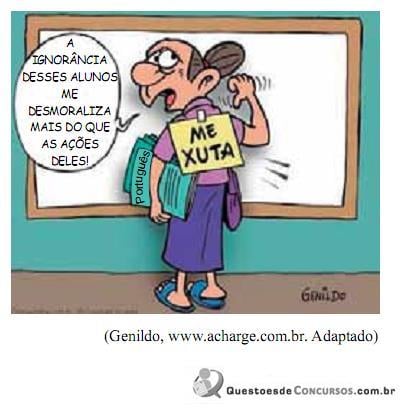
Analisando a fala da professora, conclui-se que o que mais a incomoda é
Analisando a fala da professora, conclui-se que o que mais a incomoda é
Q393279
Português
Texto associado
Leia os versos das Liras, de Tomás Antônio Gonzaga, para responder à questão.
Os teus olhos espalham luz divina,
a quem a luz do sol em vão se atreve;
papoila ou rosa delicada e fina
te cobre as faces, que são cor da neve.
Os teus cabelos são uns fios d’ouro;
teu lindo corpo bálsamo vapora.
Ah! não, não fez o céu, gentil pastora,
para a glória de amor igual tesouro!
Graças, Marília bela,
graças à minha estrela!
(Tomás Antônio Gonzaga, Obras Completas)
Os teus olhos espalham luz divina,
a quem a luz do sol em vão se atreve;
papoila ou rosa delicada e fina
te cobre as faces, que são cor da neve.
Os teus cabelos são uns fios d’ouro;
teu lindo corpo bálsamo vapora.
Ah! não, não fez o céu, gentil pastora,
para a glória de amor igual tesouro!
Graças, Marília bela,
graças à minha estrela!
(Tomás Antônio Gonzaga, Obras Completas)
Em ordem sintática direta, os versos – Ah! não, não fez o céu, gentil pastora, / para a glória de amor igual tesouro! – assumem a seguinte redação:
Q393278
Português
Texto associado
Leia os versos das Liras, de Tomás Antônio Gonzaga, para responder à questão.
Os teus olhos espalham luz divina,
a quem a luz do sol em vão se atreve;
papoila ou rosa delicada e fina
te cobre as faces, que são cor da neve.
Os teus cabelos são uns fios d’ouro;
teu lindo corpo bálsamo vapora.
Ah! não, não fez o céu, gentil pastora,
para a glória de amor igual tesouro!
Graças, Marília bela,
graças à minha estrela!
(Tomás Antônio Gonzaga, Obras Completas)
Os teus olhos espalham luz divina,
a quem a luz do sol em vão se atreve;
papoila ou rosa delicada e fina
te cobre as faces, que são cor da neve.
Os teus cabelos são uns fios d’ouro;
teu lindo corpo bálsamo vapora.
Ah! não, não fez o céu, gentil pastora,
para a glória de amor igual tesouro!
Graças, Marília bela,
graças à minha estrela!
(Tomás Antônio Gonzaga, Obras Completas)
Em outros versos das Liras, o poeta diz sobre Marília:
Vasta campina,
de trigo cheia,
quando na sesta
co vento ondeia,
ao seu cabelo,
quando flutua,
não é igual.
Tem a cor negra,
mas quanto val!
Comparando estes versos aos já transcritos, fica evidente que o eu lírico
Vasta campina,
de trigo cheia,
quando na sesta
co vento ondeia,
ao seu cabelo,
quando flutua,
não é igual.
Tem a cor negra,
mas quanto val!
Comparando estes versos aos já transcritos, fica evidente que o eu lírico
Q393277
Português
Texto associado
Leia os versos das Liras, de Tomás Antônio Gonzaga, para responder à questão.
Os teus olhos espalham luz divina,
a quem a luz do sol em vão se atreve;
papoila ou rosa delicada e fina
te cobre as faces, que são cor da neve.
Os teus cabelos são uns fios d’ouro;
teu lindo corpo bálsamo vapora.
Ah! não, não fez o céu, gentil pastora,
para a glória de amor igual tesouro!
Graças, Marília bela,
graças à minha estrela!
(Tomás Antônio Gonzaga, Obras Completas)
Os teus olhos espalham luz divina,
a quem a luz do sol em vão se atreve;
papoila ou rosa delicada e fina
te cobre as faces, que são cor da neve.
Os teus cabelos são uns fios d’ouro;
teu lindo corpo bálsamo vapora.
Ah! não, não fez o céu, gentil pastora,
para a glória de amor igual tesouro!
Graças, Marília bela,
graças à minha estrela!
(Tomás Antônio Gonzaga, Obras Completas)
Os versos mostram que a poética de Gonzaga explora

 Conheça nossos planos