Questões Militares
Foram encontradas 14.721 questões
Resolva questões gratuitamente!
Junte-se a mais de 4 milhões de concurseiros!


Brazil’s Rolezinhos – The Kids Are All Right
Mall owners and shopkeepers have reasons to be cautious. A few rolezinhos have led to
muggings and robberies. But most do not end in Itaquera-like chaos: the word’s true meaning is
closer to “little outing”. And theories that rolezeiros are class warriors or favela dwellers tired of
the country’s veiled racism are not correct. “Their battle cry is not ‘Less oppression!’” says Renato
Barreiros, who has directed a documentary about them. “It’s ‘More Adidas!’”
The point of a rolezinho is “to hang out, chill, buy nice things, meet people”, explains Vinicius Andrade, a 17-year-old from Capão Redondo, a favela in western São Paulo. He has taken part in 18 big rolezinhos and helped organise a few, drawing some of his 89,000 Facebook followers. His 15-year-old girlfriend, Yasmin Oliveira, a rolezeiro sweetheart with 94,000 fans of her own on the social network, says that shopping centres make good meeting places because they are safe – an important consideration in a crime-ridden city. There are few other public venues for kids, especially in poorer neighbourhoods.
As well as air conditioning, shopping centres also confer something no open-air space can: status. Rolezeiros enjoy walking around in a branded T-shirt and bermudas, with a pair of 400- reais ($170) shades perched on a baseball cap. Vinicius confesses to spending 800-1,000 reais a month on clothes and accessories, most of what he makes as a helper at a local Adventist church. Just 8% of Itaquera shoppers enjoy a monthly income in excess of 2,780 reais. Some rolezeiros support their flashy lifestyle by reselling outmoded attire to poorer neighbours.
Shopkeepers in the local malls have mixed feelings about the gatherings. On the one hand, the youngsters make ideal clients: they often pay cash and can spend 2,000-3,000 reais in one go. On the other, larger groups can scare away customers.
Adapted from http://www.economist.com
Brazil’s Rolezinhos – The Kids Are All Right
Mall owners and shopkeepers have reasons to be cautious. A few rolezinhos have led to
muggings and robberies. But most do not end in Itaquera-like chaos: the word’s true meaning is
closer to “little outing”. And theories that rolezeiros are class warriors or favela dwellers tired of
the country’s veiled racism are not correct. “Their battle cry is not ‘Less oppression!’” says Renato
Barreiros, who has directed a documentary about them. “It’s ‘More Adidas!’”
The point of a rolezinho is “to hang out, chill, buy nice things, meet people”, explains Vinicius Andrade, a 17-year-old from Capão Redondo, a favela in western São Paulo. He has taken part in 18 big rolezinhos and helped organise a few, drawing some of his 89,000 Facebook followers. His 15-year-old girlfriend, Yasmin Oliveira, a rolezeiro sweetheart with 94,000 fans of her own on the social network, says that shopping centres make good meeting places because they are safe – an important consideration in a crime-ridden city. There are few other public venues for kids, especially in poorer neighbourhoods.
As well as air conditioning, shopping centres also confer something no open-air space can: status. Rolezeiros enjoy walking around in a branded T-shirt and bermudas, with a pair of 400- reais ($170) shades perched on a baseball cap. Vinicius confesses to spending 800-1,000 reais a month on clothes and accessories, most of what he makes as a helper at a local Adventist church. Just 8% of Itaquera shoppers enjoy a monthly income in excess of 2,780 reais. Some rolezeiros support their flashy lifestyle by reselling outmoded attire to poorer neighbours.
Shopkeepers in the local malls have mixed feelings about the gatherings. On the one hand, the youngsters make ideal clients: they often pay cash and can spend 2,000-3,000 reais in one go. On the other, larger groups can scare away customers.
Adapted from http://www.economist.com
Brazil’s Rolezinhos – The Kids Are All Right
Mall owners and shopkeepers have reasons to be cautious. A few rolezinhos have led to
muggings and robberies. But most do not end in Itaquera-like chaos: the word’s true meaning is
closer to “little outing”. And theories that rolezeiros are class warriors or favela dwellers tired of
the country’s veiled racism are not correct. “Their battle cry is not ‘Less oppression!’” says Renato
Barreiros, who has directed a documentary about them. “It’s ‘More Adidas!’”
The point of a rolezinho is “to hang out, chill, buy nice things, meet people”, explains Vinicius Andrade, a 17-year-old from Capão Redondo, a favela in western São Paulo. He has taken part in 18 big rolezinhos and helped organise a few, drawing some of his 89,000 Facebook followers. His 15-year-old girlfriend, Yasmin Oliveira, a rolezeiro sweetheart with 94,000 fans of her own on the social network, says that shopping centres make good meeting places because they are safe – an important consideration in a crime-ridden city. There are few other public venues for kids, especially in poorer neighbourhoods.
As well as air conditioning, shopping centres also confer something no open-air space can: status. Rolezeiros enjoy walking around in a branded T-shirt and bermudas, with a pair of 400- reais ($170) shades perched on a baseball cap. Vinicius confesses to spending 800-1,000 reais a month on clothes and accessories, most of what he makes as a helper at a local Adventist church. Just 8% of Itaquera shoppers enjoy a monthly income in excess of 2,780 reais. Some rolezeiros support their flashy lifestyle by reselling outmoded attire to poorer neighbours.
Shopkeepers in the local malls have mixed feelings about the gatherings. On the one hand, the youngsters make ideal clients: they often pay cash and can spend 2,000-3,000 reais in one go. On the other, larger groups can scare away customers.
Adapted from http://www.economist.com
According to the text, read the statements and choose the correct alternative.
I) Hiroo Onoda was in the jungle for 29 years.
II) Hiroo Onoda was abandoned in the jungle by his country after the war ended.
III) Hiroo Onoda tried to go back home many times.
IV) Hiroo Onoda had another soldier with him until 1972.
V) Hiroo Onoda was admired by people in Lubang.
Which word is a synonym for evaluations in the text?
Observe os quadrinhos e responda à questão.
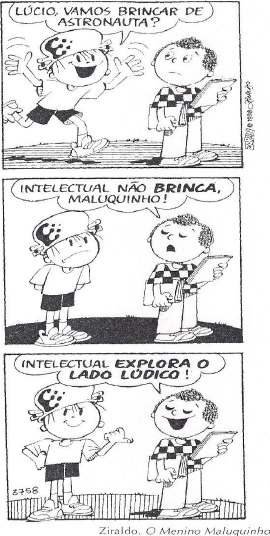
Qual a forma verbal obtida na frase “Intelectual explora o lado lúdico!” na voz passiva?
Observe os quadrinhos e responda à questão.

Em “Lúcio, vamos brincar de astronauta?”, o termo destacado exerce a função de
Anderson Cunha
A derradeira...
A derradeira
Lágrima de dor
Teimou e caiu
Ai saudade, eu não sei esquecer
Lágrima de dor
Teimou e caiu
Ai saudade, eu não sei esquecer
Aquela estrela...
Aquela estrela
Marvada chegou
Tinhosa e vil
De mim levou meu bem querer
Aquela estrela ô
Tinhosa e vil
De mim levou meu bem querer
Minha pele é solidão
O meu colo, bem querer
Lágrima de dor
Teimou e caiu
Ai saudade, eu não sei esquecer
Aquela estrela ô
Tinhosa e vil
De mim levou meu bem querer “
(...) Era a Mulher, que falava. Ah, e a Mulher rogava: – Que
trouxessem o corpo daquele rapaz moço, vistoso, o dos olhos muito verdes...
Eu desguisei. Eu deixei minhas lágrimas virem, e ordenando: – 'Traz Diadorim!' (...)
Diadorim, Diadorim, oh, ah, meus buritizais levados de verdes... (...)
Sufoquei, numa estrangulação de dó. Constante o que a
Mulher disse: carecia de se lavar e vestir o corpo.
Piedade, como que ela mesma, embebendo toalha,
limpou as faces de Diadorim, casca de tão grosso sangue, repisado. (...)
Eu dizendo que a Mulher ia lavar o corpo dele. Ela rezava rezas da Bahia.
Mandou todo o mundo sair. Eu fiquei. (...) Não me mostrou de propósito o corpo.
E disse...
Diadorim – nu de tudo. E ela disse:
– 'A Deus dada. Pobrezinha...' (...)
Como em todo o tempo antes eu não contei ao senhor – e mercê peço: – mas para o senhor divulgar comigo, a par, justo o travo de tanto segredo, sabendo somente no átimo em que eu também só soube... Que Diadorim era o corpo de uma mulher, moça perfeita... (...)
Eu estendi as mãos para tocar naquele corpo, e estremeci,
retirando as mãos para trás (...) E a Mulher estendeu a toalha,recobrindo as partes. Mas aqueles olhos eu beijei, e as faces, a boca. (...) E eu não sabia por que nome chamar; eu exclamei me doendo:
– 'Meu amor!...' "
Texto extraído do livro Grande Sertão: Veredas, de João Guimarães Rosa
I. Na trama de citações da canção Meus Buritizais levados de verdes, há uma referência à personagem Diadorim (“Diadorim, oh, ah, meus buritizais levados de verdes"), mas também uma citação textual direta à clássica canção do sertão, Asa Branca (“Quando o verde dos teus olhos/ Se espalhar na plantação").
II. Embora a saudade seja tema de ambos os textos, Meus buritizais levados de verdes e Grande Sertão: Veredas, é possível verificar um sentimento de plenitude e realização do desejo pelos amantes nos versos: “Minha pele é solidão/ O meu colo, bem querer" e no trecho citado: “Mas aqueles olhos eu beijei, e as faces, a boca. (...) E eu não sabia por que nome chamar; eu exclamei me doendo: – 'Meu amor!...' "
III. Meus buritizais levados de verdes tematiza uma das principais problemáticas do romance Grande Sertão: Veredas: a presença do maligno, a mistura entre bem e mal, o que é sintetizado na metáfora da “estrela tinhosa e vil".
IV. A cena clássica da morte de Diadorim, para a qual toda a narrativa de Riobaldo converge, é recuperada pela canção, decorrendo disso o seu teor dramático e trágico, corroborando a impossibilidade de realização do amor sintetizada no romance “até que ponto esses olhos, sempre havendo, aquela beleza verde, me adoecido, tão impossível." (p. 36).
Aqui é Minas; lá já é a Bahia? Estive nessas vilas, velhas, altas cidades... Sertão é o sozinho. Compadre meu Quelemém diz: que eu sou muito do sertão? Sertão: é dentro da gente."
(ROSA, João Guimarães. Grande Sertão: Veredas. 29 ª ed. Rio de Janeiro: Editora Nova Fronteira, 1986, p. 270.)
Texto 2
Poema Didáctico
(Socorro Lira/ Mia Couto)
Já tive um país pequeno, tão pequeno
que andava descalço dentro de mim
Um país tão magro que, no seu firmamento,
não cabia senão uma estrela menina
tão tímida e delicada, que só por dentro brilhava
Eu tive um país escrito sem maiúscula
Não tinha fundos para pagar um herói
Não tinha panos para costurar bandeira
nem solenidade para entoar um hino
Mas tinha pão e esperança pros viventes
e tinha sonhos pros nascentes
Eu tive um país pequeno
que não cabia no mundo
meu país – meu continente
há de caber nesse mundo
meu país e sua gente...
Mas tinha pão e esperança pros viventes
e tinha sonhos pros nascentes
Eu tive um país pequeno
que não cabia no mundo
meu país – meu continente
há de caber nesse mundo
meu país e sua gente
terá que caber no mundo,
meu país e minha gente.
(LIRA, Socorro. Os Sertões do Mundo. EP independente, ano 2014. Disponível em:<http://www.socorrolira.com.br/> Acesso em 25/05/2014.)
Texto 3
“João Guimarães Rosa criou este lugar fantástico, e fez dele uma espécie de lugar de todos os lugares. O sertão e as veredas de que ele fala não são da ordem da geografia. O sertão é um mundo construído na linguagem. “O sertão", diz ele, “está dentro de nós." Rosa não escreve sobre o sertão. Ele escreve como se ele fosse o sertão.
Em Moçambique nós vivíamos e vivemos ainda o momento épico de criar um espaço que seja nosso, não por tomada de posse, mas porque nele podemos encenar a ficção de nós mesmos, enquanto criaturas portadoras de História e fazedoras de futuro. Era isso a independência nacional, era isso a utopia de um mundo sonhado."
(COUTO, Mia. E se Obama fosse africano? Ensaios. São Paulo: Companhia das Letras, 2011, p. 110.)
I. A narrativa de Grande Sertão: Veredas é centrada na necessidade do narrador Riobaldo em contar e confessar o encontro e perda da personagem principal Otacília.
II. É possível afirmar que o romance Grande Sertão: Veredas reescreve o tema do sertão presente na literatura denominada regionalista, cujo marco é Os Sertões, de Euclides da Cunha, até os chamados autores regionalistas dos anos 30.
III. Polifonia, plurilinguísmo, prolixidade e abertura são características da linguagem do romance Grande Sertão: Veredas.
IV. O narrador do romance Grande Sertão: Veredas é transparente, unívoco e destituído de conflitos, diferentemente da personagem Diadorim, que assume faces diversas: Diadorim/Reinaldo/Maria Deodorina; belo e feroz; delicado e terrível.
Aqui é Minas; lá já é a Bahia? Estive nessas vilas, velhas, altas cidades... Sertão é o sozinho. Compadre meu Quelemém diz: que eu sou muito do sertão? Sertão: é dentro da gente."
(ROSA, João Guimarães. Grande Sertão: Veredas. 29 ª ed. Rio de Janeiro: Editora Nova Fronteira, 1986, p. 270.)
Texto 2
Poema Didáctico
(Socorro Lira/ Mia Couto)
Já tive um país pequeno, tão pequeno
que andava descalço dentro de mim
Um país tão magro que, no seu firmamento,
não cabia senão uma estrela menina
tão tímida e delicada, que só por dentro brilhava
Eu tive um país escrito sem maiúscula
Não tinha fundos para pagar um herói
Não tinha panos para costurar bandeira
nem solenidade para entoar um hino
Mas tinha pão e esperança pros viventes
e tinha sonhos pros nascentes
Eu tive um país pequeno
que não cabia no mundo
meu país – meu continente
há de caber nesse mundo
meu país e sua gente...
Mas tinha pão e esperança pros viventes
e tinha sonhos pros nascentes
Eu tive um país pequeno
que não cabia no mundo
meu país – meu continente
há de caber nesse mundo
meu país e sua gente
terá que caber no mundo,
meu país e minha gente.
(LIRA, Socorro. Os Sertões do Mundo. EP independente, ano 2014. Disponível em:<http://www.socorrolira.com.br/> Acesso em 25/05/2014.)
Texto 3
“João Guimarães Rosa criou este lugar fantástico, e fez dele uma espécie de lugar de todos os lugares. O sertão e as veredas de que ele fala não são da ordem da geografia. O sertão é um mundo construído na linguagem. “O sertão", diz ele, “está dentro de nós." Rosa não escreve sobre o sertão. Ele escreve como se ele fosse o sertão.
Em Moçambique nós vivíamos e vivemos ainda o momento épico de criar um espaço que seja nosso, não por tomada de posse, mas porque nele podemos encenar a ficção de nós mesmos, enquanto criaturas portadoras de História e fazedoras de futuro. Era isso a independência nacional, era isso a utopia de um mundo sonhado."
(COUTO, Mia. E se Obama fosse africano? Ensaios. São Paulo: Companhia das Letras, 2011, p. 110.)
( ) As metáforas do “sertão" e do “país", nos textos 1 e 2 citados, são análogas e representativas do “lugar fantástico" a que se refere o escritor Mia Couto, no texto 3.
( ) As referências a “sertão" e “país", nos textos 2 e 3, “não são da ordem da geografia" e representam o mundo subjetivo dos personagens/ eu-lírico representados.
( ) “Já tive um país pequeno, tão pequeno/ que andava descalço dentro de mim" diz respeito, circunstancialmente, a Moçambique, país natal do escritor Mia Couto; pode-se inferir, remete ainda a outros sertões, como o sertão mineiro de, Guimarães Rosa.
João Cabral de Melo Neto
Um galo sozinho não tece uma manhã:
ele precisará sempre de outros galos.
De um que apanhe esse grito que ele
e o lance a outro;de um outro galo
que apanhe o grito que um galo antes
e o lance a outro; e de outros galos
que com muitos outros galos se cruzem
os fios de sol de seus gritos de galo,
para que a manhã, desde uma teia tênue,
se vá tecendo, entre todos os galos.
E se encorpando em tela, entre todos,
se erguendo tenda, onde entrem todos,
se entretendendo para todos, no toldo
(a manhã) que plana livre de armação.
A manhã, toldo de um tecido tão aéreo
que, tecido, se eleva por si: luz balão.
(MELO NETO, João Cabral. Obra completa – Volume Único. Rio de Janeiro: Nova Aguilar, 1994, p. 345)
Sobre o poema Tecendo a Manhã, de João Cabral de Melo Neto, e o modernismo brasileiro, analise as afirmativas abaixo e, em seguida, assinale a alternativa que apresenta a sequência correta.
I. O poema, pertencente ao livro A Educação pela Pedra, de João Cabral de Melo Neto, revela a face mais lírica e menos objetiva do poeta modernista, na evocação da concepção mágica e propiciatória dos cantos dos galos.
II. É possível assegurar que o poeta João Cabral de Melo Neto realiza plenamente, em “Tecendo a Manhã", o seu projeto de impessoalidade da poesia modernista na supressão do tom lírico tradicional.
III. As metáforas da “manhã" e da “luz balão" representam o próprio poema (sinônimos ainda de “tela", “tecido", “tenda", “toldo"), do que se conclui ser o poema metalinguístico.
IV. Há no poema referência direta ao ditado popular “uma andorinha só não faz verão", cujo tema é a solidariedade.
Castro Alves
NÃO SABES, criança? 'Stou louco de amores...
Prendi meus afetos, formosa Pepita.
Mas onde? No templo, no espaço, nas névoas?!
Não rias, prendi-me
Num laço de fita.
Na selva sombria de tuas madeixas, (1)
Nos negros cabelos da moça bonita,
Fingindo a serpente qu'enlaça a folhagem,
Formoso enroscava-se
O laço de fita.
Meu ser, que voava nas luzes da festa,
Qual pássaro bravo, que os ares agita, (2)
Eu vi de repente cativo, submisso
Rolar prisioneiro
Num laço de fita.
E agora enleada na tênue cadeia
Debalde minh'alma se embate, se irrita... (3)
O braço, que rompe cadeias de ferro,
Não quebra teus elos,
Ó laço de fita!
Meu Deus! As falenas têm asas de opala,
Os astros se libram na plaga infinita.
Os anjos repousam nas penas brilhantes...
Mas tu... tens por asas
Um laço de fita. (4)
Há pouco voavas na célere valsa,
Na valsa que anseia, que estua e palpita.
Por que é que tremeste? Não eram meus lábios...
Beijava-te apenas...
Teu laço de fita.
Mas ai! findo o baile, despindo os adornos
N'alcova onde a vela ciosa... crepita,
Talvez da cadeia libertes as tranças
Mas eu... fico preso
No laço de fita.
Pois bem! Quando um dia na sombra do vale
Abrirem-me a cova... formosa Pepita!
Ao menos arranca meus louros da fronte,
E dá-me por c'roa...
Teu laço de fita.
(ALVES, Castro. Obra completa. Rio de Janeiro: Editora Nova Aguilar, 1997, p. 84-85.
Castro Alves
NÃO SABES, criança? 'Stou louco de amores...
Prendi meus afetos, formosa Pepita.
Mas onde? No templo, no espaço, nas névoas?!
Não rias, prendi-me
Num laço de fita.
Na selva sombria de tuas madeixas, (1)
Nos negros cabelos da moça bonita,
Fingindo a serpente qu'enlaça a folhagem,
Formoso enroscava-se
O laço de fita.
Meu ser, que voava nas luzes da festa,
Qual pássaro bravo, que os ares agita, (2)
Eu vi de repente cativo, submisso
Rolar prisioneiro
Num laço de fita.
E agora enleada na tênue cadeia
Debalde minh'alma se embate, se irrita... (3)
O braço, que rompe cadeias de ferro,
Não quebra teus elos,
Ó laço de fita!
Meu Deus! As falenas têm asas de opala,
Os astros se libram na plaga infinita.
Os anjos repousam nas penas brilhantes...
Mas tu... tens por asas
Um laço de fita. (4)
Há pouco voavas na célere valsa,
Na valsa que anseia, que estua e palpita.
Por que é que tremeste? Não eram meus lábios...
Beijava-te apenas...
Teu laço de fita.
Mas ai! findo o baile, despindo os adornos
N'alcova onde a vela ciosa... crepita,
Talvez da cadeia libertes as tranças
Mas eu... fico preso
No laço de fita.
Pois bem! Quando um dia na sombra do vale
Abrirem-me a cova... formosa Pepita!
Ao menos arranca meus louros da fronte,
E dá-me por c'roa...
Teu laço de fita.
(ALVES, Castro. Obra completa. Rio de Janeiro: Editora Nova Aguilar, 1997, p. 84-85.
( ) O poema pertence à poesia social de Castro Alves, gênero no qual canta em favor da liberdade, em versos como: “O braço, que rompe cadeias de ferro,/ Não quebra teus elos,/Ó laço de fita!"
( ) A morte, ao final do poema, representa o aprisionamento do eu-lírico, ao impossibilitar a realização do sentimento amoroso.
( ) Há a sugestão de possível relação íntima entre os amantes, nas ações de: “despir os adornos" e “libertar as tranças" e na imagem do “crepitar da vela".
O Amor é finalmente
um embaraço de pernas,
uma união de barrigas,
um breve tremor de artérias.
Uma confusão de bocas,
uma batalha de veias,
um reboliço de ancas,
quem diz outra coisa é besta.
(Fragmento do poema “Definição do Amor", de Gregório de Matos)
Fonte: MATOS, Gregório de. Poemas escolhidos. Sel., introdução e notas de José Miguel Wisnik. São Paulo: Editora Cultrix, 1981, p. 25.
Sobre o poeta citado em fragmento, verifique as proposições abaixo e, em seguida, assinale a alternativa que apresenta a sequência correta
I. O poema pertence à poesia erótica ou érotico-irônica de Gregório de Matos.
II. Há, no poema, desprezo pela concepção amorosa cristã e idealizada do amor, ao optar por uma definição do amor ligada ao corpo e à sua experiência direta.
III. O poema possui um teor lírico e amoroso, quase religioso, na exaltação que faz à mulher.
IV. Pertence à poesia religiosa de Gregório de Matos, sendo um dos poemas mais significativos por sua definição do Amor, com letra maiúscula.
Thiago Amud
De ponta a ponta tudo é praia-palma
Quebranto na vertente das montanhas
As aves evasivas embalsamadas
País de saúva e mar, vivi pra te desvelar
Mercúrio, chumbo e césio nas aguadas
Quilombos entocados na caliça
As alegrias azinhavrando as almas
País de febre e luar, morri pra te decantar
Quando olhei a terra inteira ardendo em vasto fogaréu
Eu vi que o Morro da Mangueira parecia um inferno no céu
Grassou Saturno, tudo está em transe
O Presidente Zambo, a musa louca
Mas súbito as nascentes destilam sangue
País que agoniza luz, teu nome é a minha cruz
Não permita Deus que valhas menos que teu coração
Teus flancos de maracangalhas, tua língua de Grande Sertão
(AMUD, Thiago. De ponta a ponta tudo é praia-palma. Edição: L.PE – Universal Pub. Produção: JR Tostoi. Rio de Janeiro: Delira Música, 2013.)
Considerando o texto “De ponta a ponta tudo é praia-palma", canção do compositor brasileiro Thiago Amud, é correto afirmar que:
caráter – Júpiter – júnior
 Conheça nossos planos