Selecionar segmento
Estude com questões de diferentes segmentos
Atenção: Isso limpará todos os campos já preenchidos no filtro!
Foram encontradas 14.721 questões
Resolva questões gratuitamente!
Junte-se a mais de 4 milhões de concurseiros!


Q1901463
Inglês
Texto associado
Leia o texto destacado para responder à questão.
In a new survey of North American Indian languages, Marianne Mithun gives an admirably clear
statement of what is lost as each language ceases to be used. “Speakers of these languages and
their descendants are acutely aware of what it can mean to lose a language,” she begins – and this
is perfectly true, although these speakers must have taken the decision themselves not to teach
the language to their children. It happens all too often – people regret that their language and
culture are being lost but at the same time decide not to saddle their own children with the chore
of preserving them.
When a language disappears [Mithun continues] the most intimate aspects of culture can
disappear as well: fundamental ways of organizing experience into concepts, of relating ideas to
each other, of interacting to people. The more conscious genres of verbal art are usually lost as
well: traditional ritual, oratory, myth, legends, and even humor. Speakers commonly remark that
when they speak a different language, they say different things and even think different thoughts.
These are very interesting assertions. They slip by in a book on anthropological linguistics, where
in a book on linguistic theory they would be highly contentious. Is it true that “fundamental ways
of organizing experience into concepts [and] of relating ideas to each other” are specific to
individual languages and are therefore likely to be lost when a language ceases to be used? Is it
true that when speakers speak a different language, they “say different things and even think
different thoughts”? Again, the extent to which thought depends on language is very
controversial. These questions must be now faced, because only when we have reached an opinion on them will we be able to accept or reject Marianne Mithun’s conclusion: “The loss of a language
represents a definitive separation of a people from its heritage. It also represents an irreparable
loss for us all, the loss of opportunities to glimpse alternative ways of making sense of the human
experience.”
Fonte: Dalby, Andrew. Language in danger. New York: Columbia University Press, 2003, p. 252; 285.
Adaptado.
O termo “must”, destacado em itálico no excerto do segundo parágrafo, “These questions must
be now faced”, pode ser substituído, sem alteração de significado, por
Q1901462
Inglês
Texto associado
Leia o texto destacado para responder à questão.
In a new survey of North American Indian languages, Marianne Mithun gives an admirably clear
statement of what is lost as each language ceases to be used. “Speakers of these languages and
their descendants are acutely aware of what it can mean to lose a language,” she begins – and this
is perfectly true, although these speakers must have taken the decision themselves not to teach
the language to their children. It happens all too often – people regret that their language and
culture are being lost but at the same time decide not to saddle their own children with the chore
of preserving them.
When a language disappears [Mithun continues] the most intimate aspects of culture can
disappear as well: fundamental ways of organizing experience into concepts, of relating ideas to
each other, of interacting to people. The more conscious genres of verbal art are usually lost as
well: traditional ritual, oratory, myth, legends, and even humor. Speakers commonly remark that
when they speak a different language, they say different things and even think different thoughts.
These are very interesting assertions. They slip by in a book on anthropological linguistics, where
in a book on linguistic theory they would be highly contentious. Is it true that “fundamental ways
of organizing experience into concepts [and] of relating ideas to each other” are specific to
individual languages and are therefore likely to be lost when a language ceases to be used? Is it
true that when speakers speak a different language, they “say different things and even think
different thoughts”? Again, the extent to which thought depends on language is very
controversial. These questions must be now faced, because only when we have reached an opinion on them will we be able to accept or reject Marianne Mithun’s conclusion: “The loss of a language
represents a definitive separation of a people from its heritage. It also represents an irreparable
loss for us all, the loss of opportunities to glimpse alternative ways of making sense of the human
experience.”
Fonte: Dalby, Andrew. Language in danger. New York: Columbia University Press, 2003, p. 252; 285.
Adaptado.
De acordo com a linguista Marianne Mithun
Q1901461
Inglês
Texto associado
Leia o texto destacado para responder à questão.
Jaap Wagelaar was my all-time favorite secondary school teacher. He gave me a 10/10 for my
oral Dutch literature exam, taught psychoanalysis during grammar class, astounded pupils with
odd puppet show performances during lunch breaks and sadly ended his career with a burn-out.
Few students and fellow teachers understood him. But since I trusted his judgment like nobody
else’s, I once asked him why Piet Paaltjens and Gerard Reve, both canonized Dutch literary
figures, albeit of very divergent genres, could occasionally be kind or ironic but were more often
rather cynical, cold and heartless. The response he gave has stuck with me ever since: cynical
people are in fact the most emotional ones. Because of their sentimentality they are unable to
handle injustice and feel forced to build up a self-protective screen against painful emotions called
cynicism. Irony is mild, harmless and green. Sarcasm is biting and represents an orange traffic
light. And the color of cynicism is deep red, with the shape of a grim scar that hides a hurt soul.
They are all equally beautiful.
These words again came to my mind when thinking back on the dozens of ironic, sarcastic and
cynical memes about underperforming politicians and policy scandals disseminated over the past year. Who has not seen the image of Donald Trump walking through a desolate, scorched forest
mumbling to himself: ‘My work here is almost done’? Who has not read the scathing reports of
Flemish Ministers Bart Somers and Hilde Crevits escaping from a window aided by an
unidentified third person after a meeting of the Council of Ministers to avoid critical journalists
with the defense that they urgently needed to go on holiday and windows are faster than doors?
Who has not come across the video announcement for a fictitious thriller called Angstra
Zeneca with Dutch Health Minister Hugo de Jonge exclaiming ‘ik heb er zo’n kankerbende van
gemaakt’ (I have made it all a cancerous mess) with a grimace stretching from ear to ear? And
who has missed the most recent true story tragicomedy played by Charles Michel, male President
of the European Council, and Ursula von der Leyen, female President of the European
Commission, who had jointly been invited by Turkish President Recep Tayyip Erdogan to discuss
the position of women in Turkey? Unfortunately, they were only offered one chair for two people,
which was symbolically occupied by Michel who left Von der Leyen standing awkwardly for a
while. She ended up settling for a place on the comfortable sofa reserved for second rank guests.
It was damned easy to get addicted to these countless videos, photos, images and written
parodies. Oh, did we have fun with them! Some were ironic, some sarcastic and others cynical,
but they jointly sketch a disconcerting image of the quality and reputation of key politicians in
liberal Western democracies.
Fonte: https://www.eur.nl/en/news/. Publicado em 16/04/2021. Acesso em 29/08/21. Adaptado.
Em um encontro para discutir a posição da mulher, o anfitrião
Q1901460
Inglês
Texto associado
Leia o texto destacado para responder à questão.
Jaap Wagelaar was my all-time favorite secondary school teacher. He gave me a 10/10 for my
oral Dutch literature exam, taught psychoanalysis during grammar class, astounded pupils with
odd puppet show performances during lunch breaks and sadly ended his career with a burn-out.
Few students and fellow teachers understood him. But since I trusted his judgment like nobody
else’s, I once asked him why Piet Paaltjens and Gerard Reve, both canonized Dutch literary
figures, albeit of very divergent genres, could occasionally be kind or ironic but were more often
rather cynical, cold and heartless. The response he gave has stuck with me ever since: cynical
people are in fact the most emotional ones. Because of their sentimentality they are unable to
handle injustice and feel forced to build up a self-protective screen against painful emotions called
cynicism. Irony is mild, harmless and green. Sarcasm is biting and represents an orange traffic
light. And the color of cynicism is deep red, with the shape of a grim scar that hides a hurt soul.
They are all equally beautiful.
These words again came to my mind when thinking back on the dozens of ironic, sarcastic and
cynical memes about underperforming politicians and policy scandals disseminated over the past year. Who has not seen the image of Donald Trump walking through a desolate, scorched forest
mumbling to himself: ‘My work here is almost done’? Who has not read the scathing reports of
Flemish Ministers Bart Somers and Hilde Crevits escaping from a window aided by an
unidentified third person after a meeting of the Council of Ministers to avoid critical journalists
with the defense that they urgently needed to go on holiday and windows are faster than doors?
Who has not come across the video announcement for a fictitious thriller called Angstra
Zeneca with Dutch Health Minister Hugo de Jonge exclaiming ‘ik heb er zo’n kankerbende van
gemaakt’ (I have made it all a cancerous mess) with a grimace stretching from ear to ear? And
who has missed the most recent true story tragicomedy played by Charles Michel, male President
of the European Council, and Ursula von der Leyen, female President of the European
Commission, who had jointly been invited by Turkish President Recep Tayyip Erdogan to discuss
the position of women in Turkey? Unfortunately, they were only offered one chair for two people,
which was symbolically occupied by Michel who left Von der Leyen standing awkwardly for a
while. She ended up settling for a place on the comfortable sofa reserved for second rank guests.
It was damned easy to get addicted to these countless videos, photos, images and written
parodies. Oh, did we have fun with them! Some were ironic, some sarcastic and others cynical,
but they jointly sketch a disconcerting image of the quality and reputation of key politicians in
liberal Western democracies.
Fonte: https://www.eur.nl/en/news/. Publicado em 16/04/2021. Acesso em 29/08/21. Adaptado.
O termo “albeit”, destacado em itálico no excerto do primeiro parágrafo, “both canonized
Dutch literary figures albeit of very divergent genres”, tem sentido equivalente a
Q1901459
Inglês
Texto associado
Leia o texto destacado para responder à questão.
Stupidity permeates our perception and practice of politics. We frequently accuse politicians,
bureaucrats, journalists, voters, “elites,” and “the masses” for their stupidities. In fact, it is not
only “populist politicians,” “sensational journalism,” and “uneducated voters” who are accused of
stupidity. Similar accusations can be, and in fact have been, made concerning those who criticize
them as well. It seems that stupidity is ubiquitous, unable to be contained within or attributed to
one specific political position, personal trait, or even ignorance and erroneous reasoning.
Undertaking a theoretical investigation of stupidity, Nabutaka Otobe challenges the assumption
that stupidity can be avoided. The author argues that the very ubiquity of stupidity implies its
unavoidability — that we cannot contain it in such domains as error, ignorance, or “post-truth.”
What we witness is rather that one’s reasoning can be sound, evidence-based, and stupid. In
revealing this unavoidability, he contends that stupidity is an ineluctable problem not only of
politics, but also of thinking. We become stupid because we think: it is impossible to distinguish a
priori stupid thought from upright, righteous thought. Moreover, the failure to address the
unavoidability of stupidity leads political theory to the failure to acknowledge the productive
moments that experiences of stupidity harbor within. Such productive moments constitute the
potential of stupidity — that radical new ideas can emerge out of our seemingly banal and stupid
thinking in our daily political activity.
Fonte: https://www.routledge.com/. Publicado em 12/10/2020. Acesso em 20/08/2021.
O termo “moreover”, destacado em itálico no excerto do segundo parágrafo, “Moreover, the
failure to address the unavoidability of stupidity leads political theory to the failure”, pode ser substituído,
sem prejuízo de significado, por
Q1901457
Português
Leia atentamente o trecho destacado do conto “Seminário dos ratos”, no qual o Chefe das
Relações Públicas dirige-se ao Secretário do Bem-Estar Público e Privado. Em seguida, assinale a alternativa
CORRETA.
— Bueno, ontem à noite ele sofreu um pequeno acidente, Vossa Excelência sabe como anda o nosso trânsito! Teve que engessar um braço. Só pode chegar amanhã, já providenciei o jatinho — acrescentou o jovem com energia. — Na retaguarda fica toda uma equipe armada para a cobertura. Nosso Assessor vai pingando o noticiário por telefone, criando suspense até o encerramento, quando virão todos num jato especial, fotógrafos, canais de televisão, correspondentes estrangeiros, uma apoteose. Finis coronat opus, o fim coroa a obra!
— Bueno, ontem à noite ele sofreu um pequeno acidente, Vossa Excelência sabe como anda o nosso trânsito! Teve que engessar um braço. Só pode chegar amanhã, já providenciei o jatinho — acrescentou o jovem com energia. — Na retaguarda fica toda uma equipe armada para a cobertura. Nosso Assessor vai pingando o noticiário por telefone, criando suspense até o encerramento, quando virão todos num jato especial, fotógrafos, canais de televisão, correspondentes estrangeiros, uma apoteose. Finis coronat opus, o fim coroa a obra!
Q1901456
Português
Assinale a alternativa CORRETA acerca do conto “Herbarium”.
Q1901455
Português
Leia atentamente, à esquerda, o trecho destacado do conto “Noturno amarelo” e, em seguida,
assinale a alternativa CORRETA, à direita.
Tudo então aconteceu muito rápido. Ou foi lento? Vi o Avô dirigir-se para a porta que ficava no fundo da sala, pegar a chave que estava no chão, abrir a porta, deixar a chave no mesmo lugar e sair fechando a porta atrás de si. Foi a vez da Avó, que passou por mim com sua bengala e seu lorgnon, me fez um aceno e deixando a chave no mesmo lugar, seguiu o Avô. Vi Eduarda de longe, ajudando o noivo a vestir a capa, Mas onde foram todos? perguntei e ela não ouviu ou não entendeu.
Tudo então aconteceu muito rápido. Ou foi lento? Vi o Avô dirigir-se para a porta que ficava no fundo da sala, pegar a chave que estava no chão, abrir a porta, deixar a chave no mesmo lugar e sair fechando a porta atrás de si. Foi a vez da Avó, que passou por mim com sua bengala e seu lorgnon, me fez um aceno e deixando a chave no mesmo lugar, seguiu o Avô. Vi Eduarda de longe, ajudando o noivo a vestir a capa, Mas onde foram todos? perguntei e ela não ouviu ou não entendeu.
Q1901454
Português
Relações amorosas desgastadas são uma constante nos contos de Lygia Fagundes Telles.
Assinale a alternativa que não ilustra essa afirmação.
Q1901453
Português
Leia atentamente o trecho, à esquerda, do conto “A mão no ombro” e, em seguida, assinale, à
direita, a alternativa CORRETA.
Deixou cair a folha seca, enfurnou as mãos nos bolsos e seguiu pisando com a mesma prudência da estátua. Contornou o tufo de begônias, vacilou entre os dois ciprestes (mas o que significava essa estátua?) e enveredou por uma alameda que lhe pareceu menos sombria. Um jardim inocente.
Deixou cair a folha seca, enfurnou as mãos nos bolsos e seguiu pisando com a mesma prudência da estátua. Contornou o tufo de begônias, vacilou entre os dois ciprestes (mas o que significava essa estátua?) e enveredou por uma alameda que lhe pareceu menos sombria. Um jardim inocente.
Q1901452
Português
Leia atentamente, à esquerda, os versos destacados de “Amar”, da seção “AMAR-AMARO”. Em
seguida, assinale, à direita, a alternativa CORRETA.
Este o nosso destino: amor sem conta, distribuído pelas coisas pérfidas ou nulas, doação ilimitada a uma completa ingratidão, e na concha vazia do amor a procura medrosa, paciente, de mais e mais amor.
Este o nosso destino: amor sem conta, distribuído pelas coisas pérfidas ou nulas, doação ilimitada a uma completa ingratidão, e na concha vazia do amor a procura medrosa, paciente, de mais e mais amor.
Q1901450
Português
Para apresentar a sua Antologia poética, Carlos Drummond de Andrade escreveu: “Algumas
poesias caberiam talvez em outra seção que não a escolhida, ou em mais de uma. A razão da escolha está
na tônica da composição, ou no engano do autor.” (“Informação – NOTA DA PRIMEIRA EDIÇÃO”). Diante do
trecho citado, é possível afirmar que
Q1901448
Português
Leia atentamente, à esquerda, a primeira estrofe de “Morte do leiteiro”, da seção “NA PRAÇA DE
CONVITES”. Em seguida, assinale a alternativa CORRETA.
Há pouco leite no país, é preciso entregá-lo cedo. Há muita sede no país, é preciso entregá-lo cedo. Há no país uma legenda, que ladrão se mata com tiro.
Há pouco leite no país, é preciso entregá-lo cedo. Há muita sede no país, é preciso entregá-lo cedo. Há no país uma legenda, que ladrão se mata com tiro.
Q1901447
Português
Leia atentamente, à esquerda, o trecho destacado de Numa e a ninfa e assinale, à direita, a
alternativa que a caracteriza INCORRETAMENTE.
A Cidade Nova dança à francesa ou à americana e ao som do piano. Há por lá até o célebre tipo do pianista, tão amaldiçoado, mas tão aproveitado que bem se induz que é ocultamente querido por toda a cidade. É um tipo bem característico, bem função do lugar, o que vem a demonstrar que o ‘cateretê’ não é bem do que a Cidade Nova gosta.
A Cidade Nova dança à francesa ou à americana e ao som do piano. Há por lá até o célebre tipo do pianista, tão amaldiçoado, mas tão aproveitado que bem se induz que é ocultamente querido por toda a cidade. É um tipo bem característico, bem função do lugar, o que vem a demonstrar que o ‘cateretê’ não é bem do que a Cidade Nova gosta.
Q1901446
Português
Leia atentamente o trecho destacado de Numa e a ninfa e o compare às declarações de I a III.
Em seguida, assinale a alternativa CORRETA.
Era a política, era Campelo a garantir-lhe a impunidade e, mais alto, os protetores de Campelo dando a este mão forte e prestígio… Se o Estado é uma coação organizada, essa coação cessava por abdicação do próprio Estado… Era o ruir de tudo… Onde nos levaria tudo isso?… A sua colaboração não seria criminosa? Tinha direito perante a sua própria consciência de contribuir para semelhante ruína? Sentiu perfeitamente que esse afrouxamento da lei e da autoridade tinha por fim recrutar dedicações aos ambiciosos antipáticos à opinião. A coação legal do Estado fizera-se, para uma mascarada eleitoral, ameaça de valentão…
I. O narrador usa o discurso direto para se distanciar da personagem.
II. O discurso indireto é usado unicamente para explicitar ao leitor as certezas da personagem.
III. O uso do discurso indireto livre não é evidenciado pela falta de referência direta aos pensamentos da personagem.
Era a política, era Campelo a garantir-lhe a impunidade e, mais alto, os protetores de Campelo dando a este mão forte e prestígio… Se o Estado é uma coação organizada, essa coação cessava por abdicação do próprio Estado… Era o ruir de tudo… Onde nos levaria tudo isso?… A sua colaboração não seria criminosa? Tinha direito perante a sua própria consciência de contribuir para semelhante ruína? Sentiu perfeitamente que esse afrouxamento da lei e da autoridade tinha por fim recrutar dedicações aos ambiciosos antipáticos à opinião. A coação legal do Estado fizera-se, para uma mascarada eleitoral, ameaça de valentão…
I. O narrador usa o discurso direto para se distanciar da personagem.
II. O discurso indireto é usado unicamente para explicitar ao leitor as certezas da personagem.
III. O uso do discurso indireto livre não é evidenciado pela falta de referência direta aos pensamentos da personagem.
Q1901445
Português
Identifique a CORRETA caracterização do narrador de Numa e a ninfa.
Q1901444
Português
Acerca das personagens Numa e Lucrécio Barba de Bode, de Numa e a ninfa, é possível afirmar
CORRETAMENTE que
Q1901443
Português
Em Numa e a ninfa, o episódio (cap. 10) das contínuas interrupções do deputado Júlio Barroso no
parlamento ilustra
Ano: 2021
Banca:
FUNDEP (Gestão de Concursos)
Órgão:
CBM-MG
Prova:
FUNDEP (Gestão de Concursos) - 2021 - CBM-MG - Aspirante do Corpo de Bombeiros |
Q1893114
Inglês
Read the cartoon.
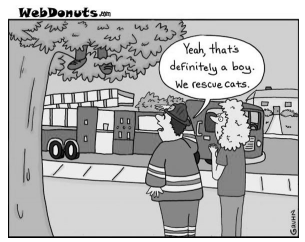
Available at: https://www.webdonuts.com/2013/06/save/.
Accessed on: July 30th, 2021.
A cartoon is intended for satire, caricature or humor.
In this cartoon, the firefighter told the woman that they
rescued cats, not boys. The verb to rescue is closest in
meaning to
Ano: 2021
Banca:
FUNDEP (Gestão de Concursos)
Órgão:
CBM-MG
Prova:
FUNDEP (Gestão de Concursos) - 2021 - CBM-MG - Aspirante do Corpo de Bombeiros |
Q1893113
Inglês
Texto associado
Learn how to prevent home fires
The best way to ensure fire protection is by preventing
fires in the first place. Small steps add up to a safer home
for you and your loved ones: switch to LED candles,
avoid smoking indoors, keep an eye out for frayed wires,
and teach your children about fire protection by informing
them about the dangers of matches and lighters.
Keep emergency equipment like fire extinguishers and fire
escape ladders in your home on each floor to help
fight any fires that do occur. Checking your smoke
alarms once a month can help prevent dead batteries
and faulty detectors.
Now that you know what to do in case of a fire in your
home, the next step is doing everything you can to make
fire prevention a top priority. Consider a home security
system with integrated fire protection to provide you and
your family with safety and peace of mind.
Available at: https://www.safewise.com/home-security-faq/
house-fire/. Accessed on: July 30, 2021. [Fragment]
Preventing fires should be a priority to families. According
to the text, which are the recommended emergency
equipment to be kept at home?
 Conheça nossos planos