Foram encontradas 40.245 questões
Resolva questões gratuitamente!
Junte-se a mais de 4 milhões de concurseiros!


 com o elevador subindo em movimento
acelerado; uma força
com o elevador subindo em movimento
acelerado; uma força  com o elevador subindo em movimento
uniforme; e uma força
com o elevador subindo em movimento
uniforme; e uma força  com o elevador subindo em movimento
retardado.
com o elevador subindo em movimento
retardado. Essas forças
 ,
,  e
e  são tais que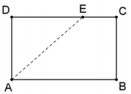
O ponto E do lado CD é tal que o segmento AE divide o retângulo em duas partes de forma que a área de uma seja o dobro da área da outra.
O segmento DE mede
Sabe-se que, em abril, 400 policiais estiveram presentes no patrulhamento e 30 assaltos ocorreram, e que, em maio, o número de assaltos caiu para 24.
O número de policiais que estiveram presentes no patrulhamento no mês de maio foi
How facial recognition technology aids police

Police officers’ ability to recognize and locate individuals with a history of committing crime is vital to their work. In fact, it is so important that officers believe possessing it is fundamental to the craft of effective street policing, crime prevention and investigation. However, with the total police workforce falling by almost 20 percent since 2010 and recorded crime rising, police forces are turning to new technological solutions to help enhance their capability and capacity to monitor and track individuals about whom they have concerns.
One such technology is Automated Facial Recognition (known as AFR). This works by analyzing key facial features, generating a mathematical representation of them, and then comparing them against known faces in a database, to determine possible matches. While a number of UK and international police forces have been enthusiastically exploring the potential of AFR, some groups have spoken about its legal and ethical status. They are concerned that the technology significantly extends the reach and depth of surveillance by the state.
Until now, however, there has been no robust evidence about what AFR systems can and cannot deliver for policing. Although AFR has become increasingly familiar to the public through its use at airports to help manage passport checks, the environment in such settings is quite controlled. Applying similar procedures to street policing is far more complex. Individuals on the street will be moving and may not look directly towards the camera. Levels of lighting change, too, and the system will have to cope with the vagaries of the British weather.
[…]
As with all innovative policing technologies there are important legal and ethical concerns and issues that still need to be considered. But in order for these to be meaningfully debated and assessed by citizens, regulators and law-makers, we need a detailed understanding of precisely what the technology can realistically accomplish. Sound evidence, rather than references to science fiction technology --- as seen in films such as Minority Report --- is essential.
With this in mind, one of our conclusions is that in terms of describing how AFR is being applied in policing currently, it is more accurate to think of it as “assisted facial recognition,” as opposed to a fully automated system. Unlike border control functions -- where the facial recognition is more of an automated system -- when supporting street policing, the algorithm is not deciding whether there is a match between a person and what is stored in the database. Rather, the system makes suggestions to a police operator about possible similarities. It is then down to the operator to confirm or refute them.
By Bethan Davies, Andrew Dawson, Martin Innes
(Source: https://gcn.com/articles/2018/11/30/facial-recognitionpolicing.aspx, accessed May 30th, 2020)
How facial recognition technology aids police
Police officers’ ability to recognize and locate individuals with a history of committing crime is vital to their work. In fact, it is so important that officers believe possessing it is fundamental to the craft of effective street policing, crime prevention and investigation. However, with the total police workforce falling by almost 20 percent since 2010 and recorded crime rising, police forces are turning to new technological solutions to help enhance their capability and capacity to monitor and track individuals about whom they have concerns.
One such technology is Automated Facial Recognition (known as AFR). This works by analyzing key facial features, generating a mathematical representation of them, and then comparing them against known faces in a database, to determine possible matches. While a number of UK and international police forces have been enthusiastically exploring the potential of AFR, some groups have spoken about its legal and ethical status. They are concerned that the technology significantly extends the reach and depth of surveillance by the state.
Until now, however, there has been no robust evidence about what AFR systems can and cannot deliver for policing. Although AFR has become increasingly familiar to the public through its use at airports to help manage passport checks, the environment in such settings is quite controlled. Applying similar procedures to street policing is far more complex. Individuals on the street will be moving and may not look directly towards the camera. Levels of lighting change, too, and the system will have to cope with the vagaries of the British weather.
[…]
As with all innovative policing technologies there are important legal and ethical concerns and issues that still need to be considered. But in order for these to be meaningfully debated and assessed by citizens, regulators and law-makers, we need a detailed understanding of precisely what the technology can realistically accomplish. Sound evidence, rather than references to science fiction technology --- as seen in films such as Minority Report --- is essential.
With this in mind, one of our conclusions is that in terms of describing how AFR is being applied in policing currently, it is more accurate to think of it as “assisted facial recognition,” as opposed to a fully automated system. Unlike border control functions -- where the facial recognition is more of an automated system -- when supporting street policing, the algorithm is not deciding whether there is a match between a person and what is stored in the database. Rather, the system makes suggestions to a police operator about possible similarities. It is then down to the operator to confirm or refute them.
By Bethan Davies, Andrew Dawson, Martin Innes
(Source: https://gcn.com/articles/2018/11/30/facial-recognitionpolicing.aspx, accessed May 30th, 2020)
( ) In relation to AFR, ethical and legal implications are being brought up. ( ) There is enough data to prove that AFR is efficient in street policing.
( ) AFR performance may be affected by changes in light and motion.
The statements are, respectively,
A esse respeito, analise as imagens a seguir.
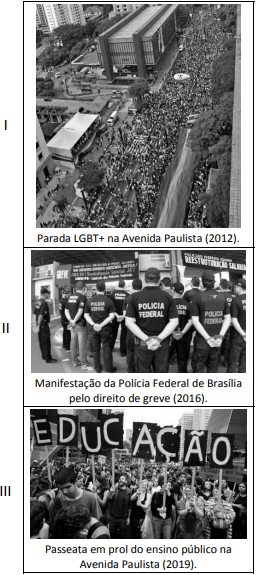
Com base nas imagens, analise as afirmativas a seguir, a respeito dos movimentos que reivindicam direitos civis, políticos e sociais, e assinale (V) para a verdadeira e (F) para a falsa.
( ) A imagem I exemplifica uma manifestação de direitos civis ao dar visibilidade à pauta atual da comunidade LGBTQ+, como, por exemplo, a criminalização da lgbtfobia. ( ) A imagem II exemplifica uma manifestação por direitos políticos ao colocar em discussão a extensão do direito de greve aos trabalhadores da área de segurança pública. ( ) A imagem III exemplifica uma manifestação em prol de direitos sociais ao reivindicar, por exemplo, maior acesso à educação pública, entendida como um direito de todos.
As afirmativas são, na ordem apresentada, respectivamente,
Nesse sentido, essas correntes consideram que
(1) 1891 ( ) Concedeu amplos poderes ao Executivo e incorporou atos institucionais que estabeleceram a suspensão dos direitos políticos e do habeas corpus. (2) 1937 ( ) Estabeleceu o fim da censura nos meios de comunicação, o direito de voto aos analfabetos e a redução da jornada semanal de 48 para 44 horas. (3) 1967 ( ) Baseou-se nos ideais positivistas e consolidou o princípio republicano federalista, além de estabelecer três Poderes, ficando extinto o Poder Moderador. (4) 1988 ( ) Inspirou-se em ideais fascistas e instituiu a censura prévia aos meios de comunicação, além de permitir ao presidente nomear interventores nos estados.
Assinale a opção que indica, segundo a ordem apresentada, a sequência correta.
Sobre as características da guerra ao longo da formação do Estado Moderno, analise a tabela a seguir.
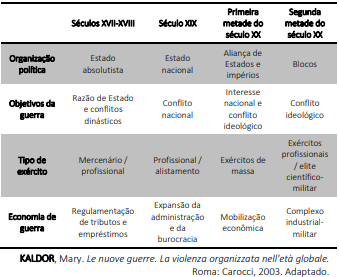
A esse respeito, são corretas as afirmativas a seguir, à exceção de uma. Assinale-a.
Considere o seguinte texto:
Abordagem a adolescente termina na apreensão de 11 kg de maconha e fuzil do Exército
Um adolescente de 16 anos foi apreendido por tráfico de drogas e porte ilícito de arma restrita, durante a tarde deste sábado (6), na Vila Zózimo, no bairro Yaris, em Curitiba. De acordo com o tenente XYZ, da Polícia Militar (PM), em abordagem de rotina a menor, os policiais apreenderam 11 kg de maconha, dezenas de pedras de crack, várias munições e um fuzil 765 das forças armadas, que estavam escondidos em um terreno baldio. Após a apreensão do adolescente, os policiais militares foram até a residência dos pais dele e os detiveram para averiguações, encaminhando-os ao Centro de Atendimento Integrado ao Cidadão, onde prestam depoimento.
(Adaptado de: https://www.bandab.com.br/seguranca/abordagem-a-adolescente-termina-na-apreensao-de-11-kg-de-maconha-e-fuzil-do-exercito/.)
No que diz respeito à ação da autoridade policial nesse
caso, considerando o disposto pelo Estatuto da Criança
e do Adolescente sobre os direitos individuais dos
adolescentes, assinale a alternativa correta.
1. O Firefox permite a navegação com privacidade por meio do recurso “Nova janela privativa”, enquanto o Chrome nomeia esse recurso como “Nova janela anônima”. 2. Tanto o Firefox quanto o Chrome podem ser utilizados para a leitura de arquivos em formato PDF. 3. Utilizando o Windows 10 como sistema operacional, o Firefox permite configurar o proxy da rede diretamente nas “Configurações de rede”, enquanto o Chrome oferece a opção de abrir a configuração de proxy do computador. 4. Nas configurações do Firefox, acessível através do caminho Abrir Menu > Opções, definem-se as permissões de acesso de sites às informações de localização, câmera e microfone.
Assinale a alternativa correta.
Considere a seguinte planilha:
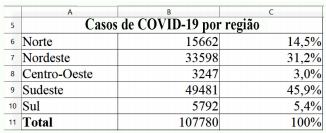
Sobre a realização de cálculos no LibreOffice Writer, versão 6.3.1 em português, considere as seguintes afirmativas:
1. O cálculo =(B10/B11) possibilita encontrar o mesmo valor percentual indicado em C10, desde que o conteúdo da célula C10 esteja configurado como “Porcentagem”.
2. O total de casos de COVID-19 nas regiões Norte e Centro-Oeste pode ser obtido pela fórmula =SOMA(B6:B8).
3. É possível encontrar o número de casos da região Sudeste por meio da fórmula =(B11*C9).
4. A fórmula =MAIOR(B6:B10;4) retorna como resultado o número 49481.
Assinale a alternativa correta.
(BEATO FILHO, Cláudio. Discutindo a reforma das polícias no Brasil. In: Civitas, Revista de Ciências Sociais [online], 2016. p. 177. Adaptado.)
No Brasil, considerando o atual arranjo constitucional, a metodologia de trabalho mencionada no texto é inviável porque:
(ROMAGNOLI, Roberta Carvalho. Várias Marias: efeitos da Lei Maria da Penha nas delegacias. In: Fractal, Ver. Psicol. [online]. 2015. p. 117.)
Resultante da articulação entre o movimento feminista brasileiro e a Corte Interamericana de Direitos Humanos, a alteração do Código Penal mencionada no texto determina que a agressão contra a mulher seja:
(Disponível em: www.brasil.elpais.com.br. Adaptado.)
Considerando o período que vai de 1968 a 1973, a crise mencionada no texto interrompeu o ciclo de crescimento econômico brasileiro porque este se baseava em:
(Disponível em: www.fgv.br. Adaptado.)
O decreto-lei mencionado no texto estabeleceu que é um crime contra a nação qualquer crime relacionado ao:

 Conheça nossos planos