Questões Militares
Sobre verbos modais | modal verbs em inglês
Foram encontradas 92 questões


Read the text to answer the question.
To begin the dialogue on cultural identity, it is essential to establish a baseline understanding the concept. Culture can be defined by the “totality of that group’s [a community or population] thought, experiences, and patterns of behavior and its concepts, values, and assumptions about life that guide behavior and how those evolve with contact with other cultures.” Cultural identity refers to people who identify themselves with a specific cultural group that has a shared system of symbols and norms for conduct. Recognition of this identity facilitates others’ understanding of the opportunities and challenges faced by individuals within a cultural group. To assist in understanding the basics of cultural identity, symbols and narratives as elements of culture will be examined in this section.
As many of our judgments are based on external observations, it should not be surprising that identities are shaped through use of symbols. According to sociologist Erik Cohen, the use of symbols in defining identity is a universal human trait. Symbols are employed in value systems such as religion, nationalism, social ideologies, and ethnicity. There are times when symbols become so significant to an existing cultural group’s identity that they stand out amongst all other symbols, dominating the narrative of cultural identity of that group. Dominant symbol systems provide “a set of stories, images, landscapes, scenarios, historical events, national symbols, and rituals which represent the shared experiences, sorrows, and triumphs and disasters which give meaning to the nation.” Therefore, understanding how complex symbol systems function and transmit meaning can help with assessing the motivations that underlie a cultural group’s actions. This is key to developing appropriate engagement strategies with cultural groups in urban environments.
Cultural groups use narrativesas a conduit for conveying messages. Narratives can be used as an analytical framework for understanding a wide spectrum of human activities. The stories conveyed through narrative can be viewed as building-blocks of identity in that they enable cultural groups to understand who they are and what they are in relation to others external to their group. In the search to understand cultural identities, knowledge of a cultural group’s narrative is “instructive for understanding how decisions might have come about, the motivations for actions, the causal assumptions drawn, and the arguments put forward, as well as a variety of other actions or variables. ”Therefore, it can be deduced that the future urban environment an Army may find itself operating within will witness a multitude of competing narratives, which may be further exacerbated by competition over limited resources and power.
Source: https://www.armyupress.army.mil/Journals/Military-Review/Online-Exclusive/2015-Online-Exclusive-Articles/Cultural-Identity/ Acess: 03/19/2026.
If I ______a millionaire, I_______ travel around the world.
Read text VI to answer question.
The internet went into overdrive when the song "Heart on My Sleeve" first dropped in 2023.
But as the song racked up millions of streams on TikTok, the truth surfaced this wasn't a new Drake and The Weeknd collab.
AI-generated music is a polarizing topic; depending on who you ask, it's either the next big innovation or a cultural catastrophe waiting to happen.
These technologically capable algorithms compose everything from background music to full-fledged songs.
But here's the flip side: AI doesn't understand human emotion.
Looking out for tomorrow, what does AI mean for the future of creativity?
As AI continues to evolve, artists and creators will have to find ways to use AI as a tool while ensuring that the heart of music its ability to move, inspire, and connect remains in human hands.
Adapted from
Read the text and answer the question.
The pursuit of happiness can end in pain
Maggie Mulqueen, psychologist
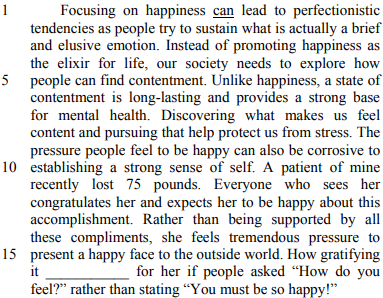
Adapted from https://www.nbcnews.com/think/opinion/suicide-studentathletes-happiness-contentment-rcna27992
Language-centered methods are those that seek to provide opportunities for learners to practice preselected linguistic structures through form-focused exercises in class. The assumption is that language practice will ultimately lead to a mastery of the target language and that learners can draw from this formal repertoire whenever they wish to communicate in the target language outside the class. According to this belief, language development is largely intentional rather than incidental; and language learning seen as a linear, additive process.
Learner-centered methods are those that are principally concerned with language use and learner needs. These methods seek to provide opportunities for learners to practice preselected, presequenced grammatical structures as well as communicative functions (i.e., speech acts such as apologizing, requesting, etc.) through meaning-focused activities. Proponents of learner-centered methods believe in accumulated entities, represented by structures plus notions and functions.
Learning-centered methods are those that are principally concerned with learning processes. These methods seek to provide opportunities for learners to participate in open-ended meaningful interaction through communicative activities or problem-solving tasks in class. The assumption is that a preoccupation with meaning-making will most likely lead to grammatical as well as communicative mastery of the language and that learners can learn through the process of communication. In this approach, unlike the other two, language development is a nonlinear process and considered more incidental than intentional. Proponents of learningcentered methods believe that language is best learned when the learner’s attention is focused on understanding, saying and doing something with language, and not when their attention is focused explicitly on linguistic features.
(Kumaravadivelu, B. Beyond Methods: Macrostrategies for language learning. Haven and London: Yale University Press. 2003. Adaptado)
Implications of the humanistic approach
Hamachek (1977) provides some useful examples of the kind of educational implications that follow from taking a humanistic approach. First, every learning experience should be seen within the context of helping learners to develop a sense of personal identity. This is in keeping with the view that one important task for the teacher is differentiation, i.e. identifying and seeking to meet the individual learner’s needs within the context of the classroom group. Second, learners should be encouraged to make choices for themselves in what and how they learn. This again is in sharp contrast to the view that the curriculum content for every learner of a similar age should be set in ‘tablets of stone’. Third, it is important for teachers to empathise with their learners by seeking to understand the ways in which they make sense of the world, rather than always seeking to impose their own viewpoints. Fourth, it is important to provide optimum conditions for individualised and group learning of an authentic nature to take place.Thus, from a humanistic perspective, a learning experience of personal consequence occurs when the learner assumes the responsibility of evaluating the degree to which he or she is personally moving toward knowledge rather than looking to an external source for such evaluation.
(Williams, M.; Burden, R.L. Psychology for Language Teachers: A Social Constructivist Approach. Cambridge:CUP, 1999. Adaptado)

1 – Impossibility
2 – Possibility
3 – Prohibition
4 – Advice
( ) Mark studied hard for his exams, but he got poor marks; he can’t be very clever.
( ) You should work less! You look too tired!
( ) She may be in the garden.
( ) You mustn’t enter here.
Read the sentences below.
Jane is a very good pianist. She can play the piano very well.
In the previous sentence, the modal verb can is used to express:
Social engineering: here's how you _______ be hacked
Lean how social engineering ________ affect you, plus common examples to help you identify and stay safe from these schemes.
Social engineering is an important term in the security world, but you _______ not be familiar with exactly what it means. While it is a broad subject, there are specific types of social engineering that we _______ examine to leam more. Let's look at social engineering as a concept so you _______ avoid falling victim to it. Social engineering is the act of manipulating people to steal private information from them, or make them give up such confidential details. (Adapted from https:/Avww.muo.com)
Read the text and answer question.

Read the text and answer question.
Leia o texto para responder à questão.
Because we all have different styles of teaching, and therefore planning, orientations about course planning and delivery should not be meant to be prescriptive. As Bailey (1996) points out, a lesson plan is like a road map “which describes where the teacher hopes to go in a lesson, presumably taking the students along”. It is the latter part of this quote that is important for teachers to remember, because they may need to make “in-flight” changes in response to the actuality of the classroom. As Bailey (1996) correctly points out, “In realizing lesson plans, part of a skilled teacher’s logic in use involves managing such departures to maximimize teaching and learning opportunities”. Clearly thought-out lesson plans will more likely maintain the attention of students and increase the likelihood that they will be interested.
(RICHARDS, Jack C.; RENANDYA, Willy A.(Ed.).
Methodology in language teaching: an anthology of current practice.
Cambridge: Cambridge University Press, 2002. p. 36. Adaptado)
Renew or replace your adult passport
You ______ be aged 16 or over (or turning 16 in the next 3 weeks). if you want an adult passport. There's a different process to get a passport for a child.
The rules for passports, drivlnq, pet travel and more ______ change from 1 January 2021. Act now so you _____ travel as planned.
If you're in the UK you _____.
-renew your passport if it's expired or will expire soon; - replace your passport if it's been lost, stolen or damaged; - change the details on your passport.
(Adapted from <https://www.gov.uk/renew-adult-passport>)


 Conheça nossos planos