Questões Militares
Sobre interpretação de texto | reading comprehension em inglês
Foram encontradas 2.325 questões


Com base no texto abaixo, responda à pergunta:
Working for the Navy can be a very interesting career choice. It will start with specialist training, both at sea and on-shore. As a result, you will develop practical and technical skills and will find yourself equipped with the confidence to interact in a team.
The Navy offers a lot of career options - from technical to non-technical posts, and for officer to civilian posts. There are hundreds of j ob opportunities available. But some positions come with high responsibilities.
For instance, Navy Electronics Technicians (ETs) are an exclusive group of professionals specially trained in electronic engineering and computer skills. They can operate and manage the electronic system s of the world’s most advanced ships and airplanes.
Another example of a Navy career is a Navy Hull Technician (HT). HTs maintain a ship’s marine sanitation system and also repair and maintain the small boats found aboard Navy ships.
Finally, Marine Technicians (MTs) operate, maintain and repair the ship’s machinery, as well as look after the power generation and distribution, and electrical control systems of ships.
Sound good so far? Take a look at the pathways to careers at sea. And find out where a j ob at sea could take you. W here do you see yourself? Click here.
(adaptado de http://www.careersatsea.org/)
Com base no texto abaixo, responda à pergunta:
Working for the Navy can be a very interesting career choice. It will start with specialist training, both at sea and on-shore. As a result, you will develop practical and technical skills and will find yourself equipped with the confidence to interact in a team.
The Navy offers a lot of career options - from technical to non-technical posts, and for officer to civilian posts. There are hundreds of j ob opportunities available. But some positions come with high responsibilities.
For instance, Navy Electronics Technicians (ETs) are an exclusive group of professionals specially trained in electronic engineering and computer skills. They can operate and manage the electronic system s of the world’s most advanced ships and airplanes.
Another example of a Navy career is a Navy Hull Technician (HT). HTs maintain a ship’s marine sanitation system and also repair and maintain the small boats found aboard Navy ships.
Finally, Marine Technicians (MTs) operate, maintain and repair the ship’s machinery, as well as look after the power generation and distribution, and electrical control systems of ships.
Sound good so far? Take a look at the pathways to careers at sea. And find out where a j ob at sea could take you. W here do you see yourself? Click here.
(adaptado de http://www.careersatsea.org/)
Six things I learned from riding in a Google self-driving car
1 - Human beings are terrible drivers.
We drink. We doze. We text. In the US, 30,000 people die from automobile accidents every year. Traffic crashes are the primary cause of death worldwide for people aged 15-24, and during a crash, 40% of drivers never even hit the brakes. We’re flawed organisms, barreling around at high speeds in vessels covered in glass, metal, distraction, and death. This is one of Google’s “moonshots” – to remove human error from a job which, for the past hundred years, has been entirely human.
2 - Google self-driving cars are timid.
The car we rode in did not strike me as dangerous. It drove slowly and deliberately, and I got the impression that it’s more likely to annoy other drivers than to harm them. In the early versions they tested on closed courses, the vehicles were programmed to be highly aggressive. Apparently during these tests, which involved obstacle courses full of traffic cones and inflatable crash-test objects, there were a lot of screeching brakes, roaring engines and terrified interns.
3 - They’re cute.
Google’s new fleet was intentionally designed to look adorable. Our brains are hardwired to treat inanimate (or animate) objects with greater care, caution, and reverence when they resemble a living thing. By turning self-driving cars into an adorable Skynet Marshmallow Bumper Bots, Google hopes to spiritually disarm other drivers. I also suspect the cuteness is used to quell some of the road rage that might emerge from being stuck behind one of these things. They’re intended as moderate-distance couriers, not openroad warriors, so their max speed is 25 miles per hour.
4 - It’s not done and it’s not perfect.
Some of the scenarios autonomous vehicles have the most trouble with are the same human beings have the most trouble with, such as traversing four-way stops or handling a yellow light. The cars use a mixture of 3D laser-mapping, GPS, and radar to analyze and interpret their surroundings, and the latest versions are fully electric with a range of about 100 miles. Despite the advantages over a human being in certain scenarios, however, these cars still aren’t ready for the real world. They can’t drive in the snow or heavy rain, and there’s a variety of complex situations they do not process well, such as passing through a construction zone. Google is hoping that, eventually, the cars will be able to handle all of this as well (or better) than a human could.
5 - I want this technology to succeed, like… yesterday.
I’m biased. Earlier this year my mom had a stroke. It damaged the visual cortex of her brain, and her vision was impaired to the point that she’ll probably never drive again. This reduced her from a fully-functional, independent human being with a career and a buzzing social life into someone who is homebound, disabled, and powerless. When discussing self-driving cars, people tend to ask many superficial questions. They ignore that 45% of disabled people in the US still work. They ignore that 95% of a car’s lifetime is spent parked. They ignore how this technology could transform the lives of the elderly, or eradicate the need for parking lots or garages or gas stations. They dismiss the entire concept because they don’t think a computer could ever be as good at merging on the freeway as they are. They ignore the great, big, beautiful picture: that this technology could make our lives so much better.
6 - It wasn’t an exhilarating ride, and that’s a good thing.
Riding in a self-driving car is not the cybernetic thrill ride one might expect. The car drives like a person, and after a few minutes you forget that you’re being driven autonomously. You forget that a robot is differentiating cars from pedestrians from mopeds from raccoons. You forget that millions of photons are being fired from a laser and interpreting, processing, and reacting to the hand signals of a cyclist. You forget that instead of an organic brain, which has had millions of years to evolve the cognitive ability to fumble its way through a four-way stop, you’re being piloted by an artificial one, which was birthed in less than a decade. The unfortunate part of something this transformative is the inevitable, ardent stupidity which is going to erupt from the general public. Even if in a few years self-driving cars are proven to be ten times safer than human-operated cars, all it’s going to take is one tragic accident and the public is going to lose their minds. There will be outrage. There will be politicizing. There will be hashtags. I say look at the bigger picture. All the self-driving cars currently on the road learn from one another, and possess 40 years of driving experience. And this technology is still in its infancy.
(Adapted from:: <http://theoatmeal.com/blog/google_self_driving_car>
Six things I learned from riding in a Google self-driving car
1 - Human beings are terrible drivers.
We drink. We doze. We text. In the US, 30,000 people die from automobile accidents every year. Traffic crashes are the primary cause of death worldwide for people aged 15-24, and during a crash, 40% of drivers never even hit the brakes. We’re flawed organisms, barreling around at high speeds in vessels covered in glass, metal, distraction, and death. This is one of Google’s “moonshots” – to remove human error from a job which, for the past hundred years, has been entirely human.
2 - Google self-driving cars are timid.
The car we rode in did not strike me as dangerous. It drove slowly and deliberately, and I got the impression that it’s more likely to annoy other drivers than to harm them. In the early versions they tested on closed courses, the vehicles were programmed to be highly aggressive. Apparently during these tests, which involved obstacle courses full of traffic cones and inflatable crash-test objects, there were a lot of screeching brakes, roaring engines and terrified interns.
3 - They’re cute.
Google’s new fleet was intentionally designed to look adorable. Our brains are hardwired to treat inanimate (or animate) objects with greater care, caution, and reverence when they resemble a living thing. By turning self-driving cars into an adorable Skynet Marshmallow Bumper Bots, Google hopes to spiritually disarm other drivers. I also suspect the cuteness is used to quell some of the road rage that might emerge from being stuck behind one of these things. They’re intended as moderate-distance couriers, not openroad warriors, so their max speed is 25 miles per hour.
4 - It’s not done and it’s not perfect.
Some of the scenarios autonomous vehicles have the most trouble with are the same human beings have the most trouble with, such as traversing four-way stops or handling a yellow light. The cars use a mixture of 3D laser-mapping, GPS, and radar to analyze and interpret their surroundings, and the latest versions are fully electric with a range of about 100 miles. Despite the advantages over a human being in certain scenarios, however, these cars still aren’t ready for the real world. They can’t drive in the snow or heavy rain, and there’s a variety of complex situations they do not process well, such as passing through a construction zone. Google is hoping that, eventually, the cars will be able to handle all of this as well (or better) than a human could.
5 - I want this technology to succeed, like… yesterday.
I’m biased. Earlier this year my mom had a stroke. It damaged the visual cortex of her brain, and her vision was impaired to the point that she’ll probably never drive again. This reduced her from a fully-functional, independent human being with a career and a buzzing social life into someone who is homebound, disabled, and powerless. When discussing self-driving cars, people tend to ask many superficial questions. They ignore that 45% of disabled people in the US still work. They ignore that 95% of a car’s lifetime is spent parked. They ignore how this technology could transform the lives of the elderly, or eradicate the need for parking lots or garages or gas stations. They dismiss the entire concept because they don’t think a computer could ever be as good at merging on the freeway as they are. They ignore the great, big, beautiful picture: that this technology could make our lives so much better.
6 - It wasn’t an exhilarating ride, and that’s a good thing.
Riding in a self-driving car is not the cybernetic thrill ride one might expect. The car drives like a person, and after a few minutes you forget that you’re being driven autonomously. You forget that a robot is differentiating cars from pedestrians from mopeds from raccoons. You forget that millions of photons are being fired from a laser and interpreting, processing, and reacting to the hand signals of a cyclist. You forget that instead of an organic brain, which has had millions of years to evolve the cognitive ability to fumble its way through a four-way stop, you’re being piloted by an artificial one, which was birthed in less than a decade. The unfortunate part of something this transformative is the inevitable, ardent stupidity which is going to erupt from the general public. Even if in a few years self-driving cars are proven to be ten times safer than human-operated cars, all it’s going to take is one tragic accident and the public is going to lose their minds. There will be outrage. There will be politicizing. There will be hashtags. I say look at the bigger picture. All the self-driving cars currently on the road learn from one another, and possess 40 years of driving experience. And this technology is still in its infancy.
(Adapted from:: <http://theoatmeal.com/blog/google_self_driving_car>
Six things I learned from riding in a Google self-driving car
1 - Human beings are terrible drivers.
We drink. We doze. We text. In the US, 30,000 people die from automobile accidents every year. Traffic crashes are the primary cause of death worldwide for people aged 15-24, and during a crash, 40% of drivers never even hit the brakes. We’re flawed organisms, barreling around at high speeds in vessels covered in glass, metal, distraction, and death. This is one of Google’s “moonshots” – to remove human error from a job which, for the past hundred years, has been entirely human.
2 - Google self-driving cars are timid.
The car we rode in did not strike me as dangerous. It drove slowly and deliberately, and I got the impression that it’s more likely to annoy other drivers than to harm them. In the early versions they tested on closed courses, the vehicles were programmed to be highly aggressive. Apparently during these tests, which involved obstacle courses full of traffic cones and inflatable crash-test objects, there were a lot of screeching brakes, roaring engines and terrified interns.
3 - They’re cute.
Google’s new fleet was intentionally designed to look adorable. Our brains are hardwired to treat inanimate (or animate) objects with greater care, caution, and reverence when they resemble a living thing. By turning self-driving cars into an adorable Skynet Marshmallow Bumper Bots, Google hopes to spiritually disarm other drivers. I also suspect the cuteness is used to quell some of the road rage that might emerge from being stuck behind one of these things. They’re intended as moderate-distance couriers, not openroad warriors, so their max speed is 25 miles per hour.
4 - It’s not done and it’s not perfect.
Some of the scenarios autonomous vehicles have the most trouble with are the same human beings have the most trouble with, such as traversing four-way stops or handling a yellow light. The cars use a mixture of 3D laser-mapping, GPS, and radar to analyze and interpret their surroundings, and the latest versions are fully electric with a range of about 100 miles. Despite the advantages over a human being in certain scenarios, however, these cars still aren’t ready for the real world. They can’t drive in the snow or heavy rain, and there’s a variety of complex situations they do not process well, such as passing through a construction zone. Google is hoping that, eventually, the cars will be able to handle all of this as well (or better) than a human could.
5 - I want this technology to succeed, like… yesterday.
I’m biased. Earlier this year my mom had a stroke. It damaged the visual cortex of her brain, and her vision was impaired to the point that she’ll probably never drive again. This reduced her from a fully-functional, independent human being with a career and a buzzing social life into someone who is homebound, disabled, and powerless. When discussing self-driving cars, people tend to ask many superficial questions. They ignore that 45% of disabled people in the US still work. They ignore that 95% of a car’s lifetime is spent parked. They ignore how this technology could transform the lives of the elderly, or eradicate the need for parking lots or garages or gas stations. They dismiss the entire concept because they don’t think a computer could ever be as good at merging on the freeway as they are. They ignore the great, big, beautiful picture: that this technology could make our lives so much better.
6 - It wasn’t an exhilarating ride, and that’s a good thing.
Riding in a self-driving car is not the cybernetic thrill ride one might expect. The car drives like a person, and after a few minutes you forget that you’re being driven autonomously. You forget that a robot is differentiating cars from pedestrians from mopeds from raccoons. You forget that millions of photons are being fired from a laser and interpreting, processing, and reacting to the hand signals of a cyclist. You forget that instead of an organic brain, which has had millions of years to evolve the cognitive ability to fumble its way through a four-way stop, you’re being piloted by an artificial one, which was birthed in less than a decade. The unfortunate part of something this transformative is the inevitable, ardent stupidity which is going to erupt from the general public. Even if in a few years self-driving cars are proven to be ten times safer than human-operated cars, all it’s going to take is one tragic accident and the public is going to lose their minds. There will be outrage. There will be politicizing. There will be hashtags. I say look at the bigger picture. All the self-driving cars currently on the road learn from one another, and possess 40 years of driving experience. And this technology is still in its infancy.
(Adapted from:: <http://theoatmeal.com/blog/google_self_driving_car>
Six things I learned from riding in a Google self-driving car
1 - Human beings are terrible drivers.
We drink. We doze. We text. In the US, 30,000 people die from automobile accidents every year. Traffic crashes are the primary cause of death worldwide for people aged 15-24, and during a crash, 40% of drivers never even hit the brakes. We’re flawed organisms, barreling around at high speeds in vessels covered in glass, metal, distraction, and death. This is one of Google’s “moonshots” – to remove human error from a job which, for the past hundred years, has been entirely human.
2 - Google self-driving cars are timid.
The car we rode in did not strike me as dangerous. It drove slowly and deliberately, and I got the impression that it’s more likely to annoy other drivers than to harm them. In the early versions they tested on closed courses, the vehicles were programmed to be highly aggressive. Apparently during these tests, which involved obstacle courses full of traffic cones and inflatable crash-test objects, there were a lot of screeching brakes, roaring engines and terrified interns.
3 - They’re cute.
Google’s new fleet was intentionally designed to look adorable. Our brains are hardwired to treat inanimate (or animate) objects with greater care, caution, and reverence when they resemble a living thing. By turning self-driving cars into an adorable Skynet Marshmallow Bumper Bots, Google hopes to spiritually disarm other drivers. I also suspect the cuteness is used to quell some of the road rage that might emerge from being stuck behind one of these things. They’re intended as moderate-distance couriers, not openroad warriors, so their max speed is 25 miles per hour.
4 - It’s not done and it’s not perfect.
Some of the scenarios autonomous vehicles have the most trouble with are the same human beings have the most trouble with, such as traversing four-way stops or handling a yellow light. The cars use a mixture of 3D laser-mapping, GPS, and radar to analyze and interpret their surroundings, and the latest versions are fully electric with a range of about 100 miles. Despite the advantages over a human being in certain scenarios, however, these cars still aren’t ready for the real world. They can’t drive in the snow or heavy rain, and there’s a variety of complex situations they do not process well, such as passing through a construction zone. Google is hoping that, eventually, the cars will be able to handle all of this as well (or better) than a human could.
5 - I want this technology to succeed, like… yesterday.
I’m biased. Earlier this year my mom had a stroke. It damaged the visual cortex of her brain, and her vision was impaired to the point that she’ll probably never drive again. This reduced her from a fully-functional, independent human being with a career and a buzzing social life into someone who is homebound, disabled, and powerless. When discussing self-driving cars, people tend to ask many superficial questions. They ignore that 45% of disabled people in the US still work. They ignore that 95% of a car’s lifetime is spent parked. They ignore how this technology could transform the lives of the elderly, or eradicate the need for parking lots or garages or gas stations. They dismiss the entire concept because they don’t think a computer could ever be as good at merging on the freeway as they are. They ignore the great, big, beautiful picture: that this technology could make our lives so much better.
6 - It wasn’t an exhilarating ride, and that’s a good thing.
Riding in a self-driving car is not the cybernetic thrill ride one might expect. The car drives like a person, and after a few minutes you forget that you’re being driven autonomously. You forget that a robot is differentiating cars from pedestrians from mopeds from raccoons. You forget that millions of photons are being fired from a laser and interpreting, processing, and reacting to the hand signals of a cyclist. You forget that instead of an organic brain, which has had millions of years to evolve the cognitive ability to fumble its way through a four-way stop, you’re being piloted by an artificial one, which was birthed in less than a decade. The unfortunate part of something this transformative is the inevitable, ardent stupidity which is going to erupt from the general public. Even if in a few years self-driving cars are proven to be ten times safer than human-operated cars, all it’s going to take is one tragic accident and the public is going to lose their minds. There will be outrage. There will be politicizing. There will be hashtags. I say look at the bigger picture. All the self-driving cars currently on the road learn from one another, and possess 40 years of driving experience. And this technology is still in its infancy.
(Adapted from:: <http://theoatmeal.com/blog/google_self_driving_car>
Consider the following characteristics of the new Google self-driving car:
1. It runs on batteries and petrol.
2. It can be used in extreme weather conditions.
3. It has a design which requires further modifications.
4. It can reach the speed of 25 miles per hour.
Mark the correct alternative.
Six things I learned from riding in a Google self-driving car
1 - Human beings are terrible drivers.
We drink. We doze. We text. In the US, 30,000 people die from automobile accidents every year. Traffic crashes are the primary cause of death worldwide for people aged 15-24, and during a crash, 40% of drivers never even hit the brakes. We’re flawed organisms, barreling around at high speeds in vessels covered in glass, metal, distraction, and death. This is one of Google’s “moonshots” – to remove human error from a job which, for the past hundred years, has been entirely human.
2 - Google self-driving cars are timid.
The car we rode in did not strike me as dangerous. It drove slowly and deliberately, and I got the impression that it’s more likely to annoy other drivers than to harm them. In the early versions they tested on closed courses, the vehicles were programmed to be highly aggressive. Apparently during these tests, which involved obstacle courses full of traffic cones and inflatable crash-test objects, there were a lot of screeching brakes, roaring engines and terrified interns.
3 - They’re cute.
Google’s new fleet was intentionally designed to look adorable. Our brains are hardwired to treat inanimate (or animate) objects with greater care, caution, and reverence when they resemble a living thing. By turning self-driving cars into an adorable Skynet Marshmallow Bumper Bots, Google hopes to spiritually disarm other drivers. I also suspect the cuteness is used to quell some of the road rage that might emerge from being stuck behind one of these things. They’re intended as moderate-distance couriers, not openroad warriors, so their max speed is 25 miles per hour.
4 - It’s not done and it’s not perfect.
Some of the scenarios autonomous vehicles have the most trouble with are the same human beings have the most trouble with, such as traversing four-way stops or handling a yellow light. The cars use a mixture of 3D laser-mapping, GPS, and radar to analyze and interpret their surroundings, and the latest versions are fully electric with a range of about 100 miles. Despite the advantages over a human being in certain scenarios, however, these cars still aren’t ready for the real world. They can’t drive in the snow or heavy rain, and there’s a variety of complex situations they do not process well, such as passing through a construction zone. Google is hoping that, eventually, the cars will be able to handle all of this as well (or better) than a human could.
5 - I want this technology to succeed, like… yesterday.
I’m biased. Earlier this year my mom had a stroke. It damaged the visual cortex of her brain, and her vision was impaired to the point that she’ll probably never drive again. This reduced her from a fully-functional, independent human being with a career and a buzzing social life into someone who is homebound, disabled, and powerless. When discussing self-driving cars, people tend to ask many superficial questions. They ignore that 45% of disabled people in the US still work. They ignore that 95% of a car’s lifetime is spent parked. They ignore how this technology could transform the lives of the elderly, or eradicate the need for parking lots or garages or gas stations. They dismiss the entire concept because they don’t think a computer could ever be as good at merging on the freeway as they are. They ignore the great, big, beautiful picture: that this technology could make our lives so much better.
6 - It wasn’t an exhilarating ride, and that’s a good thing.
Riding in a self-driving car is not the cybernetic thrill ride one might expect. The car drives like a person, and after a few minutes you forget that you’re being driven autonomously. You forget that a robot is differentiating cars from pedestrians from mopeds from raccoons. You forget that millions of photons are being fired from a laser and interpreting, processing, and reacting to the hand signals of a cyclist. You forget that instead of an organic brain, which has had millions of years to evolve the cognitive ability to fumble its way through a four-way stop, you’re being piloted by an artificial one, which was birthed in less than a decade. The unfortunate part of something this transformative is the inevitable, ardent stupidity which is going to erupt from the general public. Even if in a few years self-driving cars are proven to be ten times safer than human-operated cars, all it’s going to take is one tragic accident and the public is going to lose their minds. There will be outrage. There will be politicizing. There will be hashtags. I say look at the bigger picture. All the self-driving cars currently on the road learn from one another, and possess 40 years of driving experience. And this technology is still in its infancy.
(Adapted from:: <http://theoatmeal.com/blog/google_self_driving_car>
Six things I learned from riding in a Google self-driving car
1 - Human beings are terrible drivers.
We drink. We doze. We text. In the US, 30,000 people die from automobile accidents every year. Traffic crashes are the primary cause of death worldwide for people aged 15-24, and during a crash, 40% of drivers never even hit the brakes. We’re flawed organisms, barreling around at high speeds in vessels covered in glass, metal, distraction, and death. This is one of Google’s “moonshots” – to remove human error from a job which, for the past hundred years, has been entirely human.
2 - Google self-driving cars are timid.
The car we rode in did not strike me as dangerous. It drove slowly and deliberately, and I got the impression that it’s more likely to annoy other drivers than to harm them. In the early versions they tested on closed courses, the vehicles were programmed to be highly aggressive. Apparently during these tests, which involved obstacle courses full of traffic cones and inflatable crash-test objects, there were a lot of screeching brakes, roaring engines and terrified interns.
3 - They’re cute.
Google’s new fleet was intentionally designed to look adorable. Our brains are hardwired to treat inanimate (or animate) objects with greater care, caution, and reverence when they resemble a living thing. By turning self-driving cars into an adorable Skynet Marshmallow Bumper Bots, Google hopes to spiritually disarm other drivers. I also suspect the cuteness is used to quell some of the road rage that might emerge from being stuck behind one of these things. They’re intended as moderate-distance couriers, not openroad warriors, so their max speed is 25 miles per hour.
4 - It’s not done and it’s not perfect.
Some of the scenarios autonomous vehicles have the most trouble with are the same human beings have the most trouble with, such as traversing four-way stops or handling a yellow light. The cars use a mixture of 3D laser-mapping, GPS, and radar to analyze and interpret their surroundings, and the latest versions are fully electric with a range of about 100 miles. Despite the advantages over a human being in certain scenarios, however, these cars still aren’t ready for the real world. They can’t drive in the snow or heavy rain, and there’s a variety of complex situations they do not process well, such as passing through a construction zone. Google is hoping that, eventually, the cars will be able to handle all of this as well (or better) than a human could.
5 - I want this technology to succeed, like… yesterday.
I’m biased. Earlier this year my mom had a stroke. It damaged the visual cortex of her brain, and her vision was impaired to the point that she’ll probably never drive again. This reduced her from a fully-functional, independent human being with a career and a buzzing social life into someone who is homebound, disabled, and powerless. When discussing self-driving cars, people tend to ask many superficial questions. They ignore that 45% of disabled people in the US still work. They ignore that 95% of a car’s lifetime is spent parked. They ignore how this technology could transform the lives of the elderly, or eradicate the need for parking lots or garages or gas stations. They dismiss the entire concept because they don’t think a computer could ever be as good at merging on the freeway as they are. They ignore the great, big, beautiful picture: that this technology could make our lives so much better.
6 - It wasn’t an exhilarating ride, and that’s a good thing.
Riding in a self-driving car is not the cybernetic thrill ride one might expect. The car drives like a person, and after a few minutes you forget that you’re being driven autonomously. You forget that a robot is differentiating cars from pedestrians from mopeds from raccoons. You forget that millions of photons are being fired from a laser and interpreting, processing, and reacting to the hand signals of a cyclist. You forget that instead of an organic brain, which has had millions of years to evolve the cognitive ability to fumble its way through a four-way stop, you’re being piloted by an artificial one, which was birthed in less than a decade. The unfortunate part of something this transformative is the inevitable, ardent stupidity which is going to erupt from the general public. Even if in a few years self-driving cars are proven to be ten times safer than human-operated cars, all it’s going to take is one tragic accident and the public is going to lose their minds. There will be outrage. There will be politicizing. There will be hashtags. I say look at the bigger picture. All the self-driving cars currently on the road learn from one another, and possess 40 years of driving experience. And this technology is still in its infancy.
(Adapted from:: <http://theoatmeal.com/blog/google_self_driving_car>
Six things I learned from riding in a Google self-driving car
1 - Human beings are terrible drivers.
We drink. We doze. We text. In the US, 30,000 people die from automobile accidents every year. Traffic crashes are the primary cause of death worldwide for people aged 15-24, and during a crash, 40% of drivers never even hit the brakes. We’re flawed organisms, barreling around at high speeds in vessels covered in glass, metal, distraction, and death. This is one of Google’s “moonshots” – to remove human error from a job which, for the past hundred years, has been entirely human.
2 - Google self-driving cars are timid.
The car we rode in did not strike me as dangerous. It drove slowly and deliberately, and I got the impression that it’s more likely to annoy other drivers than to harm them. In the early versions they tested on closed courses, the vehicles were programmed to be highly aggressive. Apparently during these tests, which involved obstacle courses full of traffic cones and inflatable crash-test objects, there were a lot of screeching brakes, roaring engines and terrified interns.
3 - They’re cute.
Google’s new fleet was intentionally designed to look adorable. Our brains are hardwired to treat inanimate (or animate) objects with greater care, caution, and reverence when they resemble a living thing. By turning self-driving cars into an adorable Skynet Marshmallow Bumper Bots, Google hopes to spiritually disarm other drivers. I also suspect the cuteness is used to quell some of the road rage that might emerge from being stuck behind one of these things. They’re intended as moderate-distance couriers, not openroad warriors, so their max speed is 25 miles per hour.
4 - It’s not done and it’s not perfect.
Some of the scenarios autonomous vehicles have the most trouble with are the same human beings have the most trouble with, such as traversing four-way stops or handling a yellow light. The cars use a mixture of 3D laser-mapping, GPS, and radar to analyze and interpret their surroundings, and the latest versions are fully electric with a range of about 100 miles. Despite the advantages over a human being in certain scenarios, however, these cars still aren’t ready for the real world. They can’t drive in the snow or heavy rain, and there’s a variety of complex situations they do not process well, such as passing through a construction zone. Google is hoping that, eventually, the cars will be able to handle all of this as well (or better) than a human could.
5 - I want this technology to succeed, like… yesterday.
I’m biased. Earlier this year my mom had a stroke. It damaged the visual cortex of her brain, and her vision was impaired to the point that she’ll probably never drive again. This reduced her from a fully-functional, independent human being with a career and a buzzing social life into someone who is homebound, disabled, and powerless. When discussing self-driving cars, people tend to ask many superficial questions. They ignore that 45% of disabled people in the US still work. They ignore that 95% of a car’s lifetime is spent parked. They ignore how this technology could transform the lives of the elderly, or eradicate the need for parking lots or garages or gas stations. They dismiss the entire concept because they don’t think a computer could ever be as good at merging on the freeway as they are. They ignore the great, big, beautiful picture: that this technology could make our lives so much better.
6 - It wasn’t an exhilarating ride, and that’s a good thing.
Riding in a self-driving car is not the cybernetic thrill ride one might expect. The car drives like a person, and after a few minutes you forget that you’re being driven autonomously. You forget that a robot is differentiating cars from pedestrians from mopeds from raccoons. You forget that millions of photons are being fired from a laser and interpreting, processing, and reacting to the hand signals of a cyclist. You forget that instead of an organic brain, which has had millions of years to evolve the cognitive ability to fumble its way through a four-way stop, you’re being piloted by an artificial one, which was birthed in less than a decade. The unfortunate part of something this transformative is the inevitable, ardent stupidity which is going to erupt from the general public. Even if in a few years self-driving cars are proven to be ten times safer than human-operated cars, all it’s going to take is one tragic accident and the public is going to lose their minds. There will be outrage. There will be politicizing. There will be hashtags. I say look at the bigger picture. All the self-driving cars currently on the road learn from one another, and possess 40 years of driving experience. And this technology is still in its infancy.
(Adapted from:: <http://theoatmeal.com/blog/google_self_driving_car>
1. Drinking before driving. 2. Sending a written message while driving. 3. Sleeping for a short period of time. 4. Hitting the brakes. 5. Speeding up.
According to the text, some human mistakes that happen before or during a car accident are:
Leia o texto para responder à questão.
Police in England and Wales consider making
misogyny a hate crime

September 10, 2016
Police forces across England and Wales are considering expanding their definition of hate crime to include misogyny (hatred, dislike, or mistrust of women, or prejudice against women) after an experiment in one city that saw more than 20 investigations launched in two months.
The initial success of Nottingham’s crackdown against sexist abuse has drawn national interest after the city’s police revealed that they investigated a case of misogyny every three days during July and August, the first months to see specially trained officers targeting behaviour ranging from street harassment to unwanted physical approaches.
Several other forces have confirmed they are sending representatives to Nottingham this month to discuss the introduction of misogyny as a hate crime. Police and campaigners said the initial figures were broadly in line with other categories of hate crime such as Islamophobia and antisemitism but were likely to rise significantly as awareness increased.
Dave Alton, the hate crime manager for Nottingham police, said: “The number of reports we are receiving is comparable with other, more established, categories of hate crime. We have received numerous reports and have been able to provide a service to women in Nottinghamshire who perhaps would not have approached us six months ago. The reality is that all of the reports so far have required some form of police action.”
(www.theguardian.com. Adaptado)
Leia o texto para responder à questão.
Police in England and Wales consider making
misogyny a hate crime
September 10, 2016
Police forces across England and Wales are considering expanding their definition of hate crime to include misogyny (hatred, dislike, or mistrust of women, or prejudice against women) after an experiment in one city that saw more than 20 investigations launched in two months.
The initial success of Nottingham’s crackdown against sexist abuse has drawn national interest after the city’s police revealed that they investigated a case of misogyny every three days during July and August, the first months to see specially trained officers targeting behaviour ranging from street harassment to unwanted physical approaches.
Several other forces have confirmed they are sending representatives to Nottingham this month to discuss the introduction of misogyny as a hate crime. Police and campaigners said the initial figures were broadly in line with other categories of hate crime such as Islamophobia and antisemitism but were likely to rise significantly as awareness increased.
Dave Alton, the hate crime manager for Nottingham police, said: “The number of reports we are receiving is comparable with other, more established, categories of hate crime. We have received numerous reports and have been able to provide a service to women in Nottinghamshire who perhaps would not have approached us six months ago. The reality is that all of the reports so far have required some form of police action.”
(www.theguardian.com. Adaptado)
Leia o texto para responder à questão.
Police in England and Wales consider making
misogyny a hate crime
September 10, 2016
Police forces across England and Wales are considering expanding their definition of hate crime to include misogyny (hatred, dislike, or mistrust of women, or prejudice against women) after an experiment in one city that saw more than 20 investigations launched in two months.
The initial success of Nottingham’s crackdown against sexist abuse has drawn national interest after the city’s police revealed that they investigated a case of misogyny every three days during July and August, the first months to see specially trained officers targeting behaviour ranging from street harassment to unwanted physical approaches.
Several other forces have confirmed they are sending representatives to Nottingham this month to discuss the introduction of misogyny as a hate crime. Police and campaigners said the initial figures were broadly in line with other categories of hate crime such as Islamophobia and antisemitism but were likely to rise significantly as awareness increased.
Dave Alton, the hate crime manager for Nottingham police, said: “The number of reports we are receiving is comparable with other, more established, categories of hate crime. We have received numerous reports and have been able to provide a service to women in Nottinghamshire who perhaps would not have approached us six months ago. The reality is that all of the reports so far have required some form of police action.”
(www.theguardian.com. Adaptado)
Leia o texto para responder à questão.
Police in England and Wales consider making
misogyny a hate crime
September 10, 2016
Police forces across England and Wales are considering expanding their definition of hate crime to include misogyny (hatred, dislike, or mistrust of women, or prejudice against women) after an experiment in one city that saw more than 20 investigations launched in two months.
The initial success of Nottingham’s crackdown against sexist abuse has drawn national interest after the city’s police revealed that they investigated a case of misogyny every three days during July and August, the first months to see specially trained officers targeting behaviour ranging from street harassment to unwanted physical approaches.
Several other forces have confirmed they are sending representatives to Nottingham this month to discuss the introduction of misogyny as a hate crime. Police and campaigners said the initial figures were broadly in line with other categories of hate crime such as Islamophobia and antisemitism but were likely to rise significantly as awareness increased.
Dave Alton, the hate crime manager for Nottingham police, said: “The number of reports we are receiving is comparable with other, more established, categories of hate crime. We have received numerous reports and have been able to provide a service to women in Nottinghamshire who perhaps would not have approached us six months ago. The reality is that all of the reports so far have required some form of police action.”
(www.theguardian.com. Adaptado)
A questão refere-se ao texto a seguir:


A questão refere-se ao texto a seguir:
A questão refere-se ao texto a seguir:
A tirinha a seguir mostra um diálogo entre duas pessoas, com a participação de um terceiro interlocutor. Analise-a e responda a questão.
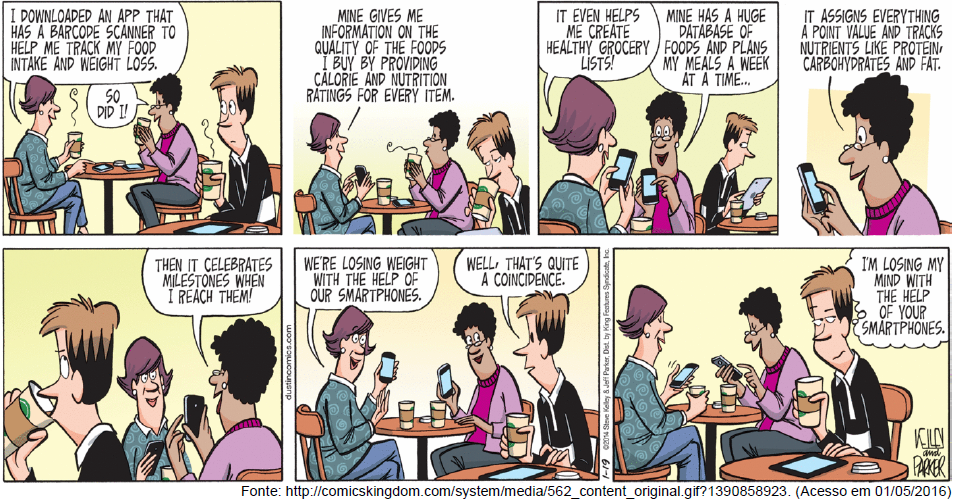
A tirinha a seguir mostra um diálogo entre duas pessoas, com a participação de um terceiro interlocutor. Analise-a e responda a questão.
A questão refere-se ao texto a seguir:


A questão refere-se ao texto a seguir:

 Conheça nossos planos