Foram encontradas 71.378 questões
Resolva questões gratuitamente!
Junte-se a mais de 4 milhões de concurseiros!


A construção social do ser humano
BERGER, Peter L.; LUCKMANN, Thomas. A construção social da realidade: tratado de sociologia do conhecimento. 36. ed. Petrópolis: Vozes, 2014. p. 68-73. [Adaptado].
“Do No Harm” is a gripping memoir written by renowned neurosurgeon Henry Marsh. Published in 2014, this book takes readers on a remarkable journey into the world of neurosurgery, offering a glimpse into the high stakes and complex nature of this critical medical profession. The quotes that follow are part of this book:
I - "An effective doctor operates not just with their scalpel, but with their words, their presence, and their healing touch” (Marsh, 2014).
II - “To be a doctor is to be a lifelong student, forever humbled by the complexity and mystery of the human body” (Marsh, 2014).
Disponível em: https://www.bookey.app/quote-book/do-no-harm. Acesso em: 4 mar. 2024. [Adaptado].
Considering quotes I and II, it can be stated that
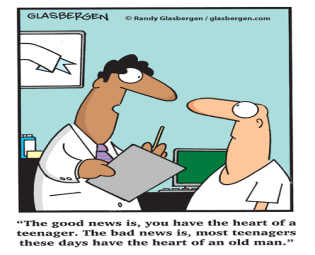
The information the doctors is expressing is:
Disponível em: https://www.glasbergen.com/. Acesso em: 4 mar. 2024
Making family medicine a more attractive specialty: strategies to address the shortage of primary care specialists in Brazil
Primary Health Care (PHC) is often the first level of the health system and is responsible for the coordination of medical and interdisciplinary care. As the preferred entry point to the Brazilian Unified Health System (SUS), PHC is of fundamental importance and is present in all regions of the country. It aims to enable access to health care and ensures the coordination and completeness of care. This structure can treat approximately 80% of the overall need related to diseases presented in the Basic Health Units.
Despite its importance, the valorization of PHC and Family Medicine (FM) as a discipline and a public policy has not been prioritized in most Brazilian educational institutions. According to the study on medical demography carried out by the Regional Medical Council of São Paulo (CREMESP), Brazil had 500,000 physicians in 2020, but with unequal distribution among the nation’s five regions, and a concentration of professionals in the capital cities compared to the countryside.
This issue is faced by many countries. In the United States (US) of 8,116 primary care postgraduate training positions (which includes pediatrics, internal medicine, and family doctors), 42 percent were filled by graduates of U.S. medical schools and the American Association of Medical Colleges (AAMC) projects a shortage of 21,100 to 55,200 primary care physicians (PCP) by 2034. In Europe, where PCP was traditionally respected and recognized, the lack of General Practitioners (GP) is also increasing and is a matter of concern. Workload and a lack of perceived prestige associated with the PCP track can make primary care less attractive. These sorts of misconceptions, along with lower salaries, burnout, and difficult career advancement makes primary care a difficult specialty to attract and retain doctors.
For Feuerwerker, vacancies in Brazilian institutions are the result of several elements: the encouragement of distinctive specialties and institutions, the historical misunderstanding and importance of the practice, and the increased incentive of specialization in medical education. The lack of investments in supplies and infrastructure in primary care, career development concerns, and low salaries, and the valorization of the formation of FM doctors in the work of the EFS also contribute to difficulty in retaining these positions in Brazil.
With the aim to reduce the vacancy rate in the medical residency programs for FM, some Brazilian health departments introduced reforms and additional financing for FM training. In 2020, the region of Campinas, where we work, introduced a program called “More Doctors for the City of Campinas” (PMMC), which established a partnership between public and private higher education institutions, hospitals, and Urgency/Emergency Units with a novel post-graduation proposal for FM. It created a program to support the training of specialists in family medicine, stimulate research, and expand care in Basic Health Units, and has since resulted in a 50% decrease in vacancies.
One of the successful elements of the Campinas program, together with quality of medical training, is that it helps bring medical classroom training closer to the community and everyday social reality. PMMC-trained physicians are aware of how their work impacts the local community and its particular health needs. The program has resulted in care that is more responsive to community needs, especially from the perspective of adopting a care model that prioritizes health promotion, disease prevention, diagnosis, and treatment in an integrated manner. However, for the EFS to continue to innovate and improve its response capacity to contemporary health problems, it must invest heavily in professional training, the rational incorporation of information and communication technologies, and the creation of appropriate working conditions for multidisciplinary teams.
Disponível em: https://speakingofmedicine.plos.org/2023/01/13/. Acesso em: 4 mar. 2024. [Adaptado].
Making family medicine a more attractive specialty: strategies to address the shortage of primary care specialists in Brazil
Primary Health Care (PHC) is often the first level of the health system and is responsible for the coordination of medical and interdisciplinary care. As the preferred entry point to the Brazilian Unified Health System (SUS), PHC is of fundamental importance and is present in all regions of the country. It aims to enable access to health care and ensures the coordination and completeness of care. This structure can treat approximately 80% of the overall need related to diseases presented in the Basic Health Units.
Despite its importance, the valorization of PHC and Family Medicine (FM) as a discipline and a public policy has not been prioritized in most Brazilian educational institutions. According to the study on medical demography carried out by the Regional Medical Council of São Paulo (CREMESP), Brazil had 500,000 physicians in 2020, but with unequal distribution among the nation’s five regions, and a concentration of professionals in the capital cities compared to the countryside.
This issue is faced by many countries. In the United States (US) of 8,116 primary care postgraduate training positions (which includes pediatrics, internal medicine, and family doctors), 42 percent were filled by graduates of U.S. medical schools and the American Association of Medical Colleges (AAMC) projects a shortage of 21,100 to 55,200 primary care physicians (PCP) by 2034. In Europe, where PCP was traditionally respected and recognized, the lack of General Practitioners (GP) is also increasing and is a matter of concern. Workload and a lack of perceived prestige associated with the PCP track can make primary care less attractive. These sorts of misconceptions, along with lower salaries, burnout, and difficult career advancement makes primary care a difficult specialty to attract and retain doctors.
For Feuerwerker, vacancies in Brazilian institutions are the result of several elements: the encouragement of distinctive specialties and institutions, the historical misunderstanding and importance of the practice, and the increased incentive of specialization in medical education. The lack of investments in supplies and infrastructure in primary care, career development concerns, and low salaries, and the valorization of the formation of FM doctors in the work of the EFS also contribute to difficulty in retaining these positions in Brazil.
With the aim to reduce the vacancy rate in the medical residency programs for FM, some Brazilian health departments introduced reforms and additional financing for FM training. In 2020, the region of Campinas, where we work, introduced a program called “More Doctors for the City of Campinas” (PMMC), which established a partnership between public and private higher education institutions, hospitals, and Urgency/Emergency Units with a novel post-graduation proposal for FM. It created a program to support the training of specialists in family medicine, stimulate research, and expand care in Basic Health Units, and has since resulted in a 50% decrease in vacancies.
One of the successful elements of the Campinas program, together with quality of medical training, is that it helps bring medical classroom training closer to the community and everyday social reality. PMMC-trained physicians are aware of how their work impacts the local community and its particular health needs. The program has resulted in care that is more responsive to community needs, especially from the perspective of adopting a care model that prioritizes health promotion, disease prevention, diagnosis, and treatment in an integrated manner. However, for the EFS to continue to innovate and improve its response capacity to contemporary health problems, it must invest heavily in professional training, the rational incorporation of information and communication technologies, and the creation of appropriate working conditions for multidisciplinary teams.
Disponível em: https://speakingofmedicine.plos.org/2023/01/13/. Acesso em: 4 mar. 2024. [Adaptado].
Making family medicine a more attractive specialty: strategies to address the shortage of primary care specialists in Brazil
Primary Health Care (PHC) is often the first level of the health system and is responsible for the coordination of medical and interdisciplinary care. As the preferred entry point to the Brazilian Unified Health System (SUS), PHC is of fundamental importance and is present in all regions of the country. It aims to enable access to health care and ensures the coordination and completeness of care. This structure can treat approximately 80% of the overall need related to diseases presented in the Basic Health Units.
Despite its importance, the valorization of PHC and Family Medicine (FM) as a discipline and a public policy has not been prioritized in most Brazilian educational institutions. According to the study on medical demography carried out by the Regional Medical Council of São Paulo (CREMESP), Brazil had 500,000 physicians in 2020, but with unequal distribution among the nation’s five regions, and a concentration of professionals in the capital cities compared to the countryside.
This issue is faced by many countries. In the United States (US) of 8,116 primary care postgraduate training positions (which includes pediatrics, internal medicine, and family doctors), 42 percent were filled by graduates of U.S. medical schools and the American Association of Medical Colleges (AAMC) projects a shortage of 21,100 to 55,200 primary care physicians (PCP) by 2034. In Europe, where PCP was traditionally respected and recognized, the lack of General Practitioners (GP) is also increasing and is a matter of concern. Workload and a lack of perceived prestige associated with the PCP track can make primary care less attractive. These sorts of misconceptions, along with lower salaries, burnout, and difficult career advancement makes primary care a difficult specialty to attract and retain doctors.
For Feuerwerker, vacancies in Brazilian institutions are the result of several elements: the encouragement of distinctive specialties and institutions, the historical misunderstanding and importance of the practice, and the increased incentive of specialization in medical education. The lack of investments in supplies and infrastructure in primary care, career development concerns, and low salaries, and the valorization of the formation of FM doctors in the work of the EFS also contribute to difficulty in retaining these positions in Brazil.
With the aim to reduce the vacancy rate in the medical residency programs for FM, some Brazilian health departments introduced reforms and additional financing for FM training. In 2020, the region of Campinas, where we work, introduced a program called “More Doctors for the City of Campinas” (PMMC), which established a partnership between public and private higher education institutions, hospitals, and Urgency/Emergency Units with a novel post-graduation proposal for FM. It created a program to support the training of specialists in family medicine, stimulate research, and expand care in Basic Health Units, and has since resulted in a 50% decrease in vacancies.
One of the successful elements of the Campinas program, together with quality of medical training, is that it helps bring medical classroom training closer to the community and everyday social reality. PMMC-trained physicians are aware of how their work impacts the local community and its particular health needs. The program has resulted in care that is more responsive to community needs, especially from the perspective of adopting a care model that prioritizes health promotion, disease prevention, diagnosis, and treatment in an integrated manner. However, for the EFS to continue to innovate and improve its response capacity to contemporary health problems, it must invest heavily in professional training, the rational incorporation of information and communication technologies, and the creation of appropriate working conditions for multidisciplinary teams.
Disponível em: https://speakingofmedicine.plos.org/2023/01/13/. Acesso em: 4 mar. 2024. [Adaptado].
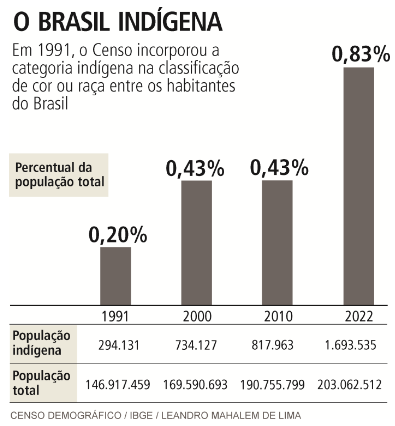
Com base em seus conhecimentos sobre a população indígena em território brasileiro e tendo em vista o gráfico a seguir, assinale a alternativa correta.
(Revista Pesquisa Fapesp. Edição 331, setembro 2023.)
Em maio de 1977, um mês e um dia depois de fechar o Congresso e decretar o Pacote de Abril, o general presidente Ernesto Geisel disse a jornalistas franceses que o Brasil era uma democracia “relativa”. Na entrevista, Geisel negou a prática de torturas e assassinatos políticos no país.
(Adaptado de http://memorialdademocracia.com.br/card/pais-tem-de mocracia-relativa-diz-geisel. Acesso em: 23/08/20
Tendo em vista seus conhecimentos sobre o regime militar e considerando o texto acima, assinale a alternativa correta.
Analise a charge a seguir.
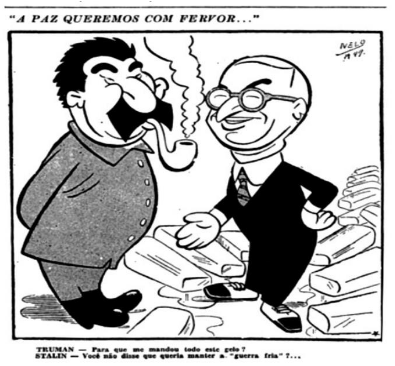
"A paz queremos com fervor…”
Truman: Para que me mandou todo esse gelo?
Stalin: Você não disse que queria manter a “guerra fria”?...
(Nelo, Folha da manhã, 13 fevereiro de 1949, p. 1. In: SOTANA, E. C. O início da Guerra Fria nas páginas da imprensa escrita brasileira (1946-1949). Diálogos, 18, jan.-abr., p. 350, 2014.)
Sobre a charge e o contexto em que foi produzida, assinale a alternativa correta.
Na Lei de Terras de 1850, podia-se ler o seguinte artigo: “Art. 12. O Governo reservará das terras devolutas as que julgar necessárias: 1º, para a colonização dos indígenas; 2º, para a fundação de povoações, abertura de estradas, e quaisquer outras servidões, e assento de estabelecimentos públicos; 3º, para a construção naval”.
A Lei de Terras
O trecho a seguir é extraído do “Livro das leis da Siderúrgica Crowley”, Inglaterra, início do século XVIII.
“Nenhuma pessoa deve confiar, para calcular o tempo, em qualquer relógio que não o do supervisor. [...] Toda manhã, às 5 horas, o diretor deve tocar o sino para o início do trabalho; às 8 horas, para o café da manhã; depois de meia hora, para o retorno ao trabalho; ao meio-dia, para o almoço; às 13 horas, para o trabalho; e às 20 horas, para o fim do expediente, quando tudo deve ser trancado”. (Adaptado de THOMPSON, E.P. Costumes em comum. São Paulo: Cia das Letras, p. 290, 1998.)
Sobre a relação com o tempo, que se esperava dos trabalhadores ingleses, a leitura do texto revela que
O jesuíta José de Acosta, no final do século XVI, propôs três métodos de evangelização para o que distinguia como três tipos de bárbaros. Os povos brasis – “sem lei, sem rei, que mudam de casa ou se, a tendo fixa, elas se assemelham a covis de feras” – somente podiam ser convertidos com o auxílio da força. Incas e Astecas – que possuíam cidades, governo, magistrados e leis – podiam ser administradas por um governador cristão. Por fim, somente nas nações civilizadas da Ásia, como a China e o Japão, podiam os religiosos aplicar o mesmo método utilizado – entre os gregos e os romanos – pelos apóstolos: ou seja, a catequese pacífica e racional que não envolvia mudança de governo. (Adaptado de CARVALHO, F. A. L. Imagens dos índios na Amazônia espanhola, nos séculos XVI e XVII. Revista de Indias, vol. LXXVIII, n. 274, p. 695, 2018.)
No século XVI, a percepção do jesuíta Acosta sobre como deveria ser o governo de povos não europeus
Desde o início de sua série histórica “Conflitos no Campo Brasil”, a Comissão Pastoral da Terra (CPT) registrou 56 massacres no campo, ocorridos em todas as regiões do Brasil. De acordo com sua metodologia, a CPT reconhece como “massacre” os casos nos quais três pessoas ou mais são mortas na mesma data e em uma mesma localidade, numa mesma ocorrência de conflitos pela terra, portanto. Durante esta série histórica, foram registrados diversos “ciclos de violência”. O primeiro, entre 1985 e 1988, fez 112 vítimas fatais. O segundo, entre os anos de 1993 e 1996, teve 56 mortes e se caracterizou por massacres emblemáticos como os de Corumbiara/RO, Haximu/RR e Eldorado dos Carajás/PA.
De 2017 aos dias de hoje, o relatório tem registrado uma nova onda de massacres: neste período, mais de 50 pessoas foram fatalmente vitimadas. (Adaptado de “Massacres no Campo voltam a crescer durante atual crise da democracia no Brasil”. CPT/Massacres no Campo, 14/12/2021; fonte: Centro de Documentação Dom Tomás Balduino - CEDOC/CPT.)
O texto apresentado faz parte do relatório de 2021 sobre violências no campo, elaborado pela Comissão Pastoral da Terra. Há, nesse excerto, três ideias importantes. Assinale a alternativa que apresenta essas ideias.
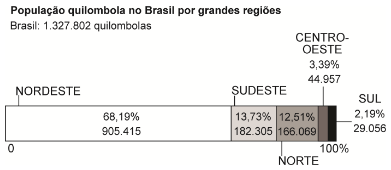
(Censo Demográfico 2022: Quilombolas – Primeiros Resultados do Universo. Adaptado de Agência IBGE: Brasil tem 1,3 milhão de quilombolas em 1.696 municípios (ibge.gov.br). Acesso em: 16/09/2023.)
Tendo em vista seus conhecimentos sobre as populações quilombolas no Brasil e considerando os dados da figura, assinale a alternativa correta.
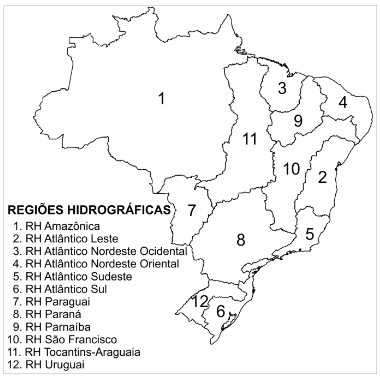
(Agência Nacional de Águas. Disponível em: https://metadados.snirh.gov.br/geonetwork/srv/api/records/0574947a-2c5b-48d2-96a4-b07c4702bbab. Acesso em: 22/11/2023.)
Tendo em vista seus conhecimentos sobre as bacias hidrográficas presentes no território brasileiro e considerando o mapa fornecido, indique a alternativa correta.
“[O STF] tem que votar contra. Estão desrespeitando o que está escrito na Constituição Federal. Não é hora do marco temporal sair como cobra grande para acabar com a gente. Os garimpeiros estão doidos para o Congresso Nacional aprovar essa lei do marco temporal, para eles continuarem a garimpar e botar máquina em terra indígena. [...] [O] marco temporal significa continuar a roubar a terra”. (Trecho de entrevista dada pelo xamã Davi Kopenawa à Folha de S. Paulo em 06/06/2023.)
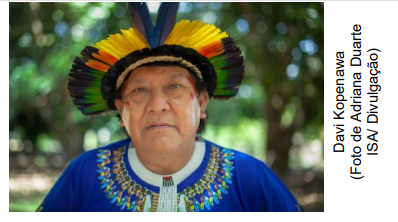
O Recurso Extraordinário (RE) 1017365, julgado no Supremo Tribunal Federal em 27/09/2023, discute a tese do marco temporal para a demarcação de terras indígenas. Considerando seus conhecimentos e as informações apresentadas, assinale a alternativa correta.
O gráfico a seguir retrata a dinâmica populacional e a Transição Demográfica (TD) do Brasil desde 1880, com projeção até 2100.
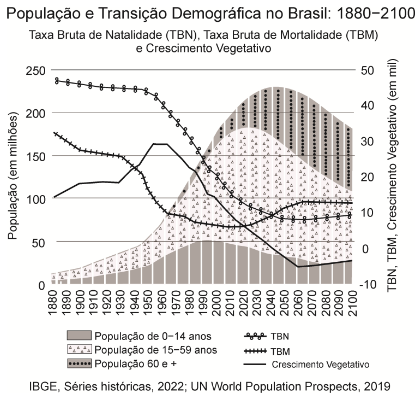
(Adaptado de ALVES, J.E.D. A transição demográfica nos 200 anos da Independência do Brasil.)
Considere o gráfico acima, seus conhecimentos sobre a Taxa Bruta de Natalidade (TBN), a Taxa Bruta de Mortalidade (TBM) e o crescimento Vegetativo ou Natural da população brasileira e indique a alternativa que faz a análise correta do período de 1950 a 2020.
Nos últimos anos, o avanço do garimpo ilegal na Terra Indígena Yanomami, somado ao desmonte de políticas públicas, foram importantes indutores de impactos socioambientais e de mortes junto à população indígena que habita essa terra.
Assinale a alternativa que indica corretamente a região de localização da Terra Indígena Yanomami e os impactos socioambientais resultantes do avanço do garimpo ilegal.
A figura a seguir mostra um triângulo e certos ângulos dados em termos de valores reais x e y.
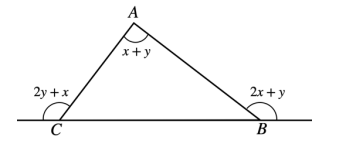
De acordo com as informações fornecidas pela figura, podese concluir que a medida do ângulo BAC ̂ é de
 Conheça nossos planos