Questões de Vestibular
Foram encontradas 75.369 questões
Resolva questões gratuitamente!
Junte-se a mais de 4 milhões de concurseiros!


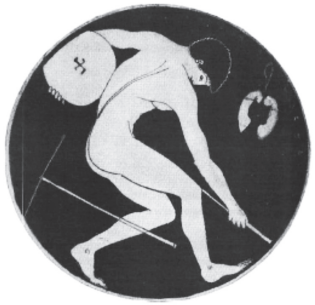
Esporte apreciado entre os helenos, o lançamento de disco exigia do atleta uma disciplina técnica, evidenciada pela harmonia dos movimentos corporais. No centro da imagem, há um jovem se preparando para o lançar o disco. A ausência da barba do personagem permite afirmar que ele está sendo preparado para o exercício da cidadania plena. A presença dos dois halteres e do enxadão indica que a cena ocorre em uma palestra: campo de exercício cercado de edifícios com funções diversas. Na imagem original, contamos com uma inscrição que diz "Kléomelos é belo".
(Texto e imagem adaptados de LESSA, F. de S. Corpo, Esporte e Masculinidade em Atenas. PHOÎNIX, Rio de Janeiro. v. 10: p. 111-132, 2004.)
A partir da imagem e do texto, assinale a alternativa correta sobre a interpretação da imagem.
(Adaptado de ALENCASTRO, L. F. O Trato dos Viventes. São Paulo: Companhia das Letras, 2000. p. 110.)
Com base no excerto, assinale a alternativa correta.
Texto 1
“Convém recorrer aos fundamentos da justiça que propus no começo: primeiro, a ninguém prejudicar, depois, servir à utilidade comum”.
(CÍCERO, Marco Túlio. Dos deveres. UFJF, p. 1-31, 2021.) 3
Texto 2
“Único, com efeito, é o direito a partir do qual a sociedade dos homens foi congregada, e una a lei que o constituiu, lei que é a reta razão ao obrigar e proibir. Quem a ignora é injusto, esteja ela escrita em algum lugar ou em nenhum. Se a justiça é obediência às leis escritas e às instituições dos povos, e se (como dizem aqueles mesmos aos quais me referi) todas as coisas devem ser medidas pela utilidade, negligenciará as leis e as destruirá, se o puder, aquele que assim julgá-lo vantajoso para si; do que se segue que absolutamente não há justiça, se esta não é fundada na natureza, e a que se constitui por causa da utilidade é deteriorada por essa utilidade”.
(CÍCERO, Marco Túlio. Sobre as leis. UFJF, p. 1-46, 2021.)
Considerando os textos, escolha a alternativa correta.
Texto 1
"Para Rosa Luxemburgo, uma sociedade socialista terá necessariamente que ser democrática (e vice-versa), o que significa que só poderá resultar da participação efetiva das massas populares. [...] ela rejeita premonitoriamente a estratégia dos partidos de esquerda que chegarão ao poder no decorrer do século XX: primeiro toma-se o poder, depois muda-se o mundo. Para ela, a tomada do poder e a instituição da democracia (equivalente aqui à mudança do mundo) não são duas etapas separadas no tempo, mas duas faces da mesma moeda”.
(Comentário de Isabel Loureiro ao texto “A Revolução Russa (1918)” de Rosa Luxemburgo. LUXEMBURGO, R. Textos Escolhidos. Editora Expressão Popular, p. 101-2, 2009. Org. Isabel Loureiro.)
Texto 2
"Sem eleições gerais, sem liberdade ilimitada de imprensa e de reunião, sem livre debate de opiniões, a vida se definha em qualquer instituição pública, torna-se uma vida aparente em que só a burocracia subsiste como o único elemento ativo. [...] Somente massas esclarecidas, autônomas, politicamente formadas poderão exercer o poder nos novos organismos de base, os conselhos; em outras palavras, realizar o socialismo democrático".
(LUXEMBURGO, R. Textos Escolhidos. A Revolução Russa (1918). Editora Expressão Popular, Org. Isabel Loureiro, p. 114-131, 2009.)
Considerando os textos, assinale a alternativa que corresponde ao pensamento de Rosa Luxemburgo.
(Adaptado de PRECIADO, P. Eu sou o monstro que vos fala. Zahar Editora, p. 78-84, 2022.)
Considerando o texto assinale a alternativa correta.
Texto 1
A adolescência é uma questão de corporificação do social. Mudanças físicas, como hormônios em ebulição, são importantes, mas elas não determinam como se experimenta a adolescência. Essa é uma questão de como as práticas sociais se relacionam com as mudanças físicas, dando significados sociais a eventos biológicos. A adolescência é um processo de se tornar participante do mundo adulto. Ela é um período em que corpos em desenvolvimento enfrentam desafios, e às vezes são danificados. Instituições, incluindo a escola, e os poderes do mundo adulto são confrontados e negociados. Isso forma uma arena de prazer, humor, curiosidade, mas também de ansiedade e violência.
(Adaptado de CONNELL, R. Crescer como masculino. In: Gênero em termos reais. São Paulo: nVersos, p. 139-141, 2016.)
Texto 2
Ordens de gênero são centrais para a vida dos adolescentes. Quando insistem na diferença absoluta entre masculinidade e feminilidade criam um dilema e fazem com que os meninos exagerem na performance da masculinidade, procurando se aproximarem da posição social dos homens adultos. Práticas corporais, como a sexualidade e o esporte, se tornam importantes meios de diferenciação e espaços de produção das masculinidades hegemônicas e subordinadas. Aquelas que produzem maior status e prestígio masculino são as com os efeitos mais tóxicos sobre os corpos dos adolescentes, como por exemplo o hábito de fumar e praticar a violência física, etc.
(Adaptado de CONNELL, R. Crescer como masculino. In: Gênero em termos reais. São Paulo: nVersos, p. 139-151, 2016.)
A partir da leitura dos textos é correto afirmar que
Texto 1
Muitos povos, de diferentes matrizes culturais, têm a compreensão de que nós e a Terra somos uma mesma entidade. Até o começo do século XX, o mundo do trabalho e da produção se dava com ferramentas e meios que não tinham a potência de exaurir os recursos da Terra como hoje. Desse tempo para cá, sobraram poucas humanidades espalhadas pelo planeta.
(Adaptado de KRENAK, A. A vida não é útil. São Paulo, Companhia das Letras, p. 38, 2020.)
Texto 2
A Terra é um denso conjunto de relações que articula seres vivos, oceanos, atmosfera, clima e solos. Ela é dotada de uma história e de um regime de atividades próprio, resultado da articulação de múltiplos processos. Hoje, já não estamos lidando com uma natureza selvagem e ameaçadora, nem com uma natureza frágil, que deve ser protegida, nem com uma natureza que pode ser explorada à vontade. A hipótese é nova. A Terra não está ameaçada, diferentemente das inúmeras espécies vivas que serão varridas pelas mudanças de seu meio, com uma rapidez sem precedente.
(Adaptado de STENGERS, I. No tempo das catástrofes. São Paulo: Cosac & Naify, p. 23, 2015.)
A partir da leitura dos textos é correto afirmar que natureza e sociedade
Texto 1
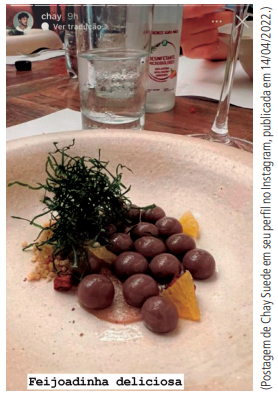
A imagem acima reproduz uma postagem feita pelo ator Chay Suede sobre uma feijoada que havia consumido em um restaurante de luxo. As reações na rede social do ator incluíram comentários como "se isso é feijoada de rico eu prefiro morrer pobre”.
(Adaptado de JIMENEZ, K. Saiba quanto Chay Suede pagou pela polêmica 'feijoada de rico'!. Portal R7, 17 de abr de 2022. Acesso em 01/09/25.)
Texto 2
A forma como as pessoas vivenciam as diferentes classes deve gerar as probabilidades dessas pessoas terem certos gostos, certos estilos de vida. No caso das classes altas, essa lógica é a do desinteresse ou da não-necessidade. Uma vez afastada de toda a urgência da vida pela sobrevivência e pela reprodução, os sujeitos das classes altas possuem uma relação de distanciamento com o mundo. Esse distanciamento transforma o senso de distinção em senso estético nessa classe. O senso estético é a noção de que o belo se dá pela forma, e não pela função.
(Adaptado de BERTONCELO, E.; NICOLAU NETTO, M. Captando a distinção empiricamente. Contemporânea, v. 13, p. 363-364, 2024.)
A partir dos textos, é correto afirmar que a polêmica associada à postagem
Leia o trecho do romance Triste fim de Policarpo Quaresma, de Lima Barreto, para responder a questão
Ricardo agarrou o cálice com delicadeza e respeito, levou-o aos lábios e foi como se todo ele bebesse o licor nacional.
— Está bom, hein?— indagou o major.
— Magnífico — fez Ricardo, estalando os lábios.
— É de Angra. Agora tu vais ver que magnífico vinho do Rio Grande temos… Qual Borgonha! Qual Bordeaux! Temos no Sul muito melhores…
E o jantar correu assim, nesse tom. Quaresma exaltando os produtos nacionais: a banha, o toucinho e o arroz; a irmã fazia pequenas objeções e Ricardo dizia: “É, é, não há dúvida” — rolando nas órbitas os olhos pequenos, franzindo a testa diminuta que se sumia no cabelo áspero, forçando muito a sua fisionomia miúda e dura a adquirir uma expressão sincera de delicadeza e satisfação.
Acabado o jantar foram ver o jardim. Era uma maravilha; não tinha nem uma flor… Certamente não se podia tomar por tal míseros beijos-de-frade, palmas-de-santa-rita, quaresmas lutulentas1 , manacás melancólicos e outros belos exemplares dos nossos campos e prados. Como em tudo o mais, o major era em jardinagem essencialmente nacional. Nada de rosas, de crisântemos, de magnólias — flores exóticas; as nossas terras tinham outras mais belas, mais expressivas, mais olentes2 , como aquelas que ele tinha ali.
Ricardo ainda uma vez concordou e os dois entraram na sala, quando o crepúsculo vinha devagar, muito vagaroso e lento, como se fosse um longo adeus saudoso do sol ao deixar a terra, pondo nas coisas a sua poesia dolente3 e a sua deliquescência4 .
Mal foi aceso o gás, o mestre de violão empunhou o instrumento, apertou as cravelhas, correu a escala, abaixando-se sobre ele como se o quisesse beijar. Tirou alguns acordes, para experimentar; e dirigiu-se ao discípulo, que já tinha o seu em posição:
— Vamos ver. Tire a escala, major.
(Triste fim de Policarpo Quaresma, 2010.)
1 lutulento: lamacento, lodoso.
2 olente: cheiroso, perfumado.
3 dolente: lamentosa, queixosa.
4 deliquescência: propriedade que certas substâncias têm de extrair água.
Nos reatores nucleares, a liberação de energia nuclear ocorre quando o isótopo 235 do urânio (235U) absorve um nêutron, torna-se extremamente instável e rompe-se quase que instantaneamente em dois outros núcleos, como os de bário-141 (141Ba) e criptônio-92 (92Kr). Desse processo, resultam ainda três nêutrons (n) e liberação de 2,70 × 10⁻¹¹ J de energia, como mostra a equação:

Nesse caso, a liberação de energia nuclear ocorre por meio de um processo de
A figura 1 mostra um dispositivo elétrico associado em paralelo a um resistor de 20 Ω. O comportamento da corrente elétrica que se estabelece nesse dispositivo em função da diferença de potencial aplicada entre seus terminais está ilustrado na figura 2.
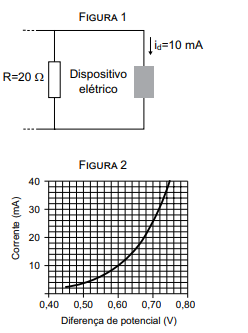
Quando a corrente elétrica nesse dispositivo é igual a 10 mA, a corrente elétrica que se estabelece no resistor vale
O gráfico mostra o conjunto de fontes de energia que compõem a matriz energética brasileira, referente ao ano de 2024.
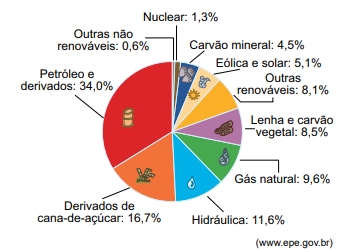
As fontes de energia renováveis que compõem essa matriz correspondem ao total de
Em uma usina termoelétrica, um combustível é utilizado para vaporizar água em uma caldeira e o vapor produzido aciona uma turbina que, por fim, movimenta um gerador. Nesse processo, cada etapa de transformação de energia apresenta um rendimento: vaporização de água na caldeira, com rendimento ηC, movimentação da turbina, com rendimento ηT, e movimentação do gerador, com rendimento ηG, conforme mostra o esquema.
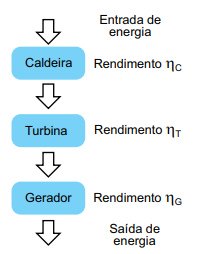
O rendimento total desse processo, ηP, é dado por
O final do ciclo evolutivo de estrelas de grande massa é catastrófico. Elas explodem e espalham parte de sua matéria pelo espaço, restando um núcleo muito denso. Se a massa desse núcleo for maior do que 3 vezes a massa do Sol, ele dará origem a uma região do espaço com uma gravidade tão intensa que nada que estiver nessa região conseguirá dela escapar, nem mesmo a luz.
Essa região é denominada
O ciclo de Otto para um motor ideal de quatro tempos encontra-se representado no diagrama da figura, que mostra o comportamento da pressão do gás em um pistão em função do volume que esse gás ocupa.
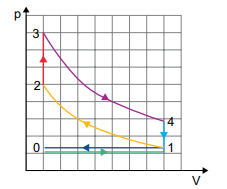
Sabendo que as transformações 1 → 2 e 3 → 4 são adiabáticas, que as transformações 2 → 3 e 4 → 1 são isovolumétricas e que as transformações 1 → 0 e 0 → 1 são isobáricas, a realização de trabalho pelo motor ocorre durante a transformação
Nos últimos anos, banhos no gelo tornaram-se populares entre esportistas, especialmente corredores, triatletas e jogadores de futebol. O mergulho em água muito fria (entre 10 e 15 graus Celsius) por cerca de 5 a 10 minutos ajuda a reduzir a inflamação e o inchaço, aliviar dores musculares e, por causa disso, acelera a recuperação após um jogo ou uma prova de longa distância.
(https://forbes.com.br. Adaptado.)
Um esportista deseja obter água a 10 ºC em uma banheira que, inicialmente, contém 3,0 × 10⁵ g de água a 25 ºC e que está em equilíbrio térmico com a banheira. Desprezando perdas de calor para o ambiente e considerando o calor específico da água igual a 1,0 cal/(g · ºC), o calor latente de fusão do gelo igual a 80 cal/g e a capacidade térmica da banheira igual a 6,0 × 10⁴ cal/ºC, a quantidade de gelo a 0 ºC que deve ser colocada na água contida na banheira para que o conjunto atinja o equilíbrio térmico a 10 ºC é
Em 1610, Galileu fez uma descoberta que contribuiu para a mudança da visão humana sobre o Universo: ele encontrou quatro satélites orbitando Júpiter, mostrando que nem tudo gira ao redor da Terra. Hoje, esses satélites são denominados Calisto, Europa, Ganimedes e Io. Seus períodos de revolução em torno de Júpiter estão indicados na tabela.
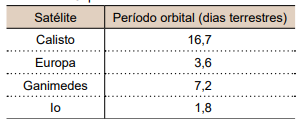
A partir desses dados, conclui-se que, entre esses quatro satélites,
A figura mostra uma pessoa que mantém um conjunto de massas de peso P suspenso e em repouso em um equipamento para exercícios de musculação, o qual contém duas roldanas fixas e uma roldana móvel.
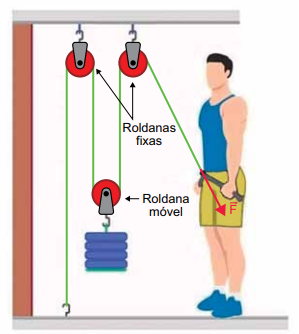
A intensidade da força, F, que é exercida sobre a extremidade do cabo ligada à barra que a pessoa segura, é igual a:

 Conheça nossos planos