Foram encontradas 36.753 questões
Resolva questões gratuitamente!
Junte-se a mais de 4 milhões de concurseiros!


Examine o mapa.
 (www.geografialinks.com. Adaptado.)
 As setas no mapa correspondem
(Antonio C. R. Moraes. Território e história do Brasil, 2005. Adaptado.)
O planejamento estatal apontado no excerto tinha como objetivo
(https://economia.uol.com.br, 14.03.2017. Adaptado.)
O Vale do Silício, importante cenário produtivo mundial, destaca-se por concentrar
Analise os gráficos.
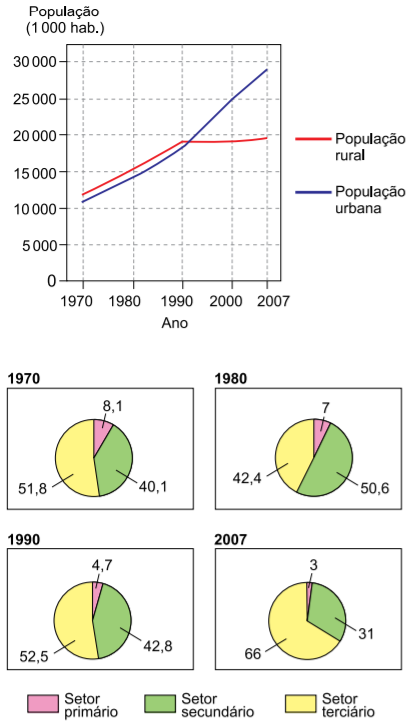
(Levon Boligian. Geografia, 2011. Adaptado.)
Considerando o fenômeno da urbanização, os gráficos correspondem a um país
(www.forumsocialportoalegre.org.br. Adaptado.)
O Fórum Social Mundial contrapõe-se às políticas

(Exame, 05.07.2017.)
A matéria de capa alude a um fato contemporâneo
 (http://bernardoschmidt.blogspot.com.br)
Considerando a imagem e os conhecimentos sobre a história política da época, pode-se concluir que esse Partido
Seja como for, o comunismo não se limitava à Rússia. [...]
Uma das minhas primeiras experiências políticas, quando me
tornei membro do partido [comunista] na época em que ainda
estudava em Berlim, foi uma discussão com o companheiro
responsável por meu recrutamento. Ele ficou desconcertado
quando lhe disse: “Bem, todo mundo sabe que a Rússia é um
país atrasado, por isso podemos esperar que o comunismo
tenha suas derrotas por lá.”
A afirmação do estudante de Berlim e futuro historiador inglês baseava-se na ideia de que
(Machado de Assis. Memorial de Aires, 1988. Adaptado.)
A trama do romance, publicado em primeira edição em 1908, transcorre na sociedade carioca do ano de 1888. O excerto reproduz o diálogo de dois amigos, referindo-se à
A Bahia é cidade d’El-Rei, e a corte do Brasil; nela residem os Srs. Bispo, Governador, Ouvidor-Geral, com outros
oficiais e justiça de Sua Majestade; [...]. É terra farta de mantimentos, carnes de vaca, porco, galinha, ovelhas, e outras
criações; tem 36 engenhos, neles se faz o melhor açúcar de
toda a costa; [...] terá a cidade com seu termo passante de
três mil vizinhos Portugueses, oito mil Índios cristãos, e três
ou quatro mil escravos da Guiné.
O padre Fernão Cardim foi testemunha da colonização portuguesa do Brasil de 1583 a 1601. O excerto faz uma descrição de Salvador, sede do Governo-Geral, referindo-se, entre outros aspectos, à
Leia o texto para responder à questão.
Leia o texto para responder à questão.
O excerto destaca a originalidade da civilização cretense, entre 2000 e 1400 a.C., em relação às sociedades do Mediterrâneo Oriental e do Oriente Médio, caracterizadas
Pseudoscientific claims that music helps plants grow have been made for decades, despite evidence that is shaky at best. Yet new research suggests some flora may be capable of sensing sounds, such as the gurgle of water through a pipe or the buzzing of insects.
In a recent study, Monica Gagliano, an evolutionary biologist at the University of Western Australia, and her colleagues placed pea seedlings in pots shaped like an upside-down Y. One arm of each pot was placed in either a tray of water or a coiled plastic tube through which water flowed; the other arm had dry soil. The roots grew toward the arm of the pipe with the fluid, regardless of whether it was easily accessible or hidden inside the tubing. “They just knew the water was there, even if the only thing to detect was the sound of it flowing inside the pipe,” Gagliano says. Yet when the seedlings were given a choice between the water tube and some moistened soil, their roots favored the latter. She hypothesizes that these plants use sound waves to detect water at a distance but follow moisture gradients to home in on their target when it is closer.
The research, reported earlier this year in Oecologia, is not the first to suggest flora can detect and interpret sounds. A 2014 study showed the rock cress Arabidopsis can distinguish between caterpillar chewing sounds and wind vibrations – the plant produced more chemical toxins after “hearing” a recording of feeding insects. “We tend to underestimate plants because their responses are usually less visible to us. But leaves turn out to be extremely sensitive vibration detectors,” says lead study author Heidi M. Appel, an environmental scientist now at the University of Toledo.
Pseudoscientific claims that music helps plants grow have been made for decades, despite evidence that is shaky at best. Yet new research suggests some flora may be capable of sensing sounds, such as the gurgle of water through a pipe or the buzzing of insects.
In a recent study, Monica Gagliano, an evolutionary biologist at the University of Western Australia, and her colleagues placed pea seedlings in pots shaped like an upside-down Y. One arm of each pot was placed in either a tray of water or a coiled plastic tube through which water flowed; the other arm had dry soil. The roots grew toward the arm of the pipe with the fluid, regardless of whether it was easily accessible or hidden inside the tubing. “They just knew the water was there, even if the only thing to detect was the sound of it flowing inside the pipe,” Gagliano says. Yet when the seedlings were given a choice between the water tube and some moistened soil, their roots favored the latter. She hypothesizes that these plants use sound waves to detect water at a distance but follow moisture gradients to home in on their target when it is closer.
The research, reported earlier this year in Oecologia, is not the first to suggest flora can detect and interpret sounds. A 2014 study showed the rock cress Arabidopsis can distinguish between caterpillar chewing sounds and wind vibrations – the plant produced more chemical toxins after “hearing” a recording of feeding insects. “We tend to underestimate plants because their responses are usually less visible to us. But leaves turn out to be extremely sensitive vibration detectors,” says lead study author Heidi M. Appel, an environmental scientist now at the University of Toledo.
Pseudoscientific claims that music helps plants grow have been made for decades, despite evidence that is shaky at best. Yet new research suggests some flora may be capable of sensing sounds, such as the gurgle of water through a pipe or the buzzing of insects.
In a recent study, Monica Gagliano, an evolutionary biologist at the University of Western Australia, and her colleagues placed pea seedlings in pots shaped like an upside-down Y. One arm of each pot was placed in either a tray of water or a coiled plastic tube through which water flowed; the other arm had dry soil. The roots grew toward the arm of the pipe with the fluid, regardless of whether it was easily accessible or hidden inside the tubing. “They just knew the water was there, even if the only thing to detect was the sound of it flowing inside the pipe,” Gagliano says. Yet when the seedlings were given a choice between the water tube and some moistened soil, their roots favored the latter. She hypothesizes that these plants use sound waves to detect water at a distance but follow moisture gradients to home in on their target when it is closer.
The research, reported earlier this year in Oecologia, is not the first to suggest flora can detect and interpret sounds. A 2014 study showed the rock cress Arabidopsis can distinguish between caterpillar chewing sounds and wind vibrations – the plant produced more chemical toxins after “hearing” a recording of feeding insects. “We tend to underestimate plants because their responses are usually less visible to us. But leaves turn out to be extremely sensitive vibration detectors,” says lead study author Heidi M. Appel, an environmental scientist now at the University of Toledo.
 Conheça nossos planos