Questões de Vestibular UEG 2025 para Vestibular - Medicina (2º Semestre 2025) - Reaplicação
Foram encontradas 5 questões


Ano: 2025
Banca:
UEG
Órgão:
UEG
Prova:
UEG - 2025 - UEG - Vestibular - Medicina (2º Semestre 2025) - Reaplicação |
Q3508157
Inglês
Leia o cartoon a seguir para responder à questão
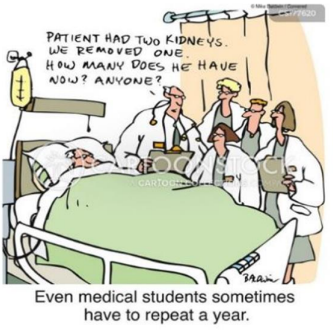
Disponível em: https://www.cartoonstock.com/directory/m/medical_student. Acesso em: 7 maio 2025.
The cartoon shows that
Ano: 2025
Banca:
UEG
Órgão:
UEG
Prova:
UEG - 2025 - UEG - Vestibular - Medicina (2º Semestre 2025) - Reaplicação |
Q3508158
Inglês
Texto associado
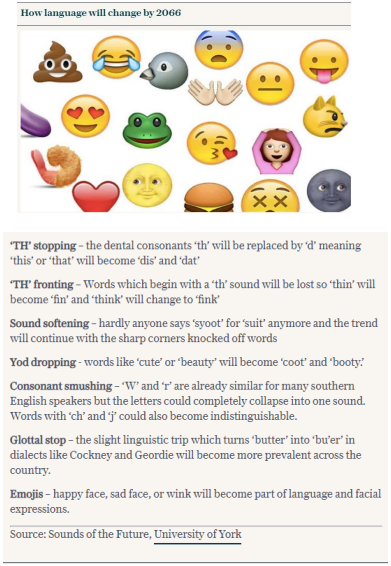
Leia os textos a seguir para responder à questão.
'Th' sound to vanish from English language by 2066 because of multiculturalism, say linguists
Visitors expecting to hear the Queen’s English spoken on the streets of London in 50 years may need to "fink" again.
By 2066, linguists are predicting that the "th"
sound will vanish completely in the capital because
there are so many foreigners who struggle to
pronounce interdental consonants - the term for a
sound created by pushing the tongue against the
upper teeth. Already Estuary English – a hybrid of
Cockney and received pronunciation (RP) which is
prevalent in the South East – is being replaced by
Multicultural London English (MLE) which is heavily
influenced by Caribbean, West African and Asian
Communities. But within the next few decades
immigration will have fundamentally altered the
language, according to experts at the University of
York.
The "th" sound – also called the voiced
dental nonsibliant fricative – is likely to change to be
replaced an "f", "d", or "v" meaning "mother" will be
pronounced "muvver" and "thick" will be voiced as
"fick". However the ‘h’ that fell silent in Cockney
dialect is set to return allowing ‘ere’ to become ‘here’
once more.
Dr Dominic Watt, a sociolinguistics expert
from the University of York, said: “Given the status of
London as the linguistically most influential city in the
English-speaking world, we can expect to see
significant changes between now and the middle of
the century. The major changes in the way we speak
over the next 50 years will involve a simplification of
the sound structure of words, they’ll become shorter
probably. By looking at how English has changed
over the last 50 years we can identify patterns that
seem to repeat. British accents seem to be less
based on class these days. Languages also change
when they come into contact with one another.
English has borrowed thousands of words from other
languages: mainly French, Latin and Greek, but there
are ‘loan words’ from dozens of other languages in
the mix.”
The Sounds of The Future report was produced from a study involving analysis of recordings from the last 50 years
as well as social media language use.
Other changes likely to become widespread by 2066 include a habit known as "yod dropping" in which the "u" sound
is replaced with an "oo". It means that "duke" becomes "dook", "news" is pronounced "nooze" and "beauty" changes to "booty".
Consonant "smushing" is also predicted where two sounds collapse together completely so that "wed" and "red" will soon be
indistinguishable. Likewise the "l" at the end of words will be dropped so that the words "Paul", "paw" and "pool" all sound the
same. Similiarly, "text" will lose the final "t" to become "tex". And, the glottal stop pronunciation of "t" – a brief catch in the
throat when the tongue tip closed against the roof of the mouth – will be the default pronunciation.
Brendan Gunn, a voice coach who is currently working with Pierce Brosnan on his new US series said: “The younger
generation always wants to be different from the older generation and that process will continue throughout history.“Text speak
which is a form of shortening will become ordinary speak, so you may end up saying ‘tagLOL’ or ‘toteschill’ which means
hashtag laugh out loud or totally chilled. Even in the Royal family it is probable that Prince George will speak much differently
to the Queen. In London I think we will see the ‘th’ becoming an ‘f’ all the time.”
Technology will also change the way people speak, and the experts predict that as artificial intelligence emerges, the
computers could begin to invent new words. Dr Watt added: “It is conceivable that some of the words that will come into
English in the next 50 years will have been invented by computers because as computers become more intelligent it may be
they start creating words of their own and feeding the, [sic] back to us.”
Disponível em: https://www.telegraph.co.uk/science/2016/09/28/. Acesso em: 8 maio 2025. (Adaptado).
According to the text, it can be stated that
Ano: 2025
Banca:
UEG
Órgão:
UEG
Prova:
UEG - 2025 - UEG - Vestibular - Medicina (2º Semestre 2025) - Reaplicação |
Q3508159
Inglês
Texto associado
Leia os textos a seguir para responder à questão.
'Th' sound to vanish from English language by 2066 because of multiculturalism, say linguists
Visitors expecting to hear the Queen’s English spoken on the streets of London in 50 years may need to "fink" again.
By 2066, linguists are predicting that the "th"
sound will vanish completely in the capital because
there are so many foreigners who struggle to
pronounce interdental consonants - the term for a
sound created by pushing the tongue against the
upper teeth. Already Estuary English – a hybrid of
Cockney and received pronunciation (RP) which is
prevalent in the South East – is being replaced by
Multicultural London English (MLE) which is heavily
influenced by Caribbean, West African and Asian
Communities. But within the next few decades
immigration will have fundamentally altered the
language, according to experts at the University of
York.
The "th" sound – also called the voiced
dental nonsibliant fricative – is likely to change to be
replaced an "f", "d", or "v" meaning "mother" will be
pronounced "muvver" and "thick" will be voiced as
"fick". However the ‘h’ that fell silent in Cockney
dialect is set to return allowing ‘ere’ to become ‘here’
once more.
Dr Dominic Watt, a sociolinguistics expert
from the University of York, said: “Given the status of
London as the linguistically most influential city in the
English-speaking world, we can expect to see
significant changes between now and the middle of
the century. The major changes in the way we speak
over the next 50 years will involve a simplification of
the sound structure of words, they’ll become shorter
probably. By looking at how English has changed
over the last 50 years we can identify patterns that
seem to repeat. British accents seem to be less
based on class these days. Languages also change
when they come into contact with one another.
English has borrowed thousands of words from other
languages: mainly French, Latin and Greek, but there
are ‘loan words’ from dozens of other languages in
the mix.”
The Sounds of The Future report was produced from a study involving analysis of recordings from the last 50 years
as well as social media language use.
Other changes likely to become widespread by 2066 include a habit known as "yod dropping" in which the "u" sound
is replaced with an "oo". It means that "duke" becomes "dook", "news" is pronounced "nooze" and "beauty" changes to "booty".
Consonant "smushing" is also predicted where two sounds collapse together completely so that "wed" and "red" will soon be
indistinguishable. Likewise the "l" at the end of words will be dropped so that the words "Paul", "paw" and "pool" all sound the
same. Similiarly, "text" will lose the final "t" to become "tex". And, the glottal stop pronunciation of "t" – a brief catch in the
throat when the tongue tip closed against the roof of the mouth – will be the default pronunciation.
Brendan Gunn, a voice coach who is currently working with Pierce Brosnan on his new US series said: “The younger
generation always wants to be different from the older generation and that process will continue throughout history.“Text speak
which is a form of shortening will become ordinary speak, so you may end up saying ‘tagLOL’ or ‘toteschill’ which means
hashtag laugh out loud or totally chilled. Even in the Royal family it is probable that Prince George will speak much differently
to the Queen. In London I think we will see the ‘th’ becoming an ‘f’ all the time.”
Technology will also change the way people speak, and the experts predict that as artificial intelligence emerges, the
computers could begin to invent new words. Dr Watt added: “It is conceivable that some of the words that will come into
English in the next 50 years will have been invented by computers because as computers become more intelligent it may be
they start creating words of their own and feeding the, [sic] back to us.”
Disponível em: https://www.telegraph.co.uk/science/2016/09/28/. Acesso em: 8 maio 2025. (Adaptado).
Considering the linguistic aspects in the text, it can be verified that
Ano: 2025
Banca:
UEG
Órgão:
UEG
Prova:
UEG - 2025 - UEG - Vestibular - Medicina (2º Semestre 2025) - Reaplicação |
Q3508160
Inglês
Texto associado
Leia o texto a seguir para responder à questão.
We often hear older generations talk about how much more difficult they had it when they were young—and doctors are no
exception. It’s not uncommon to hear older physicians and younger physicians argue about whose training was more difficult.
But how does medical school today actually compare to medical school in the past? Let’s explore both sides of the argument
to determine who had it tougher.
Medical students today have much more information to learn compared to previous years. According to a 2011 article, the
doubling time of medical knowledge in 1950 was approximately 50 years. In 1980, it was 7 years. In 2010, it was 3.5 years.
And today, medical knowledge is believed to double every 2-3 months.
Although there is a lag between the primary literature and the information that is added to medical school curricula, students
are still learning much more information today than in previous years. Despite these vast increases in knowledge, medical
school is still the same duration that it has been for decades. Students complete 2 years of preclinical coursework followed by
2 years of clinicals. This means that students have to cram much more learning into those 4 short years.
That being said, the way that today’s medical students learn is very different than what it was for students in the past. We have
a much better understanding of how to optimize learning today. People have developed countless methods to be more efficient
with studying. From the Pomodoro method to the Feynman technique and spaced repetition, we have hacked our study
strategies so that we can learn more in less time.
In the past, medical students had to flip through their textbooks or notes to find the information they needed. Nowadays, you
can take out your phone, put your question into Google, and have more information than you could want on whatever topic
you’re trying to learn.
Beyond the amount of information and resources, however, there is also the fact that many schools nowadays are transitioning
to pass-fail curriculums. In fact, within the last year, USMLE Step 1, which has long been the most important test in
determining your competitiveness for residency, has also become pass-fail.
The goal of these changes has been to decrease stress and burnout among students as research has shown that student wellbeing is enhanced and academic performance is not negatively affected by pass-fail curriculums. That being said, due to the
nature of these curricula, students may need to spend more time on extracurricular activities such as research and leadership
to stand out for residency applications.
In addition, just because medical school curriculums and Step 1 are pass-fail doesn’t make them easy. Students must still put
in significant time and effort to pass while managing their other activities. As such it can be difficult to gauge how much time to
put into medical school classes vs studying for boards vs extracurricular activities. Achieving the perfect balance between all of
these responsibilities can often feel near impossible.
Disponível em: https://medschoolinsiders.com/pre-med/medical-school-today-vs-in-the-past/. Acesso em: 7 maio 2025. (Adaptado).
According to the text, medical students, nowadays,
Ano: 2025
Banca:
UEG
Órgão:
UEG
Prova:
UEG - 2025 - UEG - Vestibular - Medicina (2º Semestre 2025) - Reaplicação |
Q3508161
Inglês
Texto associado
Leia o texto a seguir para responder à questão.
We often hear older generations talk about how much more difficult they had it when they were young—and doctors are no
exception. It’s not uncommon to hear older physicians and younger physicians argue about whose training was more difficult.
But how does medical school today actually compare to medical school in the past? Let’s explore both sides of the argument
to determine who had it tougher.
Medical students today have much more information to learn compared to previous years. According to a 2011 article, the
doubling time of medical knowledge in 1950 was approximately 50 years. In 1980, it was 7 years. In 2010, it was 3.5 years.
And today, medical knowledge is believed to double every 2-3 months.
Although there is a lag between the primary literature and the information that is added to medical school curricula, students
are still learning much more information today than in previous years. Despite these vast increases in knowledge, medical
school is still the same duration that it has been for decades. Students complete 2 years of preclinical coursework followed by
2 years of clinicals. This means that students have to cram much more learning into those 4 short years.
That being said, the way that today’s medical students learn is very different than what it was for students in the past. We have
a much better understanding of how to optimize learning today. People have developed countless methods to be more efficient
with studying. From the Pomodoro method to the Feynman technique and spaced repetition, we have hacked our study
strategies so that we can learn more in less time.
In the past, medical students had to flip through their textbooks or notes to find the information they needed. Nowadays, you
can take out your phone, put your question into Google, and have more information than you could want on whatever topic
you’re trying to learn.
Beyond the amount of information and resources, however, there is also the fact that many schools nowadays are transitioning
to pass-fail curriculums. In fact, within the last year, USMLE Step 1, which has long been the most important test in
determining your competitiveness for residency, has also become pass-fail.
The goal of these changes has been to decrease stress and burnout among students as research has shown that student wellbeing is enhanced and academic performance is not negatively affected by pass-fail curriculums. That being said, due to the
nature of these curricula, students may need to spend more time on extracurricular activities such as research and leadership
to stand out for residency applications.
In addition, just because medical school curriculums and Step 1 are pass-fail doesn’t make them easy. Students must still put
in significant time and effort to pass while managing their other activities. As such it can be difficult to gauge how much time to
put into medical school classes vs studying for boards vs extracurricular activities. Achieving the perfect balance between all of
these responsibilities can often feel near impossible.
Disponível em: https://medschoolinsiders.com/pre-med/medical-school-today-vs-in-the-past/. Acesso em: 7 maio 2025. (Adaptado).
According to the text, medical students, in the past,

 Conheça nossos planos