Questões de Vestibular Comentadas sobre não definido
Foram encontradas 37.536 questões


(Patricio Dugnani. “Meios de Comunicação de Massa e Meios Digitais: remassificação e internetilização”. In: Anagramas Rumbos y Sentidos de la Comunicación, 2024. Adaptado.)
O excerto revela que a comunicação contemporânea mantém traços centrais dos conceitos de indústria cultural, teorizados pela Escola de Frankfurt, que podem ser identificados a partir da
(Diogo Meyer e Charbel Niño El-Hani. Evolução: o sentido da biologia, 2005. Adaptado.)
A reorganização do campo da biologia descrito no excerto representa, para a filosofia da ciência,
O ponto de partida da filosofia autêntica encontra-se no espanto, na admiração ou na angústia. Uma fissura manifesta-se na existência; é preciso cimentar a brecha da dúvida. O pensamento vem e põe ordem na desordem. Chamam--se filosofia os primeiros princípios que traduzem a justificação que a pessoa se dá sobre seu lugar no mundo. O que a reflexão procura é sempre um estado de paz, princípio de uma orientação ontológica em fé da qual o homem se encontra à vontade na sua paisagem. Neste sentido, a função da filosofia não é diferente da do mito. O mito é a primeira forma desta adaptação espiritual da comunidade humana ao seu contorno. O pensador, uma vez rompida a consciência coletiva, retoma-o por sua conta, com os meios acrescidos da reflexão.
(Georges Gusdorf. Mito e metafísica, 1979. Adaptado.)
Com base no excerto, a relação entre mito e filosofia pode ser compreendida como a
(Ricardo Westin. www12.senado.leg.br, 14.09.2020. Adaptado.)
No contexto tratado pelo excerto, a lei adotada em meados do século XIX e uma consequência dela percebida ainda hoje no Brasil são
(https://relacoesexteriores.com.br. Adaptado.)
A construção geopolítica do termo “Sul Global” evidencia uma
(Manuel Castells. Redes de indignação e esperança: movimentos sociais na era da internet, 2013.)
O tipo de movimento social caracterizado no excerto é exemplificado
Nunca mais vi meu irmão
Diz que ele pergunta de mim (não sei não)
A gente nunca teve muito a ver
Outra ideia, outro rolê
Os maluco lá do bairro
Já falava de revólver, droga, carro
Pela janela da classe, eu olhava lá fora
A rua me atraía mais do que a escola
Fiz dezessete, tinha que sobreviver
Agora eu era um homem, tinha que correr
No mundão você vale o que tem
Eu não podia contar com ninguém
[...] fica você com seu sonho de doutô
Quando acordar cê me avisa, morô?
Eu e meu irmão era como óleo e água
Quando eu saí de casa trouxe muita mágoa
Isso há mais ou menos seis anos atrás [...]
Meu sobrinho nasceu
Diz que o rosto dele é parecido com o meu
É, diz...
Um pivete eu sempre quis
Meu irmão merece ser feliz
Deve estar a essa altura
Bem perto de fazer a formatura
Acho que é direito, advocacia
Acho que era isso que ele queria
Sinceramente, eu me sinto feliz
Graças a Deus, não fez o que eu fiz
Minha finada mãe, proteja o seu menino
O diabo agora guia o meu destino
Se o júri for generoso comigo
Quinze anos pra cada latrocínio
Sem dinheiro pra me defender [...]
(Sobrevivendo no inferno, 2018.)
O excerto da letra identifica
(Cláudia Fonseca. “Ser mulher, mãe e pobre”. In: Mary Del Priore (org.). História das mulheres no Brasil, 2015.)
Os dados apresentados no excerto mostram que
— Mas o que é que há? perguntou Aires.
— A república está proclamada.
— Já há governo?
— Penso que já; mas diga-me V. Ex.a: ouviu alguém acusar-me jamais de atacar o governo? Ninguém. Entretanto... Uma fatalidade! Venha em meu socorro. Excelentíssimo. Ajude-me a sair deste embaraço. A tabuleta está pronta, o nome todo pintado. — “Confeitaria do Império”, a tinta é viva e bonita. O pintor teima em que lhe pague o trabalho, para então fazer outro. Eu, se a obra não estivesse acabada, mudava de título, por mais que me custasse, mas hei de perder o dinheiro que gastei? V. Ex.a crê que, se ficar “Império”, venham quebrar-me as vidraças?
— Isso não sei.
— Realmente, não há motivo; é o nome da casa, nome de trinta anos, ninguém a conhece de outro modo.
— Mas pode por “Confeitaria da República”...
— Lembrou-me isso, em caminho, mas também me lembrou que, se daqui a um ou dous meses, houver nova reviravolta, fico no ponto em que estou hoje, e perco outra vez o dinheiro.
(Machado de Assis. Obra completa, 1986.)
O excerto mostra um diálogo do proprietário de uma confeita ria com outro personagem, o Conselheiro Aires. No diálogo, o dono da confeitaria expressa
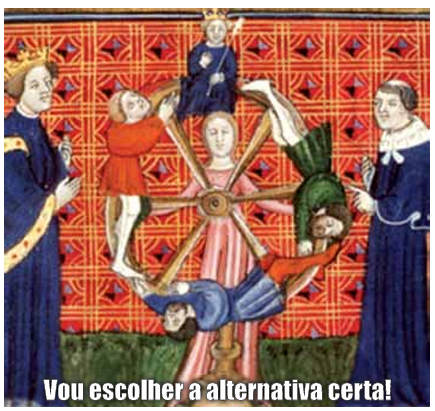
(www.medievalmemes.org)
O meme mostra uma roda da fortuna, sendo girada pela senhora Fortuna, e expõe uma característica da mentalidade do Período Medieval:
(Barbara Ehrenreich. Dançando nas ruas, 2010.)
Ao tratar do surgimento do cristianismo, o excerto
Leia o texto para responder à questão.
Dr. Mariangela Hungria will receive the $500,000 award for her work to utilize biological processes to sustainably improve crop1 nutrition, yields2 and productivity. The scientist whose discoveries helped Brazil become a global agricultural powerhouse has been named the 2025 World Food Prize Laureate.
Dr. Mariangela Hungria, a microbiologist from São Paulo, has developed dozens of biological seed and soil treatments that help crops source nutrients through soil bacteria, significantly increasing yields of major crops while also reducing the need for synthetic fertilizer. Her products are estimated to have been used across more than 40 million hectares in Brazil, saving farmers up to US$40 billion a year in costs while avoiding more than 180 million metric tons of CO2 equivalent emissions per year.
Dr. Hungria’s work has helped improve yields of wheat, corn, rice, common beans, and other major crops, including soybean, which is now Brazil’s top agricultural export. Over her 40-year career with the Brazilian Agricultural Research Corporation (Embrapa), national soybean production increased from 15 million tons in 1979 to an anticipated 173 million tons in the next harvest3 in 2025.
Dr. Hungria, who overcame prejudices against women and young mothers in academia to be named one of the 100 most powerful women in agriculture in Brazil by Forbes magazine in 2021, said she was inspired by Dr. Norman Borlaug, the father of the Green Revolution and founder of the World Food Prize. “I like to say that he made the Green Revolution possible, and we had this great opportunity to start a ‘micro green revolution’ — a green revolution, but with microorganisms,” she added. “I can’t quite believe I am now receiving the World Food Prize. Many people questioned me and my abilities throughout my career but I believed in what I was doing and persevered. The role of women in agriculture, from farming to science, deserves more recognition. I hope my achievement inspires others to pursue their passions in science.”
(www.worldfoodprize.org, 13.05.2025. Adaptado.)
1crop: cultivated plant that is grown as food, especially grain, fruit or vegetable.
2yields: the full amounts of an agricultural product.
3harvest: the crops that are cut and collected.
Leia o texto para responder à questão.
Dr. Mariangela Hungria will receive the $500,000 award for her work to utilize biological processes to sustainably improve crop1 nutrition, yields2 and productivity. The scientist whose discoveries helped Brazil become a global agricultural powerhouse has been named the 2025 World Food Prize Laureate.
Dr. Mariangela Hungria, a microbiologist from São Paulo, has developed dozens of biological seed and soil treatments that help crops source nutrients through soil bacteria, significantly increasing yields of major crops while also reducing the need for synthetic fertilizer. Her products are estimated to have been used across more than 40 million hectares in Brazil, saving farmers up to US$40 billion a year in costs while avoiding more than 180 million metric tons of CO2 equivalent emissions per year.
Dr. Hungria’s work has helped improve yields of wheat, corn, rice, common beans, and other major crops, including soybean, which is now Brazil’s top agricultural export. Over her 40-year career with the Brazilian Agricultural Research Corporation (Embrapa), national soybean production increased from 15 million tons in 1979 to an anticipated 173 million tons in the next harvest3 in 2025.
Dr. Hungria, who overcame prejudices against women and young mothers in academia to be named one of the 100 most powerful women in agriculture in Brazil by Forbes magazine in 2021, said she was inspired by Dr. Norman Borlaug, the father of the Green Revolution and founder of the World Food Prize. “I like to say that he made the Green Revolution possible, and we had this great opportunity to start a ‘micro green revolution’ — a green revolution, but with microorganisms,” she added. “I can’t quite believe I am now receiving the World Food Prize. Many people questioned me and my abilities throughout my career but I believed in what I was doing and persevered. The role of women in agriculture, from farming to science, deserves more recognition. I hope my achievement inspires others to pursue their passions in science.”
(www.worldfoodprize.org, 13.05.2025. Adaptado.)
1crop: cultivated plant that is grown as food, especially grain, fruit or vegetable.
2yields: the full amounts of an agricultural product.
3harvest: the crops that are cut and collected.
Leia o texto para responder à questão.
Dr. Mariangela Hungria will receive the $500,000 award for her work to utilize biological processes to sustainably improve crop1 nutrition, yields2 and productivity. The scientist whose discoveries helped Brazil become a global agricultural powerhouse has been named the 2025 World Food Prize Laureate.
Dr. Mariangela Hungria, a microbiologist from São Paulo, has developed dozens of biological seed and soil treatments that help crops source nutrients through soil bacteria, significantly increasing yields of major crops while also reducing the need for synthetic fertilizer. Her products are estimated to have been used across more than 40 million hectares in Brazil, saving farmers up to US$40 billion a year in costs while avoiding more than 180 million metric tons of CO2 equivalent emissions per year.
Dr. Hungria’s work has helped improve yields of wheat, corn, rice, common beans, and other major crops, including soybean, which is now Brazil’s top agricultural export. Over her 40-year career with the Brazilian Agricultural Research Corporation (Embrapa), national soybean production increased from 15 million tons in 1979 to an anticipated 173 million tons in the next harvest3 in 2025.
Dr. Hungria, who overcame prejudices against women and young mothers in academia to be named one of the 100 most powerful women in agriculture in Brazil by Forbes magazine in 2021, said she was inspired by Dr. Norman Borlaug, the father of the Green Revolution and founder of the World Food Prize. “I like to say that he made the Green Revolution possible, and we had this great opportunity to start a ‘micro green revolution’ — a green revolution, but with microorganisms,” she added. “I can’t quite believe I am now receiving the World Food Prize. Many people questioned me and my abilities throughout my career but I believed in what I was doing and persevered. The role of women in agriculture, from farming to science, deserves more recognition. I hope my achievement inspires others to pursue their passions in science.”
(www.worldfoodprize.org, 13.05.2025. Adaptado.)
1crop: cultivated plant that is grown as food, especially grain, fruit or vegetable.
2yields: the full amounts of an agricultural product.
3harvest: the crops that are cut and collected.
According to the fourth paragraph, Dr. Hungria partly attributes her success to
Leia o texto para responder à questão.
Dr. Mariangela Hungria will receive the $500,000 award for her work to utilize biological processes to sustainably improve crop1 nutrition, yields2 and productivity. The scientist whose discoveries helped Brazil become a global agricultural powerhouse has been named the 2025 World Food Prize Laureate.
Dr. Mariangela Hungria, a microbiologist from São Paulo, has developed dozens of biological seed and soil treatments that help crops source nutrients through soil bacteria, significantly increasing yields of major crops while also reducing the need for synthetic fertilizer. Her products are estimated to have been used across more than 40 million hectares in Brazil, saving farmers up to US$40 billion a year in costs while avoiding more than 180 million metric tons of CO2 equivalent emissions per year.
Dr. Hungria’s work has helped improve yields of wheat, corn, rice, common beans, and other major crops, including soybean, which is now Brazil’s top agricultural export. Over her 40-year career with the Brazilian Agricultural Research Corporation (Embrapa), national soybean production increased from 15 million tons in 1979 to an anticipated 173 million tons in the next harvest3 in 2025.
Dr. Hungria, who overcame prejudices against women and young mothers in academia to be named one of the 100 most powerful women in agriculture in Brazil by Forbes magazine in 2021, said she was inspired by Dr. Norman Borlaug, the father of the Green Revolution and founder of the World Food Prize. “I like to say that he made the Green Revolution possible, and we had this great opportunity to start a ‘micro green revolution’ — a green revolution, but with microorganisms,” she added. “I can’t quite believe I am now receiving the World Food Prize. Many people questioned me and my abilities throughout my career but I believed in what I was doing and persevered. The role of women in agriculture, from farming to science, deserves more recognition. I hope my achievement inspires others to pursue their passions in science.”
(www.worldfoodprize.org, 13.05.2025. Adaptado.)
1crop: cultivated plant that is grown as food, especially grain, fruit or vegetable.
2yields: the full amounts of an agricultural product.
3harvest: the crops that are cut and collected.
Leia o texto para responder à questão.
Dr. Mariangela Hungria will receive the $500,000 award for her work to utilize biological processes to sustainably improve crop1 nutrition, yields2 and productivity. The scientist whose discoveries helped Brazil become a global agricultural powerhouse has been named the 2025 World Food Prize Laureate.
Dr. Mariangela Hungria, a microbiologist from São Paulo, has developed dozens of biological seed and soil treatments that help crops source nutrients through soil bacteria, significantly increasing yields of major crops while also reducing the need for synthetic fertilizer. Her products are estimated to have been used across more than 40 million hectares in Brazil, saving farmers up to US$40 billion a year in costs while avoiding more than 180 million metric tons of CO2 equivalent emissions per year.
Dr. Hungria’s work has helped improve yields of wheat, corn, rice, common beans, and other major crops, including soybean, which is now Brazil’s top agricultural export. Over her 40-year career with the Brazilian Agricultural Research Corporation (Embrapa), national soybean production increased from 15 million tons in 1979 to an anticipated 173 million tons in the next harvest3 in 2025.
Dr. Hungria, who overcame prejudices against women and young mothers in academia to be named one of the 100 most powerful women in agriculture in Brazil by Forbes magazine in 2021, said she was inspired by Dr. Norman Borlaug, the father of the Green Revolution and founder of the World Food Prize. “I like to say that he made the Green Revolution possible, and we had this great opportunity to start a ‘micro green revolution’ — a green revolution, but with microorganisms,” she added. “I can’t quite believe I am now receiving the World Food Prize. Many people questioned me and my abilities throughout my career but I believed in what I was doing and persevered. The role of women in agriculture, from farming to science, deserves more recognition. I hope my achievement inspires others to pursue their passions in science.”
(www.worldfoodprize.org, 13.05.2025. Adaptado.)
1crop: cultivated plant that is grown as food, especially grain, fruit or vegetable.
2yields: the full amounts of an agricultural product.
3harvest: the crops that are cut and collected.
Leia o texto para responder à questão.
Dr. Mariangela Hungria will receive the $500,000 award for her work to utilize biological processes to sustainably improve crop1 nutrition, yields2 and productivity. The scientist whose discoveries helped Brazil become a global agricultural powerhouse has been named the 2025 World Food Prize Laureate.
Dr. Mariangela Hungria, a microbiologist from São Paulo, has developed dozens of biological seed and soil treatments that help crops source nutrients through soil bacteria, significantly increasing yields of major crops while also reducing the need for synthetic fertilizer. Her products are estimated to have been used across more than 40 million hectares in Brazil, saving farmers up to US$40 billion a year in costs while avoiding more than 180 million metric tons of CO2 equivalent emissions per year.
Dr. Hungria’s work has helped improve yields of wheat, corn, rice, common beans, and other major crops, including soybean, which is now Brazil’s top agricultural export. Over her 40-year career with the Brazilian Agricultural Research Corporation (Embrapa), national soybean production increased from 15 million tons in 1979 to an anticipated 173 million tons in the next harvest3 in 2025.
Dr. Hungria, who overcame prejudices against women and young mothers in academia to be named one of the 100 most powerful women in agriculture in Brazil by Forbes magazine in 2021, said she was inspired by Dr. Norman Borlaug, the father of the Green Revolution and founder of the World Food Prize. “I like to say that he made the Green Revolution possible, and we had this great opportunity to start a ‘micro green revolution’ — a green revolution, but with microorganisms,” she added. “I can’t quite believe I am now receiving the World Food Prize. Many people questioned me and my abilities throughout my career but I believed in what I was doing and persevered. The role of women in agriculture, from farming to science, deserves more recognition. I hope my achievement inspires others to pursue their passions in science.”
(www.worldfoodprize.org, 13.05.2025. Adaptado.)
1crop: cultivated plant that is grown as food, especially grain, fruit or vegetable.
2yields: the full amounts of an agricultural product.
3harvest: the crops that are cut and collected.
Os termos sublinhados referem-se, respectivamente, a

 Conheça nossos planos