Questões de Vestibular
Sobre verbos | verbs em inglês
Foram encontradas 316 questões


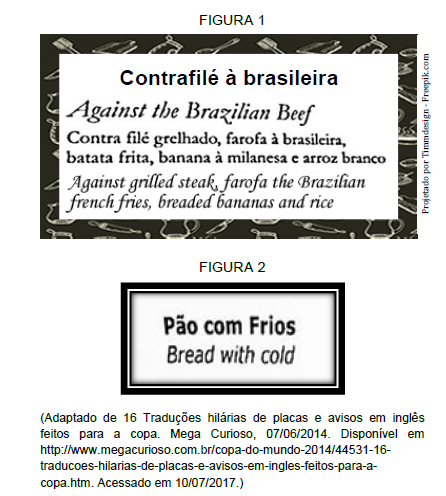
Entre as inadequações no uso do inglês observadas nas
figuras 1 e 2, podemos citar:
Examine a tira para responder à questão.


factors yet to be found. (l. 31)
The expression yet to be found is used to represent an action which:
“One never builds something finished”:
the brilliance of architect Paulo Mendes da Rocha
Oliver Wainwright
February 4, 2017
“All space is public,” says Paulo Mendes da Rocha. “The only private space that you can imagine is in the human mind.” It is an optimistic statement from the 88-year-old Brazilian architect, given he is a resident of São Paulo, a city where the triumph of the private realm over the public could not be more stark. The sprawling megalopolis is a place of such marked inequality that its superrich hop between their rooftop helipads because they are too scared of street crime to come down from the clouds.
But for Mendes da Rocha, who received the 2017 gold medal from the Royal Institute of British Architects this week – an accolade previously bestowed on such luminaries as Le Corbusier and Frank Lloyd Wright – the ground is everything. He has spent his 60-year career lifting his massive concrete buildings up, in gravity-defying balancing acts, or else burying them below ground in an attempt to liberate the Earth’s surface as a continuous democratic public realm. “The city has to be for everybody,” he says, “not just for the very few.”
(www.theguardian.com. Adaptado.)

NOGUEIRA, Salvador. Translated by Marina Della Valle. Disponível em: <
www1folha.uol.com.br/internacional/em/scienceandhealth/2016/03/
1755511-russia-will-install-telescope-in-brazil..shtml>. Acesso em: 27 set.
2016.
Leia o texto a seguir para responder à questão.
The Internet of Things
The “Internet of Things” (IoT) is becoming an increasingly growing topic of conversation both in the workplace and outside of it. It’s a concept that not only has the potential to impact how we live but also how we work. But what exactly is the “Internet of Things” and what impact is it going to have on you, if any? There are a lot of complexities around the “Internet of Things” but we want to stick to the basics. Lots of technical and policyrelated conversations are being had but many people are still just trying to grasp the foundation of what the heck these conversations are about.
Let’s start with understanding a few things.
Broadband Internet is becoming more widely available, the cost of connecting is decreasing, more devices are being created with Wi-Fi capabilities and sensors built into them, technology costs are going down, and smartphone penetration is sky-rocketing. All of these things are creating a “perfect storm” for the IoT.
So What Is The Internet of Things?
Simply put, this is the concept of basically connecting any device with an on and off switch to the Internet (and/or to each other). This includes everything from cellphones, coffee makers, washing machines, headphones, lamps, wearable devices and almost anything else you can think of.
So what now?
The new rule for the future is going to be, “Anything that can be connected, will be connected.”


Translated by Milli Legrain. Disponível em: <www1.folha.uol.com.br/…/
1441449-fire-and-drought-turns-amazon…shtml>. Acesso em: 7 set.
2016.

THE HONEYBEE has... Disponível em: <www.bbc.co.uk/news/scienceenvironment-34749846>. Acesso em: 21 set. 2016.
INSTRUÇÃO: Responda à questão com base no texto abaixo.

Disponível em: https://www.gov.uk/government/news/impact-of-smartphones-on-behaviour-in-lessons-to-be-reviewed. Acesso em: 13 set. 2015
I - “has already called for more schools” (l.15)
II - “we have given teachers more power” (l.18)
III - “That is why we have taken the decision” (l.21)
IV- “we hear of lessons being disrupted” (l. 27 e 28)
V - “they can be easilly distracted” (l.30)
Quais estão corretas?
INSTRUÇÃO: Para responder à questão, considere o texto abaixo.

(Excerpt from Zen and the Art of Motorcycle Maintenance, By Robert M. Pirsig. New York: Harpertorch, 1974)
I - “began” (l. 01) e “didn't spend” (l. 06) estão no passado simples.
II - “seems” (l. 02) e “prefers” (l. 04) estão no presente simples.
III - “would never have become” (l. 06) é uma estrutura usada para algo que não teria acontecido com uma condição, expressa por uma outra oração com o verbo no passado simples.
IV - “we´ve been thinking” (l. 08) e “has been” (l. 10) estão no presente perfeito contínuo.
Assinale a alternativa correta.
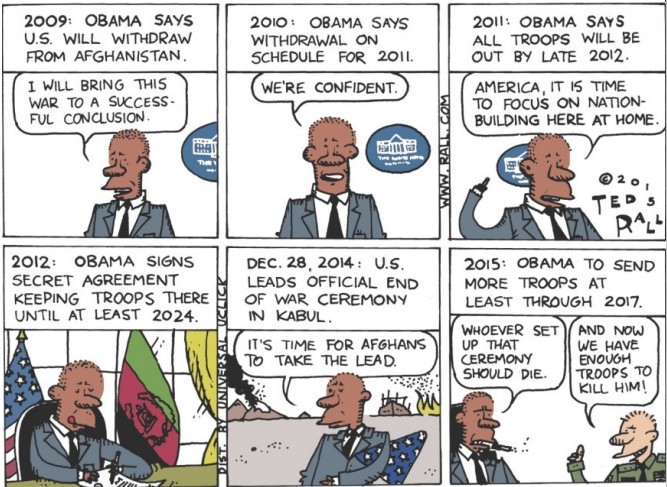
Observe a charge a seguir e marque a alternativa correta.
 Qual é o tempo verbal
predominante na charge de “Barack Obama”?
Qual é o tempo verbal
predominante na charge de “Barack Obama”?

Published in 1981, Todd Strasser’s The Wave recounts a true incident that took place in a history class at a Palo Alto, California, high school in 1969. The teacher of the class, Ron Jones, (1)__________ is fictionally renamed Ben Ross in the book, actually formulated the experiment described in the narrative in an effort to help his students understand how the Holocaust could have happened without the mass condemnation of the German people. What begins as a simple class project quickly takes on a life of its own, (2) __________, as students conform mindlessly to the experimental system, and others are pressured ruthlessly to join in. Group dynamics and peer influence bordering on coercion create a sinister atmosphere of fear and mistrust, The Wave spontaneously takes on the characteristics of a cult. The event disrupts an entire school (3) __________ raises a plethora of dark questions concerning responsibility, freedom, and group dynamics. Ron Jones calls it “one of the most frightening events ever experienced in the classroom.” As a novelization of a teleplay by Johnny Dawkins, based on a short story by Ron Jones, Strasser’s book (4) __________ not have attracted an abundance of criticism as a literary entity in itself, (5) __________ The Wave clearly holds an important place in the canon of young adult literature. (…) Available at: <http://www.enotes.com/topics/the-wave/critical-essays>. Accessed on: 20 set. 2016
Choose the CORRECT alternative..

I - “began” (l. 01) e “didn't spend” (l. 06) estão no passado simples.
II - “seems” (l. 02) e “prefers” (l. 04) estão no presente simples.
III - “would never have become” (l. 06) é uma estrutura usada para algo que não teria acontecido com uma condição, expressa por uma outra oração com o verbo no passado simples.
IV - “we´ve been thinking” (l. 08) e “has been” (l. 10) estão no presente perfeito contínuo.
Assinale a alternativa correta.
Leia os textos 6, 7 e 8 e complete as lacunas com verbos auxiliares modais. Atenção para o
contexto e o uso da língua, conforme a gramática.


Isso te espera no Elite
Além das questões objetivas, o Elite tem 4 formatos de exercício: múltipla escolha, associação (relacione itens entre colunas), ordenação (organize a sequência correta) e preencher lacunas (complete o texto). São mais de 11 mil exercícios pra fixar o conteúdo de um jeito diferente do tradicional, com correção na hora.
- Mais de 11 mil exercícios de fixação disponíveis
- Múltipla escolha, associação, ordenação e preencher lacunas
- Filtre por disciplina, assunto e desempenho (acertei/errei)
Título do modal
Você sabe que pode fazer mais!
-
.
-
.
-
.
-
.
-
.
Limite de 10 questões por dia atingido!
Você pode fazer muito mais, !
-
Ambiente de prática com questões, gabaritos, simulados e provas!
-
Preparatório completo com videoaulas, PDFs e conteúdo teórico atualizado
-
Tecnologia de ponta com análises avançadas para melhorar sua performance e desempenho
-
E muito mais! São dezenas de recursos para você se preparar com qualidade
 Conheça nossos planos