Questões de Vestibular
Sobre verbos | verbs em inglês
Foram encontradas 317 questões


Disponível em: https://www.britannica.com/story/what-does-the-rosetta-stone-say. Acesso em: 23 nov. 2025.
Fill in the blanks with the words which best complete the text. Choose the correct answer.
Leia a tirinha de Brian Crane para responder à questão.
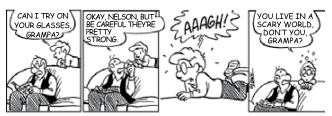
(Brian Crane. Still Pickled After All These Years, 2004.)
Leia o texto a seguir para responder à questão.
The problem with artificial intelligence? It's neither artificial, nor intelligent.
Elon Musk and Apple's co-founder Steve Wozniak have recently signed a letter calling for a six-month moratorium on the development of AI systems. The goal is to give society time to adapt to what the signatories describe as an “AI summer”, which they believe will ultimately benefit humanity, as long as the right guardrails are put in place. These guardrails include rigorously audited safety protocols.
It is a laudable goal, but there is an even better way to spend these six months: retiring the hackneyed label of “artificial intelligence” from public debate.
[...]
However, many critics have pointed out that intelligence is not just about pattern-matching. Equally important is the ability to draw generalisations. Marcel Duchamp's 1917 work of art Fountain is a prime example of this. Before Duchamp's piece, a urinal was just a urinal. But, with a change of perspective, Duchamp turned it into a work of art. At that moment, he was generalising about art.
[...]
Human intelligence is not one-dimensional. It rests on what the 20th-century Chilean psychoanalyst Ignacio Matte Blanco called bi-logic: a fusion of the static and timeless logic of formal reasoning and the contextual and highly dynamic logic of emotion. The former searches for differences; the latter is quick to erase them. Marcel Duchamp's mind knew that the urinal belonged in a bathroom; his heart didn't. Bi-logic explains how we regroup mundane things in novel and insightful ways. We all do this — not just Duchamp.
AI will never get there because machines cannot have a sense (rather than mere knowledge) of the past, the present and the future; of history, injury or nostalgia. Without that, there’s no emotion, depriving bi-logic of one of its components. Thus, machines remain trapped in the singular formal logic.
[...]
But the reason why tools like ChatGPT can do anything even remotely creative is because their training sets were produced by actually existing humans, with their complex emotions, anxieties and all. If we want such creativity to persist, we should also be funding the production of art, fiction and history — not just data centres and machine learning.
That’s not at all where things point now. The ultimate risk of not retiring terms such as “artificial intelligence” is that they will render the creative work of intelligence invisible, while making the world more predictable and dumb.
So, instead of spending six months auditing the algorithms while we wait for the “AI summer,” we might as well go and reread Shakespeare’s A Midsummer Night’s Dream. That will do so much more to increase the intelligence in our world.
Fonte: MOROZOV, Evgeny. The problem with artificial intelligence? It’s neither artificial nor intelligent. The Guardian, 30 mar. 2023. Disponível em: https://www.theguardian.com/commentisfree/2023/mar/30/artificial-intelligence-chatgpt-human-mind
Observe the following sentence from paragraph 1. “The goal is to give society time to adapt to what the signatories describe as an “Al summer”, which they believe will ultimately benefit humanity, as long as the right guardrails are put in place.” Choose the alternative that can be considered the CORRECT past version of the sentence above.
Leia o texto a seguir para responder à questão.
Back To School But Not To Screens: States Ramp Up Cellphone Bans
Work has been easier for public high school teacher Brian Kerekes since last August, when he first experienced the impacts of a newly enacted Florida law to restrict students’ cellphone use during class. The longtime statistics instructor, who started a new school year on Monday, now spends less time circling the classroom policing students and more time educating them on how to gather and interpret data.
Before Florida passed the ban in May 2023 — becoming the first of at least eight U.S. states to prohibit or restrict cellphone use in schools — phones proved a constant disruption in Kerekes’ classroom at Tohopekaliga High School in the central Florida city of Kissimmee.
“Students were either using them to talk to someone in a different class or talk to someone on the other side of the room or just to zone out, get on TikTok or whatever,” Kerekes, who's been a teacher for 17 years, said in an interview.
Fellow teachers nationwide face the same challenge, which explains why more states and districts are moving to limit or outright ban cellphones in the classroom, and even during the school day altogether.
The rules will look different from state to state and district to district, but all stem from the same concerns.
Seventy-two percent of high school teachers cite cellphones as a major distraction in the classroom, according to a fall 2023 Pew Research Center study. Educators also worry that constant access to social media can adversely impact kids’ mental health.
U.S. Surgeon General Vivek Murthy went so far as to issue a health advisory last year, warning that enough evidence exists to show social media can be unsafe for children and teens. “We are in the middle of a national youth mental health crisis,” he said, “and I am concerned that social media is an important driver of that crisis, one that we must urgently address.”
While social media can connect kids, make them feel less alone and offer an entertaining and creative outlet, it also exposes them to harmful content, Murthy pointed out in the advisory released by the U.S. Department of Health and Human Services. And, as educators such as Kerekes note, some students use their phones to bully fellow students online during the school day, and in the most extreme cases, to set up fights and film them.
The hope is that cellphone bans will reduce such incidents. Kerekes said he’s hearing they have.
Fonte: KATZ, Leslie. Back To School But Not To Screens: States Ramp Up Cellphone Bans. Forbes, 13 ago. 2024. Disponível em: https://www.forbes.com/sites/lesliekatz/2024/08/13/back-to-school-but-not-to-screens-more-students-face-cellphone-bans/
Leia o texto a seguir para responder à questão.
The voluminous literature dealing with the idea of human progress is decidedly a mixed bag. While some of these writings are impressive and even inspiring, many of them are superficial, perhaps even ridiculous, in their reiteration (especially during the nineteenth century) of the comforting prospect that every day in every way we are growing better and better.
This kind of foolishness is manifested especially in discussions of such matters as economic, political, and moral progress, and of progress in art. [...]
From time to time, there seems to be real and measurable improvement in these areas. At other times the opposite seems equally to be the case. Thus the fervent belief of writers like the French sociophilosopher Auguste Comte in the inevitability of progress in all fields of human endeavor must be viewed as insupportable. We cannot accept it any longer, even if we once thought it was true.
Progress in human knowledge is another matter. Here it is possible to argue cogently that progress is in the nature of things. “Not only does each individual progress from day to day”, wrote French philosopher, mathematician, and mystic Blaise Pascal, “but mankind as a whole constantly progresses... in proportion as the universe grows older.” The essence of man as a rational being, as a later historian would put it, is that he develops his potential capacities by accumulating the experience of past generations.
Just as in our individual lives we learn more and more from day to day and from year to year because we remember some at least of what we have learned and add our new knowledge to it, so in the history of the race the collective memory retains at least some knowledge from the past to which is added every new discovery.
The memories of individuals fail and the persons die, but the memory of the race is eternal, or at least it can be expected to endure as long as human beings continue to write books and read them, or — which becomes more and more common — store up their knowledge in other mediums for the use of future generations.
Fonte: VAN DOREN, Charles. A History of Knowledge: Past, Present and Future. New York: The Random House Publishing Group, 1991, p. XV–XVI.
Leia o texto para responder à questão.
In my research recently published in an open access journal, I used a popular language model, GPT-4 by OpenAI, to create simple summaries of scientific papers. These summaries generated by artificial intelligence (AI) used simpler language and more common words, like “job” instead of “occupation”, than summaries written by the researchers who had done the work.
In one experiment, I found that readers of the AI-generated summaries had a better understanding of the science than readers of the human-written summaries. A second experiment investigated what effects the simpler summaries might have on people’s perceptions of the scientists who performed the research. In this experiment, participants rated the scientists whose work was described in the simpler texts as more credible than the scientists whose work was described in the more complex texts.
Have you ever read about a scientific discovery and felt like it was written in a foreign language? New scientific information is probably hard to understand — especially if you try to read a science article in a research journal. In an era where understanding science is crucial for informed decision- -making, the abilities to comprehend and communicate complex ideas are more important than ever. Trust in science has been declining for years, and one contributing factor may be the challenge of understanding scientific jargon.
As AI continues to evolve, its role in science communication may expand, especially if using generative AI becomes more commonplace. Simple science descriptions are preferable to and more beneficial than complex ones, and AI tools can help. But scientists could also achieve the same goals by working harder to minimize jargon and communicate clearly — no AI necessary.
(David Markowitz. https://theconversation.com, 30.10.2024. Adaptado.)
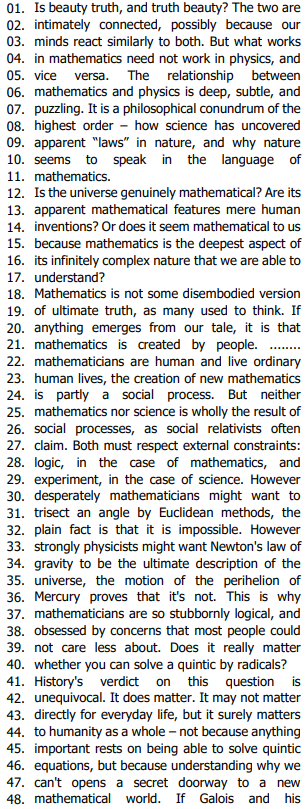
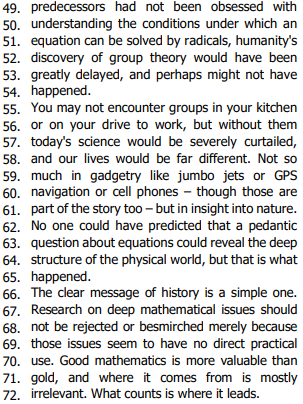
Adapted from: STEWART, I. Why Beauty is Truth – The History of Symmetry. Cambridge, MA: Basic Books, 2007. p. 275-276.
( ) Mathematics is not an area detached from human experience. Nevertheless, the text fails to provide practical examples of how it contributes to improve aspects of our daily life.
( ) The word could (l. 62) may be replaced by must, without causing changes to grammar accuracy or to the original meaning of the sentence.
( ) Mathematics unequivocally relates to social processes, history, logic, and philosophy.
( ) The segment Research on deep mathematical issues should not be rejected or besmirched (l. 67-68) may be rephrased as One should not reject or besmirch research on deep mathematical issues, without causing changes to grammar accuracy or to the original meaning of the sentence.
The correct sequence of filling in the parentheses, from top to bottom, is
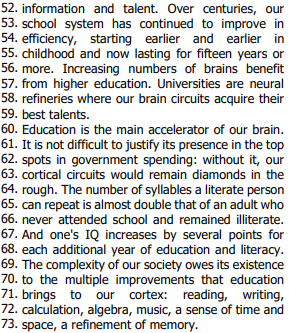
Instrução: A questão está relacionada ao texto abaixo.
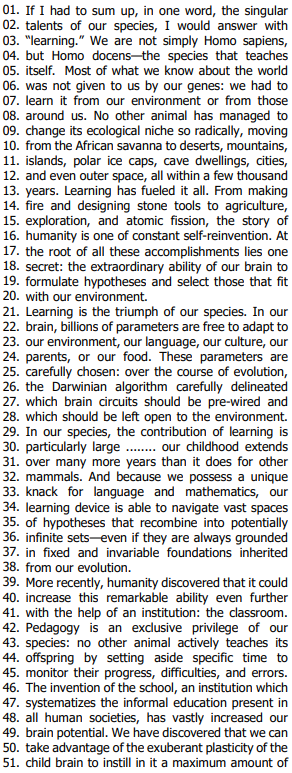
Adapted from: DEHAENE, Stanislas. How we learn: Why brains learn better than any machine… for now. New York: Viking Press, 2020.
I - The use of present perfect simple in the clause No other animal has managed to change its ecological niche so radically (l. 08-09) implies that the author considers the event referred to finished and unrelated to the present.
II - The use of simple past in More recently, humanity discovered (l. 39) is a deviation from the standard norm, and the fragment would be made grammatically correct if its verb tense were the present perfect simple since the event it refers to is said to be recent.
III- The use of passive voice in the clause These parameters are carefully chosen (l. 24-25) means that the author does not know or prefers not to stress who or what makes the choice referred to.
Which ones are correct according to the text?
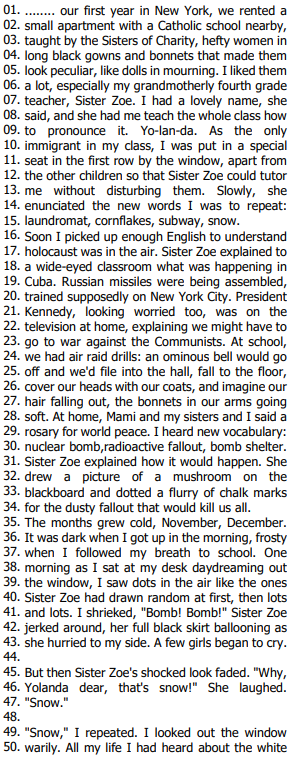
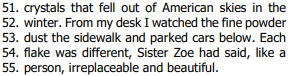
Instrução: A questão está relacionada ao texto abaixo.
Adaptado de: ÁLVAREZ, J. Snow. In: Castillo-Speed, L. Latina – Women’s voices from the borderlands. New York: Touchstone, 1995.
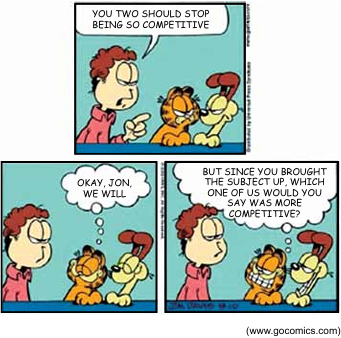
Leia a tirinha do cartunista Jim Davis para responder à questão.
(www.gocomics.com)
Read the text below and answer the question.
TEXT I
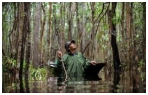
The Amazon is often referred to as "the world's largest medicine cabinet" CREDIT: Getty
(https://www.telegraph.co.uk/travel/cruises/articles/how-to-be-a-botanical-buff/)
Medicinal Treasures of the Rainforest
The widespread destruction of tropical rainforest ecosystems and the consequent extinction of numerous plant and animal species is happening before we know even the most basic facts about what we are losing.
Covering only 6 percent of the Earth's surface, tropical moist forests contain at least half of all species. The abundant botanical resources of tropical forests have already provided tangible medical advances; yet only 1 percent of the known plant and animal species have been thoroughly examined for their medicinal potentials. Meanwhile, 2 percent of the world's rainforests are irreparably damaged each year.
Approximately 7,000 medical compounds prescribed by Western doctors are derived from plants. These drugs had an estimated retail value of US$43 billion in 1985. Seventy percent of the 3000 plants identified by the United States National Cancer Institute as having potential anti-cancer properties are endemic to the rainforest. Tropical forest species serve Western surgery and internal medicine in three ways. First, extracts from organisms can be used directly as drugs. For maladies ranging from nagging headaches to lethal contagions such as malaria, rainforest medicines have provided modern society with a variety of cures and pain relievers.
[…]
Secondly, chemical structures of forest organisms sometimes serve as templates from which scientists and researchers can chemically synthesize drug compounds.[…]
Finally, rainforest plants provide aids for research. Certain plant compounds enable scientists to understand how cancer cells grow, while others serve as testing agents for potentially harmful food and drug products. Tropical forests offer hope for safer contraceptives for both women and men. The exponential growth of world population clearly demonstrates the need for more reliable and effective birth control methods. Worldwide, approximately 4,000 plant species have been shown to offer contraceptive possibilities. The rainforest also holds secrets for safer pesticides for farmers. Two species of potatoes have leaves that produce a sticky substance that traps and kills predatory insects. This natural self-defense mechanism could potentially reduce the need for using pesticides on potatoes. Who knows what other tricks the rainforest might have up its leaves?
Adapted from https://www.adventure-life.com/amazon/articles/medicinaltreasures-of-the-rainforest
“It doesn’t really make a lot of sense,” says Ariane Lewis, a neurocritical care clinician at NYU Langone Health in New York City.
Com base no fragmento, assinale a alternativa que apresenta, corretamente, a sua reescrita no discurso indireto.

 Conheça nossos planos