Questões de Vestibular
Sobre verbos | verbs em inglês
Foram encontradas 317 questões


THE STORY OF ELLIS ISLAND
Mass migrations have marked the history of the human race ever since people began to dream of a better life

Disponível em: <https://linguapress.com/advanced/ellis-island.htm>. Acesso em: 7 out. 2019. Adaptado.
( )I. Ann was sat in an armchair watching television. ( )II. The police stops me on my way last night. ( )III. I’m hungry. I’m wanting something to eat. ( )IV. You’re always watched TV. You should do something more active. ( )V. Rice don’t grow in cold climates.
Assinale a alternativa correta:
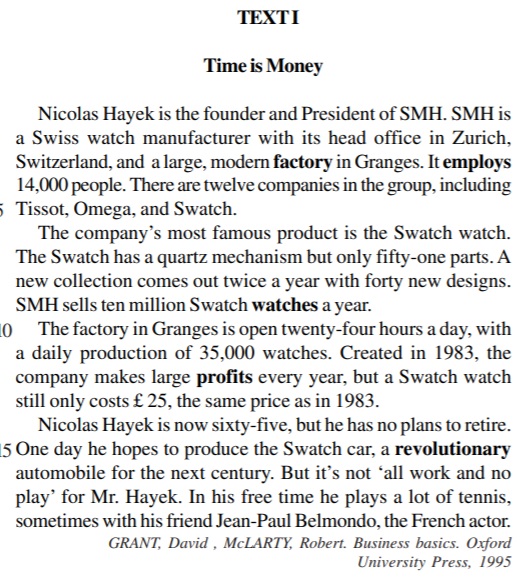
I- “factory” II- “employs” III- “watches” IV- “profit” V- “revolutionary”
Marque a alternativa que possui a seqüência correta das respostas:
The key to staying young? Camouflage.
Pickles by Brian Crane

Source: www.gocomics.com/pickles


TEXTO
The Future Of Work: 5 Important Ways Jobs
Will Change In The 4th Industrial Revolution


Fonte:
https://www.forbes.com/2019/07/15
TEXTO
The Future Of Work: 5 Important Ways Jobs
Will Change In The 4th Industrial Revolution
Fonte:
https://www.forbes.com/2019/07/15
TEXTO
The Future Of Work: 5 Important Ways Jobs
Will Change In The 4th Industrial Revolution
Fonte:
https://www.forbes.com/2019/07/15


Had the Earth been flat, a total of three satellites would have been enough to provide this information (l. 30-31)
In relation to the rest of the statement, the underlined fragment has the objective of:
Read Text to
answer question.
The article analyzes the relationship of Indigenous
Peoples with the public policy of Social Assistance (AS) in Brazil. Based on
data collected during field work carried out in 2014, will analyze the case of
the Indigenous Reserve of Dourados, Mato Grosso do Sul. In the first part, I
characterize the unequal relationship between society and national state with
Indigenous Peoples to, then approach the Welfare State politics as an
opportunity to face the violation of rights resulting from the colonial siege. Then
we will see if Dourados to illustrate the dilemmas and possibilities of
autonomy and indigenous role faced with this public policy. It is expected to
contribute to the discussion of statehood pointing concrete cases where the
local implementation of AS policy is permeable to a greater or lesser extent,
the demands of Indigenous Peoples by adaptation to their social organizations
and worldviews.
(BORGES, Júlio César. Brazilian society has made us poor: Social Assistance and ethnic autonomy of Indiggenous Peoples. The case of Dourados, Mato Grosso do Sul. Horiz. antropol. Disponível em: <http://www.scielo.br/scielo.php?script=sci_abstract&pid=S0104-71832016000200303&lng=en&nrm=iso&tlng=en>. Acesso em: 10 nov. 2018).
Cleir Avila Ferreira Júnior was born in Campo Grande, Mato Grosso do Sul State, Brazil. He is a self-taught artist. He has painted professionally since he was 18 years old. He has begun his artistic works with a hyperrealist influence, where he portrayed some regional and ecological themes, especially the Pantanal nature, presented in almost all his art.
In 1994, he started his mural work on the sides of some Campo Grande’s buildings, as example: the great "Onça Pintada" (50m high and 220m2) took him and his team a month of execution, and the "Tuiuiús" (40m high and 300m2) was his second mural. In 1995, he painted the "Blue Macaw" (45m high and 430m2). In 1996, he built the "Macaws’ Monument" in front of the international airport in Campo Grande, MS. In 1998, he painted a mural of 700m2 in Corumbá, MS, where he portrayed the red macaw in one of its walls and in the other two a big gold fish. Therefore, he did uncountable art around Mato Grosso do Sul State, mainly into the touristic cities.
(FERREIRA JÚNIOR, Cleir Avila. Disponível em: <http://www.artenossaterra.xpg.com.br/index.html>. Acesso em: 10 nov. 2018).
Based on part of the Text II, answer the question: In which verb tense are the following sentences?
“In 1995, he painted the ‘Blue Macaw’ (45m high and 430m2 ). In 1996, he built the ‘Macaws Monument’ in front of the international airport in Campo Grande, MS. In 1998, he painted a mural of 700m2 in Corumbá, MS, where he portrayed the red macaw in one of its walls and in the other two a big gold fish. Therefore, he did uncountable art around Mato Grosso do Sul State, mainly into the touristic cities”.




Available at: <http://www.bbc.com/culture/story/20180503-our-fi ction-
-addiction-why-humans-need-stories>. Retrieved on: 3 May 2018.
Adapted.
Texto 1
“Eu, Marília, não sou algum vaqueiro,
Que vive de guardar alheio gado;
De tosco trato, de expressões grosseiro,
Dos frios gelado e dos sóis queimado.
Tenho próprio casal e nele assisto
Dá-me vinho, legume, fruta, azeite;
Das brancas ovelhinhas tiro o leite,
E mais as finas lãs, de que me visto.
Graças, Marília bela,
Graças à minha Estrela!”
(Tomás Antonio Gonzaga)
Complete the sentence below with the correct verbs. Choose the CORRECT answer.
I ______ you in the park yesterday. You ______ on the grass and ______ a book.
INSTRUÇÃO: Para responder às questão, considere o texto abaixo.
Am I too old to learn a new language?

Adapted from:<https://www.theguardian.com/education/2014/sep/13/am-i-too-old-to-learn-a-language>

 Conheça nossos planos