Questões de Vestibular Sobre sinônimos | synonyms em inglês

Foram encontradas 318 questões

Ano: 2023 Banca: UNICENTRO Órgão: UNICENTRO Prova: UNICENTRO - 2023 - UNICENTRO - Vestibular |
Q3910174 Inglês
Leia o texto a seguir e responda à questão.
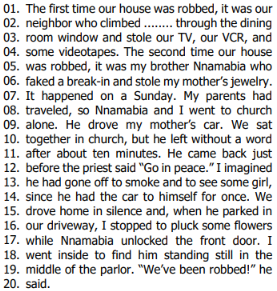
What does ‘brain dead’ really mean? The battle over how science defines the end of life
Ideological differences threaten to muddy the definition of death in the United States – with potentially negative consequences for clinicians and people awaiting organ transplants. • Max Kozlov • Published on 11 July 2023
Dead in California but alive in New Jersey: that was the status of 13-year-old Jahi McMath after physicians in Oakland, California, declared her brain dead in 2013, after complications from a tonsillectomy. Unhappy with the care that their daughter received and unwilling to remove life support, McMath’s family moved with her to New Jersey, where the law allowed them to lodge a religious objection to the declaration of brain death and keep McMath connected to life-support systems for another four and a half years. Prompted by such legal discrepancies and a growing number of lawsuits around the United States, a group of neurologists, physicians, lawyers and bioethicists is attempting to harmonize state laws surrounding the determination of death. They say that imprecise language in existing laws – as well as research done since the laws were passed – threatens to undermine public confidence in how death is defined worldwide. “It doesn’t really make a lot of sense,” says Ariane Lewis, a neurocritical care clinician at NYU Langone Health in New York City. “Death is something that should be a set, finite thing. It shouldn’t be something that’s left up to interpretation.” Since 2021, a committee in the Uniform Law Commission (ULC), a non-profit organization in Chicago, Illinois, that drafts model legislation for states to adopt, has been revising its recommendation for the legal determination of death. The drafting committee hopes to clarify the definition of brain death, determine whether consent is required to test for it, specify how to handle family objections and provide guidance on how to incorporate future changes to medical standards. The broader membership of the ULC will offer feedback on the first draft of the revised law at a meeting on 26 July. After members vote on it, the text could be ready for state legislatures to consider by the middle of next year.
(Disponível em: <https://www.nature.com/articles/d41586-023-02226-z> . Acesso em: 12 set. 2023.)
Leia o fragmento do texto a seguir.
They say that imprecise language in existing laws – as well as research done since the laws were passed – threatens to undermine public confidence in how death is defined worldwide.
Com base no fragmento do texto, assinale a alternativa que apresenta, corretamente, o sinônimo da palavra “undermine”.
Alternativas
Ano: 2023 Banca: UFGD Órgão: UFGD Prova: UFGD - 2023 - UFGD - Vestibular - Ingresso em 2024 |
Q3249045 Inglês
The big idea: why we need a new definition of junk food
Ultra-processed products now make up 60% of our diet – and they’re killing us
Strange as it may seem, food has replaced tobacco as the leading cause of early death globally. Each year,more people die in America from illnesses caused by poor diet than were killed fighting in every war in US history combined. In the UK the situation is equally 1. dire. Officially, the health effects of food are entirely due to its nutritional content – the amount of fat, salt, sugar and fibre it contains. The current system leaves it up to you to read the detailed information on the pack and decide how much to eat based on recommended values, and if you have children, you’ll need to know the values for them too. This is nigh-on impossible for most people – but even if you were able to calculate exactly how much fat, salt and sugar you were consuming in each 2. mouthful, you would still be neglecting one vital determinant of health – how the food was processed. You might feel like you’ve heard all this before. People have expressed concern about “processed food” for a long time, but it’s not always been an easy concept to 3. pin down. After all, we have been processing food for hundreds of thousands of years. The human diet was invented by primarily female domestic scientists who modified plants and animals by milling, shaking, pounding and grinding them, or altering them via fermentation and heat, before salting, smoking and drying them for preservation. Food processing has shaped almost every aspect of our bodies: we have the shortest guts of any animal our size because part of their job is outsourced to our kitchens. We are the only animal that must process its food to survive. Processing is fine.
But just over a decade ago a team of scientists in Brazil noticed a 4. paradox in the data from their national nutrition surveys. Obesity had gone from being rare, to being the country’s dominant public health problem – even though people were buying less oil and sugar. What theywere eating more of was industrially processed food: biscuits, emulsified breads, confectionary and so on. The team developed a definition that distinguished between traditional food, whole or processed, and these items, which they termed ultra processed foods, or UPFs for short.
Disponible in: https://www.theguardian.com/books/2023/may/15/the-big-idea-why-we-need-a-new-definition-of-junk-food. Access in: May, 15 2023 (adapted).

Choose the alternative whose bold words have similar meanings in the sentences.
Alternativas
Q2182188 Inglês
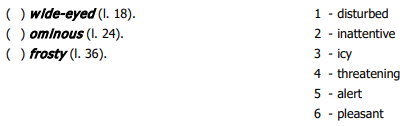
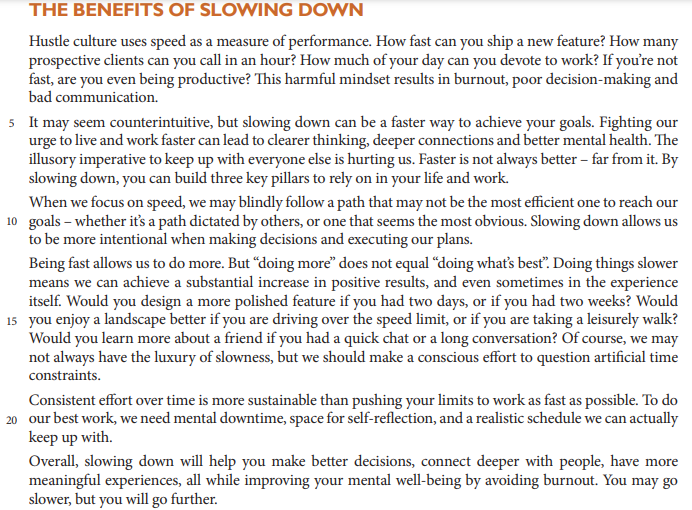
Helpful methods to slow down include journaling, (l. 25-26) The underlined word may be substituted, without significant change in meaning, by the words below:
Alternativas
Ano: 2022 Banca: NC-UFPR Órgão: UFPR Prova: NC-UFPR - 2022 - UFPR - Prova de Conhecimentos Gerais |
Q3265626 Inglês
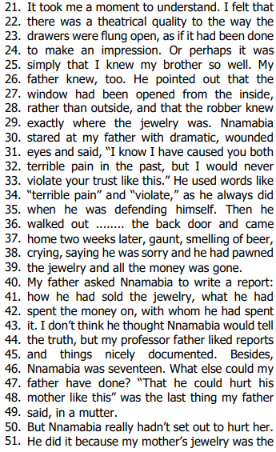
Nineties fashion was hard to pin down. A clash of trends screamed for our attention while others were so quietly cool they're still sartorial staples in our collective wardrobes: slip dresses, Doc Martens, chokers, crop tops. While the 1980s were all about volume – padded shoulders, puffed jackets, big hair and an obsession with designer wear – style in the early 1990s was decidedly low maintenance.

(Available in: https://edition.cnn.com/style/article/1990s-fashion-history/index.html.) 
In the first line of the excerpt, the underlined and in bold type expression can be substituted without losing its meaning by: 
Alternativas
Ano: 2022 Banca: NC-UFPR Órgão: UFPR Prova: NC-UFPR - 2022 - UFPR - Prova de Conhecimentos Gerais |
Q3265621 Inglês
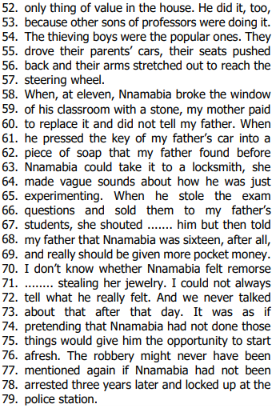
Kevin Adkins almost kicked the Ice Age skull to the side because he thought it was just debris from a recent flood – then he saw that it had teeth. 


     When Kevin Adkins took his father-in-law, Tony Hager, on his first turkey hunt on May 8, 2022, the two West Virginians spotted an animal skull in a Putnam County creek. Covered in mud from a flood that had hit the region two days earlier, it was initially unidentifiable. So Adkins took it home – and later learned that it belonged to an 11,000-year-old giant sloth.

       While 36-year-old Adkins had hunted turkeys in Putnam County plenty of times before, he had never come across something like this. Trudging through the muddy wilderness, the Red House resident and his father-in-law were primarily interested in nabbing some wild birds when they encountered the relic.

    “We were running and gunning for toms,” Adkins told Outdoor Life. “We’d worked a gobbler for about 30 minutes, then the bird moved off, so we picked up and headed up the creek. I looked down in the middle of the creek as we crossed it and saw a big blob of something I thought was a root ball, so I almost kicked it away.”

     “But I noticed something different about it and looked closer,” Adkins went on. “That’s when I saw some molar teeth, so I picked it up.”

       Determined not to let the potential find of a lifetime distract from his turkey hunt, Adkins propped the skull next to the creek and forged ahead. When he and Hager concluded their hunt later that morning, they retrieved the skull and carried it home.

     “[My wife] thought it was a cow skull because it was so big,” Adkins said. The skull weighed about 30 pounds and sported tufts of hair. It had four molar teeth on either side of its jawbone.

      “But my father-in-law said no, it was something very different,” continued Adkins. “That’s when we started searching the internet, sending photos to family and friends, and then I posted it on social media. That really got things moving along with trying to ID what I’d found.”

(Available in: https://allthatsinteresting.com/tag/news.)
These are expressions, in the text, that make reference to “turkey”, EXCEPT:
Alternativas
Ano: 2022 Banca: UERJ Órgão: UERJ Prova: UERJ - 2022 - UERJ - Vestibular - Exame Único |
Q1994395 Inglês

Essential reading on, and beyond, Indigenous Peoples Day


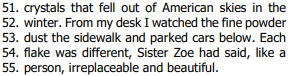
to acknowledge what is working in our communities and in our movements. (l. 31)


The underlined word may be substituted, without significant change in meaning, by the one below:

Alternativas
Ano: 2022 Banca: FUVEST Órgão: USP Prova: FUVEST - 2022 - USP - Vestibular - 1ª Fase |
Q1994358 Inglês
    The expression “dark doldrums” chills the hearts of renewable-energy engineers, who use it to refer to the lulls when solar panels and wind turbines are thwarted by clouds, night, or still air. On a bright, cloudless day, a solar farm can generate prodigious amounts of electricity. But at night solar cells do little, and in calm air turbines sit useless.
     The dark doldrums make it difficult for us to rely totally on renewable energy. Power companies need to plan not just for individual storms or windless nights but for difficulties that can stretch for days. Last year, Europe experienced a weekslong “wind drought,” and in 2006 Hawaii endured six weeks of consecutive rainy days. On a smaller scale, communities that want to go all-renewable need to fill the gaps. The obvious solution is batteries, which power everything from mobile phones to electric vehicles; they are relatively inexpensive to make and getting cheaper. But typical models exhaust their stored energy after only three or four hours of maximum output, and—as every smartphone owner knows—their capacity dwindles with each recharge. Moreover, it is expensive to collect enough batteries to cover longer discharges.
    We already have one kind of renewable energy storage: more than ninety per cent of the world’s energy-storage capacity is in reservoirs, as part of a technology called pumped-storage hydropower, used to smooth out sharp increases in electricity demand. Motors pump water uphill from a river or a reservoir to a higher reservoir; when the water is released downhill, it spins a turbine, generating power. A pumped-hydro installation is like a giant, permanent battery, charged when water is pumped uphill and depleted as it flows down. Some countries are expanding their use of pumped hydro, but the right geography is hard to find, permits are difficult to obtain, and construction is slow and expensive. The hunt is on for new approaches to energy storage.

The New Yorker. Abril, 2022. Adaptado. 
Na frase “But typical models exhaust their stored energy after only three or four hours of maximum output, and—as every smartphone owner knows—their capacity dwindles with each recharge.” (2º parágrafo), “dwindles” poderia ser substituído, sem prejuízo de sentido, por 
Alternativas
Ano: 2022 Banca: FUVEST Órgão: USP Prova: FUVEST - 2022 - USP - Vestibular - 1ª Fase |
Q1994322 Inglês
    From French electronic and Japanese indie to K-pop and Spanish jazz, it’s common for people to listen to songs they don’t necessarily understand. Not knowing the language of the lyrics, it seems, doesn’t stop people from liking—and sometimes even singing along to—a song. Unless the listener is looking up the dictionary meaning of the lyrics, then the dictionary meaning of the lyrics doesn’t make or break their appreciation of a song. But why?
    “It’s a complicated answer,” said musicologist Lisa Decenteceo, adding that it all starts with what’s called “sound symbolism.” Sound symbolism refers to the study of the relationships between utterances and their meaning. This doesn’t have to do only with music. Marketers, for example, can tune into sound symbolism as part of their strategy in coming up with appealing brand names. In music as well as in branding, Decenteceo explained, there’s something about the appeal of words as sounds, beyond their meaning in a language. While things like culture and personal experiences affect people’s responses to different kinds of music, she explained there are certain musical techniques that are generally used to convey certain moods. One of which is scale. “Songs in a major scale usually have brighter, happier sounds, while minor scales usually have the slightly darker, melancholic feel,” explains Thea Tolentino, a music teacher.
    The human brain is wired to respond to sound, she added. In a process called entrainment, the brain “synchronizes our breathing, our movement, even neural activities with the sounds we hear.” This is why fast-paced music is so popular for running, for example, or why some yoga teachers play rhythmic and melodic tracks in their classes. And there are also the things that accompany the words. “Elements of sound and music like pitch, melody, harmony, timbre, and amplitude have an affective, emotional, psychological, cognitive, and even physical impact on listeners. Music adds so much meaning and dimension to texts through a complex of these avenues,” said Decenteceo. What all these things do, she added, is liberate the words. “Song frees the voice from any burden of saying anything meaningful”. It’s important, then, to understand music as a discourse between musical elements. But all in all, Decenteceo said there’s value in whatever immediate appeal people find in the music they listen to, whether or not they understand the words. Music, after all, is the universal language. 

Disponível em https://www.vice.com/. March, 2022. Adaptado.
Na frase “there are certain musical techniques that are generally used to convey certain moods” (2º parágrafo), a palavra “convey” poderia ser substituída, sem prejuízo de sentido, por 
Alternativas
Ano: 2022 Banca: ECONRIO Órgão: USS Prova: ECONRIO - 2022 - USS - Vestibular Medicina - Inglês |
Q1862482 Inglês

Considering dental assessments, machine learning tools should:

Alternativas
Ano: 2021 Banca: FUVEST Órgão: USP Prova: FUVEST - 2021 - USP - Vestibular - Edital 2022 |
Q1858894 Inglês

        If you take a look at my smartphone, you’ll know that I like to order out. But am I helping the small local businesses? You would think that if you own a restaurant you’d be thrilled to have an outsourced service that would take care of your delivery operations while leveraging their marketing might to expand your businesses’ brand. However, restaurant owners have complained of lack of quality control once their food goes out the door. They don’t like that the delivery people are the face of their product when it gets into the customer’s hand. Some of the delivery services have been accused of listing restaurants on their apps without the owners’ permission, and oftentimes publish menu items and prices that are incorrect or out of date.

        But there is another reason why restaurant owners aren’t fond of delivery services. It’s the costs, which, for some, are becoming unsustainable. Even with the increased revenues from the delivery services, the fees wind up killing a restaurant’s margins to the extent that it’s at best marginally profitable. Therefore, some restaurants are pushing harder to drive orders from their own websites and offering special deals for customers that use their in-house delivery people.

        The simple fact is that these delivery apps are here to stay. They are enormously popular and have significantly grown. I believe that restaurant owners that resist these apps are hurting their brands by missing out on potential customers. The good news is that the delivery platforms are not as evil as some would portray them. They have some skin in the game. They are competing against other services. They want their listed restaurants to profit. Maybe instead of fighting, the nation’s restaurant industry needs to proactively embrace the delivery service industry and figure out ways to profitably work together.

The Guardian. 02 December, 2020. Adaptado.

Em “I believe that restaurant owners that resist these apps are hurting their brands by missing out on potential customers” (3º parágrafo), a expressão sublinhada pode ser substituída, sem prejuízo de sentido, por: 
Alternativas
Ano: 2021 Banca: UERJ Órgão: UERJ Prova: UERJ - 2021 - UERJ - Vestibular - Exame Único |
Q1770226 Inglês


PAUL SIMON and ART GARFUNKEL

Adaptado de genius.com.

In line 13, come-on is a verb transformed into a noun. This noun has the following meaning:
Alternativas
Ano: 2021 Banca: UERJ Órgão: UERJ Prova: UERJ - 2021 - UERJ - Vestibular - Exame Único |
Q1770224 Inglês


PAUL SIMON and ART GARFUNKEL

Adaptado de genius.com.

where the ragged people go (l. 8) In the text, the underlined words refer to the following social group:
Alternativas
Ano: 2021 Banca: UERJ Órgão: UERJ Prova: UERJ - 2021 - UERJ - Vestibular - Exame Único |
Q1770223 Inglês


PAUL SIMON and ART GARFUNKEL

Adaptado de genius.com.

I was no more than a boy (l. 5) The underlined expression may be substituted, without significant change in meaning, by the word below:
Alternativas
Q1682914 Inglês
    Remember the good old days, when you could have a heated-yet-enjoyable debate with your friends about things that didn’t matter that much — times when you could be a true fan of the Manchester United soccer team when you didn’t come from the city of Manchester?

    How things have changed.

    Now disagreements feel deadly serious. Like when your colleague pronounces that wearing a face mask in public is a threat to his liberty. Or when you see that one of your friends has just tweeted that, actually, all lives matter. Before you know it, you’re feeling angry and forming harsh new judgments about your colleagues and friends. Let’s take a collective pause and breathe: there are some ways we can all try to have more civil disagreements in this febrile age of culture wars.

1. ‘Coupling’ and ‘decoupling’

    The first is to consider how inclined people are to ‘couple’ or ‘decouple’ topics involving wider political and social factors. Swedish data analyst John Nerst has used the terms to describe the contrasting ways in which people approach contentious issues. Those of us more inclined to ‘couple’ see them as inextricably related to a broader matrix of factors, whereas those more predisposed to ‘decouple’ prefer to consider an issue in isolation. To take a crude example, a decoupler might consider in isolation the question of whether a vaccine provides a degree of immunity to a virus; a coupler, by contrast, would immediately see the issue as inextricably entangled in a mesh of factors, such as pharmaceutical industry power and parental choice.

2.____________________

    Most of us are deeply committed to our beliefs, especially concerning moral and social issues, such that when we’re presented with facts that contradict our beliefs, we often choose to dismiss those facts, rather than update our beliefs.

    A study at Arizona State University, U.S., analysed more than 100,000 comments on a forum where users post their views on an issue and invite others to persuade them to change their mind. The researchers found that regardless of the kind of topic, people were more likely to change their mind when confronted with more evidence-based arguments. “Our work may suggest that while attitude change is hard-won, providing facts, statistics and citations for one’s arguments can convince people to change their minds,” they concluded.

3. Just be nicer?

    Finally, it’s easier said than done, but let’s all try to be more respectful of and attentive to each other’s positions. We should do this not just for virtuous reasons, but because the more we create that kind of a climate, the more open-minded and intellectually flexible we will all be inclined to be. And then hopefully, collectively, we can start having more constructive disagreements — even in our present very difficult times.

(Christian Jarrett. www.bbc.com, 14.10.2020. Adaptado.)
In the fragment from the third paragraph “when you see that one of your friends has just tweeted that, actually, all lives matter”, the underlined word can be replaced, with no change in meaning, by
Alternativas
Ano: 2021 Banca: UPENET/IAUPE Órgão: UPE Prova: UPENET/IAUPE - 2021 - UPE - Vestibular - 3º Fase - 1º Dia |
Q1679744 Inglês
Considere a análise linguística elaborada para o texto e assinale a alternativa INCORRETA.
Alternativas
Ano: 2021 Banca: UPENET/IAUPE Órgão: UPE Prova: UPENET/IAUPE - 2021 - UPE - Vestibular - 2º Fase - 1º Dia |
Q1675846 Inglês

Text 1


What is Distance Learning and Why Is It So Important?


1 Distance learning – any form of remote education where the student is not physically present for the lesson – is booming thanks to the power of the Internet. In fact, there are a number of advantages of learning remotely over even traditional teaching models. As the Internet blurs the line between near and far, distance learning is set to disrupt the current paradigm of education.
2 Historically, distance learning described correspondence courses in which students would communicate with their schools or teachers by mail. More recently, distance education has moved online to include a huge range of systems and methods on practically any connected device.
3 Distance education is clearly different from regular education in terms of a student or teacher‘s physical presence. For the most part, it translates into increased freedom for both learners and educators, but it also requires higher degrees of discipline and planning to successfully complete the course of study.
4 The enhanced freedom of remote learning is most clearly seen in the fact that students can choose courses that fit their schedules and resources. (Teachers can do the same.) And in the case of digital learning, students can also choose the location and teaching styles that best suit their needs.
5 Remote education is certainly not a magic bullet and there will always be a place for in-class learning. At the same time, distance learning still has a lot of untapped potential to reach students where they are and connect educators and learners in new ways. From increased flexibility to new learning styles, it seems that the future of learning will be as diverse in time and place as it will be in thought.

Disponível em: https://www.viewsonic.com/library/education/what-is-distance-learning-and-why-is-it-so-important/. Texto adaptado. Acesso em: 20 set. 2020.

In the 4 th paragraph, there are two words that can be used as synonyms. They are
Alternativas
Q1675415 Inglês


*TV and/or radio

     Three-quarters of the world’s children live in countries where classrooms are closed. As lockdowns ease, schools should be among the first places to reopen. Children seem to be less likely than adults to catch covid-19. And the costs of closure are staggering: in the lost productivity of home schooling parents; and, far more important, in the damage done to children by lost learning. The costs fall most heavily on the youngest, who among other things miss out on picking up social and emotional skills; and on the less welloff, who are less likely to attend online lessons and who may be missing meals as well as classes. West African children whose schools were closed during the Ebola epidemic in 2014 are still paying the price.

(www.economist.com, 01.05.2020. Adaptado.)
No trecho “who are less likely to attend online lessons”, o termo sublinhado pode ser substituído, sem alteração de sentido, por
Alternativas
Q2030422 Inglês
Americans May Add Five Times More Plastic to the Oceans Than Thought

The United States is using more
plastic than ever, and waste exported for
recycling is often mishandled, according
to a new study.
The United States contribution
to coastal plastic pollution worldwide is
significantly larger than previously
thought, possibly by as much as five
times, according to a study published
Friday. The research, published in Science
Advances, is the sequel to a 2015 paper
by the same authors. Two factors
contributed to the sharp increase:
Americans are using more plastic than
ever and the current study included
pollution generated by United States
exports of plastic waste, while the earlier
one did not.
The United States, which does
not have sufficient infrastructure to
handle its recycling demands at home,
exports about half of its recyclable waste.
Of the total exported, about 88 percent
ends up in countries considered to have
inadequate waste management.
“When you consider how much
of our plastic waste isn’t actually
recyclable because it is low-value,
contaminated or difficult to process, it’s
not surprising that a lot of it ends up
polluting the environment,” said the
study’s lead author, Kara Lavender Law,
research professor of oceanography at
Sea Education Association, in a
statement.
The study estimates that in
2016, the United States contributed
between 1.1 and 2.2 million metric tons of
plastic waste to the oceans through a
combination of littering, dumping and 
mismanaged exports. At a minimum,
that’s almost double the total estimated
waste in the team’s previous study. At the
high end, it would be a fivefold increase
over the earlier estimate.
Nicholas Mallos, a senior
director at the Ocean Conservancy and an
author of the study, said the upper
estimate would be equal to a pile of
plastic covering the area of the White
House Lawn and reaching as high as the
Empire State Building.
The ranges are wide partly
because “there’s no real standard for
being able to provide good quality data on
collection and disposal of waste in
general,” said Ted Siegler, a resource
economist at DSM Environmental
Solutions, a consulting firm, and an
author of the study. Mr. Siegler said the
researchers had evaluated waste-disposal
practices in countries around the world
and used their “best professional
judgment” to determine the lowest and
highest amounts of plastic waste likely to
escape into the environment. They settled
on a range of 25 percent to 75 percent.
Tony Walker, an associate
professor at the Dalhousie University
School for Resource and Environmental
Studies in Halifax, Nova Scotia, said that
analyzing waste data can amount to a
“data minefield” because there are no
data standards across municipalities.
Moreover, once plastic waste is shipped
overseas, he said, data is often not
recorded at all.
Nonetheless, Dr. Walker, who
was not involved in the study, said it
could offer a more accurate accounting of
plastic pollution than the previous study,
which likely underestimated the United
States’ contribution. “They’ve put their
best estimate, as accurate as they can be
with this data,” he said, and used ranges,
which underscores that the figures are
estimates.
Of the plastics that go into the
United States recycling system, about 9
percent of the country’s total plastic
waste, there is no guarantee that they’ll
be remade into new consumer goods. New
plastic is so inexpensive to manufacture
that only certain expensive, high-grade
plastics are profitable to recycle within the
United States, which is why roughly half
of the country’s plastic waste was shipped
abroad in 2016, the most recent year for
which data is available.
Since 2016, however, the
recycling landscape has changed. China
and many countries in Southeast Asia
have stopped accepting plastic waste
imports. And lower oil prices have further
reduced the market for recycled plastic.
“What the new study really underscores is
we have to get a handle on source
reduction at home,” Mr. Mallos said. “That
starts with eliminating unnecessary and
problematic single-use plastics.”

From: https://www.nytimes.com/2020/10/30/
The phrase “The research, published in Science Advances…” (lines 10-11) can be correctly rewritten as
Alternativas
Q2030421 Inglês
Americans May Add Five Times More Plastic to the Oceans Than Thought

The United States is using more
plastic than ever, and waste exported for
recycling is often mishandled, according
to a new study.
The United States contribution
to coastal plastic pollution worldwide is
significantly larger than previously
thought, possibly by as much as five
times, according to a study published
Friday. The research, published in Science
Advances, is the sequel to a 2015 paper
by the same authors. Two factors
contributed to the sharp increase:
Americans are using more plastic than
ever and the current study included
pollution generated by United States
exports of plastic waste, while the earlier
one did not.
The United States, which does
not have sufficient infrastructure to
handle its recycling demands at home,
exports about half of its recyclable waste.
Of the total exported, about 88 percent
ends up in countries considered to have
inadequate waste management.
“When you consider how much
of our plastic waste isn’t actually
recyclable because it is low-value,
contaminated or difficult to process, it’s
not surprising that a lot of it ends up
polluting the environment,” said the
study’s lead author, Kara Lavender Law,
research professor of oceanography at
Sea Education Association, in a
statement.
The study estimates that in
2016, the United States contributed
between 1.1 and 2.2 million metric tons of
plastic waste to the oceans through a
combination of littering, dumping and 
mismanaged exports. At a minimum,
that’s almost double the total estimated
waste in the team’s previous study. At the
high end, it would be a fivefold increase
over the earlier estimate.
Nicholas Mallos, a senior
director at the Ocean Conservancy and an
author of the study, said the upper
estimate would be equal to a pile of
plastic covering the area of the White
House Lawn and reaching as high as the
Empire State Building.
The ranges are wide partly
because “there’s no real standard for
being able to provide good quality data on
collection and disposal of waste in
general,” said Ted Siegler, a resource
economist at DSM Environmental
Solutions, a consulting firm, and an
author of the study. Mr. Siegler said the
researchers had evaluated waste-disposal
practices in countries around the world
and used their “best professional
judgment” to determine the lowest and
highest amounts of plastic waste likely to
escape into the environment. They settled
on a range of 25 percent to 75 percent.
Tony Walker, an associate
professor at the Dalhousie University
School for Resource and Environmental
Studies in Halifax, Nova Scotia, said that
analyzing waste data can amount to a
“data minefield” because there are no
data standards across municipalities.
Moreover, once plastic waste is shipped
overseas, he said, data is often not
recorded at all.
Nonetheless, Dr. Walker, who
was not involved in the study, said it
could offer a more accurate accounting of
plastic pollution than the previous study,
which likely underestimated the United
States’ contribution. “They’ve put their
best estimate, as accurate as they can be
with this data,” he said, and used ranges,
which underscores that the figures are
estimates.
Of the plastics that go into the
United States recycling system, about 9
percent of the country’s total plastic
waste, there is no guarantee that they’ll
be remade into new consumer goods. New
plastic is so inexpensive to manufacture
that only certain expensive, high-grade
plastics are profitable to recycle within the
United States, which is why roughly half
of the country’s plastic waste was shipped
abroad in 2016, the most recent year for
which data is available.
Since 2016, however, the
recycling landscape has changed. China
and many countries in Southeast Asia
have stopped accepting plastic waste
imports. And lower oil prices have further
reduced the market for recycled plastic.
“What the new study really underscores is
we have to get a handle on source
reduction at home,” Mr. Mallos said. “That
starts with eliminating unnecessary and
problematic single-use plastics.”

From: https://www.nytimes.com/2020/10/30/
“There are no data standards” (lines 73-74) can be correctly rewritten as
Alternativas
Q1796824 Inglês
Read the text to answer question.

The aliens among us

     Humans think of themselves as the world’s apex predators. Hence the silence of sabre-tooth tigers, the absence of moas from New Zealand and the long list of endangered megafauna. But sars-cov-2 shows how people can also end up as prey. Viruses have caused a litany of modern pandemics, from Covid-19, to hiv/aids to the influenza outbreak in 1918-20, which killed many more people than the first world war. Before that, the colonisation of the Americas by Europeans was abetted – and perhaps made possible – by epidemics of smallpox, measles and influenza brought unwittingly by the invaders, which annihilated many of the original inhabitants.

(www.economist.com, 22.08.2020. Adapted.)
In the fragment “epidemics of smallpox, measles and influenza brought unwittingly by the invaders”, the underlined word can be replaced, with no change in meaning, by
Alternativas
Respostas
21: D
22: A
23: A
24: C
25: X
26: B
27: E
28: E
29: D
30: D
31: D
32: A
33: C
34: A
35: A
36: E
37: D
38: C
39: D
40: D