No trecho do terceiro parágrafo “Besides, other price pressu...
Próximas questões
Com base no mesmo assunto
Ano: 2024
Banca:
VUNESP
Órgão:
UNESP
Prova:
VUNESP - 2024 - UNESP - Vestibular - Conhecimentos Gerais |
Q3352060
Inglês
Texto associado
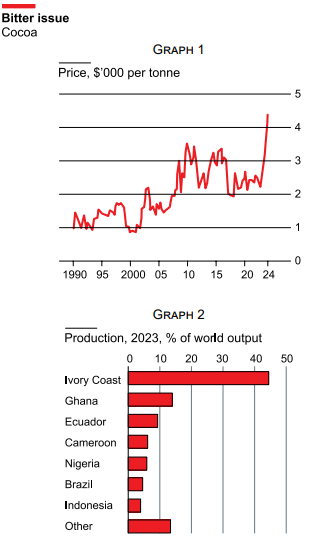
Leia o texto e examine os gráficos para responder à questão.
If you’re a chocoholic you may have noticed that your
habit has lately become more expensive. The price of cocoa
began creeping up in the second half of 2022. Since then
it has doubled, reaching an all-time high in January 2024.
That steep rise spells trouble for the chocolate business and
sweet-toothed consumers alike.
Climate patterns are partly to blame for rising costs. Cocoa
is mostly produced by small farmers in West Africa. Ghana
and Ivory Coast grow about 60% of the world’s crop.
Last season, in 2023, the El Niño weather pattern led to
unseasonably high temperatures and rainfall that ravaged
crops. Total rainfall in Ivory Coast’s cocoa-growing areas
in 2023 was the highest in 20 years, according to Gro
Intelligence, a data firm.
This year El Niño has brought severe drought to the cocoa
farms, reducing production further. ING, a bank, estimates
that this year the gap between global production and
consumption will be at its widest since at least 2014. Extreme
weather patterns have hit other commodities, too. Droughts
in Thailand and India are affecting rice plantations. Torrential
rain in Brazil, the world’s biggest sugar exporter, has affected
its exports. Besides, other price pressures are specific to the
cocoa industry. Swollen-shoot virus and black-pod disease —
killers of cocoa trees — spread across Ghana and Ivory Coast
during heavy rainfall last year. Tropical Research Services,
a research company, estimates that by the end of 2023 the
swollen-shoot virus had infected around 20% of Ivory Coast’s
cocoa trees.
(www.economist.com, 28.02.2024. Adaptado.)
No trecho do terceiro parágrafo “Besides, other price pressures
are specific to the cocoa industry”, o termo sublinhado pode
ser substituído, sem alteração de sentido, por:
 Conheça nossos planos