Questões de Vestibular Sobre inglês
Foram encontradas 6.367 questões


Leia o texto e responda à questão.

Adapted from: https://www.dailymail.co.uk/sciencetech/article-7399879/European-capital-cities-dominate-list-worlds-FASTEST-public-transport-systems.html
Last access: August, 29, 2019.
Leia o texto e responda à questão.
Adapted from: https://www.dailymail.co.uk/sciencetech/article-7399879/European-capital-cities-dominate-list-worlds-FASTEST-public-transport-systems.html
Last access: August, 29, 2019.
Leia o texto e responda à questão.
Adapted from: https://www.dailymail.co.uk/sciencetech/article-7399879/European-capital-cities-dominate-list-worlds-FASTEST-public-transport-systems.html
Last access: August, 29, 2019.
Leia o texto e responda à questão.
Adapted from: https://www.dailymail.co.uk/sciencetech/article-7399879/European-capital-cities-dominate-list-worlds-FASTEST-public-transport-systems.html
Last access: August, 29, 2019.
Observe o infográfico a seguir para responder à questão.

Disponível em: https://www.iema.net/wed18/wedresources. Acesso em: 25 jun. 2019.
Considerando-se as informações expressas na imagem e nas sentenças presentes no infográfico, verifica-se que a
When the OECD launched the Programme for International Student Assessment — PISA — the idea was to enable countries to make cross-national comparisons of student achievement using a common/standard metric to increase human capital. In other words, higher academic achievement should corelate with earnings in the future and a country’s standard of living. As PISA states, it publishes the results of the test a year after the students are tested to help governments shape their education policies.
As PISA has developed, through seven global testing rounds every three years, with the first in 2000 and the most recent in 2018, for some it has gained a reputation as the “Olympics of education” given the widespread attention that country rankings receive following the release of results.
Now, partly in the face of criticisms, PISA is looking at expanding how and what it tests. As this process unfolds, policy-makers must remember that the social consequences of a test are just as important as the test’s content. Putting a new face on PISA will undoubtedly present various opportunities and challenges.
To date, PISA has been restricted to what is generally called the “cognitive” side of learning, focusing on reading, mathematics and scientific literacy. In addition to test questions, students and school principals fill out questionnaires to provide contextual information on student and school environment characteristics that can be associated with more or less favourable performance.
Countries that excel in PISA tests, such as Finland, a country with less than six million people, have become regarded by policy-makers as a “global reference society” — an ideal to aspire to — due to their high performance in PISA rankings.
Asian countries or jurisdictions like Singapore, Hong Kong (China) and Japan tend to consistently achieve exceptional PISA performances and hence get a lot of attention from other countries wishing to emulate their success via borrowing policy. For example, England flew teachers out to China to study mathematics teaching.
In the next administration in 2021, PISA will tackle creative thinking, trying to find ways to assess, and have students assess, flexibility in thinking and habits of creativity such as being inquisitive and persistent. The PISA team is also developing a way of testing students’ digital learning, which should be ready in time for the 2024 assessment.
However, it should be remembered that education policies from high achieving nations don’t migrate across international boundaries without consideration given to national and cultural contexts. Rather, innovations and changes in education require teachers to have the time and opportunity to re-educate themselves in relation to more recent insights in what it means to get the best out of children.
When the OECD launched the Programme for International Student Assessment — PISA — the idea was to enable countries to make cross-national comparisons of student achievement using a common/standard metric to increase human capital. In other words, higher academic achievement should corelate with earnings in the future and a country’s standard of living. As PISA states, it publishes the results of the test a year after the students are tested to help governments shape their education policies.
As PISA has developed, through seven global testing rounds every three years, with the first in 2000 and the most recent in 2018, for some it has gained a reputation as the “Olympics of education” given the widespread attention that country rankings receive following the release of results.
Now, partly in the face of criticisms, PISA is looking at expanding how and what it tests. As this process unfolds, policy-makers must remember that the social consequences of a test are just as important as the test’s content. Putting a new face on PISA will undoubtedly present various opportunities and challenges.
To date, PISA has been restricted to what is generally called the “cognitive” side of learning, focusing on reading, mathematics and scientific literacy. In addition to test questions, students and school principals fill out questionnaires to provide contextual information on student and school environment characteristics that can be associated with more or less favourable performance.
Countries that excel in PISA tests, such as Finland, a country with less than six million people, have become regarded by policy-makers as a “global reference society” — an ideal to aspire to — due to their high performance in PISA rankings.
Asian countries or jurisdictions like Singapore, Hong Kong (China) and Japan tend to consistently achieve exceptional PISA performances and hence get a lot of attention from other countries wishing to emulate their success via borrowing policy. For example, England flew teachers out to China to study mathematics teaching.
In the next administration in 2021, PISA will tackle creative thinking, trying to find ways to assess, and have students assess, flexibility in thinking and habits of creativity such as being inquisitive and persistent. The PISA team is also developing a way of testing students’ digital learning, which should be ready in time for the 2024 assessment.
However, it should be remembered that education policies from high achieving nations don’t migrate across international boundaries without consideration given to national and cultural contexts. Rather, innovations and changes in education require teachers to have the time and opportunity to re-educate themselves in relation to more recent insights in what it means to get the best out of children.
When the OECD launched the Programme for International Student Assessment — PISA — the idea was to enable countries to make cross-national comparisons of student achievement using a common/standard metric to increase human capital. In other words, higher academic achievement should corelate with earnings in the future and a country’s standard of living. As PISA states, it publishes the results of the test a year after the students are tested to help governments shape their education policies.
As PISA has developed, through seven global testing rounds every three years, with the first in 2000 and the most recent in 2018, for some it has gained a reputation as the “Olympics of education” given the widespread attention that country rankings receive following the release of results.
Now, partly in the face of criticisms, PISA is looking at expanding how and what it tests. As this process unfolds, policy-makers must remember that the social consequences of a test are just as important as the test’s content. Putting a new face on PISA will undoubtedly present various opportunities and challenges.
To date, PISA has been restricted to what is generally called the “cognitive” side of learning, focusing on reading, mathematics and scientific literacy. In addition to test questions, students and school principals fill out questionnaires to provide contextual information on student and school environment characteristics that can be associated with more or less favourable performance.
Countries that excel in PISA tests, such as Finland, a country with less than six million people, have become regarded by policy-makers as a “global reference society” — an ideal to aspire to — due to their high performance in PISA rankings.
Asian countries or jurisdictions like Singapore, Hong Kong (China) and Japan tend to consistently achieve exceptional PISA performances and hence get a lot of attention from other countries wishing to emulate their success via borrowing policy. For example, England flew teachers out to China to study mathematics teaching.
In the next administration in 2021, PISA will tackle creative thinking, trying to find ways to assess, and have students assess, flexibility in thinking and habits of creativity such as being inquisitive and persistent. The PISA team is also developing a way of testing students’ digital learning, which should be ready in time for the 2024 assessment.
However, it should be remembered that education policies from high achieving nations don’t migrate across international boundaries without consideration given to national and cultural contexts. Rather, innovations and changes in education require teachers to have the time and opportunity to re-educate themselves in relation to more recent insights in what it means to get the best out of children.

Disponível em: https://www.who.int/mediacentre/events/2015/world-antibiotic-awareness-week/infographics/en/. Acesso em: 02 maio 2019.
Disponível em: https://www.who.int/mediacentre/events/2015/world-antibiotic-awareness-week/infographics/en/. Acesso em: 02 maio 2019.
Leia o texto a seguir para responder à questão.
Artificial intelligence and the future of medicine
Right now, the challenges we need to address as we try to bring AI into medical practice include improving the quality of the data that we feed into AI systems, developing ways to evaluate whether an AI system is actually better than standard of care, ensuring patient privacy and making sure not only that AI doesn't disrupt clinical work flow but in fact improves it. But if doctors do their jobs right and build these systems well, much of what we have described will become so ingrained in the system, people won't even refer to it separately as informatics or AI. It will just be medicine.
Leia o texto a seguir para responder à questão.
Artificial intelligence and the future of medicine
Right now, the challenges we need to address as we try to bring AI into medical practice include improving the quality of the data that we feed into AI systems, developing ways to evaluate whether an AI system is actually better than standard of care, ensuring patient privacy and making sure not only that AI doesn't disrupt clinical work flow but in fact improves it. But if doctors do their jobs right and build these systems well, much of what we have described will become so ingrained in the system, people won't even refer to it separately as informatics or AI. It will just be medicine.
Leia o texto a seguir para responder à questão.
Artificial intelligence and the future of medicine
Right now, the challenges we need to address as we try to bring AI into medical practice include improving the quality of the data that we feed into AI systems, developing ways to evaluate whether an AI system is actually better than standard of care, ensuring patient privacy and making sure not only that AI doesn't disrupt clinical work flow but in fact improves it. But if doctors do their jobs right and build these systems well, much of what we have described will become so ingrained in the system, people won't even refer to it separately as informatics or AI. It will just be medicine.
Observe o infográfico a seguir para responder à questão.
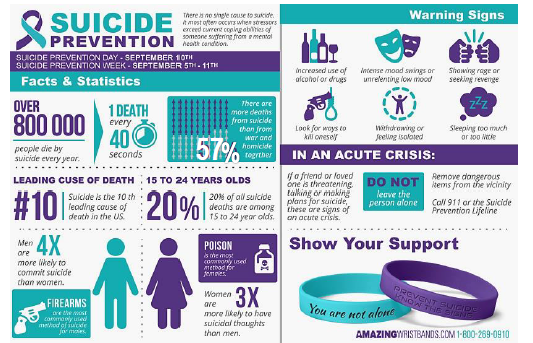
Disponível: https://morgan6062.com/2018/06/09/suicide-prevention-hotlines/. Acesso em: 08 out. 2019
According the information expressed in the image and data, Suicide Prevention, we verify that
Leia o texto a seguir para responder à questão.
Forest fires: the good and the bad
Every year it seems like there’s another disastrous wildfire in the American West. In 2018, nearly 9 million acres were burned in the US alone. Uncontrolled fires often started accidentally by people, rampage and decimate forests. F
or most people, a forest fire is synonymous with disaster. But there are some kinds of forest fires that actually benefit the environment.
A controlled burn is a wildfire that people set intentionally for a specific purpose. Well-thought-out and wellmanaged controlled burns can be incredibly beneficial for forest management—in part because they can help stop an out-of-control wildfire. The technique is called backburning, and it involves setting a controlled fire in the path of the approaching wildfire. All the flammable material is burnt up and extinguished. When the wildfire approaches, there’s no more fuel left for it to keep going, and it dies out.
Controlled burns are also used to prevent forest fires. Even before human involvement, natural, low-intensity wildfires occurred every few years to burn up fuel, plant debris, and dead trees, making way for young, healthy trees and vegetation to thrive. That new growth in turn supports forest wildlife. Forest managers are now replicating this natural strategy when appropriate, starting manageable, slow-burning fires to make room for new life that will help keep the forest healthy in the long term.
The same method is one of WWF’s strategies for maintaining grassland habitats in the Northern Great Plains. Working with partners such as the U.S. Fish and Wildlife Service, WWF has intentionally burned hundreds of acres of prairie land to revitalize these key habitats. The fire burns off tall, aggressive vegetation that isn’t as hospitable to wildlife, and makes room for new growth that attracts bison, birds, and prairie dogs.
This doesn’t mean all intentional wildfires are good – far from it. Many of the fires intentionally set for agriculture and land clearing are at best ill-advised, and at worst devastating. Slash and burn fires are set every day to destroy large sections of forests. Of course, these forests don’t just remove trees; they kill and displace wildlife, alter water cycles and soil fertility, and endanger the lives and livelihoods of local communities. They also can rage out of control. In 1997, fires set intentionally to clear forests in Indonesia escalated into one of the largest wildfires in recorded history. Hundreds of people died; millions of acres burned; already at-risk species like orangutans perished by the hundreds; and a smoke and ash haze hung over southeast Asia for months, reducing visibility and causing acute health conditions.
That’s exactly why WWF helps governments around the world crack down on slash and burn deforestation. WWF also works with farmers and companies to stop unnecessary agricultural burns. And when our scientists think fire could be the best solution for revitalizing wild areas, we bring the right experts to the table to study the situation and come up with a plan.
All fire is risky. To minimize that risk as much as possible, controlled burns must be well-considered, wellplanned, and ignited and maintained by trained professionals. The bottom line? Fire can be a tool for conservation, but only when used the right way.
Disponível em: https://www.worldwildlife.org/stories/forest-fires-the-good-and-the-bad. Acesso em: 08 out. 2019
Leia o texto a seguir para responder à questão.
Forest fires: the good and the bad
Every year it seems like there’s another disastrous wildfire in the American West. In 2018, nearly 9 million acres were burned in the US alone. Uncontrolled fires often started accidentally by people, rampage and decimate forests. F
or most people, a forest fire is synonymous with disaster. But there are some kinds of forest fires that actually benefit the environment.
A controlled burn is a wildfire that people set intentionally for a specific purpose. Well-thought-out and wellmanaged controlled burns can be incredibly beneficial for forest management—in part because they can help stop an out-of-control wildfire. The technique is called backburning, and it involves setting a controlled fire in the path of the approaching wildfire. All the flammable material is burnt up and extinguished. When the wildfire approaches, there’s no more fuel left for it to keep going, and it dies out.
Controlled burns are also used to prevent forest fires. Even before human involvement, natural, low-intensity wildfires occurred every few years to burn up fuel, plant debris, and dead trees, making way for young, healthy trees and vegetation to thrive. That new growth in turn supports forest wildlife. Forest managers are now replicating this natural strategy when appropriate, starting manageable, slow-burning fires to make room for new life that will help keep the forest healthy in the long term.
The same method is one of WWF’s strategies for maintaining grassland habitats in the Northern Great Plains. Working with partners such as the U.S. Fish and Wildlife Service, WWF has intentionally burned hundreds of acres of prairie land to revitalize these key habitats. The fire burns off tall, aggressive vegetation that isn’t as hospitable to wildlife, and makes room for new growth that attracts bison, birds, and prairie dogs.
This doesn’t mean all intentional wildfires are good – far from it. Many of the fires intentionally set for agriculture and land clearing are at best ill-advised, and at worst devastating. Slash and burn fires are set every day to destroy large sections of forests. Of course, these forests don’t just remove trees; they kill and displace wildlife, alter water cycles and soil fertility, and endanger the lives and livelihoods of local communities. They also can rage out of control. In 1997, fires set intentionally to clear forests in Indonesia escalated into one of the largest wildfires in recorded history. Hundreds of people died; millions of acres burned; already at-risk species like orangutans perished by the hundreds; and a smoke and ash haze hung over southeast Asia for months, reducing visibility and causing acute health conditions.
That’s exactly why WWF helps governments around the world crack down on slash and burn deforestation. WWF also works with farmers and companies to stop unnecessary agricultural burns. And when our scientists think fire could be the best solution for revitalizing wild areas, we bring the right experts to the table to study the situation and come up with a plan.
All fire is risky. To minimize that risk as much as possible, controlled burns must be well-considered, wellplanned, and ignited and maintained by trained professionals. The bottom line? Fire can be a tool for conservation, but only when used the right way.
Disponível em: https://www.worldwildlife.org/stories/forest-fires-the-good-and-the-bad. Acesso em: 08 out. 2019
Leia o texto a seguir para responder à questão.
Forest fires: the good and the bad
Every year it seems like there’s another disastrous wildfire in the American West. In 2018, nearly 9 million acres were burned in the US alone. Uncontrolled fires often started accidentally by people, rampage and decimate forests. F
or most people, a forest fire is synonymous with disaster. But there are some kinds of forest fires that actually benefit the environment.
A controlled burn is a wildfire that people set intentionally for a specific purpose. Well-thought-out and wellmanaged controlled burns can be incredibly beneficial for forest management—in part because they can help stop an out-of-control wildfire. The technique is called backburning, and it involves setting a controlled fire in the path of the approaching wildfire. All the flammable material is burnt up and extinguished. When the wildfire approaches, there’s no more fuel left for it to keep going, and it dies out.
Controlled burns are also used to prevent forest fires. Even before human involvement, natural, low-intensity wildfires occurred every few years to burn up fuel, plant debris, and dead trees, making way for young, healthy trees and vegetation to thrive. That new growth in turn supports forest wildlife. Forest managers are now replicating this natural strategy when appropriate, starting manageable, slow-burning fires to make room for new life that will help keep the forest healthy in the long term.
The same method is one of WWF’s strategies for maintaining grassland habitats in the Northern Great Plains. Working with partners such as the U.S. Fish and Wildlife Service, WWF has intentionally burned hundreds of acres of prairie land to revitalize these key habitats. The fire burns off tall, aggressive vegetation that isn’t as hospitable to wildlife, and makes room for new growth that attracts bison, birds, and prairie dogs.
This doesn’t mean all intentional wildfires are good – far from it. Many of the fires intentionally set for agriculture and land clearing are at best ill-advised, and at worst devastating. Slash and burn fires are set every day to destroy large sections of forests. Of course, these forests don’t just remove trees; they kill and displace wildlife, alter water cycles and soil fertility, and endanger the lives and livelihoods of local communities. They also can rage out of control. In 1997, fires set intentionally to clear forests in Indonesia escalated into one of the largest wildfires in recorded history. Hundreds of people died; millions of acres burned; already at-risk species like orangutans perished by the hundreds; and a smoke and ash haze hung over southeast Asia for months, reducing visibility and causing acute health conditions.
That’s exactly why WWF helps governments around the world crack down on slash and burn deforestation. WWF also works with farmers and companies to stop unnecessary agricultural burns. And when our scientists think fire could be the best solution for revitalizing wild areas, we bring the right experts to the table to study the situation and come up with a plan.
All fire is risky. To minimize that risk as much as possible, controlled burns must be well-considered, wellplanned, and ignited and maintained by trained professionals. The bottom line? Fire can be a tool for conservation, but only when used the right way.
Disponível em: https://www.worldwildlife.org/stories/forest-fires-the-good-and-the-bad. Acesso em: 08 out. 2019

 Conheça nossos planos