Questões de Vestibular Sobre interpretação de texto | reading comprehension em inglês

Foram encontradas 5.299 questões

Ano: 2017 Banca: FUNTEF - PR Órgão: IF-PR Prova: FUNTEF-PR - 2017 - IF-PR - Vestibular |
Q1271511 Inglês

August 16, 2017 / 10:00 AM

Four years without Big Ben’s bongs? It can’t be right, says UK PM May

    LONDON (Reuters) - Prime Minister Theresa May said on Wednesday it could not be right for “Big Ben”, the bell in the British parliament’s clock tower whose bongs (1)_______, to fall silent for four years during renovations. May joined other politicians who have protested at the news that the great bell, which has rung every hour for most of the past 157 years, would cease its bongs to ensure the safety of workers carrying out renovations on the tower.

    “Of course we want to ensure that people are safe at work, but it can’t be right for Big Ben to be silent for four years,” May told reporters.

    “I hope that the Speaker (of the House of Commons) ... will urgently look into this and ensure that we can hear Big Ben through those four years.”

    Big Ben’s bongs, which are heard marking the start of some of the BBC’s flagship news bulletins, are part of the soundtrack of daily life in the British capital and beyond.

    Officially known as the Elizabeth Tower, the clock tower that houses Big Ben is believed to be the most photographed building in the United Kingdom. May’s comments were more restrained than those of her Brexit minister, David Davis, who said on Tuesday that (2)_____.

    Another Conservative politician, member of parliament Nigel Evans, suggested earlier on Wednesday that the bongs could be switched back on every evening when the workers carrying out the renovations of the clock tower finished for the day.

    Steve Jaggs, parliament’s Keeper of the Great Clock, had announced this week that Big Ben would stop its regular chimes at midday (1100 GMT) on Monday, Aug. 21, inviting members of the public to gather nearby to hear the final bongs.

    The bell will still toll for important (3)_____ but will otherwise remain silent until 2021.

Reporting by Estelle Shirbon; editing by Michael Holden (Adaptado de Acesso em 16/08/2017) 

When will the bongs begin again regularly?
Alternativas
Ano: 2017 Banca: FUNTEF - PR Órgão: IF-PR Prova: FUNTEF-PR - 2017 - IF-PR - Vestibular |
Q1271510 Inglês

August 16, 2017 / 10:00 AM

Four years without Big Ben’s bongs? It can’t be right, says UK PM May

    LONDON (Reuters) - Prime Minister Theresa May said on Wednesday it could not be right for “Big Ben”, the bell in the British parliament’s clock tower whose bongs (1)_______, to fall silent for four years during renovations. May joined other politicians who have protested at the news that the great bell, which has rung every hour for most of the past 157 years, would cease its bongs to ensure the safety of workers carrying out renovations on the tower.

    “Of course we want to ensure that people are safe at work, but it can’t be right for Big Ben to be silent for four years,” May told reporters.

    “I hope that the Speaker (of the House of Commons) ... will urgently look into this and ensure that we can hear Big Ben through those four years.”

    Big Ben’s bongs, which are heard marking the start of some of the BBC’s flagship news bulletins, are part of the soundtrack of daily life in the British capital and beyond.

    Officially known as the Elizabeth Tower, the clock tower that houses Big Ben is believed to be the most photographed building in the United Kingdom. May’s comments were more restrained than those of her Brexit minister, David Davis, who said on Tuesday that (2)_____.

    Another Conservative politician, member of parliament Nigel Evans, suggested earlier on Wednesday that the bongs could be switched back on every evening when the workers carrying out the renovations of the clock tower finished for the day.

    Steve Jaggs, parliament’s Keeper of the Great Clock, had announced this week that Big Ben would stop its regular chimes at midday (1100 GMT) on Monday, Aug. 21, inviting members of the public to gather nearby to hear the final bongs.

    The bell will still toll for important (3)_____ but will otherwise remain silent until 2021.

Reporting by Estelle Shirbon; editing by Michael Holden (Adaptado de Acesso em 16/08/2017) 

What is the official name of the clock tower that houses the famous bell?
Alternativas
Ano: 2017 Banca: FUNTEF - PR Órgão: IF-PR Prova: FUNTEF-PR - 2017 - IF-PR - Vestibular |
Q1271509 Inglês

August 16, 2017 / 10:00 AM

Four years without Big Ben’s bongs? It can’t be right, says UK PM May

    LONDON (Reuters) - Prime Minister Theresa May said on Wednesday it could not be right for “Big Ben”, the bell in the British parliament’s clock tower whose bongs (1)_______, to fall silent for four years during renovations. May joined other politicians who have protested at the news that the great bell, which has rung every hour for most of the past 157 years, would cease its bongs to ensure the safety of workers carrying out renovations on the tower.

    “Of course we want to ensure that people are safe at work, but it can’t be right for Big Ben to be silent for four years,” May told reporters.

    “I hope that the Speaker (of the House of Commons) ... will urgently look into this and ensure that we can hear Big Ben through those four years.”

    Big Ben’s bongs, which are heard marking the start of some of the BBC’s flagship news bulletins, are part of the soundtrack of daily life in the British capital and beyond.

    Officially known as the Elizabeth Tower, the clock tower that houses Big Ben is believed to be the most photographed building in the United Kingdom. May’s comments were more restrained than those of her Brexit minister, David Davis, who said on Tuesday that (2)_____.

    Another Conservative politician, member of parliament Nigel Evans, suggested earlier on Wednesday that the bongs could be switched back on every evening when the workers carrying out the renovations of the clock tower finished for the day.

    Steve Jaggs, parliament’s Keeper of the Great Clock, had announced this week that Big Ben would stop its regular chimes at midday (1100 GMT) on Monday, Aug. 21, inviting members of the public to gather nearby to hear the final bongs.

    The bell will still toll for important (3)_____ but will otherwise remain silent until 2021.

Reporting by Estelle Shirbon; editing by Michael Holden (Adaptado de Acesso em 16/08/2017) 

Why will Big Ben be silent for four years?
Alternativas
Ano: 2017 Banca: FUNTEF - PR Órgão: IF-PR Prova: FUNTEF-PR - 2017 - IF-PR - Vestibular |
Q1271508 Inglês

August 16, 2017 / 10:00 AM

Four years without Big Ben’s bongs? It can’t be right, says UK PM May

    LONDON (Reuters) - Prime Minister Theresa May said on Wednesday it could not be right for “Big Ben”, the bell in the British parliament’s clock tower whose bongs (1)_______, to fall silent for four years during renovations. May joined other politicians who have protested at the news that the great bell, which has rung every hour for most of the past 157 years, would cease its bongs to ensure the safety of workers carrying out renovations on the tower.

    “Of course we want to ensure that people are safe at work, but it can’t be right for Big Ben to be silent for four years,” May told reporters.

    “I hope that the Speaker (of the House of Commons) ... will urgently look into this and ensure that we can hear Big Ben through those four years.”

    Big Ben’s bongs, which are heard marking the start of some of the BBC’s flagship news bulletins, are part of the soundtrack of daily life in the British capital and beyond.

    Officially known as the Elizabeth Tower, the clock tower that houses Big Ben is believed to be the most photographed building in the United Kingdom. May’s comments were more restrained than those of her Brexit minister, David Davis, who said on Tuesday that (2)_____.

    Another Conservative politician, member of parliament Nigel Evans, suggested earlier on Wednesday that the bongs could be switched back on every evening when the workers carrying out the renovations of the clock tower finished for the day.

    Steve Jaggs, parliament’s Keeper of the Great Clock, had announced this week that Big Ben would stop its regular chimes at midday (1100 GMT) on Monday, Aug. 21, inviting members of the public to gather nearby to hear the final bongs.

    The bell will still toll for important (3)_____ but will otherwise remain silent until 2021.

Reporting by Estelle Shirbon; editing by Michael Holden (Adaptado de Acesso em 16/08/2017) 

In the previous text, three parts of sentences have been removed. Below you will find the three removed parts PLUS one which doesn’t fit. Choose from the parts of sentences (I – IV) the one which fits each gap (1 – 3). Remember, there is one extra sentence you do not need to use. Sentences I) the House of Commons said on Monday II) events such as New Year’s Eve celebrations III) are one of the country’s most familiar sounds IV) the silencing of Big Ben for such a long period was “mad”
Now choose the correct alternative.
Alternativas
Ano: 2017 Banca: IF SUL - MG Órgão: IF Sul - MG Prova: IF SUL - MG - 2017 - IF Sul - MG - Vestibular - Segundo Semestre |
Q1271227 Inglês
AI Picks Up Racial and Gender Biases When Learning from What Humans Write

AI1 picks up racial and gender biases2 when learning language from text, researchers say. Without any supervision, a machine learning algorithm learns to associate female names more with family words than career words, and black names as being more unpleasant than white names.

For a study published today in Science, researchers tested the bias of a common AI model, and then matched the results against a well-known psychological test that measures bias in humans. The team replicated in the algorithm all the psychological biases they tested, according to a study from co-author Aylin Caliskan, a post-doc at Princeton University. Because machine learning algorithms are so common, influencing everything from translation to scanning names on resumes, this research shows that the biases are pervasive, too. 

An algorithm is a set of instructions that humans write to help computers learn. Think of it like a recipe, says Zachary Lipton, an AI researcher at UC San Diego who was not involved in the study. Because algorithms use existing materials — like books or text on the internet — it’s obvious that AI can pick up biases if the materials themselves are biased. (For example, Google Photos tagged black users as gorillas.) We’ve known for a while, for instance, that language algorithms learn to associate the word “man” with “professor” and the word “woman” with “assistant professor.” But this paper is interesting because it incorporates previous work done in psychology on human biases, Lipton says.

For today’s study, Caliskan’s team created a test that resembles the Implicit Association Test (IAT), which is commonly used in psychology to measure how biased people are (though there has been some controversy over its accuracy). In the IAT, subjects are presented with two images — say, a white man and a black man — and words like “pleasant” or “unpleasant.” The IAT calculates how quickly you match up “white man” and “pleasant” versus “black man” and “pleasant,” and vice versa. The idea is that the longer it takes you to match up two concepts, the more trouble you have associating them.

The test developed by the researchers also calculates bias, but instead of measuring “response time”, it measures the mathematical distance between two words. In other words, if there’s a bigger numerical distance between a black name and the concept of “pleasant” than a white name and “pleasant”, the model’s association between the two isn’t as strong. The further apart the words are, the less the algorithm associates them together.

Caliskan’s team then tested their method on one particular algorithm: Global Vectors for Word Representation (GLoVe) from Stanford University. GLoVe basically crawls the web to find data and learns associations between billions of words. The researchers found that, in GLoVe, female words are more associated with arts than with math or science, and black names are seen as more unpleasant than white names. That doesn’t mean there’s anything wrong with the AI system, per se, or how the AI is learning — there’s something wrong with the material.

1AI: Artificial Intelligence
2bias: prejudice; preconception

Disponível em <http://www.theverge.com/>. Acesso em: 18/04/2017.
Why does Artificial Intelligence (AI) pick up biases?
Alternativas
Ano: 2017 Banca: IF SUL - MG Órgão: IF Sul - MG Prova: IF SUL - MG - 2017 - IF Sul - MG - Vestibular - Segundo Semestre |
Q1271226 Inglês
AI Picks Up Racial and Gender Biases When Learning from What Humans Write

AI1 picks up racial and gender biases2 when learning language from text, researchers say. Without any supervision, a machine learning algorithm learns to associate female names more with family words than career words, and black names as being more unpleasant than white names.

For a study published today in Science, researchers tested the bias of a common AI model, and then matched the results against a well-known psychological test that measures bias in humans. The team replicated in the algorithm all the psychological biases they tested, according to a study from co-author Aylin Caliskan, a post-doc at Princeton University. Because machine learning algorithms are so common, influencing everything from translation to scanning names on resumes, this research shows that the biases are pervasive, too. 

An algorithm is a set of instructions that humans write to help computers learn. Think of it like a recipe, says Zachary Lipton, an AI researcher at UC San Diego who was not involved in the study. Because algorithms use existing materials — like books or text on the internet — it’s obvious that AI can pick up biases if the materials themselves are biased. (For example, Google Photos tagged black users as gorillas.) We’ve known for a while, for instance, that language algorithms learn to associate the word “man” with “professor” and the word “woman” with “assistant professor.” But this paper is interesting because it incorporates previous work done in psychology on human biases, Lipton says.

For today’s study, Caliskan’s team created a test that resembles the Implicit Association Test (IAT), which is commonly used in psychology to measure how biased people are (though there has been some controversy over its accuracy). In the IAT, subjects are presented with two images — say, a white man and a black man — and words like “pleasant” or “unpleasant.” The IAT calculates how quickly you match up “white man” and “pleasant” versus “black man” and “pleasant,” and vice versa. The idea is that the longer it takes you to match up two concepts, the more trouble you have associating them.

The test developed by the researchers also calculates bias, but instead of measuring “response time”, it measures the mathematical distance between two words. In other words, if there’s a bigger numerical distance between a black name and the concept of “pleasant” than a white name and “pleasant”, the model’s association between the two isn’t as strong. The further apart the words are, the less the algorithm associates them together.

Caliskan’s team then tested their method on one particular algorithm: Global Vectors for Word Representation (GLoVe) from Stanford University. GLoVe basically crawls the web to find data and learns associations between billions of words. The researchers found that, in GLoVe, female words are more associated with arts than with math or science, and black names are seen as more unpleasant than white names. That doesn’t mean there’s anything wrong with the AI system, per se, or how the AI is learning — there’s something wrong with the material.

1AI: Artificial Intelligence
2bias: prejudice; preconception

Disponível em <http://www.theverge.com/>. Acesso em: 18/04/2017.
Com relação ao teste desenvolvido pelos pesquisadores para calcular o preconceito, assinale a alternativa correta.
Alternativas
Ano: 2017 Banca: IF SUL - MG Órgão: IF Sul - MG Prova: IF SUL - MG - 2017 - IF Sul - MG - Vestibular - Segundo Semestre |
Q1271225 Inglês
AI Picks Up Racial and Gender Biases When Learning from What Humans Write

AI1 picks up racial and gender biases2 when learning language from text, researchers say. Without any supervision, a machine learning algorithm learns to associate female names more with family words than career words, and black names as being more unpleasant than white names.

For a study published today in Science, researchers tested the bias of a common AI model, and then matched the results against a well-known psychological test that measures bias in humans. The team replicated in the algorithm all the psychological biases they tested, according to a study from co-author Aylin Caliskan, a post-doc at Princeton University. Because machine learning algorithms are so common, influencing everything from translation to scanning names on resumes, this research shows that the biases are pervasive, too. 

An algorithm is a set of instructions that humans write to help computers learn. Think of it like a recipe, says Zachary Lipton, an AI researcher at UC San Diego who was not involved in the study. Because algorithms use existing materials — like books or text on the internet — it’s obvious that AI can pick up biases if the materials themselves are biased. (For example, Google Photos tagged black users as gorillas.) We’ve known for a while, for instance, that language algorithms learn to associate the word “man” with “professor” and the word “woman” with “assistant professor.” But this paper is interesting because it incorporates previous work done in psychology on human biases, Lipton says.

For today’s study, Caliskan’s team created a test that resembles the Implicit Association Test (IAT), which is commonly used in psychology to measure how biased people are (though there has been some controversy over its accuracy). In the IAT, subjects are presented with two images — say, a white man and a black man — and words like “pleasant” or “unpleasant.” The IAT calculates how quickly you match up “white man” and “pleasant” versus “black man” and “pleasant,” and vice versa. The idea is that the longer it takes you to match up two concepts, the more trouble you have associating them.

The test developed by the researchers also calculates bias, but instead of measuring “response time”, it measures the mathematical distance between two words. In other words, if there’s a bigger numerical distance between a black name and the concept of “pleasant” than a white name and “pleasant”, the model’s association between the two isn’t as strong. The further apart the words are, the less the algorithm associates them together.

Caliskan’s team then tested their method on one particular algorithm: Global Vectors for Word Representation (GLoVe) from Stanford University. GLoVe basically crawls the web to find data and learns associations between billions of words. The researchers found that, in GLoVe, female words are more associated with arts than with math or science, and black names are seen as more unpleasant than white names. That doesn’t mean there’s anything wrong with the AI system, per se, or how the AI is learning — there’s something wrong with the material.

1AI: Artificial Intelligence
2bias: prejudice; preconception

Disponível em <http://www.theverge.com/>. Acesso em: 18/04/2017.
Assinale a alternativa que está de acordo com o texto.
Alternativas
Ano: 2017 Banca: IF SUL - MG Órgão: IF Sul - MG Prova: IF SUL - MG - 2017 - IF Sul - MG - Vestibular - Segundo Semestre |
Q1271224 Inglês
Com relação às expressões abaixo, assinale a alternativa correta.
written word, movable type, mass publication
Alternativas
Ano: 2017 Banca: IF SUL - MG Órgão: IF Sul - MG Prova: IF SUL - MG - 2017 - IF Sul - MG - Vestibular - Segundo Semestre |
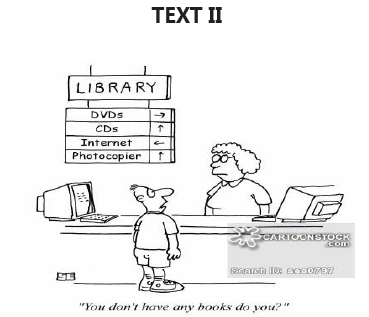
Q1271223 Inglês
A evolução da comunicação é retratada com ironia no cartum. Com relação à figura e ao texto, é INCORRETO afirmar que:
Alternativas
Ano: 2017 Banca: IF-MT Órgão: IF-MT Prova: IF-MT - 2017 - IF-MT - Vestibular - Segundo Semestre |
Q1270624 Inglês

TEXTO I 

HOW TO TRICK YOUR BRAIN INTO HEALTHY EATING

Charles Spence and Jozef Youssef


Quanto aos referentes do texto, analise as frases e os referentes em destaque para assinalar a opção correta:
Alternativas
Ano: 2017 Banca: IF-MT Órgão: IF-MT Prova: IF-MT - 2017 - IF-MT - Vestibular - Segundo Semestre |
Q1270622 Inglês

TEXTO I 

HOW TO TRICK YOUR BRAIN INTO HEALTHY EATING

Charles Spence and Jozef Youssef


Em: In fact, many people don’t even use their dining space at home, [...] (L. 27 - 28), a palavra de ligação “In fact”, confere ao texto uma ideia de:
Alternativas
Ano: 2017 Banca: IF-MT Órgão: IF-MT Prova: IF-MT - 2017 - IF-MT - Vestibular - Segundo Semestre |
Q1270620 Inglês

TEXTO I 

HOW TO TRICK YOUR BRAIN INTO HEALTHY EATING

Charles Spence and Jozef Youssef


No que diz respeito aos resultados das pesquisas, analise as assertivas abaixo: I. As pesquisas provaram que os alimentos orgânicos colocados em louças maiores não enganam o nosso estômago. II. Colocar alimentos em louças menores tende a enganar o nosso cérebro para acreditar que estamos comendo mais. III. Servir comida calórica em diferentes vasilhames mais pesados pode nos dar a sensação de volume e profundidade. IV. As pesquisas mostram que comer com a mão não dominante, geralmente leva a um consumo menor de alimentos. Está CORRETO o que se afirma em:
Alternativas
Ano: 2017 Banca: IF-MT Órgão: IF-MT Prova: IF-MT - 2017 - IF-MT - Vestibular - Segundo Semestre |
Q1270619 Inglês

TEXTO I 

HOW TO TRICK YOUR BRAIN INTO HEALTHY EATING

Charles Spence and Jozef Youssef


De acordo com os autores do texto, as pessoas:
Alternativas
Ano: 2017 Banca: IF-MT Órgão: IF-MT Prova: IF-MT - 2017 - IF-MT - Vestibular - Segundo Semestre |
Q1270618 Inglês

TEXTO I 

HOW TO TRICK YOUR BRAIN INTO HEALTHY EATING

Charles Spence and Jozef Youssef


É INCORRETO afirmar que:
Alternativas
Ano: 2017 Banca: IF-MT Órgão: IF-MT Prova: IF-MT - 2017 - IF-MT - Vestibular - Segundo Semestre |
Q1270617 Inglês

TEXTO I 

HOW TO TRICK YOUR BRAIN INTO HEALTHY EATING

Charles Spence and Jozef Youssef


Da leitura do texto, pode-se inferir que o cérebro:
Alternativas
Ano: 2017 Banca: IF-MT Órgão: IF-MT Prova: IF-MT - 2017 - IF-MT - Vestibular - Segundo Semestre |
Q1270616 Inglês

TEXTO I 

HOW TO TRICK YOUR BRAIN INTO HEALTHY EATING

Charles Spence and Jozef Youssef


Quanto à opinião dos autores do texto em questão, é correto afirmar que:
Alternativas
Ano: 2017 Banca: IF-MT Órgão: IF-MT Prova: IF-MT - 2017 - IF-MT - Vestibular - Segundo Semestre |
Q1270615 Inglês

TEXTO I 

HOW TO TRICK YOUR BRAIN INTO HEALTHY EATING

Charles Spence and Jozef Youssef


De acordo com as informações do texto, pode-se afirmar:
Alternativas
Ano: 2017 Banca: IF-TO Órgão: IF-TO Prova: IF-TO - 2017 - IF-TO - Vestibular - Segundo Semestre |
Q1270280 Inglês
Brazil Committee Head Confident Pension Reforms Will Pass
By Thomson Reuters.

Brasilia (Reuters) - The head of the committee in Brazil's lower house of Congress that is examining a landmark pension reform proposal said he is confident the measure would easily pass the committee on Wednesday.
Deputy Carlos Marun told reporters he thinks at least 22 of the 37 members of the committee will approve the measure - three more than necessary - and that it would be taken up by the full house in the second half of this month.
The unpopular constitutional amendment would make Brazilians work longer and reduce some pension benefits to plug a widening budget deficit at the root of the country's worst recession ever. (Reporting by Maria Carolina Marcello; Writing by Brad Brooks; Editing by Daniel Flynn)
Copyright 2017 Thomson Reuters.
https://www.usnews.com/news/world/articles/2017-05-03/brazilcommittee-head-confident-pension-reforms.Acesso: 11/05/2017
O trecho sublinhado no texto relata que o Deputado Carlos Marun
Alternativas
Ano: 2017 Banca: IF-TO Órgão: IF-TO Prova: IF-TO - 2017 - IF-TO - Vestibular - Segundo Semestre |
Q1270279 Inglês
Brazil Committee Head Confident Pension Reforms Will Pass
By Thomson Reuters.

Brasilia (Reuters) - The head of the committee in Brazil's lower house of Congress that is examining a landmark pension reform proposal said he is confident the measure would easily pass the committee on Wednesday.
Deputy Carlos Marun told reporters he thinks at least 22 of the 37 members of the committee will approve the measure - three more than necessary - and that it would be taken up by the full house in the second half of this month.
The unpopular constitutional amendment would make Brazilians work longer and reduce some pension benefits to plug a widening budget deficit at the root of the country's worst recession ever. (Reporting by Maria Carolina Marcello; Writing by Brad Brooks; Editing by Daniel Flynn)
Copyright 2017 Thomson Reuters.
https://www.usnews.com/news/world/articles/2017-05-03/brazilcommittee-head-confident-pension-reforms.Acesso: 11/05/2017
Leia as afirmativas a seguir atenciosamente. Elas se referem ao texto acima.

I) Todos os parágrafos do texto têm como assunto central a reforma da Previdência social e dos direitos trabalhistas, valorizando os idosos.
II) O primeiro parágrafo do texto relata que a proposta de reformas do sistema de pensões poderá ser facilmente aprovada.
III)O segundo parágrafo expõe que o deputado Carlos Marun acredita que pelo menos 22 dos 37 membros do comitê aprovarão a proposta
IV)O terceiro parágrafo expressa que, com emenda constitucional, os brasileiros poderão trabalhar por mais tempo e terem seus benefícios pensionistas reduzidos, como meta de conter o déficit orçamentário da pior recessão do país.
V) O terceiro parágrafo apresenta soluções para os problemas dos trabalhadores brasileiros priorizando os seus benefícios e direitos trabalhistas

Marque a alternativa que contenha afirmações falsas com relação ao texto:
Alternativas
Ano: 2017 Banca: IF-TO Órgão: IF-TO Prova: IF-TO - 2017 - IF-TO - Vestibular - Segundo Semestre |
Q1270278 Inglês
Be proactive and protect yourself from yellow fever

By World Health Organization
People living in or travelling to potentially endemic areas of yellow fever transmission should protect themselves. The yellow fever vaccine provides lifelong protection against the disease. You should protect yourself from mosquito bites by wearing light-coloured, long-sleeved shirts and trousers, sleeping under a bed net day and night, using insect repellents and getting rid of stagnant water from places where mosquitoes breed.

Information products on yellow fever and vaccination are available in multiple languages including Portuguese.
http://www.who.int/csr/disease/yellowfev/en/Acesso:12/05/2017.
O segmento “using insect repellents and getting rid of stagnant water from places where mosquitoes breed” diz respeito a
Alternativas
Respostas
1981: A
1982: D
1983: C
1984: B
1985: B
1986: A
1987: C
1988: B
1989: D
1990: C
1991: D
1992: B
1993: E
1994: A
1995: C
1996: D
1997: B
1998: A
1999: D
2000: B