Questões de Vestibular
Comentadas sobre interpretação de texto | reading comprehension em inglês
Foram encontradas 2.293 questões



O TEXTO 2, como um todo, tem por objetivo primordial mostrar:
TEXT 1
Houston’s Poor Neighborhoods Could Be Prime Zika Real Estate
The World Health Organization (WHO) has warned of the potential for the explosive spread of the Zika virus through the Americas. Margaret Chan, the director of the WHO, advised that the Americas could be hit by 4 million cases of Zika this year. The outbreak of Zika virus now centered in Brazil has been linked to a sudden increase in severe birth defects including microcephaly, babies born with smaller heads and brains. The National Public Radio – USA (NPR) recently reported that other neurological problems, such as babies born blind, may also be linked to Zika. Researchers do not fully understand Zika or have not yet proven causality, but the circumstantial evidence connecting the Zika outbreak to the sudden, large increase in birth defects is very strong.
Reports quoted experts who said that Zika was a low risk to the United States because the U.S. doesn’t have the poverty and high population densities that have caused the explosive spread of Zika in Brazil. However, Dr. Peter Hotez, a tropical disease researcher who lives in Texas, has warned that poverty and high population density makes Houston highly vulnerable to a Zika outbreak. He warned that the whole Mexican Gulf coast is already sufferingfrom increasing levels of tropical diseases spread by mosquitoes, in particular dengue fever. Because Zika virus is related to dengue fever and has the same mosquito vector, the expansion of dengue in the Gulf coast region is a good indicator of the potential spread of Zika virus
Adapted from: <http://www.democraticunderground.com/
112796307>
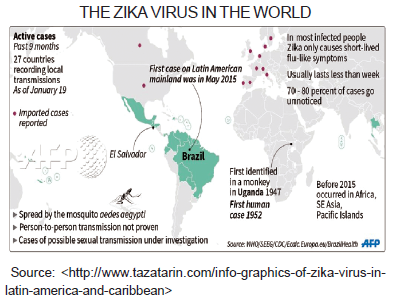
TEXT 1
Houston’s Poor Neighborhoods Could Be Prime Zika Real Estate
The World Health Organization (WHO) has warned of the potential for the explosive spread of the Zika virus through the Americas. Margaret Chan, the director of the WHO, advised that the Americas could be hit by 4 million cases of Zika this year. The outbreak of Zika virus now centered in Brazil has been linked to a sudden increase in severe birth defects including microcephaly, babies born with smaller heads and brains. The National Public Radio – USA (NPR) recently reported that other neurological problems, such as babies born blind, may also be linked to Zika. Researchers do not fully understand Zika or have not yet proven causality, but the circumstantial evidence connecting the Zika outbreak to the sudden, large increase in birth defects is very strong.
Reports quoted experts who said that Zika was a low risk to the United States because the U.S. doesn’t have the poverty and high population densities that have caused the explosive spread of Zika in Brazil. However, Dr. Peter Hotez, a tropical disease researcher who lives in Texas, has warned that poverty and high population density makes Houston highly vulnerable to a Zika outbreak. He warned that the whole Mexican Gulf coast is already suffering from increasing levels of tropical diseases spread by mosquitoes, in particular dengue fever. Because Zika virus is related to dengue fever and has the same mosquito vector, the expansion of dengue in the Gulf coast region is a good indicator of the potential spread of Zika virus.
Adapted from: <http://www.democraticunderground.com/
112796307>
TEXT 1
Houston’s Poor Neighborhoods Could Be Prime Zika Real Estate
The World Health Organization (WHO) has warned of the potential for the explosive spread of the Zika virus through the Americas. Margaret Chan, the director of the WHO, advised that the Americas could be hit by 4 million cases of Zika this year. The outbreak of Zika virus now centered in Brazil has been linked to a sudden increase in severe birth defects including microcephaly, babies born with smaller heads and brains. The National Public Radio – USA (NPR) recently reported that other neurological problems, such as babies born blind, may also be linked to Zika. Researchers do not fully understand Zika or have not yet proven causality, but the circumstantial evidence connecting the Zika outbreak to the sudden, large increase in birth defects is very strong.
Reports quoted experts who said that Zika was a low risk to the United States because the U.S. doesn’t have the poverty and high population densities that have caused the explosive spread of Zika in Brazil. However, Dr. Peter Hotez, a tropical disease researcher who lives in Texas, has warned that poverty and high population density makes Houston highly vulnerable to a Zika outbreak. He warned that the whole Mexican Gulf coast is already suffering from increasing levels of tropical diseases spread by mosquitoes, in particular dengue fever. Because Zika virus is related to dengue fever and has the same mosquito vector, the expansion of dengue in the Gulf coast region is a good indicator of the potential spread of Zika virus.
Adapted from: <http://www.democraticunderground.com/
112796307>

The classic fairy tale finishes by the woodchopper killing another character. However, this does not happen in this modern version.
In the end of this version, the woodchopper carries out the act of:
This form includes a permission to perform the following action:
This modern version of the fairy tale Little Red Riding Hood addresses different social issues.
One of these issues is:
Leia o texto para responder à questão.
Disparity in life spans of the rich and the poor is growing
Sabrina Tavernise
February 12, 2016

Experts have long known that rich people generally live longer than poor people. But a growing body of data shows a more disturbing pattern: Despite big advances in medicine, technology and education, the longevity gap between high-income and low-income Americans has been widening sharply.
The poor are losing ground not only in income, but also in years of life, the most basic measure of well-being. In the early 1970s, a 60-year-old man in the top half of the earnings ladder could expect to live 1.2 years longer than a man of the same age in the bottom half, according to an analysis by the Social Security Administration. Fast-forward to 2001, and he could expect to live 5.8 years longer than his poorer counterpart.
New research released this month contains even more jarring numbers. Looking at the extreme ends of the income spectrum, economists at the Brookings Institution found that for men born in 1920, there was a six-year difference in life expectancy between the top 10 percent of earners and the bottom 10 percent. For men born in 1950, that difference had more than doubled, to 14 years. For women, the gap grew to 13 years, from 4.7 years. “There has been this huge spreading out,” said Gary Burtless, one of the authors of the study.
The growing chasm is alarming policy makers, and has surfaced in the presidential campaign. During a Democratic debate, Senator Bernie Sanders and Hillary Clinton expressed concern over shortening life spans for some Americans. “This may be the next frontier of the inequality discussion,” said Peter Orszag, a former Obama administration official now at Citigroup, who was among the first to highlight the pattern. The causes are still being investigated, but public health researchers say that deep declines in smoking among the affluent and educated may partly explain the difference.
Overall, according to the Brookings study, life expectancy for the bottom 10 percent of wage earners improved by just 3 percent for men born in 1950 compared with those born in 1920. For the top 10 percent, though, it jumped by about 28 percent. (The researchers used a common measure – life expectancy at age 50 – and included data from 1984 to 2012.)
(www.nytimes.com. Adaptado.)
Leia o texto para responder à questão.
Disparity in life spans of the rich and the poor is growing
Sabrina Tavernise
February 12, 2016
Experts have long known that rich people generally live longer than poor people. But a growing body of data shows a more disturbing pattern: Despite big advances in medicine, technology and education, the longevity gap between high-income and low-income Americans has been widening sharply.
The poor are losing ground not only in income, but also in years of life, the most basic measure of well-being. In the early 1970s, a 60-year-old man in the top half of the earnings ladder could expect to live 1.2 years longer than a man of the same age in the bottom half, according to an analysis by the Social Security Administration. Fast-forward to 2001, and he could expect to live 5.8 years longer than his poorer counterpart.
New research released this month contains even more jarring numbers. Looking at the extreme ends of the income spectrum, economists at the Brookings Institution found that for men born in 1920, there was a six-year difference in life expectancy between the top 10 percent of earners and the bottom 10 percent. For men born in 1950, that difference had more than doubled, to 14 years. For women, the gap grew to 13 years, from 4.7 years. “There has been this huge spreading out,” said Gary Burtless, one of the authors of the study.
The growing chasm is alarming policy makers, and has surfaced in the presidential campaign. During a Democratic debate, Senator Bernie Sanders and Hillary Clinton expressed concern over shortening life spans for some Americans. “This may be the next frontier of the inequality discussion,” said Peter Orszag, a former Obama administration official now at Citigroup, who was among the first to highlight the pattern. The causes are still being investigated, but public health researchers say that deep declines in smoking among the affluent and educated may partly explain the difference.
Overall, according to the Brookings study, life expectancy for the bottom 10 percent of wage earners improved by just 3 percent for men born in 1950 compared with those born in 1920. For the top 10 percent, though, it jumped by about 28 percent. (The researchers used a common measure – life expectancy at age 50 – and included data from 1984 to 2012.)
(www.nytimes.com. Adaptado.)
Leia o texto para responder à questão.
Disparity in life spans of the rich and the poor is growing
Sabrina Tavernise
February 12, 2016
Experts have long known that rich people generally live longer than poor people. But a growing body of data shows a more disturbing pattern: Despite big advances in medicine, technology and education, the longevity gap between high-income and low-income Americans has been widening sharply.
The poor are losing ground not only in income, but also in years of life, the most basic measure of well-being. In the early 1970s, a 60-year-old man in the top half of the earnings ladder could expect to live 1.2 years longer than a man of the same age in the bottom half, according to an analysis by the Social Security Administration. Fast-forward to 2001, and he could expect to live 5.8 years longer than his poorer counterpart.
New research released this month contains even more jarring numbers. Looking at the extreme ends of the income spectrum, economists at the Brookings Institution found that for men born in 1920, there was a six-year difference in life expectancy between the top 10 percent of earners and the bottom 10 percent. For men born in 1950, that difference had more than doubled, to 14 years. For women, the gap grew to 13 years, from 4.7 years. “There has been this huge spreading out,” said Gary Burtless, one of the authors of the study.
The growing chasm is alarming policy makers, and has surfaced in the presidential campaign. During a Democratic debate, Senator Bernie Sanders and Hillary Clinton expressed concern over shortening life spans for some Americans. “This may be the next frontier of the inequality discussion,” said Peter Orszag, a former Obama administration official now at Citigroup, who was among the first to highlight the pattern. The causes are still being investigated, but public health researchers say that deep declines in smoking among the affluent and educated may partly explain the difference.
Overall, according to the Brookings study, life expectancy for the bottom 10 percent of wage earners improved by just 3 percent for men born in 1950 compared with those born in 1920. For the top 10 percent, though, it jumped by about 28 percent. (The researchers used a common measure – life expectancy at age 50 – and included data from 1984 to 2012.)
(www.nytimes.com. Adaptado.)
Leia o texto para responder à questão.
Disparity in life spans of the rich and the poor is growing
Sabrina Tavernise
February 12, 2016
Experts have long known that rich people generally live longer than poor people. But a growing body of data shows a more disturbing pattern: Despite big advances in medicine, technology and education, the longevity gap between high-income and low-income Americans has been widening sharply.
The poor are losing ground not only in income, but also in years of life, the most basic measure of well-being. In the early 1970s, a 60-year-old man in the top half of the earnings ladder could expect to live 1.2 years longer than a man of the same age in the bottom half, according to an analysis by the Social Security Administration. Fast-forward to 2001, and he could expect to live 5.8 years longer than his poorer counterpart.
New research released this month contains even more jarring numbers. Looking at the extreme ends of the income spectrum, economists at the Brookings Institution found that for men born in 1920, there was a six-year difference in life expectancy between the top 10 percent of earners and the bottom 10 percent. For men born in 1950, that difference had more than doubled, to 14 years. For women, the gap grew to 13 years, from 4.7 years. “There has been this huge spreading out,” said Gary Burtless, one of the authors of the study.
The growing chasm is alarming policy makers, and has surfaced in the presidential campaign. During a Democratic debate, Senator Bernie Sanders and Hillary Clinton expressed concern over shortening life spans for some Americans. “This may be the next frontier of the inequality discussion,” said Peter Orszag, a former Obama administration official now at Citigroup, who was among the first to highlight the pattern. The causes are still being investigated, but public health researchers say that deep declines in smoking among the affluent and educated may partly explain the difference.
Overall, according to the Brookings study, life expectancy for the bottom 10 percent of wage earners improved by just 3 percent for men born in 1950 compared with those born in 1920. For the top 10 percent, though, it jumped by about 28 percent. (The researchers used a common measure – life expectancy at age 50 – and included data from 1984 to 2012.)
(www.nytimes.com. Adaptado.)
Leia o texto para responder à questão.
Disparity in life spans of the rich and the poor is growing
Sabrina Tavernise
February 12, 2016
Experts have long known that rich people generally live longer than poor people. But a growing body of data shows a more disturbing pattern: Despite big advances in medicine, technology and education, the longevity gap between high-income and low-income Americans has been widening sharply.
The poor are losing ground not only in income, but also in years of life, the most basic measure of well-being. In the early 1970s, a 60-year-old man in the top half of the earnings ladder could expect to live 1.2 years longer than a man of the same age in the bottom half, according to an analysis by the Social Security Administration. Fast-forward to 2001, and he could expect to live 5.8 years longer than his poorer counterpart.
New research released this month contains even more jarring numbers. Looking at the extreme ends of the income spectrum, economists at the Brookings Institution found that for men born in 1920, there was a six-year difference in life expectancy between the top 10 percent of earners and the bottom 10 percent. For men born in 1950, that difference had more than doubled, to 14 years. For women, the gap grew to 13 years, from 4.7 years. “There has been this huge spreading out,” said Gary Burtless, one of the authors of the study.
The growing chasm is alarming policy makers, and has surfaced in the presidential campaign. During a Democratic debate, Senator Bernie Sanders and Hillary Clinton expressed concern over shortening life spans for some Americans. “This may be the next frontier of the inequality discussion,” said Peter Orszag, a former Obama administration official now at Citigroup, who was among the first to highlight the pattern. The causes are still being investigated, but public health researchers say that deep declines in smoking among the affluent and educated may partly explain the difference.
Overall, according to the Brookings study, life expectancy for the bottom 10 percent of wage earners improved by just 3 percent for men born in 1950 compared with those born in 1920. For the top 10 percent, though, it jumped by about 28 percent. (The researchers used a common measure – life expectancy at age 50 – and included data from 1984 to 2012.)
(www.nytimes.com. Adaptado.)
Leia a charge para responder à questão.

Leia a charge para responder à questão.
Analise o texto a seguir.


Disponível em: <https://pt.slideshare.net/oxblondieox98/human-diversity-in-education-11433320>. Acesso: 15 set. 2015.
According to the ideas expressed in the text
Leia o texto a seguir para responder à questão.
Migrant or Refugee? There Is a Difference, With Legal Implications
In the first half of this year alone, at least 137,000 men, women and children crossed the Mediterranean Sea to reach the shores of Europe, according to the United Nations. Thousands are traveling across the Balkans now. However, are they refugee or migrants? Does it make any difference? In search for these answers, let’s read the interview.
Q. Does it matter what you call them?
A. Yes. The terms “migrant” and “refugee” are sometimes used interchangeably, but there is a crucial legal difference between the two.
Q. Who is a refugee?
A. Briefly, a refugee is a person who has fled his or her country to escape war or persecution, and can prove it.
Q. What does the distinction mean for European countries?
A. Refugees are entitled to basic protections under the 1951 convention and other international agreements. Once in Europe, refugees can apply for political asylum or another protected status, sometimes temporary. By law, refugees cannot be sent back to countries where their lives would be in danger. “One of the most fundamental principles laid down in international law is that refugees should not be expelled or returned to situations where their life and freedom would be under threat,” the refugee agency said in a statement on Thursday.
Q. Who is a migrant?
A. Anyone moving from one country to another is considered a migrant unless he or she is specifically fleeing war or persecution. Migrants may be fleeing dire poverty, or may be well-off and merely seeking better opportunities, or may be migrating to join relatives who have gone before them. There is an emerging debate about whether migrants fleeing their homes because of the effects of climate change – the desertification of the Sahel region, for example, or the sinking of coastal islands in Bangladesh – ought to be reclassified as refugees.
Q. Are migrants treated differently from refugees?
A. Countries are free to deport migrants who arrive without legal papers, which they cannot do with refugees under the 1951 convention. So it is not surprising that many politicians in Europe prefer to refer to everyone fleeing to the continent as migrants.
Disponível em: <https://www.nytimes.com/2015/08/28/world/migrants-refugees-europe-syria.html?_r=0>. Acesso em: 15 set. 2015.
Leia o texto a seguir para responder à questão.
Migrant or Refugee? There Is a Difference, With Legal Implications
In the first half of this year alone, at least 137,000 men, women and children crossed the Mediterranean Sea to reach the shores of Europe, according to the United Nations. Thousands are traveling across the Balkans now. However, are they refugee or migrants? Does it make any difference? In search for these answers, let’s read the interview.
Q. Does it matter what you call them?
A. Yes. The terms “migrant” and “refugee” are sometimes used interchangeably, but there is a crucial legal difference between the two.
Q. Who is a refugee?
A. Briefly, a refugee is a person who has fled his or her country to escape war or persecution, and can prove it.
Q. What does the distinction mean for European countries?
A. Refugees are entitled to basic protections under the 1951 convention and other international agreements. Once in Europe, refugees can apply for political asylum or another protected status, sometimes temporary. By law, refugees cannot be sent back to countries where their lives would be in danger. “One of the most fundamental principles laid down in international law is that refugees should not be expelled or returned to situations where their life and freedom would be under threat,” the refugee agency said in a statement on Thursday.
Q. Who is a migrant?
A. Anyone moving from one country to another is considered a migrant unless he or she is specifically fleeing war or persecution. Migrants may be fleeing dire poverty, or may be well-off and merely seeking better opportunities, or may be migrating to join relatives who have gone before them. There is an emerging debate about whether migrants fleeing their homes because of the effects of climate change – the desertification of the Sahel region, for example, or the sinking of coastal islands in Bangladesh – ought to be reclassified as refugees.
Q. Are migrants treated differently from refugees?
A. Countries are free to deport migrants who arrive without legal papers, which they cannot do with refugees under the 1951 convention. So it is not surprising that many politicians in Europe prefer to refer to everyone fleeing to the continent as migrants.
Disponível em: <https://www.nytimes.com/2015/08/28/world/migrants-refugees-europe-syria.html?_r=0>. Acesso em: 15 set. 2015.

 Conheça nossos planos