Questões de Vestibular
Comentadas sobre interpretação de texto | reading comprehension em inglês
Foram encontradas 2.293 questões


Q384157
Inglês
Texto associado
ABORTION BECOMES ISSUE IN BRAZIL'S PRESIDENTIAL RUNOFF
As Brazil's charismatic President Luiz Inacio Lula da Silva makes a triumphant exit, having fostered a fast-growing economy that lifted millions out of poverty and pleased financial markets, his country seems more than ever to embody the word "progress" that is emblazoned across its national flag. But as the Oct. 31 run-off election to choose his successor approaches, the focus is shifting to one aspect of Brazilian society where many say there has been little progress: Abortion is still illegal, despite one in five Brazilian women undergoing the procedure in their lifetimes.
With religious-right votes up for grabs in the upcoming poll, the two remaining candidates and the leading party are backing down from earlier abortion-rights endorsements, leading abortion-rights advocates to say that votes are being traded for women's health. Two-thirds of Brazil's 191 million people are Roman Catholics, making it the world's largest Catholic nation. But the number of those professing evangelical beliefs, some 17 percent of the population, is growing fast.
The frenzy to collect more of those votes is causing Lula's left-wing Workers Party to mull whether to back off its commitment to see abortion rights debated in Congress, and the party's candidate, Dilma Rousseff, heavily favored to win, is distancing herself from abortion-rights comments she made before becoming a candidate.
"It will be really ugly if the Workers Party pulls abortion rights from its agenda," said Regina Soares, a spokeswoman for the abortion-rights group Catholics for the Right to Decide. "[Abortion] is a problem of a huge size, which has same importance as unemployment and homelessness," she said. Abortion is illegal in Brazil except in the case of rape or if the mother's life is in danger. Yet one in five Brazilian women under age 40 has had an abortion, the vast majority illegally. Half of those women end up in the hospital as the result of complications, said Marcelo Medeiros, an economist and sociologist who coordinated a 2009 government-funded abortion study. The abortion question shifted to the fore after Sunday's first-round presidential elections, in which Rousseff was expected to sail easily past the 50 percent mark that would have made a second round unnecessary. But she received 46.8 percent, forcing a runoff with centrist challenger Jose Serra at the end of the month. Support for the 62-year- old former guerrilla, Lula's chosen successor, eroded in part because the religious right aired ads portraying Rousseff as pro-abortion-rights, observers said. To shore up votes, the Workers Party is considering whether to yank its promise to see abortion rights debated in Congress. In his more recent position as Brazil's health minister, Serra, along with the Workers Party, has advocated for a debate on abortion in Congress in the name of public health. But during his campaign, Serra declared himself anti-abortion. Observers are split on whether the issue could prevent a Rousseff win. Alberto Almeida, director of market research group Instituto Analise, said voters don't see the difference between the abortion stances of Serra and Rousseff. "Abortion won't have a big role in the election because nobody has a clear position on abortion," Almeida said. But a Workers Party senator from Parana state said some of her party members could end up promoting legalized abortion, a position that could "cost the presidency," said Gleisi Hoffman, according to a Folha report. "While most Brazilians support abortion in special cases, the rest is "a gray area," Medeiros said.
Adapted from:
KELLER, Karen. Abortion Becomes Issue in Brazil's Presidential Runoff. Disponível em: http://www.aolnews.com/world/article/abortion-becomes-an- issue-in-brazils-presidential-runoff/19665625. Acesso em: 4 nov. 2010.
As Brazil's charismatic President Luiz Inacio Lula da Silva makes a triumphant exit, having fostered a fast-growing economy that lifted millions out of poverty and pleased financial markets, his country seems more than ever to embody the word "progress" that is emblazoned across its national flag. But as the Oct. 31 run-off election to choose his successor approaches, the focus is shifting to one aspect of Brazilian society where many say there has been little progress: Abortion is still illegal, despite one in five Brazilian women undergoing the procedure in their lifetimes.
With religious-right votes up for grabs in the upcoming poll, the two remaining candidates and the leading party are backing down from earlier abortion-rights endorsements, leading abortion-rights advocates to say that votes are being traded for women's health. Two-thirds of Brazil's 191 million people are Roman Catholics, making it the world's largest Catholic nation. But the number of those professing evangelical beliefs, some 17 percent of the population, is growing fast.
The frenzy to collect more of those votes is causing Lula's left-wing Workers Party to mull whether to back off its commitment to see abortion rights debated in Congress, and the party's candidate, Dilma Rousseff, heavily favored to win, is distancing herself from abortion-rights comments she made before becoming a candidate.
"It will be really ugly if the Workers Party pulls abortion rights from its agenda," said Regina Soares, a spokeswoman for the abortion-rights group Catholics for the Right to Decide. "[Abortion] is a problem of a huge size, which has same importance as unemployment and homelessness," she said. Abortion is illegal in Brazil except in the case of rape or if the mother's life is in danger. Yet one in five Brazilian women under age 40 has had an abortion, the vast majority illegally. Half of those women end up in the hospital as the result of complications, said Marcelo Medeiros, an economist and sociologist who coordinated a 2009 government-funded abortion study. The abortion question shifted to the fore after Sunday's first-round presidential elections, in which Rousseff was expected to sail easily past the 50 percent mark that would have made a second round unnecessary. But she received 46.8 percent, forcing a runoff with centrist challenger Jose Serra at the end of the month. Support for the 62-year- old former guerrilla, Lula's chosen successor, eroded in part because the religious right aired ads portraying Rousseff as pro-abortion-rights, observers said. To shore up votes, the Workers Party is considering whether to yank its promise to see abortion rights debated in Congress. In his more recent position as Brazil's health minister, Serra, along with the Workers Party, has advocated for a debate on abortion in Congress in the name of public health. But during his campaign, Serra declared himself anti-abortion. Observers are split on whether the issue could prevent a Rousseff win. Alberto Almeida, director of market research group Instituto Analise, said voters don't see the difference between the abortion stances of Serra and Rousseff. "Abortion won't have a big role in the election because nobody has a clear position on abortion," Almeida said. But a Workers Party senator from Parana state said some of her party members could end up promoting legalized abortion, a position that could "cost the presidency," said Gleisi Hoffman, according to a Folha report. "While most Brazilians support abortion in special cases, the rest is "a gray area," Medeiros said.
Adapted from:
KELLER, Karen. Abortion Becomes Issue in Brazil's Presidential Runoff. Disponível em: http://www.aolnews.com/world/article/abortion-becomes-an- issue-in-brazils-presidential-runoff/19665625. Acesso em: 4 nov. 2010.
What does the text read about Luiz Inácio Lula da Silva:
Q238729
Inglês


It is also stated in the text that currently Vargas Llosa is
Q238728
Inglês
As to the relationship between Vargas Llosa and García Márquez, the text says that they
Q238727
Inglês
According to the text, Gabriel García Márquez, Julio Cortázar and Carlos Fuentes are considered writers who
Q238726
Inglês
Among other Spanish language writers who have won the Nobel Prize in Literature, the text mentions
Q238725
Inglês
As to the Sweedish Academy selection of Vargas Llosa, it is said that politically speaking, it
Q238724
Inglês
According to the text, reactions to the annoucement of Vargas Llosa’s Nobel in his home country included
Q229466
Inglês
Texto associado
Leia o texto abaixo e responda às questões de 1 a 3.
Hitting Children is Wrong and the Law Must Say So - Now
NEWELL, Peter. Disponível em: . Acesso em: 16 ago. 2010. (Adaptado).
Hitting Children is Wrong and the Law Must Say So - Now
Ending corporal punishment is an issue which touches most people very personally. Most of us were hit as
children; most parents have hit their growing children. So far, globally, only about 17 states have completely
prohibited all corporal punishment, with six or seven more committed to do so. In this region, I know that at least
two – Brazil and Costa Rica – have had prohibition Bills presented to their Parliaments.
At the first two Regional Consultations for the UN Secretary General’s Study, in the Caribbean and two weeks
ago in South Asia, clear recommendations to prohibit all corporal punishment, including in the family, were
adopted. But I still heard government officials and NGOs and others making more excuses: “We must wait until
there is more support for parents; more training for teachers; smaller classes. Let’s educate first and then
change the law…” and so on. From children’s perspective this is intolerable. From the perspective of
international human rights law it is illegal. Why should children wait? Would we wait to prohibit violence against
women until we can provide full employment and universal anger management classes for men? Would we wait
to ban hitting of elderly confused relatives until we have full-time nursing care, and full training for all carers,
available for them?
No more excuses: this UN Study provides the opportunity to move quickly on, to put in the past the idea that
states should authorise violence against children and instead focus on giving priority to ending all violence
against children. State governments and all of us have to take a deep breath and stop deceiving ourselves -
hitting children is wrong and the law must say so - now.
children; most parents have hit their growing children. So far, globally, only about 17 states have completely
prohibited all corporal punishment, with six or seven more committed to do so. In this region, I know that at least
two – Brazil and Costa Rica – have had prohibition Bills presented to their Parliaments.
At the first two Regional Consultations for the UN Secretary General’s Study, in the Caribbean and two weeks
ago in South Asia, clear recommendations to prohibit all corporal punishment, including in the family, were
adopted. But I still heard government officials and NGOs and others making more excuses: “We must wait until
there is more support for parents; more training for teachers; smaller classes. Let’s educate first and then
change the law…” and so on. From children’s perspective this is intolerable. From the perspective of
international human rights law it is illegal. Why should children wait? Would we wait to prohibit violence against
women until we can provide full employment and universal anger management classes for men? Would we wait
to ban hitting of elderly confused relatives until we have full-time nursing care, and full training for all carers,
available for them?
No more excuses: this UN Study provides the opportunity to move quickly on, to put in the past the idea that
states should authorise violence against children and instead focus on giving priority to ending all violence
against children. State governments and all of us have to take a deep breath and stop deceiving ourselves -
hitting children is wrong and the law must say so - now.
NEWELL, Peter. Disponível em:
. Acesso em: 16 ago. 2010. (Adaptado).
Considerando os aspectos estruturais do texto, é CORRETO afirmar:
Q229465
Inglês
Texto associado
Leia o texto abaixo e responda às questões de 1 a 3.
Hitting Children is Wrong and the Law Must Say So - Now
NEWELL, Peter. Disponível em:. Acesso em: 16 ago. 2010. (Adaptado).
Hitting Children is Wrong and the Law Must Say So - Now
Ending corporal punishment is an issue which touches most people very personally. Most of us were hit as
children; most parents have hit their growing children. So far, globally, only about 17 states have completely
prohibited all corporal punishment, with six or seven more committed to do so. In this region, I know that at least
two – Brazil and Costa Rica – have had prohibition Bills presented to their Parliaments.
At the first two Regional Consultations for the UN Secretary General’s Study, in the Caribbean and two weeks
ago in South Asia, clear recommendations to prohibit all corporal punishment, including in the family, were
adopted. But I still heard government officials and NGOs and others making more excuses: “We must wait until
there is more support for parents; more training for teachers; smaller classes. Let’s educate first and then
change the law…” and so on. From children’s perspective this is intolerable. From the perspective of
international human rights law it is illegal. Why should children wait? Would we wait to prohibit violence against
women until we can provide full employment and universal anger management classes for men? Would we wait
to ban hitting of elderly confused relatives until we have full-time nursing care, and full training for all carers,
available for them?
No more excuses: this UN Study provides the opportunity to move quickly on, to put in the past the idea that
states should authorise violence against children and instead focus on giving priority to ending all violence
against children. State governments and all of us have to take a deep breath and stop deceiving ourselves -
hitting children is wrong and the law must say so - now.
children; most parents have hit their growing children. So far, globally, only about 17 states have completely
prohibited all corporal punishment, with six or seven more committed to do so. In this region, I know that at least
two – Brazil and Costa Rica – have had prohibition Bills presented to their Parliaments.
At the first two Regional Consultations for the UN Secretary General’s Study, in the Caribbean and two weeks
ago in South Asia, clear recommendations to prohibit all corporal punishment, including in the family, were
adopted. But I still heard government officials and NGOs and others making more excuses: “We must wait until
there is more support for parents; more training for teachers; smaller classes. Let’s educate first and then
change the law…” and so on. From children’s perspective this is intolerable. From the perspective of
international human rights law it is illegal. Why should children wait? Would we wait to prohibit violence against
women until we can provide full employment and universal anger management classes for men? Would we wait
to ban hitting of elderly confused relatives until we have full-time nursing care, and full training for all carers,
available for them?
No more excuses: this UN Study provides the opportunity to move quickly on, to put in the past the idea that
states should authorise violence against children and instead focus on giving priority to ending all violence
against children. State governments and all of us have to take a deep breath and stop deceiving ourselves -
hitting children is wrong and the law must say so - now.
NEWELL, Peter. Disponível em:
. Acesso em: 16 ago. 2010. (Adaptado).
Com base nas ideias e opiniões expressas no texto, é CORRETO afirmar:
Q229464
Inglês
Texto associado
Leia o texto abaixo e responda às questões de 1 a 3.
Hitting Children is Wrong and the Law Must Say So - Now
NEWELL, Peter. Disponível em:. Acesso em: 16 ago. 2010. (Adaptado).
Hitting Children is Wrong and the Law Must Say So - Now
Ending corporal punishment is an issue which touches most people very personally. Most of us were hit as
children; most parents have hit their growing children. So far, globally, only about 17 states have completely
prohibited all corporal punishment, with six or seven more committed to do so. In this region, I know that at least
two – Brazil and Costa Rica – have had prohibition Bills presented to their Parliaments.
At the first two Regional Consultations for the UN Secretary General’s Study, in the Caribbean and two weeks
ago in South Asia, clear recommendations to prohibit all corporal punishment, including in the family, were
adopted. But I still heard government officials and NGOs and others making more excuses: “We must wait until
there is more support for parents; more training for teachers; smaller classes. Let’s educate first and then
change the law…” and so on. From children’s perspective this is intolerable. From the perspective of
international human rights law it is illegal. Why should children wait? Would we wait to prohibit violence against
women until we can provide full employment and universal anger management classes for men? Would we wait
to ban hitting of elderly confused relatives until we have full-time nursing care, and full training for all carers,
available for them?
No more excuses: this UN Study provides the opportunity to move quickly on, to put in the past the idea that
states should authorise violence against children and instead focus on giving priority to ending all violence
against children. State governments and all of us have to take a deep breath and stop deceiving ourselves -
hitting children is wrong and the law must say so - now.
children; most parents have hit their growing children. So far, globally, only about 17 states have completely
prohibited all corporal punishment, with six or seven more committed to do so. In this region, I know that at least
two – Brazil and Costa Rica – have had prohibition Bills presented to their Parliaments.
At the first two Regional Consultations for the UN Secretary General’s Study, in the Caribbean and two weeks
ago in South Asia, clear recommendations to prohibit all corporal punishment, including in the family, were
adopted. But I still heard government officials and NGOs and others making more excuses: “We must wait until
there is more support for parents; more training for teachers; smaller classes. Let’s educate first and then
change the law…” and so on. From children’s perspective this is intolerable. From the perspective of
international human rights law it is illegal. Why should children wait? Would we wait to prohibit violence against
women until we can provide full employment and universal anger management classes for men? Would we wait
to ban hitting of elderly confused relatives until we have full-time nursing care, and full training for all carers,
available for them?
No more excuses: this UN Study provides the opportunity to move quickly on, to put in the past the idea that
states should authorise violence against children and instead focus on giving priority to ending all violence
against children. State governments and all of us have to take a deep breath and stop deceiving ourselves -
hitting children is wrong and the law must say so - now.
NEWELL, Peter. Disponível em:
. Acesso em: 16 ago. 2010. (Adaptado).
De acordo com o conteúdo do texto, é CORRETO afirmar:
Q228630
Inglês
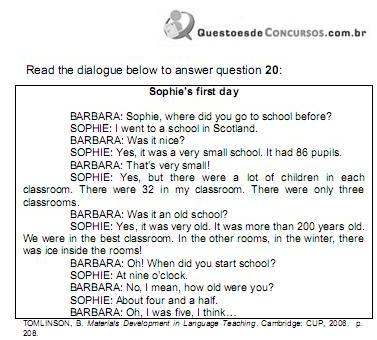
Read the statements below and mark the INCORRECT one according to the text:
Q228629
Inglês

Read the statements below and mark the CORRECT answer:
Q222451
Inglês
According to Chimamanda Adichie, “The single story creates stereotypes. And the problem with stereotypes is not that they are untrue, but that they are incomplete. They make one story become the only story”. Which of these statements is a stereotype about Nigeria?
Q215699
Inglês
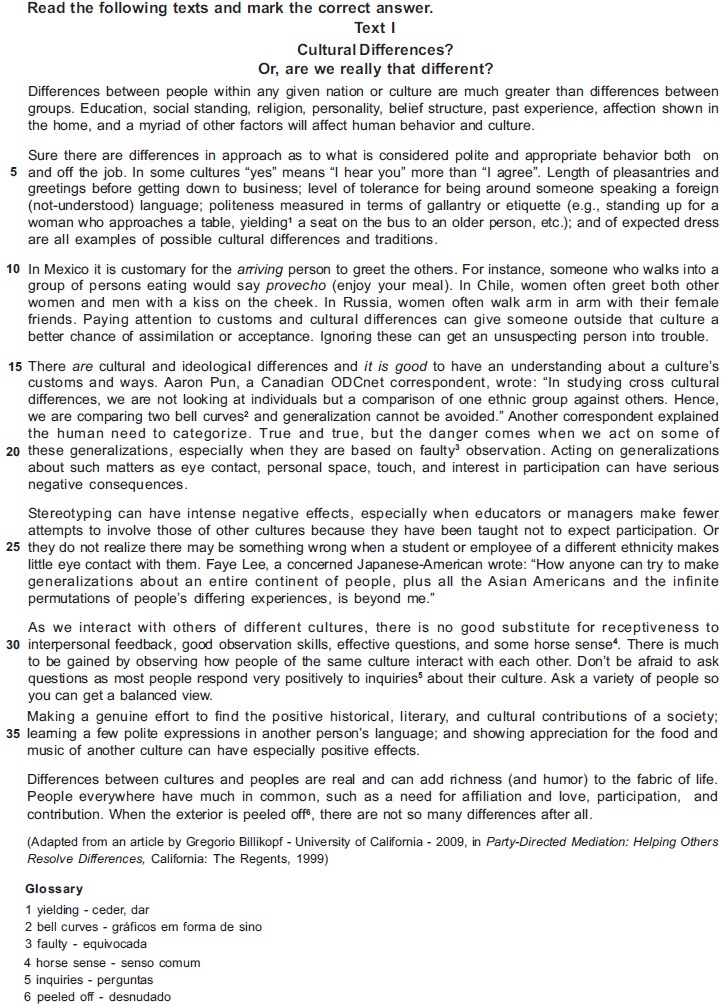
In Text II, the cartoon shows people from different continents, consequently from different cultures, interacting in real time on the internet. Mark the excerpt from Text I which may establish a link with Text II.
Q215698
Inglês
EXEMPLIFICATION is used by the author of the text to develop his argumentation. In paragraph 7, through the use of exemplification, the author
Q215696
Inglês
Discourse markers are used to provide cohesion to the text. In the excerpt “Hence, we are comparing two bell curves and generalization cannot be avoided” (lines 17-18), the discourse marker in bold expresses the following semantic relation:
Q215695
Inglês
According to what is stated in the 2nd paragraph, offering a seat on the bus to an older person is an example of
Q215693
Inglês
According to Text I, in order to interact successfully with people from a different culture, one must
Q215692
Inglês
The title of Text I reflects the author’s position regarding culture. Choose the statement in which this position is best conveyed.
Ano: 2010
Banca:
VUNESP
Órgão:
UNIFESP
Prova:
VUNESP - 2010 - UNIFESP - Vestibular - Língua Portuguesa, Língua Estrangeira e Redação |
Q215445
Inglês
Texto associado
Instrução: Leia o texto para responder às questões de números 40 a 45.
To Scientists, Laughter Is No Joke - It’s Serious
March 31, 2010.
(www.nytimes.com. Adaptado.)
To Scientists, Laughter Is No Joke - It’s Serious
March 31, 2010.
So a scientist walks into a shopping mall to watch people laugh. There’s no punchline. Laughter is a serious scientific subject, one that researchers are still trying to figure out. Laughing is primal, our first way of communicating. Apes laugh. So do dogs and rats. Babies laugh long before they speak. No one teaches you how to laugh. You just do. And often you laugh involuntarily, in a specific rhythm and in certain spots in conversation.
You may laugh at a prank on April Fools’ Day. But surprisingly, only 10 to 15 percent of laughter is the result of someone making a joke, said Baltimore neuroscientist Robert Provine, who has studied laughter for decades. Laughter is mostly about social responses rather than reaction to a joke. “Laughter above all else is a social thing,’’ Provine said. “The requirement for laughter is another person.’’
Over the years, Provine, a professor with the University of Maryland Baltimore County, has boiled laughter down to its basics. “All language groups laugh ‘ha-ha-ha’ basically the same way,’’ he said. “Whether you speak Mandarin, French or English, everyone will understand laughter. ... There’s a pattern generator in our brain that produces this sound.’’
Each “ha’’ is about one-15th of a second, repeated every fifth of a second, he said. Laugh faster or slower than that and it sounds more like panting or something else. Deaf people laugh without hearing, and people on cell phones laugh without seeing, illustrating that laughter isn’t dependent on a single sense but on social interactions, said Provine, author of the book “Laughter: A Scientific Investigation.’’
“It’s joy, it’s positive engagement with life,’’ said Jaak Panksepp, a Bowling Green University psychology professor. “It’s deeply social.’’ And it’s not just a people thing either. Chimps tickle each other and even laugh when another chimp pretends to tickle them. By studying rats, Panksepp and other scientists can figure out what’s going on in the brain during laughter. And it holds promise for human ills.
Northwestern biomedical engineering professor Jeffrey Burgdorf has found that laughter in rats produces an insulin-like growth factor chemical that acts as an antidepressant and anxietyreducer. He thinks the same thing probably happens in humans, too. This would give doctors a new chemical target in the brain in their effort to develop drugs that fight depression and anxiety in people. Even so, laughter itself hasn’t been proven to be the best medicine, experts said.
You may laugh at a prank on April Fools’ Day. But surprisingly, only 10 to 15 percent of laughter is the result of someone making a joke, said Baltimore neuroscientist Robert Provine, who has studied laughter for decades. Laughter is mostly about social responses rather than reaction to a joke. “Laughter above all else is a social thing,’’ Provine said. “The requirement for laughter is another person.’’
Over the years, Provine, a professor with the University of Maryland Baltimore County, has boiled laughter down to its basics. “All language groups laugh ‘ha-ha-ha’ basically the same way,’’ he said. “Whether you speak Mandarin, French or English, everyone will understand laughter. ... There’s a pattern generator in our brain that produces this sound.’’
Each “ha’’ is about one-15th of a second, repeated every fifth of a second, he said. Laugh faster or slower than that and it sounds more like panting or something else. Deaf people laugh without hearing, and people on cell phones laugh without seeing, illustrating that laughter isn’t dependent on a single sense but on social interactions, said Provine, author of the book “Laughter: A Scientific Investigation.’’
“It’s joy, it’s positive engagement with life,’’ said Jaak Panksepp, a Bowling Green University psychology professor. “It’s deeply social.’’ And it’s not just a people thing either. Chimps tickle each other and even laugh when another chimp pretends to tickle them. By studying rats, Panksepp and other scientists can figure out what’s going on in the brain during laughter. And it holds promise for human ills.
Northwestern biomedical engineering professor Jeffrey Burgdorf has found that laughter in rats produces an insulin-like growth factor chemical that acts as an antidepressant and anxietyreducer. He thinks the same thing probably happens in humans, too. This would give doctors a new chemical target in the brain in their effort to develop drugs that fight depression and anxiety in people. Even so, laughter itself hasn’t been proven to be the best medicine, experts said.
(www.nytimes.com. Adaptado.)
The excerpt of the first paragraph – You just do. – means that

 Conheça nossos planos