Questões de Vestibular
Sobre aspectos linguísticos | linguistic aspects em inglês
Foram encontradas 169 questões


Millennials Are Giving Their Babies Increasingly Strange Names
Mandy Oaklander
Sept. 29, 2016
The people having the most kids in this country, Millennials, are giving their babies stranger and stranger names. In a time when actual people are naming their children Legendary and Sadman and Lux, that should perhaps come as no surprise.
Jean Twenge, a psychology professor at San Diego State University, and research assistant Lauren Dawson analyzed the first names of 358 million babies in a U.S. Social Security Administration database. Between 2004 and 2006, 66% of boys and 76% of girls had a name that wasn’t one of the 50 most common names of that time period. By contrast, in 2011-2015, 72% of boys and 79% of girls had names that were not in the top 50 most popular. In the top 10 for 2015 in the U.S. were Harper, Liam, Mason, Isabella, Olivia, Ava, and Mia. Brooklyn was ranked 31st most popular for girls across the U.S. (though not for girls in New York, where the name didn’t rank in the top 100).
Twenge credits the rise of stranger names on our increasingly individualistic culture: one that focuses on the self and is less concerned with social rules. “Millennials were raised with phrases like, you shouldn’t care what anyone else thinks of you, you can be anything you want to be, it’s good to be different, you have to love yourself first before you love anyone else,” says Twenge. Our obsession with celebrities is also a hallmark of individualism.
Twenge found that Millennials are much more accepting of same-sex relationships and experiences. “What we’re seeing is this movement toward more sexual freedom,” Twenge told TIME. “There’s more freedom for people to do what they want without following the traditional, often now seen as outdated, social rules about who you’re supposed to have sex with and when.”
Adaptado de: http://time.com/4511927/millennials-parents-baby-names/ Acesso em: 01º outubro 2016
Text 4
Eclipse in Africa: 'Ring of Fire' eclipse wows stargazers
Stargazers in parts of Africa have been treated to a spectacular "ring of fire" in the sky as the sun was almost - but not completely - eclipsed.
An annular eclipse happens when the moon is farther away from the Earth than during a total eclipse.
The result is a bright circle of sunshine surrounding a dark, shadowy core.
The best views were seen in Tanzania, where the event lasted about three minutes.
The eclipse could also be viewed in parts of Gabon, Congo-Brazzaville, the Democratic Republic of Congo, Madagascar, and the French Indian Ocean island of La Reunion.
The moon does not move in a perfect circle around the earth - instead, its orbit is slightly elliptical. That means the distance of the moon varies between around 225,000-252,000 miles (362,000-405,555 km).
When the moon is farther away from the earth, it appears smaller - and does not totally cover the sun's disc during a total eclipse. The result is also known as a "ring of fire" eclipse.
The next eclipse is due to take place in February 2017, and can be seen from parts of South America and Africa.
Avaiable at:http://www.bbc.com/news/world-africa. Accessed on 02/09/16.
Answer the question below, according to the Text 4.
Com base nas expressões retiradas do texto, considere as afirmativas a seguir.
I. A expressão “a flash of brown lightning” enfatiza a velocidade da movimentação dos esquilos.
II. A frase “I’ll have you!” indica que a personagem havia decidido previamente qual esquilo escolheria.
III. Ao utilizar a frase “You watch”, o enunciador destaca uma habilidade permanente do enunciatário, no caso, a habilidade de olhar.
IV. Em “Her head must have sounded quite hollow”, o trecho sublinhado indica que o enunciador tem certeza de que sua afirmação é a verdade.
Assinale a alternativa correta.
Leia o infográfico a seguir e responda à questão.

(EDMONDS, K. Report Back: your action against Illegal Wildlife Trade. In WWF-Canada Blog. 16 abr. 2013. Disponível em: <http://blog.wwf.ca/blog/2013/04/16/report-back-your-action-against-illegal-wildlife-trade/>. Acesso em: 23 jul. 2016.)
I. O uso dos termos grifados demonstra que o enunciador está surpreso com a ação efetuada.
II. Os termos grifados acrescentam ênfase ao ineditismo da celebração budista e equivalem, em português, ao termo “primeiríssima”.
III. Os termos grifados modificam o grupo nominal “Buddhist merit-making cerimony”.
IV. A expressão grifada poderia ser substituída, sem alteração de sentido, pela expressão “the very first”.
Assinale a alternativa correta.
O texto a seguir se refere a questão.
Challenges concerning multiculturalism in Canada
The official Canadian policy of multiculturalism has been updated twice since its introduction in 1971. It was originally created as a policy based on the logic of ethnicity, modified to deal with racism and amended to include freedom of religion. In 1988 the Canadian Multiculturalism Act was passed.
Canada is considered a nation of immigrants such that cultural diversity is often presented as the essence of national identity. However, it is difficult to negotiate social and political policy when trying to speak for such a varied populace. Two very real challenges that Canada faces in regard to multiculturalism are the clash of cultures and the socioeconomic position of immigrants.
An example of clash of cultures is the one between English and French-Canada. The province of Quebec has always asserted a distinct identity and an inclination towards separatism from the rest of the country. In 1995, there was a referendum in the province of Quebec concerning separation in which 49% of the voting population voted “yes” and 51% voted “no”. The clash between French and English-Canada is primarily a cultural clash with Quebec concerned with preserving its own history, language and values; fearing these things are apt to become lost within English-Canada. Since the referendum, tensions have cooled a bit and Canada’s national administration has increased their efforts to accommodate Quebec identity within a Canadian identity.
Another challenge of multiculturalism is the socioeconomic position of immigrants. Diversity is supported by governmental policy but Canada is still a society where racist interactions and poor-bashing are severely detrimental to minorities (especially recent arrivals). There are many barriers to equal integration, especially in education, housing and employment. For example, in the workforce it is very difficult to get a job when the potential employer feels you are not speaking “proper” English or you do not have any Canadian work experience on your resumé. This often leads to overqualified people in full-time minimum wage positions with little or no benefits and no access, time or funds for language classes or other training programs. These sorts of circumstances lead to isolation, alienation, poverty and unsafe environments where a new immigrant does not feel safe to report or act against harassment or abuse.
Source: Adapted from http://globalcitizens.pbworks.com/w/page/9036226/Challenges%20Concerning%20Multiculturalism%20in%20Canada.
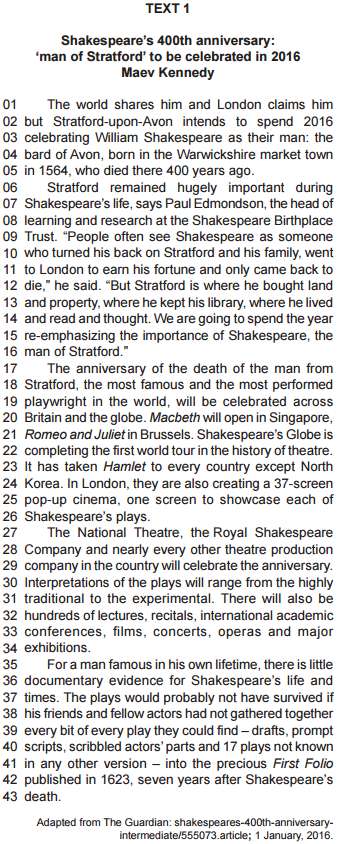
The pairs of phrases below belong to the same
semantic field, EXCEPT for
TEXTO 8
IX
Horas depois, teve Rubião um pensamento horrível. Podiam crer que ele próprio incitara o amigo à viagem, para o fim de o matar mais depressa, e entrar na posse do legado, se é que realmente estava incluso no testamento. Sentiu remorsos. Por que não empregou todas as forças, para contê-lo? Viu o cadáver do Quincas Borba, pálido, hediondo, fitando nele um olhar vingativo; resolveu, se acaso o fatal desfecho se desse em viagem, abrir mão do legado.
Pela sua parte o cão vivia farejando, ganindo, querendo fugir; não podia dormir quieto, levantava-se muitas vezes, à noite, percorria a casa, e tornava ao seu canto. De manhã, Rubião chamava-o à cama, e o cão acudia alegre; imaginava que era o próprio dono; via depois que não era, mas aceitava as carícias, e fazia-lhe outras, como se Rubião tivesse de levar as suas ao amigo, ou trazê-lo para ali. Demais, havia-se-lhe afeiçoado também, e para ele era a ponte que o ligava à existência anterior. Não comeu durante os primeiros dias. Suportando menos a sede, Rubião pôde alcançar que bebesse leite; foi a única alimentação por algum tempo. Mais tarde, passava as horas, calado, triste, enrolado em si mesmo, ou então com o corpo estendido e a cabeça entre as mãos.
Quando o médico voltou, ficou espantado da temeridade do doente; deviam tê-lo impedido de sair; a morte era certa.
— Certa?
— Mais tarde ou mais cedo. Levou o tal cachorro?
— Não, senhor, está comigo; pediu que cuidasse dele, e chorou, olhe que chorou que foi um nunca acabar. Verdade é, disse ainda Rubião para defender o enfermo, verdade é que o cachorro merece a estima do dono; parece gente.
O médico tirou o largo chapéu de palha para concertar a fita; depois sorriu. Gente? Com que então parecia gente? Rubião insistia, depois explicava; não era gente como a outra gente, mas tinha coisas de sentimento, e até de juízo. Olhe, ia contar-lhe uma...
— Não, homem, não, logo, logo, vou a um doente de erisipela... Se vierem cartas dele, e não forem reservadas, desejo vê-las, ouviu? E lembranças ao cachorro, concluiu saindo.
Algumas pessoas começaram a mofar do Rubião e da singular incumbência de guardar um cão em vez de ser o cão que o guardasse a ele. Vinha a risota, choviam as alcunhas. Em que havia de dar o professor! sentinela de cachorro! Rubião tinha medo da opinião pública. Com efeito, parecia-lhe ridículo; fugia aos olhos estranhos, olhava com fastio para o animal, dava-se ao diabo, arrenegava da vida. Não tivesse a esperança de um legado, pequeno que fosse. Era impossível que lhe não deixasse uma lembrança.
(ASSIS, Machado de. Quincas Borba. São Paulo: Ática, 2011. p. 30-31.)
(Available at http://c.merriam-webster.com/medlineplus/erysipelas., accessed on July 14th, 2016.)
Choose the appropriate alternative:
Question based on Text.


Adapted from: <http://www.theguardian.com/global-development-professionals-network/2015/oct/13/fighting-corruptionzombies-development-anti-corruption >.Access on: 03/11/2015.
Question based on Text.
Adapted from: <http://www.theguardian.com/global-development-professionals-network/2015/oct/13/fighting-corruptionzombies-development-anti-corruption >.Access on: 03/11/2015.
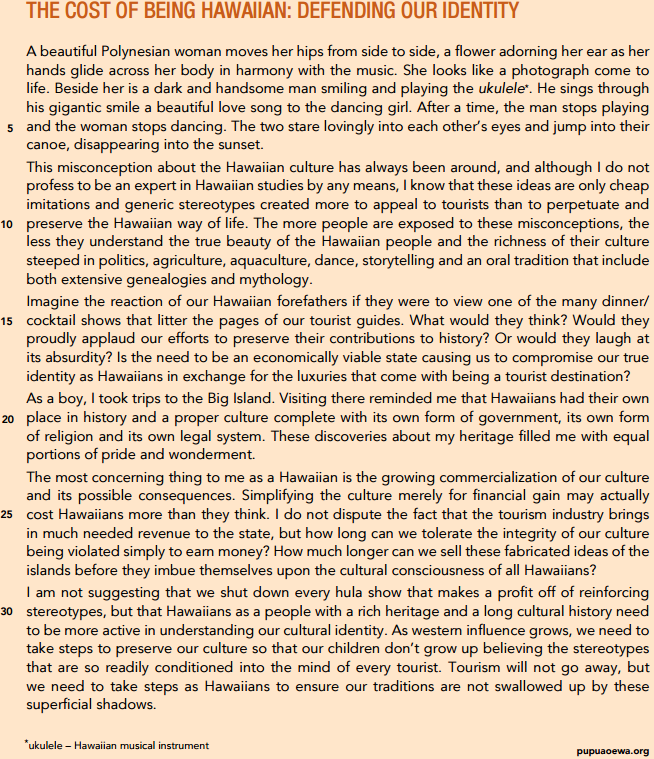
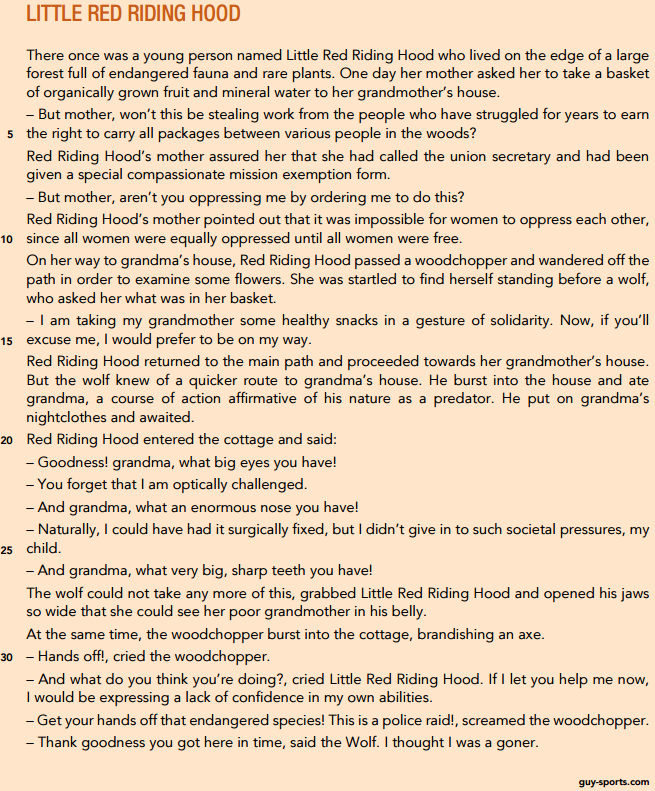
A fairy tale consists of both narrative and descriptive sequences.
The lines of the story that present predominantly descriptive sequences are:
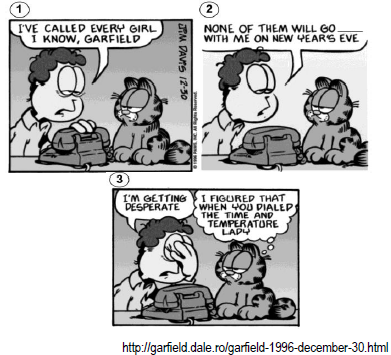
Muitos verbos em inglês consistem em duas partes: um verbo
“base” (tais como bring, take, go, come) acompanhados de uma
preposição ou de uma partícula adverbial (tais como up, down,
out, in, off). No segundo quadro da tirinha, foi retirada a palavra
que acompanha o verbo GO. A preposição que completa o
sentido do verbo na fala do personagem é

Leia o texto em que um termo foi retirado.
Rio 2016 unveils innovative Olympic torch
The innovative design, which is _________________ by the warmth of the Brazilian people, features moveable segments that expand vertically to reveal the colours of Brazil when the Olympic flame is passed from one torchbearer to another. The triangular shape of the torch, meanwhile, alludes to the three Olympic Values of excellence, friendship and respect, while the floating effect of its different segments represents the efforts of the athletes.
<http://tinyurl.com/qee99wp>Acesso em: 28.07.2015. Adaptado.

TEXT
A library tradition is being refashioned to emphasize early literacy and better prepare young children for school, and drawing many new fans in the process.
Among parents of the under-5 set, spots for story time have become as coveted as seats for a hot Broadway show like “Hamilton.” Lines stretch down the block at some branches, with tickets given out on a first-come-first-served basis because there is not enough room to accommodate all of the children who show up.
Workers at the 67th Street Library on the Upper East Side of Manhattan turn away at least 10 people from every reading. They have been so overwhelmed by the rush at story time — held in the branch’s largest room, on the third floor — that once the space is full, they close the door and shut down the elevator. “It is so crowded and so popular, it’s insane,” Jacqueline Schector, a librarian, said.
Story time is drawing capacity crowds at public libraries across New York and across the country at a time when, more than ever, educators are emphasizing the importance of early literacy in preparing children for school and for developing critical thinking skills. The demand crosses economic lines, with parents at all income levels vying to get in.
Many libraries have refashioned the traditional readings to include enrichment activities such as counting numbers and naming colors, as well as music and dance. And many parents have made story time a fixture in their family routines alongside school pickups and playground outings — and, for those who employ nannies, a nonnegotiable requirement of the job.
In New York, demand for story time has surged across the city’s three library systems — the New York Public Library, the Brooklyn Public Library, and the Queens Library — and has posed logistical challenges for some branches, particularly those in small or cramped buildings. Citywide, story time attendance rose to 510,367 people in fiscal year 2015, up nearly 28 percent from 399,751 in fiscal 2013.
“The secret’s out,” said Lucy Yates, 44, an opera coach with two sons who goes to story time at the Fort Washington Library every week.
Stroller-pushing parents and nannies begin to line up for story time outside some branches an hour before doors open. To prevent overcrowding, tickets are given out at the New Amsterdam and Webster branches, both in Manhattan, the Parkchester branch in the Bronx, and a half-dozen branches in Brooklyn, including in Park Slope, Kensington and Bay Ridge.
The 67th Street branch keeps adding story times — there are now six a week — and holds sessions outdoors in the summer, when crowds can swell to 200 people.
In Queens, 41 library branches are scheduled to add weekend hours this month, and many will undoubtedly include weekend story times. As Joanne King, a spokeswoman for the library explained, parents have been begging for them and “every story time is full, every time we have one.”
Long a library staple, story time has typically been an informal reading to a small group of boys and girls sitting in a circle. Today’s story times involve carefully planned lessons by specially trained librarians that emphasize education as much as entertainment, and often include suggestions for parents and caregivers about how to reinforce what children have learned, library officials said.
Libraries around the country have expanded story time and other children’s programs in recent years, attracting a new generation of patrons in an age when online offerings sometimes make trips to the book stacks unnecessary. Sari Feldman, president of the American Library Association, said such early-literacy efforts are part of a larger transformation libraries are undergoing to become active learning centers for their communities by offering services like classes in English as a second language, computer skills and career counseling.
Ms. Feldman said the increased demand for story time was a product, in part, of more than a decade of work by the library association and others to encourage libraries to play a larger role in preparing young children for school. In 2004, as part of that effort, the association developed a curriculum, “Every Child Ready to Read,” that she said is now used by thousands of libraries.
The New York Public Library is adding 45 children’s librarians to support story time and other programs, some of which are run in partnership with the city government. It has also designated 20 of its 88 neighborhood branches, including the Fort Washington Library, as “enhanced literary sites.” As such, they will double their story time sessions, to an average of four a week, and distribute 15,000 “family literacy kits” that include a book and a schedule of story times.
“It is clear that reading and being exposed to books early in life are critical factors in student success,” Anthony W. Marx, president of the New York Public Library, said. “The library is playing an increasingly important role in strengthening early literacy in this city, expanding efforts to bring reading to children and their families through quality, free story times, curated literacy programs, after-school programs and more.”
For its part, the Queens Library plans to expand a “Kick Off to Kindergarten” program that attracted more than 180 families for a series of workshops last year. Library officials said that more than three-quarters of the children who enrolled, many of whom spoke a language other than English at home, developed measurable classroom skills.
From: www.nytimes.com/2015/11/02
TEXT
A library tradition is being refashioned to emphasize early literacy and better prepare young children for school, and drawing many new fans in the process.
Among parents of the under-5 set, spots for story time have become as coveted as seats for a hot Broadway show like “Hamilton.” Lines stretch down the block at some branches, with tickets given out on a first-come-first-served basis because there is not enough room to accommodate all of the children who show up.
Workers at the 67th Street Library on the Upper East Side of Manhattan turn away at least 10 people from every reading. They have been so overwhelmed by the rush at story time — held in the branch’s largest room, on the third floor — that once the space is full, they close the door and shut down the elevator. “It is so crowded and so popular, it’s insane,” Jacqueline Schector, a librarian, said.
Story time is drawing capacity crowds at public libraries across New York and across the country at a time when, more than ever, educators are emphasizing the importance of early literacy in preparing children for school and for developing critical thinking skills. The demand crosses economic lines, with parents at all income levels vying to get in.
Many libraries have refashioned the traditional readings to include enrichment activities such as counting numbers and naming colors, as well as music and dance. And many parents have made story time a fixture in their family routines alongside school pickups and playground outings — and, for those who employ nannies, a nonnegotiable requirement of the job.
In New York, demand for story time has surged across the city’s three library systems — the New York Public Library, the Brooklyn Public Library, and the Queens Library — and has posed logistical challenges for some branches, particularly those in small or cramped buildings. Citywide, story time attendance rose to 510,367 people in fiscal year 2015, up nearly 28 percent from 399,751 in fiscal 2013.
“The secret’s out,” said Lucy Yates, 44, an opera coach with two sons who goes to story time at the Fort Washington Library every week.
Stroller-pushing parents and nannies begin to line up for story time outside some branches an hour before doors open. To prevent overcrowding, tickets are given out at the New Amsterdam and Webster branches, both in Manhattan, the Parkchester branch in the Bronx, and a half-dozen branches in Brooklyn, including in Park Slope, Kensington and Bay Ridge.
The 67th Street branch keeps adding story times — there are now six a week — and holds sessions outdoors in the summer, when crowds can swell to 200 people.
In Queens, 41 library branches are scheduled to add weekend hours this month, and many will undoubtedly include weekend story times. As Joanne King, a spokeswoman for the library explained, parents have been begging for them and “every story time is full, every time we have one.”
Long a library staple, story time has typically been an informal reading to a small group of boys and girls sitting in a circle. Today’s story times involve carefully planned lessons by specially trained librarians that emphasize education as much as entertainment, and often include suggestions for parents and caregivers about how to reinforce what children have learned, library officials said.
Libraries around the country have expanded story time and other children’s programs in recent years, attracting a new generation of patrons in an age when online offerings sometimes make trips to the book stacks unnecessary. Sari Feldman, president of the American Library Association, said such early-literacy efforts are part of a larger transformation libraries are undergoing to become active learning centers for their communities by offering services like classes in English as a second language, computer skills and career counseling.
Ms. Feldman said the increased demand for story time was a product, in part, of more than a decade of work by the library association and others to encourage libraries to play a larger role in preparing young children for school. In 2004, as part of that effort, the association developed a curriculum, “Every Child Ready to Read,” that she said is now used by thousands of libraries.
The New York Public Library is adding 45 children’s librarians to support story time and other programs, some of which are run in partnership with the city government. It has also designated 20 of its 88 neighborhood branches, including the Fort Washington Library, as “enhanced literary sites.” As such, they will double their story time sessions, to an average of four a week, and distribute 15,000 “family literacy kits” that include a book and a schedule of story times.
“It is clear that reading and being exposed to books early in life are critical factors in student success,” Anthony W. Marx, president of the New York Public Library, said. “The library is playing an increasingly important role in strengthening early literacy in this city, expanding efforts to bring reading to children and their families through quality, free story times, curated literacy programs, after-school programs and more.”
For its part, the Queens Library plans to expand a “Kick Off to Kindergarten” program that attracted more than 180 families for a series of workshops last year. Library officials said that more than three-quarters of the children who enrolled, many of whom spoke a language other than English at home, developed measurable classroom skills.
From: www.nytimes.com/2015/11/02

 Conheça nossos planos