Questões de Vestibular
Sobre aspectos linguísticos | linguistic aspects em inglês
Foram encontradas 169 questões


Em relação aos recursos linguístico-semânticos do texto, relacione as colunas de modo a identificar a função dos termos em destaque.
(I) Until this changes, Gaviorno and her colleagues will have their work cut out.
(II) From the female lawyer who asks for something from the judge and gets it because she is pretty, to the woman who is murdered by her husband. . .
(III) Everyone arrested for violence against women must attend an introductory lecture.
(IV) “You can’t just wait with your arms folded while the justice system takes its time to do something,”
(V) Group sessions are run like an AA group.
(A) Demonstra obrigatoriedade de uma ação.
(B) Aponta “limite” de algo.
(C) Demonstra que duas ações acontecem ao mesmo tempo.
(D) Aponta “origem e limite” de algo.
(E) Compara duas ideias.
Assinale a alternativa que contém a associação correta.
Why so few nurses are men

Ask health professionals in any country what the biggest problem in their health-care system is and one of the most common answers is the shortage of nurses. In ageing rich countries, demand for nursing care is becoming increasingly insatiable. Britain’s National Health Service, for example, has 40,000-odd nurse vacancies. Poor countries struggle with the emigration of nurses for greener pastures. One obvious solution seems neglected: recruit more men. Typically, just 5-10% of nurses registered in a given country are men. Why so few?
Views of nursing as a “woman’s job” have deep roots. Florence Nightingale, who established the principles of modern nursing in the 1860s, insisted that men’s “hard and horny” hands were “not fitted to touch, bathe and dress wounded limbs”. In Britain the Royal College of Nursing, the profession’s union, did not even admit men as members until 1960. Some nursing schools in America started admitting men only in 1982, after a Supreme Court ruling forced them to. Senior nurse titles such as “sister” (a ward manager) and “matron” (which in some countries is used for men as well) do not help matters. Unsurprisingly, some older people do not even know that men can be nurses too. Male nurses often encounter patients who assume they are doctors.
Another problem is that beliefs about what a nursing job entails are often outdated – in ways that may be particularly off-putting for men. In films, nurses are commonly portrayed as the helpers of heroic male doctors. In fact, nurses do most of their work independently and are the first responders to patients in crisis. To dispel myths, nurse-recruitment campaigns display nursing as a professional job with career progression, specialisms like anaesthetics, cardiology or emergency care, and use for skills related to technology, innovation and leadership. However, attracting men without playing to gender stereotypes can be tricky. “Are you man enough to be a nurse?”, the slogan of an American campaign, was involved in controversy.
Nursing is not a career many boys aspire to, or are encouraged to consider. Only two-fifths of British parents say they would be proud if their son became a nurse. Because of all this, men who go into nursing are usually already closely familiar with the job. Some are following in the career footsteps of their mothers. Others decide that the job would suit them after they see a male nurse care for a relative or they themselves get care from a male nurse when hospitalised. Although many gender stereotypes about jobs and caring have crumbled, nursing has, so far, remained unaffected.
(www.economist.com, 22.08.2018. Adaptado.)
T E X T
Can you learn in your sleep?
Sleep is known to be crucial for learning and memory formation. What's more, scientists have even managed to pick out specific memories and consolidate them during sleep. However, the exact mechanisms behind this were unknown — until now.
Those among us who grew up with the popular cartoon "Dexter's Laboratory" might remember the famous episode wherein Dexter's trying to learn French overnight. He creates a device that helps him to learn in his sleep by playing French phrases to him. Of course, since the show is a comedy, Dexter's record gets stuck on the phrase "Omelette du fromage" and the next day he's incapable of saying anything else. This is, of course, a problem that puts him through a series of hilarious situations.
The idea that we can learn in our sleep has captivated the minds of artists and scientists alike; the possibility that one day we could all drastically improve our productivity by learning in our sleep is very appealing. But could such a scenario ever become a reality?
New research seems to suggest so, and scientists in general are moving closer to understanding precisely what goes on in the brain when we sleep and how the restful state affects learning and memory formation.
For instance, previous studies have shown that non-rapid eye movement (non-REM) sleep — or dreamless sleep — is crucial for consolidating memories. It has also been shown that sleep spindles, or sudden spikes in oscillatory brain activity that can be seen on an electroencephalogram (EEG) during the second stage of non-REM sleep, are key for this memory consolidation. Scientists were also able to specifically target certain memories and reactivate, or strengthen, them by using auditory cues.
However, the mechanism behind such achievements remained mysterious until now. Researchers were also unaware if such mechanisms would help with memorizing new information.
Therefore, a team of researchers set out to investigate. Scott Cairney, from the University of York in the United Kingdom, co-led the research with Bernhard Staresina, who works at the University of Birmingham, also in the U.K. Their findings were published in the journal Current Biology.
Cairney explains the motivation for the research, saying, "We are quite certain that memories are reactivated in the brain during sleep, but we don't know the neural processes that underpin this phenomenon." "Sleep spindles," he continues, "have been linked to the benefits of sleep for memory in previous research, so we wanted to investigate whether these brain waves mediate reactivation. If they support memory reactivation, we further reasoned that it could be possible to decipher memory signals at the time that these spindles took place."
To test their hypotheses, Cairney and his colleagues asked 46 participants "to learn associations between words and pictures of objects or scenes before a nap." Afterward, some of the participants took a 90-minute nap, whereas others stayed awake. To those who napped, "Half of the words were [...] replayed during the nap to trigger the reactivation of the newly learned picture memories," explains Cairney.
"When the participants woke after a good period of sleep," he says, "we presented them again with the words and asked them to recall the object and scene pictures. We found that their memory was better for the pictures that were connected to the words that were presented in sleep, compared to those words that weren't," Cairney reports.
Using an EEG machine, the researchers were also able to see that playing the associated words to reactivate memories triggered sleep spindles in the participants' brains. More specifically, the EEG sleep spindle patterns "told" the researchers whether the participants were processing memories related to objects or memories related to scenes.
"Our data suggest that spindles facilitate processing of relevant memory features during sleep and that this process boosts memory consolidation," says Staresina. "While it has been shown previously," he continues, "that targeted memory reactivation can boost memory consolidation during sleep, we now show that sleep spindles might represent the key underlying mechanism."
Cairney adds, "When you are awake you learn new things, but when you are asleep you refine them, making it easier to retrieve them and apply them correctly when you need them the most. This is important for how we learn but also for how we might help retain healthy brain functions."
Staresina suggests that this newly gained knowledge could lead to effective strategies for boosting memory while sleeping.
So, though learning things from scratch à la "Dexter's Lab" may take a while to become a reality, we can safely say that our brains continue to learn while we sleep, and that researchers just got a lot closer to understanding why this happens.
From:
https://www.medicalnewstoday.com/articles/Mar/2018
O envelhecimento da população
O número de homens e mulheres nos EUA com 60 anos ou mais que ainda trabalham (1) __________ por mais de uma década. Economistas (2) __________ uma série de razões para essa tendência. Primeiro, desde 1985 a economia dos Estados Unidos (3) __________, portanto, tem havido um aumento da demanda por mão de obra. Ao mesmo tempo, o custo de alguns serviços, como cuidados de saúde, (4) __________, portanto, os trabalhadores precisam ganhar mais dinheiro mais tarde na vida. Além disso, as mudanças nas regras de benefícios da seguridade social (5) __________ um efeito considerável sobre os padrões de trabalho. (…)
VINCE, M. Macmillan English grammar in context. Macmillan, Londres. 2008. p. 23
Verifique a alternativa CORRETA .
The true potential of technology to change behavior
Technology could successfully change behaviours where decades of campaigns and legislation have failed. With the quantified self already walking among us and the internet of things within easy reach, digital technology is creating unprecedented opportunities to encourage, enable and empower more sustainable behaviours.
If we are to unlock the power of technology we must be more ambitious than simply digitising analogue strategies or creating another communications channel.
The true potential of technology lies in its ability to do things that nothing else can do. In behaviour change terms, the potential to succeed where decades of education programmes, awareness campaigns and product innovation have failed; to make a difference where government policy and legislation has had limited impact.
Using behavioural insights, it is possible to highlight the bottlenecks, drop out points and achilles heels of traditional behaviour change efforts — the reasons why we have failed in the past — and apply the unique possibilities of technology to these specific challenges.
Overcoming our limitations
Luckily, the history of the human race is almost defined by its ability to invent stuff that bolsters its feeble capabilities. That stuff is, of course, what we generically refer to as 'technology'. And in the same way that the internal combustion engine and the light bulb allow us to overcome our relatively feeble powers of motion and perception, so digital technology can be directed to overcoming our relatively feeble powers of reasoning, selfcontrol, motivation, self-awareness and agency—the factors that make behaviour change so difficult.
Herein lies the true potential of technology: not in the laboratory or the workshop, but in an understanding of the behavioural dynamics that define the human condition, both generally and within the context of a specific user-group, market segment or community.
Fonte: JOHNSON, Steven. Recognising the true potential of technology to change behaviour. Disponível em:<https://www.theguardian.com/sustainablebusiness/behavioural-insights/true-potential-technology-change-behaviour>
I. She would like me to speak to her mother.
II. We want he goes to England with us.
III. They asked that she study more.
IV. He would rather to traveling in winter.
V. I think people should avoid speaking too loud in public.

written word, movable type, mass publication
TEXTO I
HOW TO TRICK YOUR BRAIN INTO HEALTHY EATING
Charles Spence and Jozef Youssef

TEXTO I
HOW TO TRICK YOUR BRAIN INTO HEALTHY EATING
Charles Spence and Jozef Youssef
Observe a frase retirada do texto e escolha a opção CORRETA:
“It’s a horizon that was once obscured by the War of the Waleses”

TWERSKI, Abraham. Disponível em: <https://www.goalcast.com/2016/10/28/rabbi-twerski-times-stress-signals-growth/>
TEXT 3
Before the wall: life along the U.S. - Mexico border
President´s Trump executive order to begin the construction of a wall between the United States and Mexico has left many wondering what it will mean for them and the future. For nearly 700 miles along the American border with Mexico, a wall already exists.
It passes through the silt deserts of Sonora, where cacti grow like organ pipes. Farther east, heavy steel X-frames cut through the flat miles of sun-bleached grass like battlefield markers. In Texas, the red-tinged beams that make up parts of the border fence are cold, hard and rough to the touch. In Tijuana, two fences – one old, the other more recent – plunge all the way into the ocean, where waves corrode the stanchioned metal.
The border spans 1,900 miles across four states – California, New Mexico, Arizona and Texas. Where a fence already stands, the surrounding dirt and grass tell the stories of those who try to cross it, those who patrol it and those who live next to it.
There are old cell phones between the beams. Wind-torn plastic bags with toothpaste and toothbrushes inside. Discarded clothing. Scattered sunflower seeds, spit out by Border Patrol agents sitting in their vehicles as they watch, and watch, and watch.
About 40 miles past Ciudad Juárez, the wall of metal mesh abruptly ends, like a half-finished thought. The remaining border is marked by the Rio Grande. But hundreds of miles in rural Texas, including Big Bend National Park, are unfenced and lack any man-made barriers or walls whatsoever.
by Azam Ahmed, Manny Fernandez and Paulina Villegas. Avaiable at: www.nytimes.com. (accessed on March 27th, 2017)
Answer the question and, according to Text 3.

Choking to death
Sharks have been swimming in the oceans since before dinosaurs walked the earth. They’ve shaped the marine environment and everything in it. Without sharks the oceans could collapse, taking with them their ability to produce 50% of the oxygen we breathe and absorb 20% of the CO2 emissions we produce.
With every shark slaughtered we’re strengthening our stranglehold on the planet.
Too many fishing boats, too few fish The International Union for the Conservation of Nature recently reported that 85% of the world’s fish stocks are fully exploited or overexploited. It’s the big fish that will disappear first.
That’s why we’re focussing on key species that are most vulnerable to overfishing yet widely available in shops and restaurants.
Join us and help protect our blue planet.
(Adaptado de: Bite-Back Shark & Marine Conservation (website) Why we do it. Disponível em: https://www.bite-back.com/whatwe-do/why-we-do-it/. Acesso em: 15 ago. 2017).
( ) Em “Join us and help protect our blue planet”, o termo grifado tem a função de envolver o leitor.
( ) Em “that are most vulnerable to overfishing yet widely available”, o termo grifado pode ser substituído, sem alteração de sentido, por “even”.
( ) Na frase “We’re not going to let that happen.”, o termo grifado se refere a “choking to death”.
( ) O trecho “the ocean’s most deadly predator,” pode ser traduzido por “o predador mais mortal do oceano.”
( ) No trecho “Unless something changes, sharks could become a thing of the past”, o termo grifado indica uma condição.
Assinale a alternativa que contém, de cima para baixo, a sequência correta.

What poem would Trump like to see on the Statue of Liberty?
Donald Trump recently proposed to cut legal immigration to the US by half over in the next decade and to establish a merit-based immigration program. Under the plan, applicants with certain credentials, such as English proficiency, doctorates, high salaries, Olympic medalists and Nobel prizes winners would be given preference.
Many people viewed the proposal as an attack on American values like equality and opportunity. Trump’s plan also led to a heated exchange in a press briefing when CNN’s Jim Acosta asked White House aide Stephen Miller if the Emma Lazarus poem The New Colossus that is at the base of the Statue of Liberty is still relevant. In response, we’d like you to write poems that riff on the final lines Lazarus’s work:
Give me your tired, your poor,
Your huddled masses yearning to breathe free,
The wretched refuse of your teeming shore.
Send these, the homeless, tempest-tost to me,
I lift my lamp beside the golden door!
We’d like to invite our readers to join the Guardian’s Lady Liberty poetry challenge What poem would Trump like to see at the base of the Statue of Liberty? How would Trump rewrite the message of American compassion? We’ll publish a selection of our favorite reader-submitted poems. The Guardian also asked 21 American poets to imagine in writing what type of poem would Trump like to see at the statue? For inspiration, read the submission from the poet John Yau below.
The New Colossus as Donald Trump
I don’t need more tired or poor
Let the mucky masses camp on their own dirty shore
Let them stay wretched, it is what they deserve
Send me only those who know how to bow, scrape and
serve
Or else I will close the gate to my golden hotel
— John Yau
(Adaptado de: What poem would Trump like to see on the Statue of Liberty? The Guardian. (Online) 10 ago. 2017. Disponível em: https://www.theguardian.com/us-news/2017/aug/10/trump-poem-statue-of-liberty#top Acesso em 10 ago. 2017.
Huddled masses? Losers! Trump v the Statue of Liberty. The Guardian. (Online) 10 ago. 2017. Disponível em: https://www.theguardian.com/us-news/ng-interactive/2017/aug/10/the-new-colossus-emma-lazarus-poems-donald-trump-immigration. Acesso em: 10 ago. 2017.)
Leia o texto a seguir.
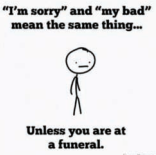
(Funny Being.com (online) 2017. 80 Most Funny Life Memes. Disponível em:<http://www.funnybeing.com/80-most-funny-life-memes/> . Acesso em: 8 ago. 2017.)
Com relação ao meme, considere as afirmativas a seguir.
I. O efeito de humor do meme reside no uso inapropriado de expressões informais em ocasiões formais.
II. A expressão “My bad” é inadequada para o contexto, pois expressa superficialidade de sentimentos.
III. A utilização de “My bad” no contexto do funeral é uma admissão de culpa, daí o efeito cômico.
IV. O efeito cômico do meme é ressaltado pelo uso da palavra “unless” cuja função é especificar o contexto.
Assinale a alternativa correta.

Life
Linus Pauling was born in Portland, Oregon, in the United States. His family came from a line of Prussian farmers, and his father worked as a pharmaceuticals salesman, among other things. After first studying at Oregon State University in Corvallis, Oregon, Linus Pauling earned his PhD from the California Institute of Technology in Pasadena, with which he maintained ties for the rest of his career. In the 1950s, Linus Pauling’s involvement in the anti-nuclear movement led to his being labeled a suspected communist, which resulted in his passport being revoked at times. Linus and Ava Helen Pauling had four children together.
Work
1954 Prize: The development of quantum mechanics during the 1920s had a great impact not only on the field of physics, but also on chemistry. During the 1930s Linus Pauling was among the pioneers who used quantum mechanics to understand and describe chemical bonding – that is, the way atoms join together to form molecules. Linus Pauling worked in a broad range of areas within chemistry. For example, he worked on the structures of biologically important chemical compounds. In 1951 he published the structure of the alpha helix, which is an important basic component of many proteins.
1962 Prize: The atom bombs dropped on Hiroshima and Nagasaki were a turning point in Linus Pauling’s life. Together with other scientists he spoke and wrote against the nuclear arms race, and he was a driving force in the Pugwash movement. It sought to reduce the role of nuclear arms in international politics and was awarded the Peace Prize in 1995. In 1959, Linus Pauling drafted the famous “Hiroshima Appeal”, the concluding document issued after the Fifth World Conference against Atomic and Hydrogen Bombs. He was one of the prime movers who urged the nuclear powers the USA, the Soviet Union and Great Britain to conclude a nuclear test ban treaty, which entered into force on 10 October 1963. On the same day, the Norwegian Nobel Committee announced that Linus Pauling had been awarded the Peace Prize that had been held over from 1962.
(Adaptado de: Linus Pauling - Facts. In: Nobelprize.org. (web) Nobel Media AB 2014.Disponível em:<http://www.nobelprize.org/nobel_prizes/peace/laureates/1962/ pauling-facts.html.>
Com base nos termos sublinhados no texto, considere as afirmativas a seguir.
I. O emprego da expressão “into force” enfatiza o caráter arbitrário do tratado assinado em 1963.
II. O uso da expressão “turning point” ressalta a importância que os acontecimentos de Hiroshima e Nagasaki tiveram sobre Linus Pauling.
III. Os termos “not only” e “but also” estão interligados e adicionam ênfase à informação sobre as aplicações da mecânica quântica também na Química.
IV. A expressão “that is” introduz uma explicação e poderia ser substituída, sem alteração de sentido por “in other words”.
Assinale a alternativa correta.


REMNICK, D. Leonard Cohen makes it Darker. Available
at: www.TAGARCHIVES: Leonard Cohen – Bob Dylan
Interface. Accessed on Nov. 9th, 2016.

 Conheça nossos planos