Foram encontradas 317.116 questões
Resolva questões gratuitamente!
Junte-se a mais de 4 milhões de concurseiros!


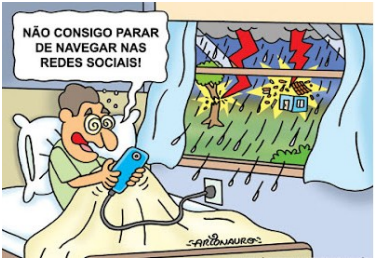
ARIONAURO. Celular vício redes sociais. Disponível em <http://www.arionaurocartuns.com.br/2021/02/chargecelular-vicio-redes-sociais.htm>.
A expressão “Não consigo parar de navegar”, utilizada na charge acima, indica uma ação:
Leia o texto a seguir para responder à questão.
O mistério assustador
Numa pequena cidade do interior havia um mistério
nunca revelado. Todos os moradores tinham medo e andavam apavorados. Tratava-se
de uma pequena casa abandonada, onde morou um antigo prefeito da cidadezinha.
Após sua morte, os moradores passaram a ouvir estranhos barulhos de sua casa.
Gritos, portas que batiam, eram alguns sons que todos ouviam ao se aproximar da
casa.
Certo dia, dois compadres resolveram entrar na casa
que intrigava todos os moradores da pacata cidade. Logo que se aproximaram da
casa começaram a ouvir barulhos de portas batendo.
Os dois ficaram muito assustados, mas não desistiram e
entraram na casa. Perceberam que o barulho vinha do quarto, então subiram as
escadas em direção a ele, respiraram fundo, criaram coragem e abriram a porta,
mas não havia nada lá dentro. Os dois compadres resolveram andar por toda a
casa. Os barulhos continuavam cada vez mais altos. Eles entraram na biblioteca,
a porta se fechou e eles ficaram paralisados com aquilo que viram. Eles
soltaram um grito de horror que foi ouvido por todos da rua. Desde esse dia
nunca mais se viram esses dois compadres.
E a cidade, que tinha um grande mistério, passou a ter
dois, para o terror de todos os moradores.
PONTE PRETA,
Stanislaw. O mistério assustador. Editora Papirus. Disponível em
<https://www.editoraopirus.com.br/uploads/mg/materiais/redacao/mg-redacao-9-ano-603e8d4cd2190.pdf>.
“Logo que se aproximaram da casa começaram a ouvir barulhos de portas batendo.”
A expressão verbal destacada no período acima indica:
Leia o texto a seguir para responder à questão.
O mistério assustador
Numa pequena cidade do interior havia um mistério
nunca revelado. Todos os moradores tinham medo e andavam apavorados. Tratava-se
de uma pequena casa abandonada, onde morou um antigo prefeito da cidadezinha.
Após sua morte, os moradores passaram a ouvir estranhos barulhos de sua casa.
Gritos, portas que batiam, eram alguns sons que todos ouviam ao se aproximar da
casa.
Certo dia, dois compadres resolveram entrar na casa
que intrigava todos os moradores da pacata cidade. Logo que se aproximaram da
casa começaram a ouvir barulhos de portas batendo.
Os dois ficaram muito assustados, mas não desistiram e
entraram na casa. Perceberam que o barulho vinha do quarto, então subiram as
escadas em direção a ele, respiraram fundo, criaram coragem e abriram a porta,
mas não havia nada lá dentro. Os dois compadres resolveram andar por toda a
casa. Os barulhos continuavam cada vez mais altos. Eles entraram na biblioteca,
a porta se fechou e eles ficaram paralisados com aquilo que viram. Eles
soltaram um grito de horror que foi ouvido por todos da rua. Desde esse dia
nunca mais se viram esses dois compadres.
E a cidade, que tinha um grande mistério, passou a ter
dois, para o terror de todos os moradores.
PONTE PRETA,
Stanislaw. O mistério assustador. Editora Papirus. Disponível em
<https://www.editoraopirus.com.br/uploads/mg/materiais/redacao/mg-redacao-9-ano-603e8d4cd2190.pdf>.
“(...) dois compadres resolveram entrar na casa que intrigava todos os moradores da pacata cidade.”
A palavra destacada no trecho acima é sinônima de:
Leia o texto a seguir para responder à questão.
O mistério assustador
Numa pequena cidade do interior havia um mistério
nunca revelado. Todos os moradores tinham medo e andavam apavorados. Tratava-se
de uma pequena casa abandonada, onde morou um antigo prefeito da cidadezinha.
Após sua morte, os moradores passaram a ouvir estranhos barulhos de sua casa.
Gritos, portas que batiam, eram alguns sons que todos ouviam ao se aproximar da
casa.
Certo dia, dois compadres resolveram entrar na casa
que intrigava todos os moradores da pacata cidade. Logo que se aproximaram da
casa começaram a ouvir barulhos de portas batendo.
Os dois ficaram muito assustados, mas não desistiram e
entraram na casa. Perceberam que o barulho vinha do quarto, então subiram as
escadas em direção a ele, respiraram fundo, criaram coragem e abriram a porta,
mas não havia nada lá dentro. Os dois compadres resolveram andar por toda a
casa. Os barulhos continuavam cada vez mais altos. Eles entraram na biblioteca,
a porta se fechou e eles ficaram paralisados com aquilo que viram. Eles
soltaram um grito de horror que foi ouvido por todos da rua. Desde esse dia
nunca mais se viram esses dois compadres.
E a cidade, que tinha um grande mistério, passou a ter
dois, para o terror de todos os moradores.
PONTE PRETA,
Stanislaw. O mistério assustador. Editora Papirus. Disponível em
<https://www.editoraopirus.com.br/uploads/mg/materiais/redacao/mg-redacao-9-ano-603e8d4cd2190.pdf>.
No texto “O mistério assustador”, o narrador é:
A Decolonial Lens to English Language Teaching from a Teacher Educator’s Experience
[...] Identity is a central category in ELT (English Language Teaching). For instance, several studies have been conducted to document English language teachers’ identities (ELTIs) and how they are constructed [...]. However, identity continues to be seen and researched within what Mignolo (2009) labels as the colonial difference. The colonial difference operates by converting differences into values and establishing a hierarchy of human beings ontologically and epistemically. Ontologically, it is assumed that there are inferior human beings. Epistemically, it is assumed that inferior human beings are rationally and aesthetically deficient.
In this respect, the ELT field has witnessed how colonial constructions of ELTIs have been combined with factors such as race, gender, ethnicity, class, language, and others [...].
Therefore, ELP (English Language Pedagogy) is a remnant of coloniality. In particular, ELP in ELT has separated the subjects from their bodies/identitary features and their geographical location regarding the teaching practice [...]. This attempt is evident in the insertion of the notion of competence as the only discourse mostly reproduced in teaching and teacher education. This unidirectional/dimensional discourse is what has caused that “English language teaching and learning identities are more oriented towards that goal of identifying decontextualized forms of being in the field of teaching” (Castañeda-Peña, 2018, p. 18). For instance, Grosfoguel (2010), when discussing coloniality, claims that: “By breaking the link between the subject of enunciation and the ethnic/racial/sexual/gender/epistemic place, Western philosophy and science manage to create a myth about a real universal knowledge that masks, that is, conceals not only the speaker but also the epistemic, geo and body-political place of the structures of colonial power/knowledge from which the subject speaks [...].
In line with decoloniality by Mignolo and Walsh (2018), we think of ELP otherwise – as “the ongoing serpentine movement toward possibilities of other modes of being, thinking, knowing, sensing, and living”; a movement only possible if those who enact ELP name it, reclaim it, and commit to “changing, disrupting, and dismantling the hegemonic relations” [...].
Therefore, I would like to resort to intersectionality – the intersection of different identitary features – to allow the recognition of whom we are based on what we do, as “who we are and from where we speak is highly relevant for the intellectual projects we are likely to pursue” (Moya, 2011, p. 79). Intersectionality can assist in claiming agency (Stone-Mediatore, 2003) in spaces and territories where colonial histories have been present [...].
Intersectional narratives are then discursive representations of experience in which there is conceptual integration among those conversing. In fact, intersectional narratives serve this study to ground concepts and interpretations for “knowledge co-creation, in which researchers and participants develop shared understandings and develop new ideas” (Galafassi et al., 2018, p. 9). This is why intersectional narratives in this study comprise a relevant theoretical construct indispensable to investigating epistemological ruptures [...].
Available in: https://revistas.unal.edu.co/index.php/profile/article/view/90754. Acess on: Feb. 10, 2026. (Adapted).
The article states that
[...] Foreign language learners may encounter various communication problems when their interlanguage is limited. In order to convey their messages and remain in a conversation until their communication goal is achieved, [...] learners need to employ communication strategies, which have been defined generally as device used by second language learners to overcome perceived barriers to achieving specific communication goals [...]. Language learning cannot be separated from its culture. Language is a clear manifestation of culture. A word can have both cognitive meaning and cultural meaning. Cultural meaning refers to words and expressions which represent cultural perception, values and behavior. At discourse level, the link between language, communication and culture is virtually inseparable.
Miscommunication occurs when one interprets communicative rules of one culture in terms of the rules of another culture. In the process of learning a second language, learners make some errors due to first language interference. By knowing strategies to avoid misinterpretation between different backgrounds of speakers, the problems mentioned before shall be avoided easily. Language teaching at school has traditionally been aimed at developing linguistic competence. Teachers tend to teach grammar and linguistic features without letting their learners practice and improve their communication in English. Probably this is one reason that cause some learners are good in English but they cannot use English orally. This problem may be solved by introducing communication strategies to learners in order to avoid communication problems and equip them with strategies to overcome the problems of speaking that they are dealing with [...].
Communication strategies are usually associated with spoken language and research has shown that students tend to use various communication strategies when they are unable to express what they want to say because of their lack of resources in their second language (L2) [...]. When learners experience that fluency in their first language (hereafter L1) does not follow the same pattern as their L2, a gap is created in the knowledge of their L2. These gaps can take many forms: a word, a phrase, a structure, a tense marker or an idiom [...]. In order to overcome that gap, learners have two options: they can either leave the original communicative goal or they can try to reach alternative plans and use other linguistic means that they have at their disposal [...]. It is also important to know that culture and language cannot be separated. Therefore, in the context of language teaching, the knowledge of language and its culture need to be taught as well. The role of teachers in introducing communication strategies to students could determine learners’ successfulness in facing problems of communication [...].
Despite the fact that many [...] researchers lend support to communication strategies training, some opposition to it has been expressed. Bialystok (1990) and Kellerman (1991) argue that one should teach the language itself rather than the strategies. Schmidt (1983) believes that L2 learners develop their strategic competence at the expense of their linguistic competence. According to Skehan (1998), using communication strategies by skilled learners may hinder the development of their interlanguage knowledge resources [...].
Available in: https://files.eric.ed.gov/fulltext/EJ1129727.pdf. Acess on: Jan. 30, 2026.
According to the text,
 Conheça nossos planos