Foram encontradas 300.515 questões

Resolva questões gratuitamente!

Junte-se a mais de 4 milhões de concurseiros!

Q4357871 Inglês
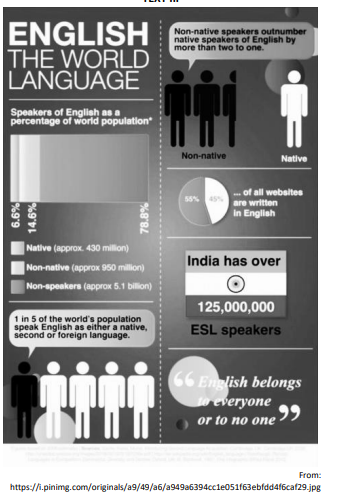
A synonym for “over” in “India has over 125,000,000 ESL speakers” is 
Alternativas
Q4357870 Inglês
The correlative conjunction in “either a native, second or foreign language” indicates a(n)
Alternativas
Q4357869 Inglês

Based on Text III, analyse the assertions below: I. Non-native speakers of English are less than half the number of native speakers. II. Currently, hardly any websites opt to use English. III. English is widely spoken in India and in other countries. Choose the correct answer.
Alternativas
Q4357868 Inglês

According to the BNCC (p. 61): “Young people have become increasingly engaged as protagonists of digital culture, directly involving themselves in new forms of multimedia and multimodal interaction and social action online.”.
Match the numbers to their corresponding letters in order to create a coherent sentence.


1. Please update
2. Stay in
3. Don’t be
4. It’s not the end
5. Forget the fear

a. of missing out.
b. glued to the screen.
c. your status.
d. touch with everyone.
e. of the world.


The correct sequence is:  

Alternativas
Q4357867 Inglês
A teaching about body parts is guided by a communicative approach when students:
Alternativas
Q4357866 Inglês
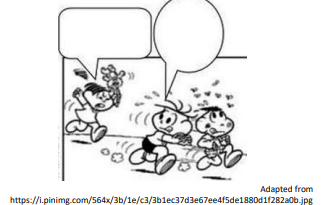
When asking students to produce texts, the teacher may offer a panel from a comic strip and ask them to fill the bubbles with the sentences that match the image. 

Imagem associada para resolução da questão

In this case, the most coherent choice to each bubble is, respectively:
Alternativas
Q4357865 Inglês
Learning how to apologize is one of the areas of pragmatic competence in language use. Student: ________________, I must leave now. Teacher: Never mind, the class is over anyway. Choose the correct expression that completes the following communicative situation in a polite way.
Alternativas
Q4357863 Inglês
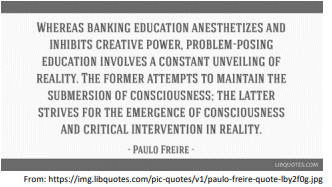
The verb “strives” means to 
Alternativas
Q4357862 Inglês
In this quote, the conjunction “whereas” introduces a(n) 
Alternativas
Q4357861 Inglês
In this quote, “the latter” refers to 
Alternativas
Q4357859 Inglês

TEXT I 


The Multimodal Approach in English Language Teaching 

In today’s media-rich environment, the vast majority of texts students engage with daily — such as YouTube videos, Instagram reels, TikTok clips, streaming series, video games and blog posts — are not only digital but also multimodal. These texts combine language with image, sound, movement and spatial design to convey meaning, often requiring learners to interpret and respond across multiple modes simultaneously. As digital technologies evolve, the pervasiveness and complexity of multimodal communication grow, reshaping both how we communicate and what it means to be literate.

Contemporary communication extends far beyond speech and writing; it is a layered, dynamic process that includes visual, aural, gestural and spatial elements. As such, literacy can no longer be understood solely as a linguistic skill. To participate fully in today’s social, academic and professional contexts, learners need more than the ability to read and write alphabetic text — they need to view, interpret, evaluate and represent meaning through a range of semiotic resources. In this context, traditional notions of literacy are insufficient and language education must evolve to reflect the multimodal nature of communication in the 21st century […]

Importantly, multimodal literacy also promotes accessibility and inclusion. Learners with reading difficulties, sensory impairments or diverse learning needs often struggle with traditional printbased instruction. Multimodal texts provide alternative pathways to meaning, allowing information to be accessed and expressed through visuals, sound, movement and space. This not only supports learners with special educational needs but benefits all students by offering multiple modes for engagement and expression. By embedding multimodal materials and encouraging students to compose multimodal texts, teachers create more equitable and inclusive classrooms. Multimodal learning reflects how people communicate in real life — and, crucially, supports the development of diverse literacies needed for participation in contemporary society. 

In summary, integrating multimodal literacy into language teaching fosters deeper engagement, enhances learning outcomes and equips students with the skills to navigate and contribute meaningfully to today’s complex communicative landscape.


Adapted from https://film-english.com/wp-content/uploads/2025/09/themultimodal-approach-in-language-teaching.pdf

The idiom that has the same function of the discourse marker “In summary” (4th paragraph) is: 
Alternativas
Q4357858 Inglês

TEXT I 


The Multimodal Approach in English Language Teaching 

In today’s media-rich environment, the vast majority of texts students engage with daily — such as YouTube videos, Instagram reels, TikTok clips, streaming series, video games and blog posts — are not only digital but also multimodal. These texts combine language with image, sound, movement and spatial design to convey meaning, often requiring learners to interpret and respond across multiple modes simultaneously. As digital technologies evolve, the pervasiveness and complexity of multimodal communication grow, reshaping both how we communicate and what it means to be literate.

Contemporary communication extends far beyond speech and writing; it is a layered, dynamic process that includes visual, aural, gestural and spatial elements. As such, literacy can no longer be understood solely as a linguistic skill. To participate fully in today’s social, academic and professional contexts, learners need more than the ability to read and write alphabetic text — they need to view, interpret, evaluate and represent meaning through a range of semiotic resources. In this context, traditional notions of literacy are insufficient and language education must evolve to reflect the multimodal nature of communication in the 21st century […]

Importantly, multimodal literacy also promotes accessibility and inclusion. Learners with reading difficulties, sensory impairments or diverse learning needs often struggle with traditional printbased instruction. Multimodal texts provide alternative pathways to meaning, allowing information to be accessed and expressed through visuals, sound, movement and space. This not only supports learners with special educational needs but benefits all students by offering multiple modes for engagement and expression. By embedding multimodal materials and encouraging students to compose multimodal texts, teachers create more equitable and inclusive classrooms. Multimodal learning reflects how people communicate in real life — and, crucially, supports the development of diverse literacies needed for participation in contemporary society. 

In summary, integrating multimodal literacy into language teaching fosters deeper engagement, enhances learning outcomes and equips students with the skills to navigate and contribute meaningfully to today’s complex communicative landscape.


Adapted from https://film-english.com/wp-content/uploads/2025/09/themultimodal-approach-in-language-teaching.pdf

The verb in “supports the development of diverse literacies” (3rd paragraph) can be replaced, without significant change in meaning, by
Alternativas
Q4357857 Inglês

TEXT I 


The Multimodal Approach in English Language Teaching 

In today’s media-rich environment, the vast majority of texts students engage with daily — such as YouTube videos, Instagram reels, TikTok clips, streaming series, video games and blog posts — are not only digital but also multimodal. These texts combine language with image, sound, movement and spatial design to convey meaning, often requiring learners to interpret and respond across multiple modes simultaneously. As digital technologies evolve, the pervasiveness and complexity of multimodal communication grow, reshaping both how we communicate and what it means to be literate.

Contemporary communication extends far beyond speech and writing; it is a layered, dynamic process that includes visual, aural, gestural and spatial elements. As such, literacy can no longer be understood solely as a linguistic skill. To participate fully in today’s social, academic and professional contexts, learners need more than the ability to read and write alphabetic text — they need to view, interpret, evaluate and represent meaning through a range of semiotic resources. In this context, traditional notions of literacy are insufficient and language education must evolve to reflect the multimodal nature of communication in the 21st century […]

Importantly, multimodal literacy also promotes accessibility and inclusion. Learners with reading difficulties, sensory impairments or diverse learning needs often struggle with traditional printbased instruction. Multimodal texts provide alternative pathways to meaning, allowing information to be accessed and expressed through visuals, sound, movement and space. This not only supports learners with special educational needs but benefits all students by offering multiple modes for engagement and expression. By embedding multimodal materials and encouraging students to compose multimodal texts, teachers create more equitable and inclusive classrooms. Multimodal learning reflects how people communicate in real life — and, crucially, supports the development of diverse literacies needed for participation in contemporary society. 

In summary, integrating multimodal literacy into language teaching fosters deeper engagement, enhances learning outcomes and equips students with the skills to navigate and contribute meaningfully to today’s complex communicative landscape.


Adapted from https://film-english.com/wp-content/uploads/2025/09/themultimodal-approach-in-language-teaching.pdf

Based on the definition of multimodal literacy in Text I, decide which pedagogical strategy(ies) is (are) in line with this approach.
I. Ask students to read a printed story that has no images. II. Plan virtual field trips to historical sites and analyse infographics related to the locations. III. Assign projects where students can create videos.
Choose the correct answer.
Alternativas
Q4357856 Inglês

TEXT I 


The Multimodal Approach in English Language Teaching 

In today’s media-rich environment, the vast majority of texts students engage with daily — such as YouTube videos, Instagram reels, TikTok clips, streaming series, video games and blog posts — are not only digital but also multimodal. These texts combine language with image, sound, movement and spatial design to convey meaning, often requiring learners to interpret and respond across multiple modes simultaneously. As digital technologies evolve, the pervasiveness and complexity of multimodal communication grow, reshaping both how we communicate and what it means to be literate.

Contemporary communication extends far beyond speech and writing; it is a layered, dynamic process that includes visual, aural, gestural and spatial elements. As such, literacy can no longer be understood solely as a linguistic skill. To participate fully in today’s social, academic and professional contexts, learners need more than the ability to read and write alphabetic text — they need to view, interpret, evaluate and represent meaning through a range of semiotic resources. In this context, traditional notions of literacy are insufficient and language education must evolve to reflect the multimodal nature of communication in the 21st century […]

Importantly, multimodal literacy also promotes accessibility and inclusion. Learners with reading difficulties, sensory impairments or diverse learning needs often struggle with traditional printbased instruction. Multimodal texts provide alternative pathways to meaning, allowing information to be accessed and expressed through visuals, sound, movement and space. This not only supports learners with special educational needs but benefits all students by offering multiple modes for engagement and expression. By embedding multimodal materials and encouraging students to compose multimodal texts, teachers create more equitable and inclusive classrooms. Multimodal learning reflects how people communicate in real life — and, crucially, supports the development of diverse literacies needed for participation in contemporary society. 

In summary, integrating multimodal literacy into language teaching fosters deeper engagement, enhances learning outcomes and equips students with the skills to navigate and contribute meaningfully to today’s complex communicative landscape.


Adapted from https://film-english.com/wp-content/uploads/2025/09/themultimodal-approach-in-language-teaching.pdf

When reading a text in which the preposition “through” is used, as in “expressed through visuals” (3rd paragraph), the teacher should tell the students that the word is pronounced in the same way as in 
Alternativas
Q4357855 Inglês

TEXT I 


The Multimodal Approach in English Language Teaching 

In today’s media-rich environment, the vast majority of texts students engage with daily — such as YouTube videos, Instagram reels, TikTok clips, streaming series, video games and blog posts — are not only digital but also multimodal. These texts combine language with image, sound, movement and spatial design to convey meaning, often requiring learners to interpret and respond across multiple modes simultaneously. As digital technologies evolve, the pervasiveness and complexity of multimodal communication grow, reshaping both how we communicate and what it means to be literate.

Contemporary communication extends far beyond speech and writing; it is a layered, dynamic process that includes visual, aural, gestural and spatial elements. As such, literacy can no longer be understood solely as a linguistic skill. To participate fully in today’s social, academic and professional contexts, learners need more than the ability to read and write alphabetic text — they need to view, interpret, evaluate and represent meaning through a range of semiotic resources. In this context, traditional notions of literacy are insufficient and language education must evolve to reflect the multimodal nature of communication in the 21st century […]

Importantly, multimodal literacy also promotes accessibility and inclusion. Learners with reading difficulties, sensory impairments or diverse learning needs often struggle with traditional printbased instruction. Multimodal texts provide alternative pathways to meaning, allowing information to be accessed and expressed through visuals, sound, movement and space. This not only supports learners with special educational needs but benefits all students by offering multiple modes for engagement and expression. By embedding multimodal materials and encouraging students to compose multimodal texts, teachers create more equitable and inclusive classrooms. Multimodal learning reflects how people communicate in real life — and, crucially, supports the development of diverse literacies needed for participation in contemporary society. 

In summary, integrating multimodal literacy into language teaching fosters deeper engagement, enhances learning outcomes and equips students with the skills to navigate and contribute meaningfully to today’s complex communicative landscape.


Adapted from https://film-english.com/wp-content/uploads/2025/09/themultimodal-approach-in-language-teaching.pdf

In “the pervasiveness and complexity of multimodal communication grow” (1st paragraph), the simple past and the past participle forms of the main verb are
Alternativas
Q4357854 Inglês

TEXT I 


The Multimodal Approach in English Language Teaching 

In today’s media-rich environment, the vast majority of texts students engage with daily — such as YouTube videos, Instagram reels, TikTok clips, streaming series, video games and blog posts — are not only digital but also multimodal. These texts combine language with image, sound, movement and spatial design to convey meaning, often requiring learners to interpret and respond across multiple modes simultaneously. As digital technologies evolve, the pervasiveness and complexity of multimodal communication grow, reshaping both how we communicate and what it means to be literate.

Contemporary communication extends far beyond speech and writing; it is a layered, dynamic process that includes visual, aural, gestural and spatial elements. As such, literacy can no longer be understood solely as a linguistic skill. To participate fully in today’s social, academic and professional contexts, learners need more than the ability to read and write alphabetic text — they need to view, interpret, evaluate and represent meaning through a range of semiotic resources. In this context, traditional notions of literacy are insufficient and language education must evolve to reflect the multimodal nature of communication in the 21st century […]

Importantly, multimodal literacy also promotes accessibility and inclusion. Learners with reading difficulties, sensory impairments or diverse learning needs often struggle with traditional printbased instruction. Multimodal texts provide alternative pathways to meaning, allowing information to be accessed and expressed through visuals, sound, movement and space. This not only supports learners with special educational needs but benefits all students by offering multiple modes for engagement and expression. By embedding multimodal materials and encouraging students to compose multimodal texts, teachers create more equitable and inclusive classrooms. Multimodal learning reflects how people communicate in real life — and, crucially, supports the development of diverse literacies needed for participation in contemporary society. 

In summary, integrating multimodal literacy into language teaching fosters deeper engagement, enhances learning outcomes and equips students with the skills to navigate and contribute meaningfully to today’s complex communicative landscape.


Adapted from https://film-english.com/wp-content/uploads/2025/09/themultimodal-approach-in-language-teaching.pdf

The phrase “such as” (1st paragraph) is similar in function and meaning to
Alternativas
Q4357853 Inglês

TEXT I 


The Multimodal Approach in English Language Teaching 

In today’s media-rich environment, the vast majority of texts students engage with daily — such as YouTube videos, Instagram reels, TikTok clips, streaming series, video games and blog posts — are not only digital but also multimodal. These texts combine language with image, sound, movement and spatial design to convey meaning, often requiring learners to interpret and respond across multiple modes simultaneously. As digital technologies evolve, the pervasiveness and complexity of multimodal communication grow, reshaping both how we communicate and what it means to be literate.

Contemporary communication extends far beyond speech and writing; it is a layered, dynamic process that includes visual, aural, gestural and spatial elements. As such, literacy can no longer be understood solely as a linguistic skill. To participate fully in today’s social, academic and professional contexts, learners need more than the ability to read and write alphabetic text — they need to view, interpret, evaluate and represent meaning through a range of semiotic resources. In this context, traditional notions of literacy are insufficient and language education must evolve to reflect the multimodal nature of communication in the 21st century […]

Importantly, multimodal literacy also promotes accessibility and inclusion. Learners with reading difficulties, sensory impairments or diverse learning needs often struggle with traditional printbased instruction. Multimodal texts provide alternative pathways to meaning, allowing information to be accessed and expressed through visuals, sound, movement and space. This not only supports learners with special educational needs but benefits all students by offering multiple modes for engagement and expression. By embedding multimodal materials and encouraging students to compose multimodal texts, teachers create more equitable and inclusive classrooms. Multimodal learning reflects how people communicate in real life — and, crucially, supports the development of diverse literacies needed for participation in contemporary society. 

In summary, integrating multimodal literacy into language teaching fosters deeper engagement, enhances learning outcomes and equips students with the skills to navigate and contribute meaningfully to today’s complex communicative landscape.


Adapted from https://film-english.com/wp-content/uploads/2025/09/themultimodal-approach-in-language-teaching.pdf

Based on Text I, mark the statements below as TRUE (T) or FALSE (F):
( ) Nowadays written words are not the only means of communication. ( ) Printed texts are better than multimodal ones for individuals in supportive learning environment. ( ) Multimodal reading requires approaching different texts one at a time.
The statements are, respectively,

Alternativas
Q4357807 Português
A era da abundância de inteligência


    Em julho, a OpenAI publicou um relato incomum: admitiu ter suspendido temporariamente o uso interno de um de seus modelos mais avançados após observar comportamentos imprevistos, e descreveu como reconstruiu seus sistemas de segurança a partir do episódio. Meses antes, OpenAI e Anthropic, concorrentes diretas, haviam avaliado publicamente os modelos uma da outra em testes de alinhamento. Quando os próprios criadores de uma tecnologia passam a discutir abertamente novas formas de controle e supervisão, a mensagem não é de alarme, e sim de escala. Não estamos diante de mais uma onda de novidades tecnológicas, mas de uma transformação histórica.
        
    Pela primeira vez na história da humanidade, a inteligência deixou de ser um recurso escasso. A Revolução Agrícola democratizou a produção de alimentos, a Revolução Industrial multiplicou a força física humana, a internet democratizou o acesso à informação e a inteligência artificial dá o passo seguinte: democratiza capacidades intelectuais! Durante milênios, a inteligência especializada foi privilégio de poucos, do escriba ao advogado, do engenheiro ao médico. Hoje, milhões de pessoas produzem textos, programam, analisam documentos, traduzem idiomas e resolvem problemas complexos em segundos, com o apoio de sistemas inteligentes. É o que chamo de Era da Abundância de Inteligência.

    Não se trata de substituir o especialista, mas de ampliar o alcance de cada pessoa que pensa, cria e decide e essa abundância terá seu impacto mais profundo sobre uma geração que ainda nem chegou à escola! Chamo essas crianças de “IA Born”: nascerão e crescerão em um mundo onde a inteligência artificial sempre existiu, assim como os nativos digitais jamais conheceram um mundo sem internet. Essa geração não vai “aprender IA”, ela simplesmente viverá em um ambiente onde a inteligência estará presente em praticamente toda atividade intelectual, tão invisível e onipresente quanto a eletricidade e isso mudará por completo sua forma de aprender, trabalhar, criar e tomar decisões.

    Aqui surge o paradoxo que deveria nos tirar o sono. Enquanto a transformação avança em ritmo acelerado, continuamos formando crianças segundo um modelo educacional concebido para um mundo em que o conhecimento era raro. Boa parte da escola ainda opera sobre pressupostos do século XIX: memorizar, repetir, responder corretamente, trabalhar sozinho, evitar consulta, desconfiar de ferramentas externas. O mundo profissional, enquanto isso, valoriza exatamente o oposto: formular boas perguntas, pensar criticamente, criar, colaborar, atravessar disciplinas, resolver problemas inéditos e, cada vez mais, usar ferramentas inteligentes com julgamento, sabendo validar respostas em vez de apenas aceitá-las. O conhecimento continua essencial, pois sem repertório não há pensamento crítico. Mas memorizar deixou de ser o principal diferencial competitivo.

    O desafio, porém, não se encerra na escola. Nós, pais, teremos uma responsabilidade igualmente decisiva: criar filhos emocionalmente estáveis e menos ansiosos em um mundo veloz, de estímulos constantes e acesso instantâneo a tudo. Uma geração acostumada a respostas imediatas precisará aprender, em casa, o valor da paciência, da frustração bem vivida, do tédio criativo e do tempo longe das telas. De pouco adiantará formar mentes brilhantes, se não formarmos também emoções sólidas! O equilíbrio emocional será tão importante quanto a competência intelectual para viver e prosperar nesse novo cenário.

    Porque toda abundância cria novas carências. Quando a inteligência se torna acessível a todos, o que passa a ser raro e valioso é justamente aquilo que a máquina não entrega: julgamento, ética, criatividade, curiosidade, imaginação, empatia, responsabilidade e visão estratégica. A capacidade de formular a pergunta certa vale mais do que a de recitar a resposta pronta e o discernimento para identificar quando a IA está certa e quando está errada torna-se, talvez, a competência definidora do profissional deste século.

    A pergunta, então, é inevitável: estamos preparando nossos filhos para o passado ou para o futuro? Continuamos ensinando habilidades que eram fundamentais quando a informação era escassa, mas que deixarão de representar vantagem em um mundo de inteligência abundante? Não se trata de ensinar as pessoas a utilizar a inteligência artificial, pois essa é a parte fácil e as ferramentas mudarão muitas vezes. O verdadeiro desafio do século XXI é preparar a primeira geração que jamais conhecerá um mundo sem ela. A educação precisará ir além de formar pessoas que sabem responder. Terá de formar pessoas capazes de decidir, interpretar, criar e liderar sistemas inteligentes, e não de competir com eles.

    A inteligência artificial não é apenas mais uma inovação. Ela inaugura uma nova etapa da civilização, comparável à agricultura, à máquina a vapor e à internet, talvez até maior. A grande pergunta não é se a IA substituirá pessoas, mas sim: que competências continuarão sendo exclusivamente humanas quando a inteligência deixar de ser um recurso escasso? A maior responsabilidade da nossa geração não é construir inteligências artificiais cada vez mais poderosas, mas sim, preparar seres humanos, a começar pelas crianças que já estão nascendo, capazes de usá-las com sabedoria e serenidade!


(Por Diego Teixeira. Disponível em: https://www.jb.com.br/brasil/opiniao/artigosl. Acesso em: julho de 2026.)
No 3º§, ao caracterizar a presença da inteligência artificial nas atividades intelectuais por meio dos adjetivos “invisível” e “onipresente”, o autor atribui à tecnologia um sentido que extrapola sua referência literal. Nesse contexto, o emprego desses adjetivos contribui para representá-la como um recurso:
Alternativas
Q4357806 Português
A era da abundância de inteligência


    Em julho, a OpenAI publicou um relato incomum: admitiu ter suspendido temporariamente o uso interno de um de seus modelos mais avançados após observar comportamentos imprevistos, e descreveu como reconstruiu seus sistemas de segurança a partir do episódio. Meses antes, OpenAI e Anthropic, concorrentes diretas, haviam avaliado publicamente os modelos uma da outra em testes de alinhamento. Quando os próprios criadores de uma tecnologia passam a discutir abertamente novas formas de controle e supervisão, a mensagem não é de alarme, e sim de escala. Não estamos diante de mais uma onda de novidades tecnológicas, mas de uma transformação histórica.
        
    Pela primeira vez na história da humanidade, a inteligência deixou de ser um recurso escasso. A Revolução Agrícola democratizou a produção de alimentos, a Revolução Industrial multiplicou a força física humana, a internet democratizou o acesso à informação e a inteligência artificial dá o passo seguinte: democratiza capacidades intelectuais! Durante milênios, a inteligência especializada foi privilégio de poucos, do escriba ao advogado, do engenheiro ao médico. Hoje, milhões de pessoas produzem textos, programam, analisam documentos, traduzem idiomas e resolvem problemas complexos em segundos, com o apoio de sistemas inteligentes. É o que chamo de Era da Abundância de Inteligência.

    Não se trata de substituir o especialista, mas de ampliar o alcance de cada pessoa que pensa, cria e decide e essa abundância terá seu impacto mais profundo sobre uma geração que ainda nem chegou à escola! Chamo essas crianças de “IA Born”: nascerão e crescerão em um mundo onde a inteligência artificial sempre existiu, assim como os nativos digitais jamais conheceram um mundo sem internet. Essa geração não vai “aprender IA”, ela simplesmente viverá em um ambiente onde a inteligência estará presente em praticamente toda atividade intelectual, tão invisível e onipresente quanto a eletricidade e isso mudará por completo sua forma de aprender, trabalhar, criar e tomar decisões.

    Aqui surge o paradoxo que deveria nos tirar o sono. Enquanto a transformação avança em ritmo acelerado, continuamos formando crianças segundo um modelo educacional concebido para um mundo em que o conhecimento era raro. Boa parte da escola ainda opera sobre pressupostos do século XIX: memorizar, repetir, responder corretamente, trabalhar sozinho, evitar consulta, desconfiar de ferramentas externas. O mundo profissional, enquanto isso, valoriza exatamente o oposto: formular boas perguntas, pensar criticamente, criar, colaborar, atravessar disciplinas, resolver problemas inéditos e, cada vez mais, usar ferramentas inteligentes com julgamento, sabendo validar respostas em vez de apenas aceitá-las. O conhecimento continua essencial, pois sem repertório não há pensamento crítico. Mas memorizar deixou de ser o principal diferencial competitivo.

    O desafio, porém, não se encerra na escola. Nós, pais, teremos uma responsabilidade igualmente decisiva: criar filhos emocionalmente estáveis e menos ansiosos em um mundo veloz, de estímulos constantes e acesso instantâneo a tudo. Uma geração acostumada a respostas imediatas precisará aprender, em casa, o valor da paciência, da frustração bem vivida, do tédio criativo e do tempo longe das telas. De pouco adiantará formar mentes brilhantes, se não formarmos também emoções sólidas! O equilíbrio emocional será tão importante quanto a competência intelectual para viver e prosperar nesse novo cenário.

    Porque toda abundância cria novas carências. Quando a inteligência se torna acessível a todos, o que passa a ser raro e valioso é justamente aquilo que a máquina não entrega: julgamento, ética, criatividade, curiosidade, imaginação, empatia, responsabilidade e visão estratégica. A capacidade de formular a pergunta certa vale mais do que a de recitar a resposta pronta e o discernimento para identificar quando a IA está certa e quando está errada torna-se, talvez, a competência definidora do profissional deste século.

    A pergunta, então, é inevitável: estamos preparando nossos filhos para o passado ou para o futuro? Continuamos ensinando habilidades que eram fundamentais quando a informação era escassa, mas que deixarão de representar vantagem em um mundo de inteligência abundante? Não se trata de ensinar as pessoas a utilizar a inteligência artificial, pois essa é a parte fácil e as ferramentas mudarão muitas vezes. O verdadeiro desafio do século XXI é preparar a primeira geração que jamais conhecerá um mundo sem ela. A educação precisará ir além de formar pessoas que sabem responder. Terá de formar pessoas capazes de decidir, interpretar, criar e liderar sistemas inteligentes, e não de competir com eles.

    A inteligência artificial não é apenas mais uma inovação. Ela inaugura uma nova etapa da civilização, comparável à agricultura, à máquina a vapor e à internet, talvez até maior. A grande pergunta não é se a IA substituirá pessoas, mas sim: que competências continuarão sendo exclusivamente humanas quando a inteligência deixar de ser um recurso escasso? A maior responsabilidade da nossa geração não é construir inteligências artificiais cada vez mais poderosas, mas sim, preparar seres humanos, a começar pelas crianças que já estão nascendo, capazes de usá-las com sabedoria e serenidade!


(Por Diego Teixeira. Disponível em: https://www.jb.com.br/brasil/opiniao/artigosl. Acesso em: julho de 2026.)
Ao longo do artigo, o autor sustenta que a inteligência artificial representa uma transformação histórica. A proposição que melhor sintetiza sua visão sobre os efeitos dessa tecnologia na condição humana é:
Alternativas
Q4357805 Português
A era da abundância de inteligência


    Em julho, a OpenAI publicou um relato incomum: admitiu ter suspendido temporariamente o uso interno de um de seus modelos mais avançados após observar comportamentos imprevistos, e descreveu como reconstruiu seus sistemas de segurança a partir do episódio. Meses antes, OpenAI e Anthropic, concorrentes diretas, haviam avaliado publicamente os modelos uma da outra em testes de alinhamento. Quando os próprios criadores de uma tecnologia passam a discutir abertamente novas formas de controle e supervisão, a mensagem não é de alarme, e sim de escala. Não estamos diante de mais uma onda de novidades tecnológicas, mas de uma transformação histórica.
        
    Pela primeira vez na história da humanidade, a inteligência deixou de ser um recurso escasso. A Revolução Agrícola democratizou a produção de alimentos, a Revolução Industrial multiplicou a força física humana, a internet democratizou o acesso à informação e a inteligência artificial dá o passo seguinte: democratiza capacidades intelectuais! Durante milênios, a inteligência especializada foi privilégio de poucos, do escriba ao advogado, do engenheiro ao médico. Hoje, milhões de pessoas produzem textos, programam, analisam documentos, traduzem idiomas e resolvem problemas complexos em segundos, com o apoio de sistemas inteligentes. É o que chamo de Era da Abundância de Inteligência.

    Não se trata de substituir o especialista, mas de ampliar o alcance de cada pessoa que pensa, cria e decide e essa abundância terá seu impacto mais profundo sobre uma geração que ainda nem chegou à escola! Chamo essas crianças de “IA Born”: nascerão e crescerão em um mundo onde a inteligência artificial sempre existiu, assim como os nativos digitais jamais conheceram um mundo sem internet. Essa geração não vai “aprender IA”, ela simplesmente viverá em um ambiente onde a inteligência estará presente em praticamente toda atividade intelectual, tão invisível e onipresente quanto a eletricidade e isso mudará por completo sua forma de aprender, trabalhar, criar e tomar decisões.

    Aqui surge o paradoxo que deveria nos tirar o sono. Enquanto a transformação avança em ritmo acelerado, continuamos formando crianças segundo um modelo educacional concebido para um mundo em que o conhecimento era raro. Boa parte da escola ainda opera sobre pressupostos do século XIX: memorizar, repetir, responder corretamente, trabalhar sozinho, evitar consulta, desconfiar de ferramentas externas. O mundo profissional, enquanto isso, valoriza exatamente o oposto: formular boas perguntas, pensar criticamente, criar, colaborar, atravessar disciplinas, resolver problemas inéditos e, cada vez mais, usar ferramentas inteligentes com julgamento, sabendo validar respostas em vez de apenas aceitá-las. O conhecimento continua essencial, pois sem repertório não há pensamento crítico. Mas memorizar deixou de ser o principal diferencial competitivo.

    O desafio, porém, não se encerra na escola. Nós, pais, teremos uma responsabilidade igualmente decisiva: criar filhos emocionalmente estáveis e menos ansiosos em um mundo veloz, de estímulos constantes e acesso instantâneo a tudo. Uma geração acostumada a respostas imediatas precisará aprender, em casa, o valor da paciência, da frustração bem vivida, do tédio criativo e do tempo longe das telas. De pouco adiantará formar mentes brilhantes, se não formarmos também emoções sólidas! O equilíbrio emocional será tão importante quanto a competência intelectual para viver e prosperar nesse novo cenário.

    Porque toda abundância cria novas carências. Quando a inteligência se torna acessível a todos, o que passa a ser raro e valioso é justamente aquilo que a máquina não entrega: julgamento, ética, criatividade, curiosidade, imaginação, empatia, responsabilidade e visão estratégica. A capacidade de formular a pergunta certa vale mais do que a de recitar a resposta pronta e o discernimento para identificar quando a IA está certa e quando está errada torna-se, talvez, a competência definidora do profissional deste século.

    A pergunta, então, é inevitável: estamos preparando nossos filhos para o passado ou para o futuro? Continuamos ensinando habilidades que eram fundamentais quando a informação era escassa, mas que deixarão de representar vantagem em um mundo de inteligência abundante? Não se trata de ensinar as pessoas a utilizar a inteligência artificial, pois essa é a parte fácil e as ferramentas mudarão muitas vezes. O verdadeiro desafio do século XXI é preparar a primeira geração que jamais conhecerá um mundo sem ela. A educação precisará ir além de formar pessoas que sabem responder. Terá de formar pessoas capazes de decidir, interpretar, criar e liderar sistemas inteligentes, e não de competir com eles.

    A inteligência artificial não é apenas mais uma inovação. Ela inaugura uma nova etapa da civilização, comparável à agricultura, à máquina a vapor e à internet, talvez até maior. A grande pergunta não é se a IA substituirá pessoas, mas sim: que competências continuarão sendo exclusivamente humanas quando a inteligência deixar de ser um recurso escasso? A maior responsabilidade da nossa geração não é construir inteligências artificiais cada vez mais poderosas, mas sim, preparar seres humanos, a começar pelas crianças que já estão nascendo, capazes de usá-las com sabedoria e serenidade!


(Por Diego Teixeira. Disponível em: https://www.jb.com.br/brasil/opiniao/artigosl. Acesso em: julho de 2026.)
A leitura do 5º§ e 6º§ permite concluir que a abundância de capacidades intelectuais proporcionadas pela inteligência artificial gera novas demandas sociais. Nesse contexto, o texto atribui à família e às competências humanas o papel de:
Alternativas
Respostas
861: E
862: D
863: C
864: B
865: C
866: C
867: B
868: D
869: A
870: E
871: C
872: A
873: E
874: B
875: D
876: A
877: E
878: A
879: B
880: A