Questões de Concurso
Para letras
Foram encontradas 301.545 questões
Resolva questões gratuitamente!
Junte-se a mais de 4 milhões de concurseiros!


Brain rot
“Brain rot” is defined as “the supposed deterioration of a person’s mental or intellectual state, especially viewed as the result of overconsumption of material (now particularly online content) considered to be trivial or unchallenging. Also: something characterized as likely to lead to such deterioration”. The term gained new prominence as a term used to capture concerns about the impact of consuming excessive amounts of low-quality online content, especially on social media. The term increased in usage frequency by 230% between 2023 and 2024.
The first recorded use of “brain rot” was found in 1854 in Henry David Thoreau’s book Walden, which reports his experiences of living a simple lifestyle in the natural world. Thoreau criticizes society’s tendency to devalue complex ideas, or those that can be interpreted in multiple ways, in favour of simple ones, and sees this as indicative of a general decline in mental and intellectual effort: “While England endeavours to cure the potato rot, will not any endeavour to cure the brain-rot — which prevails so much more widely and fatally?”
The term has taken on new significance in the digital age. Initially gaining traction on social media platforms, the term is now seeing more widespread use, such as in mainstream journalism, amidst societal concerns about the negative impact of overconsuming online content.
Source: Oxford University Press. Adaptation.
Considering both past and present methods and approaches for language teaching, number the second column according to the first one and then mark the item that corresponds to the CORRECT sequence.
(1) Grammar-translation method.
(2) Direct method.
(3) Lexical approach.
( ) It’s a way of studying a language that approaches the language first through detailed analysis of its rules, followed by the task of translating sentences and texts into and out of the target language.
( ) It’s based on the idea that language is composed of units rather than grammatical structures. These units are words and chunks formed by collocations and fixed phrases.
( ) Instead of using analytical procedures that focus on explaining grammar rules, teachers encourage spontaneous use of the foreign language in the classroom. Grammar is taught in an inductively way.
Brain rot
“Brain rot” is defined as “the supposed deterioration of a person’s mental or intellectual state, especially viewed as the result of overconsumption of material (now particularly online content) considered to be trivial or unchallenging. Also: something characterized as likely to lead to such deterioration”. The term gained new prominence as a term used to capture concerns about the impact of consuming excessive amounts of low-quality online content, especially on social media. The term increased in usage frequency by 230% between 2023 and 2024.
The first recorded use of “brain rot” was found in 1854 in Henry David Thoreau’s book Walden, which reports his experiences of living a simple lifestyle in the natural world. Thoreau criticizes society’s tendency to devalue complex ideas, or those that can be interpreted in multiple ways, in favour of simple ones, and sees this as indicative of a general decline in mental and intellectual effort: “While England endeavours to cure the potato rot, will not any endeavour to cure the brain-rot — which prevails so much more widely and fatally?”
The term has taken on new significance in the digital age. Initially gaining traction on social media platforms, the term is now seeing more widespread use, such as in mainstream journalism, amidst societal concerns about the negative impact of overconsuming online content.
Source: Oxford University Press. Adaptation.
Irregular nouns do not follow the standard pluralization rule. In light of this, analyze the following items.
I. You’ve got one feet in the wrong shoe.
II. Women are rethinking motherhood.
III. The hypotheses are being debunked.
It is CORRECT to state that:
Brain rot
“Brain rot” is defined as “the supposed deterioration of a person’s mental or intellectual state, especially viewed as the result of overconsumption of material (now particularly online content) considered to be trivial or unchallenging. Also: something characterized as likely to lead to such deterioration”. The term gained new prominence as a term used to capture concerns about the impact of consuming excessive amounts of low-quality online content, especially on social media. The term increased in usage frequency by 230% between 2023 and 2024.
The first recorded use of “brain rot” was found in 1854 in Henry David Thoreau’s book Walden, which reports his experiences of living a simple lifestyle in the natural world. Thoreau criticizes society’s tendency to devalue complex ideas, or those that can be interpreted in multiple ways, in favour of simple ones, and sees this as indicative of a general decline in mental and intellectual effort: “While England endeavours to cure the potato rot, will not any endeavour to cure the brain-rot — which prevails so much more widely and fatally?”
The term has taken on new significance in the digital age. Initially gaining traction on social media platforms, the term is now seeing more widespread use, such as in mainstream journalism, amidst societal concerns about the negative impact of overconsuming online content.
Source: Oxford University Press. Adaptation.
Mark the item that displays the CORRECT translation for the text below.
The first recorded use of “brain rot” was found in 1854 in Henry David Thoreau’s book Walden, which reports his experiences of living a simple lifestyle in the natural world.
Brain rot
“Brain rot” is defined as “the supposed deterioration of a person’s mental or intellectual state, especially viewed as the result of overconsumption of material (now particularly online content) considered to be trivial or unchallenging. Also: something characterized as likely to lead to such deterioration”. The term gained new prominence as a term used to capture concerns about the impact of consuming excessive amounts of low-quality online content, especially on social media. The term increased in usage frequency by 230% between 2023 and 2024.
The first recorded use of “brain rot” was found in 1854 in Henry David Thoreau’s book Walden, which reports his experiences of living a simple lifestyle in the natural world. Thoreau criticizes society’s tendency to devalue complex ideas, or those that can be interpreted in multiple ways, in favour of simple ones, and sees this as indicative of a general decline in mental and intellectual effort: “While England endeavours to cure the potato rot, will not any endeavour to cure the brain-rot — which prevails so much more widely and fatally?”
The term has taken on new significance in the digital age. Initially gaining traction on social media platforms, the term is now seeing more widespread use, such as in mainstream journalism, amidst societal concerns about the negative impact of overconsuming online content.
Source: Oxford University Press. Adaptation.
“Seu argumento coloca a língua não como uma habilidade que se desenvolve por meio de estímulo e resposta, punição e recompensa, mas como um módulo da mente humana, geneticamente constituído. Contra o empirismo, que define o cérebro como uma tábula rasa, vazia e desestruturada no que diz respeito aos fatos mentais, o aspecto essencial da crítica de ________ é que a estrutura do cérebro é determinada a priori pelo código genético. O cérebro é programado para analisar a experiência e construir saberes com base nela. Apesar de finito, o cérebro humano pode gerar uma infinidade de sentenças por meio de regras. Em contato com o ambiente linguístico de sua comunidade, a criança adquire a língua sem esforço, mesmo sem ter sido ensinada, pois a língua é inata.” (GOMES, Maria Lúcia de Castro. Metodologia do Ensino de Língua Portuguesa; 3ª edição – editora Inter Saberes; páginas 28 e 29.)
A partir da leitura acima e dos conhecimentos sobre os teóricos que abordaram vários conceitos de linguagem no âmbito de desenvolvimento comunicativo humano, podese dizer que completa corretamente o espaço acima a apresentação do seguinte teórico:
Leia:
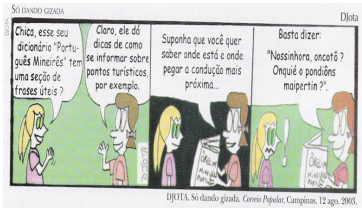
Nota-se que o humor provocado na tirinha acima é movido por uma maneira específica de expressão da linguagem. Sobre isso, pode-se afirmar que a variação empregada no texto se refere a um tipo específico tido como:
I. O escritor critica diversos aspectos da sociedade, aliados ao moralismo e à perversão das instituições de ensino do período.
II. Nota-se um tom de ironia autoral quanto às suas reminiscências escolares, deixando a entender quão nocivas estas se mostram à sua existência.
III. Embora, o narrador-personagem não expresse positividade em relação à época de sua experiência no Ateneu, este é capaz de reconhecer a contribuição humana e técnica apreendida naquele espaço de ensino, a qual é considerada como determinante para sua vida adulta.
IV. A menção feita ao Dr. Aristarco Argolo de Ramos é movida por uma descrição pautada em ressentimento e, ao mesmo tempo, análise crítica das suas intenções de avareza mercadológica e de artificialismo acadêmico diante da autopromoção por ele propagada no contexto.
Pode-se analisar que está correto o que se afirmou somente em:

 Conheça nossos planos