Selecionar segmento
Estude com questões de diferentes segmentos
Atenção: Isso limpará todos os campos já preenchidos no filtro!
Foram encontradas 3.419 questões
Resolva questões gratuitamente!
Junte-se a mais de 4 milhões de concurseiros!


Ano: 2011
Banca:
CESGRANRIO
Órgão:
Petrobras
Prova:
CESGRANRIO - 2011 - Petrobras - Engenheiro de Produção Júnior |
Q183160
Engenharia de Produção
A empresa High Quality Ltda. produz dois tipos de produtos X e Y. Considere a tabela abaixo, que contém as margens de contribuição unitária e a quantidade de ho-as-máquina (h/m) para a fabricação de uma unidade dos produtos X e Y.
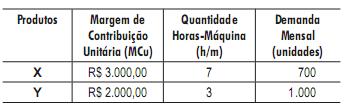
Sabendo-se que a capacidade produtiva total mensal da High Quality é de 4.000 horas, a melhor escolha da empresa para maximizar sua Margem de Contribuição Total é
Sabendo-se que a capacidade produtiva total mensal da High Quality é de 4.000 horas, a melhor escolha da empresa para maximizar sua Margem de Contribuição Total é
Ano: 2011
Banca:
CESGRANRIO
Órgão:
Petrobras
Prova:
CESGRANRIO - 2011 - Petrobras - Engenheiro de Produção Júnior |
Q183159
Engenharia de Produção
Um engenheiro de produção de uma fábrica precisa elaborar um relatório financeiro para a diretoria, incluindo os custos de cada setor produtivo. Sobre os métodos de custeamento, é INCORRETO afirmar que
Ano: 2011
Banca:
CESGRANRIO
Órgão:
Petrobras
Prova:
CESGRANRIO - 2011 - Petrobras - Engenheiro de Produção Júnior |
Q183158
Engenharia de Produção
Uma empresa possui dois ativos: X e Y. Considerando-se que o ativo X possui beta de 0,8, o ativo Y, um beta de 1,3, que a taxa livre de risco é igual a 7% e que o retorno do mercado é de 15%, de acordo com o modelo de precificação CAPM,
Ano: 2011
Banca:
CESGRANRIO
Órgão:
Petrobras
Prova:
CESGRANRIO - 2011 - Petrobras - Engenheiro de Produção Júnior |
Q183157
Engenharia de Produção
As estratégias de hedging são técnicas adotadas como compensação ou proteção ao risco. Sobre as ferramentas de hedging de risco cambial disponíveis no mercado, é INCORRETO afirmar que
Ano: 2011
Banca:
CESGRANRIO
Órgão:
Petrobras
Prova:
CESGRANRIO - 2011 - Petrobras - Engenheiro de Produção Júnior |
Q183156
Engenharia de Produção
Uma empresa possui capital aberto em uma Bolsa de Mercadorias e deseja adotar uma nova política de distribuição de dividendos. A esse respeito, é INCORRETO afirmar que
Ano: 2011
Banca:
CESGRANRIO
Órgão:
Petrobras
Prova:
CESGRANRIO - 2011 - Petrobras - Engenheiro de Produção Júnior |
Q183155
Engenharia de Produção
Nenhuma atividade organizacional é perfeita ou isenta de erros ou desvios. Sobre o desempenho global da empresa, considere os requisitos abaixo.
I – Adequação ao planejamento estratégico
II – Centralização dos subsistemas organizacionais
III – Descentralização operacional
É(São) requisito(s) indispensável(eis) ao controle de desempenho o(s) apresentado(s) APENAS em
I – Adequação ao planejamento estratégico
II – Centralização dos subsistemas organizacionais
III – Descentralização operacional
É(São) requisito(s) indispensável(eis) ao controle de desempenho o(s) apresentado(s) APENAS em
Ano: 2011
Banca:
CESGRANRIO
Órgão:
Petrobras
Prova:
CESGRANRIO - 2011 - Petrobras - Engenheiro de Produção Júnior |
Q183154
Engenharia de Produção
Durante muitos anos, acreditou-se que alguns pontos da organização possuíam grande dificuldade para sua avaliação, por serem subjetivos. A metodologia de avaliação BSC (Balanced Scorecard) tornou-se um novo caminho para a gestão estratégica.
A metodologia do BSC, enquanto elemento de medição de performance, contempla as seguintes perspectivas, EXCETO as
A metodologia do BSC, enquanto elemento de medição de performance, contempla as seguintes perspectivas, EXCETO as
Ano: 2011
Banca:
CESGRANRIO
Órgão:
Petrobras
Provas:
CESGRANRIO - 2011 - Petrobras - Engenheiro de Equipamento Júnior - Eletrônica
|
CESGRANRIO - 2011 - Petrobras - Engenheiro de Produção Júnior |
Q183153
Matemática
Distribuição do número de municípios segundo faixas da população
Faixas de população Número de municípios Até 5.000 habitantes 1.267 De 5.001 a 20.000 habitantes 2.675 De 20.001 a 100.000 habitantes 1.356 De 100.001 a 500.000 habitantes 229 Mais de 500.000 habitantes 37 Total de municípios 5.564
IBGE. Pesquisa Perfil dos Municípios Brasileiros, 2009. (Dados adaptados)
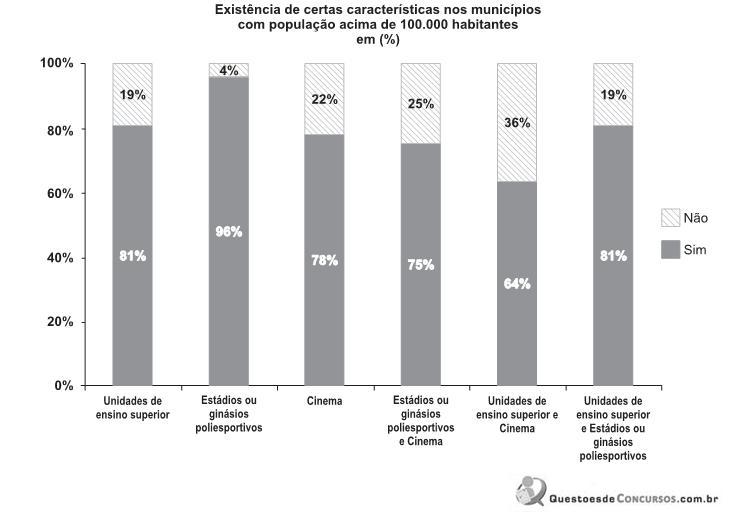
Sabe-se que 1% dos municípios com mais de 100.000 habitantes não possuem unidades de ensino superior, estádios ou ginásios poliesportivos, nem cinema. Nessa faixa de população, o número de municípios que possuem as três características, é, aproximadamente,
Faixas de população Número de municípios Até 5.000 habitantes 1.267 De 5.001 a 20.000 habitantes 2.675 De 20.001 a 100.000 habitantes 1.356 De 100.001 a 500.000 habitantes 229 Mais de 500.000 habitantes 37 Total de municípios 5.564
IBGE. Pesquisa Perfil dos Municípios Brasileiros, 2009. (Dados adaptados)
Sabe-se que 1% dos municípios com mais de 100.000 habitantes não possuem unidades de ensino superior, estádios ou ginásios poliesportivos, nem cinema. Nessa faixa de população, o número de municípios que possuem as três características, é, aproximadamente,
Ano: 2011
Banca:
CESGRANRIO
Órgão:
Transpetro
Prova:
CESGRANRIO - 2011 - Transpetro - Engenheiro Júnior - Engenharia de Produção |
Q170963
Matemática
Ano: 2011
Banca:
CESGRANRIO
Órgão:
Transpetro
Prova:
CESGRANRIO - 2011 - Transpetro - Engenheiro Júnior - Engenharia de Produção |
Q170962
Matemática
A tabela abaixo apresenta a distribuição dos equipamentos de uma grande empresa.
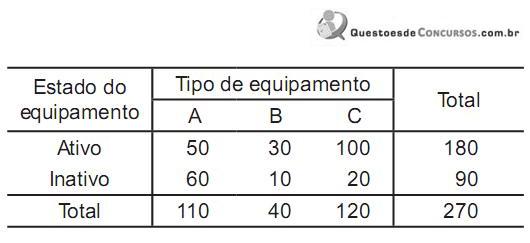
Qual é a probabilidade de que um equipamento selecionado aleatoriamente esteja inativo ou seja do tipo A?
Qual é a probabilidade de que um equipamento selecionado aleatoriamente esteja inativo ou seja do tipo A?
Ano: 2011
Banca:
CESGRANRIO
Órgão:
Transpetro
Provas:
CESGRANRIO - 2011 - Transpetro - Engenheiro Júnior - Engenharia de Produção
|
CESGRANRIO - 2011 - Transpetro - Químico de Petróleo Júnior |
Q170961
Matemática
Um dos riscos de acidentes em dutos de gás natural é de vazamento. A probabilidade de que o vazamento provoque um incêndio é de 1%. Caso não haja incêndio, o problema não acabou, pois pode ocorrer explosão de uma nuvem de gás. No caso de não haver incêndio, a probabilidade de haver explosão é de 1%.
Dado que houve um vazamento, qual é a probabilidade aproximada de não haver incêndio e não ocorrer explosão?
Dado que houve um vazamento, qual é a probabilidade aproximada de não haver incêndio e não ocorrer explosão?
Ano: 2011
Banca:
CESGRANRIO
Órgão:
Transpetro
Prova:
CESGRANRIO - 2011 - Transpetro - Engenheiro Júnior - Engenharia de Produção |
Q170960
Estatística
Considere o conjunto de dados a seguir.
60 80 80 85 85 85 85 90 90 90 90 90 100 100 100 100 100 100
O box plot correspondente a esse conjunto de dados é
60 80 80 85 85 85 85 90 90 90 90 90 100 100 100 100 100 100
O box plot correspondente a esse conjunto de dados é
Ano: 2011
Banca:
CESGRANRIO
Órgão:
Transpetro
Prova:
CESGRANRIO - 2011 - Transpetro - Engenheiro Júnior - Engenharia de Produção |
Q170959
Modelagem de Processos de Negócio (BPM)
O diagrama usado para documentar processos em gestão de produção é denominado Diagrama de Fluxo de Processo e utiliza diversos símbolos para identificar os diferentes tipos de atividades.
Nesse tipo de diagrama, qual símbolo representa a atividade de inspeção?
Nesse tipo de diagrama, qual símbolo representa a atividade de inspeção?
Ano: 2011
Banca:
CESGRANRIO
Órgão:
Transpetro
Prova:
CESGRANRIO - 2011 - Transpetro - Engenheiro Júnior - Engenharia de Produção |
Q170958
Gestão de Pessoas
Um dos desafios que se tem imposto aos responsáveis pelo recrutamento e seleção de pessoal numa empresa é, exatamente, a capacidade de atrair e reter os funcionários, particularmente aqueles mais qualificados.
Considere as afirmativas abaixo sobre os princípios que devem nortear o planejamento de pessoal, especialmente quanto à eficiência do recrutamento e seleção de pessoal.
I - O principal fator de sucesso no recrutamento e na seleção é a adequação das características e potenciais de um candidato às funções que se espera que ele desempenhe na empresa no curto, médio e longo prazos, caracterizando um processo complexo que exige uma análise sistêmica.
II - O planejamento para o recrutamento e a seleção de pessoas deve-se pautar por uma análise de curto prazo, tendo em vista que o planejamento de médio e longo prazos representam apenas metas e expectativas da empresa, fatores insu? cientes para recrutamento e seleção.
III - O recrutamento e a seleção de pessoal têm por objetivo selecionar candidatos que, além de quali? cados, sejam versáteis, trabalhem em equipe e tenham espírito de liderança, de modo que haja uma correlação intrínseca e harmônica entre o planejamento de curto, médio e longo prazos da empresa e os resultados da seleção.
Está correto APENAS o que se afirma em
Considere as afirmativas abaixo sobre os princípios que devem nortear o planejamento de pessoal, especialmente quanto à eficiência do recrutamento e seleção de pessoal.
I - O principal fator de sucesso no recrutamento e na seleção é a adequação das características e potenciais de um candidato às funções que se espera que ele desempenhe na empresa no curto, médio e longo prazos, caracterizando um processo complexo que exige uma análise sistêmica.
II - O planejamento para o recrutamento e a seleção de pessoas deve-se pautar por uma análise de curto prazo, tendo em vista que o planejamento de médio e longo prazos representam apenas metas e expectativas da empresa, fatores insu? cientes para recrutamento e seleção.
III - O recrutamento e a seleção de pessoal têm por objetivo selecionar candidatos que, além de quali? cados, sejam versáteis, trabalhem em equipe e tenham espírito de liderança, de modo que haja uma correlação intrínseca e harmônica entre o planejamento de curto, médio e longo prazos da empresa e os resultados da seleção.
Está correto APENAS o que se afirma em
Ano: 2011
Banca:
CESGRANRIO
Órgão:
Transpetro
Prova:
CESGRANRIO - 2011 - Transpetro - Engenheiro Júnior - Engenharia de Produção |
Q170957
Segurança e Saúde no Trabalho
A representação visual de um processo utilizado por divesas organizações, cuja finalidade é pôr em evidência a origem, o processamento e o destino das informações num fluxo normal do processo de trabalho, é o
Ano: 2011
Banca:
CESGRANRIO
Órgão:
Transpetro
Prova:
CESGRANRIO - 2011 - Transpetro - Engenheiro Júnior - Engenharia de Produção |
Q170956
Segurança e Saúde no Trabalho
Condições inadequadas no ambiente de trabalho contribuem para o erro humano e aumentam os riscos de acidentes. Nos locais de trabalho onde são executadas atividades que exijam solicitação intelectual e atenção constante, a NR-17 recomenda que
Ano: 2011
Banca:
CESGRANRIO
Órgão:
Transpetro
Prova:
CESGRANRIO - 2011 - Transpetro - Engenheiro Júnior - Engenharia de Produção |
Q170955
Segurança e Saúde no Trabalho
No mundo contemporâneo, o trabalho noturno passou a ser vital para diversas áreas. Algumas atividades não podem ser interrompidas, seja pelo seu caráter de imprescindibilidade, seja por razões econômicas. Entretanto, o trabalho noturno provoca desgastes ao trabalhador.
Que prática tem a finalidade de tornar o trabalho noturno menos prejudicial ao trabalhador?
Que prática tem a finalidade de tornar o trabalho noturno menos prejudicial ao trabalhador?
Ano: 2011
Banca:
CESGRANRIO
Órgão:
Transpetro
Provas:
CESGRANRIO - 2011 - Transpetro - Engenheiro Júnior - Engenharia de Produção
|
CESGRANRIO - 2011 - Transpetro - Engenheiro Júnior - Segurança |
Q170954
Segurança e Saúde no Trabalho
Visando a dar conforto ao trabalhador nos postos de trabalho, recomenda-se que
Ano: 2011
Banca:
CESGRANRIO
Órgão:
Transpetro
Prova:
CESGRANRIO - 2011 - Transpetro - Engenheiro Júnior - Engenharia de Produção |
Q170953
Segurança e Saúde no Trabalho
Na Análise Ergonômica do Trabalho (AET), as três primeiras etapas que constituem a fase de análise (demanda, atividade e tarefa) permitem realizar o diagnóstico para que se formulem as recomendações ergonômicas.
A AET constitui-se em um exemplo de ergonomia de
A AET constitui-se em um exemplo de ergonomia de
Ano: 2011
Banca:
CESGRANRIO
Órgão:
Transpetro
Prova:
CESGRANRIO - 2011 - Transpetro - Engenheiro Júnior - Engenharia de Produção |
Q170952
Engenharia de Produção
Uma empresa possui apenas uma equipe técnica e precisa determinar a sequência ótima de processamento de seis trabalhos. Em função das características dos serviços realizados e da formação da própria equipe, os trabalhos são realizados um de cada vez.
A ordem de chegada dos trabalhos na empresa foi I, II, III, IV, V e VI, conforme apresenta a tabela a seguir.
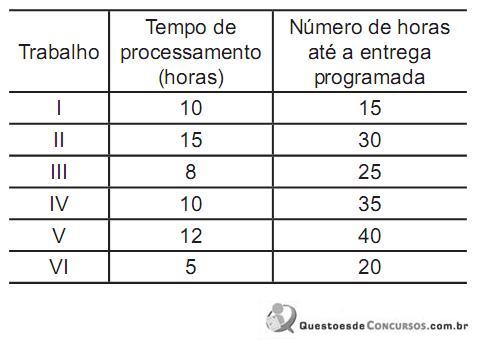
Com relação ao sequenciamento dos trabalhos, conclui-se que,
A ordem de chegada dos trabalhos na empresa foi I, II, III, IV, V e VI, conforme apresenta a tabela a seguir.
Com relação ao sequenciamento dos trabalhos, conclui-se que,

 Conheça nossos planos