Foram encontradas 11.450 questões
Resolva questões gratuitamente!
Junte-se a mais de 4 milhões de concurseiros!


O computador de certo servidor estava apresentando alguns problemas. Havia lentidão excessiva do sistema, principalmente ao abrir arquivos ou pastas que estavam ou não na rede do órgão público. Havia, também, arquivos corrompidos ou inacessíveis e mensagens de erro frequentes relacionadas à leitura ou à gravação de dados. O servidor relatou que, quando tentou inicializar o computador, escutou sons mecânicos incomuns, como cliques repetitivos.
A partir dessa situação hipotética, assinale a opção que apresenta o diagnóstico provável para esse problema.
In today’s fast‑paced business environment, hardly anything is more vital for growth and survival than innovation. And this is especially the case when it comes to technologies
IT innovation may sound like an area that’s purely the domain of IT companies, but really, it’s something that every business should be working towards. With new IT solutions coming out practically daily, it’s critical to find the ones that are going to boost operations, that are going to help companies to reach and exceed business goals. And it’s important to not just put innovative IT services in place, but to find the ones that are going to add the most value, and to find ways of using IT services in unique and innovative ways to enhance the way businesses are done.
Imagine IT innovation as a breath of fresh air into the sometimes stale corporate world, refreshing and reinvigorating business models, product development processes, and the very fabric of operational efficiency. Innovative IT breakthroughs like artificial intelligence (AI), cloud computing, or the Internet of Things (IoT), are not just buzzwords but actual business growth strategies.
The ways in which businesses can leverage innovative IT solutions are as varied as the businesses themselves. From using AI to offer personalised customer experiences, to using conversational AI as training aids for new team members, to taking advantage of platforms like Microsoft Copilot and enhancing humans’ daily workflows – the potential is limitless.
One of the real‑world IT innovation examples that showcases the power of forward‑thinking is the adoption of chatbots for customer service. With AI and natural language processing, chatbots can handle simple inquiries, freeing up human staff to tackle more complex issues. More than that, it is possible to feed chatbot information that it can learn from in turn, helping it to provide answers that are unique to a specific business. For example, it could upload responses to the most common questions received, and the chatbot will not only provide this information to potential clients and customers that ask those questions, but will adapt them to the client’s unique situation. This not only improves efficiency but also enhances the customer experience.
IT innovation doesn’t take a single form. Because there are so many different ways to take advantage of innovative technology solutions, the IT innovation types can be broadly broken down into two different categories, but even these aren’t definitive.
Businesses are always looking for ways to enhance the products and services that they offer, and using innovative IT solutions to both pinpoint new product offerings or enhance the services that companies are already specialised in can setting in an increasingly competitive market space. Using IT innovation in product development can involve finding new ways to analyse data to get more meaningful insights, finding ways to incorporate solutions into technologies like apps, smart watches, or IoT devices.
The second category of IT innovation is improving the existing processes within companies. By taking advantage of innovative technologies, they can enhance their internal operations and help the humans behind business to work smarter, not necessarily harder. This will see efficiency at an all‑time high, and more being done in less time. Some examples of ways that innovation can improve processes include using machine learning and AI to automate tasks, streamlining workflows, and both simplifying and enhancing data management.
Internet: <www.solidsystems.co.za> (adapted).
Uma empresa protocolou um requerimento no CRM‑ES solicitando providências da Administração em relação à conduta de prestadores de serviço do Conselho, que afetaram a sua esfera jurídica. Após análise, o pedido foi indeferido, sob a alegação de que a documentação apresentada era insuficiente. O departamento jurídico da empresa, discordando da decisão, decide interpor recurso administrativo.
Com base nessa situação hipotética e considerando que a decisão da Administração pode gerar sanções e que o recurso se sujeita somente às disposições da Lei nº 9.784/99, assinale a opção correta.
Um gestor público decidiu contratar diretamente uma empresa para realizar um serviço de manutenção emergencial em uma repartição, alegando urgência. Contudo, não houve, nos autos, demonstração objetiva de que a situação era imprevisível e que a demora na contratação por licitação causaria grave prejuízo ao atendimento. O gestor público foi, então, responsabilizado com base na Lei de Improbidade Administrativa.
Com base nessa situação hipotética, assinale a opção correta, acerca da conduta do gestor.
Uma herança constituída de barras de ouro foi totalmente dividida entre três irmãos: José; Pedro; e Romão. José, por ser o mais velho, recebeu a terça parte das barras de ouro, e mais uma barra e meia. Após José ter recebido a sua parte, Pedro recebeu a metade do que sobrou, e mais meia barra. Coube a Romão o restante da herança, igual a duas barras e mais três quartos de uma barra.
Com base nessa situação hipotética, o total de barras da herança era de
Em uma unidade hospitalar de certa região foi construída
uma caixa‑d’água para armazenamento de água da chuva.
Em uma visita técnica, foi constatado um vazamento por
causa de uma rachadura na estrutura dessa caixa‑d’água.
Com isso, identificou‑se que, a cada hora, o volume V de
água na caixa‑d’água, em metros cúbicos, diminuía de
acordo com a função  após t horas
do início do vazamento e considerando‑a inicialmente
cheia.
Com base nessa situação hipotética e considerando que a caixa‑d’água precisa estar completamente vazia para que seja feito o reparo da rachadura, esse reparo poderá ser feito, após o início do vazamento, depois de
Em um curso de medicina, os alunos do 8º semestre participaram de três oficinas extracurriculares: música (M); teatro (T); e matemática aplicada (MA).
Após o encerramento das atividades, a coordenação fez o seguinte levantamento:
• 15 alunos participaram da oficina de música;
• 20 alunos participaram da oficina de teatro;
• 10 alunos participaram da oficina de matemática aplicada;
• 8 alunos participaram das oficinas de música e de teatro;
• 5 alunos participaram das oficinas de música e de matemática aplicada;
• 7 alunos participaram das oficinas de teatro e de matemática aplicada; e
• 3 alunos participaram das três oficinas.
Com base nessa situação hipotética, é correto afirmar que o total de alunos que participaram de, pelo menos, uma das oficinas foi de
Um engenho utiliza 270 kg de cana para fazer 36 kg de açúcar.
Com base nessa situação hipotética e considerando que um refrigerante de 2 litros utiliza, em média, 300 gramas de açúcar na sua produção, é correto afirmar que a fábrica desse refrigerante, para produzir 60 refrigerantes por dia durante 30 dias, precisará que o engenho moa
Em um hospital, havia 5 vagas para trabalhar no laboratório, 4 no ambulatório e 6 na emergência.
Com base nessa situação hipotética, se 7 funcionários se candidatarem para o laboratório, 6 para o ambulatório e 8 para a emergência essas vagas poderão ser preenchidas, de formas distintas,
Um hospital público faz regularmente um levantamento do número de atendimentos realizados durante o dia por todos os médicos de plantão. Em um certo dia, foi gerada uma tabela, na qual se relacionaram a quantidade de médicos com a quantidade de atendimentos realizados naquele dia.
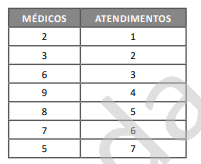
Com base nessa situação hipotética, e comparando‑se os valores da média, da mediana e da moda da distribuição das quantidades dos atendimentos realizados pelos médicos de plantão naquele dia, obter‑se‑á
 Conheça nossos planos