Foram encontradas 30.810 questões
Resolva questões gratuitamente!
Junte-se a mais de 4 milhões de concurseiros!


Leia o texto para responder a questão.
English as a Lingua Franca
A number of researchers have studied conversations in English as a Lingua Franca and have noted a number of somewhat surprising characteristics, including:
• Non-use of third person present simple tense -s (She look very sad).
• Interchangeable use of the relative pronouns who and which (a book who, a boy which).
• Omission of articles where they are mandatory in native-speaker English.
• Increasing of redundancy by adding “inexistent” prepositions (We have to study about…, The article treats of…).
• Pluralisation of nouns which are considered uncountable in native-speaker English (informations, staffs).
The evidence suggests that non-native speakers are not conforming to a native English standard. Indeed they seem to get along perfectly well despite the fact that they miss things out and put things in which they ‘should not do’. Not only this, but they are actually better at ‘accommodating’ - that is, negotiating shared meaning through helping each other in a more cooperative way - than, it is suggested, native speakers are when talking to second language speakers (Jenkins 2004). In other words, non-native speakers seem to be better at ELF communication than native speakers are.
(Jeremy Harmer, The practice of English language teaching. Adaptado)
Leia o texto para responder a questão.
English as a Lingua Franca
A number of researchers have studied conversations in English as a Lingua Franca and have noted a number of somewhat surprising characteristics, including:
• Non-use of third person present simple tense -s (She look very sad).
• Interchangeable use of the relative pronouns who and which (a book who, a boy which).
• Omission of articles where they are mandatory in native-speaker English.
• Increasing of redundancy by adding “inexistent” prepositions (We have to study about…, The article treats of…).
• Pluralisation of nouns which are considered uncountable in native-speaker English (informations, staffs).
The evidence suggests that non-native speakers are not conforming to a native English standard. Indeed they seem to get along perfectly well despite the fact that they miss things out and put things in which they ‘should not do’. Not only this, but they are actually better at ‘accommodating’ - that is, negotiating shared meaning through helping each other in a more cooperative way - than, it is suggested, native speakers are when talking to second language speakers (Jenkins 2004). In other words, non-native speakers seem to be better at ELF communication than native speakers are.
(Jeremy Harmer, The practice of English language teaching. Adaptado)
Leia o texto para responder a questão.
English as a Lingua Franca
A number of researchers have studied conversations in English as a Lingua Franca and have noted a number of somewhat surprising characteristics, including:
• Non-use of third person present simple tense -s (She look very sad).
• Interchangeable use of the relative pronouns who and which (a book who, a boy which).
• Omission of articles where they are mandatory in native-speaker English.
• Increasing of redundancy by adding “inexistent” prepositions (We have to study about…, The article treats of…).
• Pluralisation of nouns which are considered uncountable in native-speaker English (informations, staffs).
The evidence suggests that non-native speakers are not conforming to a native English standard. Indeed they seem to get along perfectly well despite the fact that they miss things out and put things in which they ‘should not do’. Not only this, but they are actually better at ‘accommodating’ - that is, negotiating shared meaning through helping each other in a more cooperative way - than, it is suggested, native speakers are when talking to second language speakers (Jenkins 2004). In other words, non-native speakers seem to be better at ELF communication than native speakers are.
(Jeremy Harmer, The practice of English language teaching. Adaptado)
Leia o texto para responder a questão.
English as a Lingua Franca
A number of researchers have studied conversations in English as a Lingua Franca and have noted a number of somewhat surprising characteristics, including:
• Non-use of third person present simple tense -s (She look very sad).
• Interchangeable use of the relative pronouns who and which (a book who, a boy which).
• Omission of articles where they are mandatory in native-speaker English.
• Increasing of redundancy by adding “inexistent” prepositions (We have to study about…, The article treats of…).
• Pluralisation of nouns which are considered uncountable in native-speaker English (informations, staffs).
The evidence suggests that non-native speakers are not conforming to a native English standard. Indeed they seem to get along perfectly well despite the fact that they miss things out and put things in which they ‘should not do’. Not only this, but they are actually better at ‘accommodating’ - that is, negotiating shared meaning through helping each other in a more cooperative way - than, it is suggested, native speakers are when talking to second language speakers (Jenkins 2004). In other words, non-native speakers seem to be better at ELF communication than native speakers are.
(Jeremy Harmer, The practice of English language teaching. Adaptado)
Leia a charge para responder a questão.
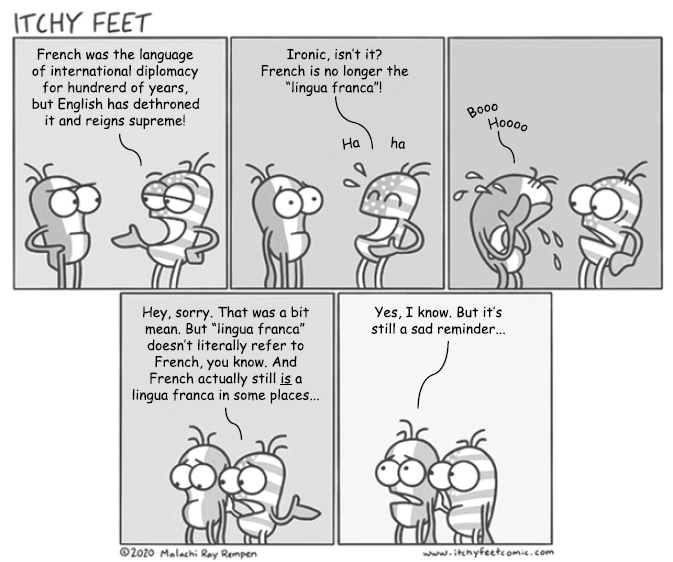
(twitter.com. Adaptado)
Leia a charge para responder a questão.
(twitter.com. Adaptado)
I. Proteger dados.
II. Filtrar a variedade de conteúdos disponíveis no ambiente virtual.
III. Saber se comportar online.
Quais estão corretas?
1. Administrar crises ou conflitos interpessoais.
2. Utilizar as ferramentas multimídias no ensino.
3. Dirigir um grupo de trabalho, conduzir reuniões.
4. Prevenir a violência na escola e fora dela.
5. Formar e renovar uma equipe pedagógica.
O resultado da somatória dos números correspondentes às informações corretas é:
Coluna 1
1. Modelos sustentados.
2. Modelos disruptivos.
Coluna 2
( ) Flex.
( ) Rotação por estação.
( ) Virtual aprimorado.
( ) Laboratório rotacional.
( ) Rotação individual.
( ) À la carte.
A ordem correta de preenchimento dos parênteses, de cima para baixo, é:
Assinale a alternativa que preenche corretamente a lacuna do trecho acima.
Coluna 1
1. Teoria Construtivista de Bruner.
2. Teoria Sócio-Cultural de Vygotsky.
3. Inteligências múltiplas (Gardner).
Coluna 2
( ) No processo de ensino, deve-se procurar identificar as inteligências mais marcantes em cada aprendiz e tentar explorá-las para atingir o objetivo final, que é o aprendizado de determinado conteúdo.
( ) Desenvolvimento cognitivo é limitado a um determinado potencial para cada intervalo de idade (ZPD); o indivíduo deve estar inserido em um grupo social e aprende o que seu grupo produz; o conhecimento surge primeiro no grupo, para só depois ser interiorizado.
( ) O aprendizado é um processo ativo, baseado em seus conhecimentos prévios e os que estão sendo estudados. O aprendiz filtra e transforma a nova informação, infere hipóteses e toma decisões.
A ordem correta de preenchimento dos parênteses, de cima para baixo, é:
 Conheça nossos planos