Foram encontradas 30.998 questões
Resolva questões gratuitamente!
Junte-se a mais de 4 milhões de concurseiros!


A name that will be familiar to any music fan, Rolling Stone has been going since 1967, and has strayed away from its rock roots, now reporting on all popular genres as well as TV, movies and culture.

Consequence of Sound is one of the best music blogs to hear about the latest music news and rumours for festivals worldwide. They also have reviews of music, film and TV.

All Music is not only a great place to get music information and recommendations, but their blog has interviews with some of the greatest musicians of all time.

The Playground is a UK-based music blog which covers most genres including indie, edm and house. The blog is also involved in some of the latest developments in the music industry as a whole.

Billboard needs no introduction, and this might be stretching the definition of blog for the purposes of this article. However, if you want to keep up with the latest news and gossip for the hottest artists and labels, this is the place to look.

This Song Is Sick has been sharing fresh new music since 2010. Here you’ll find a mix of genres, and new music from both established artists and up and coming acts. If you want to be featured on This Song Is Sick there is a submission process to send your song for consideration.

Dancing Astronaut is the place to go if you appreciate dance music. The blog reports on concerts and festivals and keeps you up to date with reviews of dance music.

Popjustice is a fun blog dedicated to all things pop. They feature news, interviews, new music, and most importantly a calendar that will tell you how long it’s been since Rihanna last released an album.
(https://audiohype.io/resources/best-music-blogs/)
A name that will be familiar to any music fan, Rolling Stone has been going since 1967, and has strayed away from its rock roots, now reporting on all popular genres as well as TV, movies and culture.
Consequence of Sound is one of the best music blogs to hear about the latest music news and rumours for festivals worldwide. They also have reviews of music, film and TV.
All Music is not only a great place to get music information and recommendations, but their blog has interviews with some of the greatest musicians of all time.
The Playground is a UK-based music blog which covers most genres including indie, edm and house. The blog is also involved in some of the latest developments in the music industry as a whole.
Billboard needs no introduction, and this might be stretching the definition of blog for the purposes of this article. However, if you want to keep up with the latest news and gossip for the hottest artists and labels, this is the place to look.
This Song Is Sick has been sharing fresh new music since 2010. Here you’ll find a mix of genres, and new music from both established artists and up and coming acts. If you want to be featured on This Song Is Sick there is a submission process to send your song for consideration.
Dancing Astronaut is the place to go if you appreciate dance music. The blog reports on concerts and festivals and keeps you up to date with reviews of dance music.
Popjustice is a fun blog dedicated to all things pop. They feature news, interviews, new music, and most importantly a calendar that will tell you how long it’s been since Rihanna last released an album.
(https://audiohype.io/resources/best-music-blogs/)
A name that will be familiar to any music fan, Rolling Stone has been going since 1967, and has strayed away from its rock roots, now reporting on all popular genres as well as TV, movies and culture.
Consequence of Sound is one of the best music blogs to hear about the latest music news and rumours for festivals worldwide. They also have reviews of music, film and TV.
All Music is not only a great place to get music information and recommendations, but their blog has interviews with some of the greatest musicians of all time.
The Playground is a UK-based music blog which covers most genres including indie, edm and house. The blog is also involved in some of the latest developments in the music industry as a whole.
Billboard needs no introduction, and this might be stretching the definition of blog for the purposes of this article. However, if you want to keep up with the latest news and gossip for the hottest artists and labels, this is the place to look.
This Song Is Sick has been sharing fresh new music since 2010. Here you’ll find a mix of genres, and new music from both established artists and up and coming acts. If you want to be featured on This Song Is Sick there is a submission process to send your song for consideration.
Dancing Astronaut is the place to go if you appreciate dance music. The blog reports on concerts and festivals and keeps you up to date with reviews of dance music.
Popjustice is a fun blog dedicated to all things pop. They feature news, interviews, new music, and most importantly a calendar that will tell you how long it’s been since Rihanna last released an album.
(https://audiohype.io/resources/best-music-blogs/)
A name that will be familiar to any music fan, Rolling Stone has been going since 1967, and has strayed away from its rock roots, now reporting on all popular genres as well as TV, movies and culture.
Consequence of Sound is one of the best music blogs to hear about the latest music news and rumours for festivals worldwide. They also have reviews of music, film and TV.
All Music is not only a great place to get music information and recommendations, but their blog has interviews with some of the greatest musicians of all time.
The Playground is a UK-based music blog which covers most genres including indie, edm and house. The blog is also involved in some of the latest developments in the music industry as a whole.
Billboard needs no introduction, and this might be stretching the definition of blog for the purposes of this article. However, if you want to keep up with the latest news and gossip for the hottest artists and labels, this is the place to look.
This Song Is Sick has been sharing fresh new music since 2010. Here you’ll find a mix of genres, and new music from both established artists and up and coming acts. If you want to be featured on This Song Is Sick there is a submission process to send your song for consideration.
Dancing Astronaut is the place to go if you appreciate dance music. The blog reports on concerts and festivals and keeps you up to date with reviews of dance music.
Popjustice is a fun blog dedicated to all things pop. They feature news, interviews, new music, and most importantly a calendar that will tell you how long it’s been since Rihanna last released an album.
(https://audiohype.io/resources/best-music-blogs/)
Ao propor tal tarefa, o professor estará contribuindo para o desenvolvimento da seguinte estratégia de leitura:
Register appropriateness is observed in alternative:
Leia os dois excertos a seguir para responder à questão:
A BNCC prioriza o foco da função social e política da língua inglesa e, nesse sentido, passa a tratá-la em seu status de língua franca. Nessa perspectiva, são acolhidos e legitimados os usos que dela fazem falantes espalhados no mundo inteiro, com diferentes repertórios linguísticos e culturais, o que possibilita, por exemplo, questionar a visão de que o único inglês “correto” – e a ser ensinado – é aquele falado por estadunidenses ou britânicos. Mais ainda, o tratamento do inglês como língua franca o desvincula da noção de pertencimento a um determinado território e, consequentemente, a culturas típicas de comunidades específicas, legitimando os usos da língua inglesa em seus contextos locais. Esse entendimento favorece uma educação linguística voltada para a interculturalidade.
(BRASIL. Base Nacional Comum Curricular. 2019. Adaptado)
Em uma entrevista, o linguista Kanavilil Rajagopalan afirma que “A língua inglesa, já há um bom tempo, deixou de ser propriedade desse ou daquele país. Em sua condição de língua internacional, a língua falada hoje por quase um terço dos seres humanos do planeta, não faz o menor sentido falarmos em falantes nativos. Essa língua, esse “fenômeno linguístico”, na verdade pertence a todos que dela fazem algum uso no seu dia a dia, por mais restrito que ele seja (como ouvir música ou ler manuais de instrução). Como professores de inglês, é nosso dever preparar nossos alunos para serem cidadãos do mundo novo que se descortina diante de nossos olhos. Para atuar nesse admirável mundo novo, os nossos alunos têm de aprender a lidar com todas as formas de inglês.”
(RAJAGOPALAN, K. O inglês como língua internacional na prática docente. In: LIMA, D.C. (Org.). Ensino e aprendizagem. São Paulo: Parábola Editorial, 2009. pp. 39; 41; 45. Adaptado)
Leia os dois excertos a seguir para responder à questão:
A BNCC prioriza o foco da função social e política da língua inglesa e, nesse sentido, passa a tratá-la em seu status de língua franca. Nessa perspectiva, são acolhidos e legitimados os usos que dela fazem falantes espalhados no mundo inteiro, com diferentes repertórios linguísticos e culturais, o que possibilita, por exemplo, questionar a visão de que o único inglês “correto” – e a ser ensinado – é aquele falado por estadunidenses ou britânicos. Mais ainda, o tratamento do inglês como língua franca o desvincula da noção de pertencimento a um determinado território e, consequentemente, a culturas típicas de comunidades específicas, legitimando os usos da língua inglesa em seus contextos locais. Esse entendimento favorece uma educação linguística voltada para a interculturalidade.
(BRASIL. Base Nacional Comum Curricular. 2019. Adaptado)
Em uma entrevista, o linguista Kanavilil Rajagopalan afirma que “A língua inglesa, já há um bom tempo, deixou de ser propriedade desse ou daquele país. Em sua condição de língua internacional, a língua falada hoje por quase um terço dos seres humanos do planeta, não faz o menor sentido falarmos em falantes nativos. Essa língua, esse “fenômeno linguístico”, na verdade pertence a todos que dela fazem algum uso no seu dia a dia, por mais restrito que ele seja (como ouvir música ou ler manuais de instrução). Como professores de inglês, é nosso dever preparar nossos alunos para serem cidadãos do mundo novo que se descortina diante de nossos olhos. Para atuar nesse admirável mundo novo, os nossos alunos têm de aprender a lidar com todas as formas de inglês.”
(RAJAGOPALAN, K. O inglês como língua internacional na prática docente. In: LIMA, D.C. (Org.). Ensino e aprendizagem. São Paulo: Parábola Editorial, 2009. pp. 39; 41; 45. Adaptado)
No atual cenário escolar, é possível observar que as TIC são introduzidas nas salas de aula como recursos que facilitam o processo de ensino e aprendizagem das diferentes disciplinas, bem como favorecem a obtenção do conhecimento em uma língua estrangeira, como é o caso da língua inglesa (Magalhães; Machado; Silva, 2015). Deste modo, o grande desafio dos professores de línguas estrangeiras do século XXI implica saber usufruir dessas ferramentas para potencializar o desenvolvimento, em seus alunos, das competências e habilidades em um segundo idioma.
(NASCIMENTO, H. C. M. Tecnologias de informação e comunicação como ferramentas facilitadoras do processo de ensino e aprendizagem da Língua Inglesa. Revista Educação Pública, v. 21, no 15, 2021)
The digital revolution is far more significant than potential for humans to learn new ways of thinking and organizing social structures.
(DEMA, O., MOELLER, A. K. Teaching culture in the 21st century language classroom. SILDUS, T. (ed.). Touch the World: Selected Papers from the 2012 Central States Conference on the Teaching of Foreign Languages. Eau Claire: Crown Prints)
Os dois excertos destacam a relevância, nos tempos atuais, do desenvolvimento
Leia o texto a seguir para responder à questão:
In the Star Trek universe, the audience occasionally gets a glimpse inside schools on the planet Vulcan. Young children stand alone in “capsules” surrounded by 360-degree digital screens. Adults walk around but do not talk to the students. Instead, each child interacts only with a sophisticated artificial intelligence (AI). Although this is not the reality in today’s classrooms on Earth, there are people for whom a vision of personalized learning conducted by artificial intelligence has considerable appeal.
Individualized learning has its place. But decades of educational research also demonstrate that learning is essentially a social endeavor. Classrooms that privilege personalized AI chatbots overlook that fact.
Generative AI is quickly coming to classrooms. If decades ago educators worldwide promoted the benefits of “One Laptop per Child”, today we may be approaching the model “one chatbot per child.” What does educational research tell us about what this model could mean for children’s learning and well-being?
During much of the 20th century, learning was understood as mainly as a matter of individual cognition. A misconception, if compared to today’s comprehension of what learning involves. Scientists now understand that apparently individual processes – such as building new knowledge – are actually social interactions with the world around us. In classrooms, this suggests that opportunities for daily personal interaction can strongly support brain health and academic learning.
Therefore, it is important to understand generative AI’s real-life impact on students.
For example: How does it feel to learn from a chatbot, day after day? How will long-term use of AI affect children’s mental health? How does AI use affect children’s relationships with each other and with their teachers? What kinds of relationships might children form with the chatbots themselves? More broadly, we could also ask: What do we, as a society, actually want children to learn?
Good teaching and learning blends social and individual processes. I see the beneficial application of any new technology in the classroom – AI or otherwise – as a way to build upon the social fabric of human learning. My concern about personalized AI tutors is how they might displace already infrequent opportunities for social interaction, further isolating children in classrooms.
(Niral Shah. www.converstion.com, 15.12.2025. Adaptado)
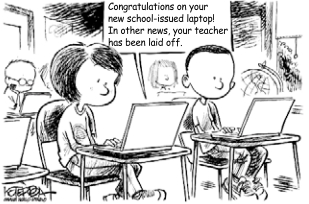
Compare os conteúdos do texto e da charge a seguir:
(https://larrycuban.wordpress.com)
A imagem e as palavras na charge retratam a hipótese receada pelo autor do texto, qual seja,
Leia o texto a seguir para responder à questão:
In the Star Trek universe, the audience occasionally gets a glimpse inside schools on the planet Vulcan. Young children stand alone in “capsules” surrounded by 360-degree digital screens. Adults walk around but do not talk to the students. Instead, each child interacts only with a sophisticated artificial intelligence (AI). Although this is not the reality in today’s classrooms on Earth, there are people for whom a vision of personalized learning conducted by artificial intelligence has considerable appeal.
Individualized learning has its place. But decades of educational research also demonstrate that learning is essentially a social endeavor. Classrooms that privilege personalized AI chatbots overlook that fact.
Generative AI is quickly coming to classrooms. If decades ago educators worldwide promoted the benefits of “One Laptop per Child”, today we may be approaching the model “one chatbot per child.” What does educational research tell us about what this model could mean for children’s learning and well-being?
During much of the 20th century, learning was understood as mainly as a matter of individual cognition. A misconception, if compared to today’s comprehension of what learning involves. Scientists now understand that apparently individual processes – such as building new knowledge – are actually social interactions with the world around us. In classrooms, this suggests that opportunities for daily personal interaction can strongly support brain health and academic learning.
Therefore, it is important to understand generative AI’s real-life impact on students.
For example: How does it feel to learn from a chatbot, day after day? How will long-term use of AI affect children’s mental health? How does AI use affect children’s relationships with each other and with their teachers? What kinds of relationships might children form with the chatbots themselves? More broadly, we could also ask: What do we, as a society, actually want children to learn?
Good teaching and learning blends social and individual processes. I see the beneficial application of any new technology in the classroom – AI or otherwise – as a way to build upon the social fabric of human learning. My concern about personalized AI tutors is how they might displace already infrequent opportunities for social interaction, further isolating children in classrooms.
(Niral Shah. www.converstion.com, 15.12.2025. Adaptado)
A post-reading discussion aimed at encouraging participants to critically react to the author’s views on the topic could include their reflecting on
Leia o texto a seguir para responder à questão:
In the Star Trek universe, the audience occasionally gets a glimpse inside schools on the planet Vulcan. Young children stand alone in “capsules” surrounded by 360-degree digital screens. Adults walk around but do not talk to the students. Instead, each child interacts only with a sophisticated artificial intelligence (AI). Although this is not the reality in today’s classrooms on Earth, there are people for whom a vision of personalized learning conducted by artificial intelligence has considerable appeal.
Individualized learning has its place. But decades of educational research also demonstrate that learning is essentially a social endeavor. Classrooms that privilege personalized AI chatbots overlook that fact.
Generative AI is quickly coming to classrooms. If decades ago educators worldwide promoted the benefits of “One Laptop per Child”, today we may be approaching the model “one chatbot per child.” What does educational research tell us about what this model could mean for children’s learning and well-being?
During much of the 20th century, learning was understood as mainly as a matter of individual cognition. A misconception, if compared to today’s comprehension of what learning involves. Scientists now understand that apparently individual processes – such as building new knowledge – are actually social interactions with the world around us. In classrooms, this suggests that opportunities for daily personal interaction can strongly support brain health and academic learning.
Therefore, it is important to understand generative AI’s real-life impact on students.
For example: How does it feel to learn from a chatbot, day after day? How will long-term use of AI affect children’s mental health? How does AI use affect children’s relationships with each other and with their teachers? What kinds of relationships might children form with the chatbots themselves? More broadly, we could also ask: What do we, as a society, actually want children to learn?
Good teaching and learning blends social and individual processes. I see the beneficial application of any new technology in the classroom – AI or otherwise – as a way to build upon the social fabric of human learning. My concern about personalized AI tutors is how they might displace already infrequent opportunities for social interaction, further isolating children in classrooms.
(Niral Shah. www.converstion.com, 15.12.2025. Adaptado)
The five direct questions in the fifth paragraph have been rewritten as indirect questions.
The only correct pair of sentences is found in alternative:
Leia o texto a seguir para responder à questão:
In the Star Trek universe, the audience occasionally gets a glimpse inside schools on the planet Vulcan. Young children stand alone in “capsules” surrounded by 360-degree digital screens. Adults walk around but do not talk to the students. Instead, each child interacts only with a sophisticated artificial intelligence (AI). Although this is not the reality in today’s classrooms on Earth, there are people for whom a vision of personalized learning conducted by artificial intelligence has considerable appeal.
Individualized learning has its place. But decades of educational research also demonstrate that learning is essentially a social endeavor. Classrooms that privilege personalized AI chatbots overlook that fact.
Generative AI is quickly coming to classrooms. If decades ago educators worldwide promoted the benefits of “One Laptop per Child”, today we may be approaching the model “one chatbot per child.” What does educational research tell us about what this model could mean for children’s learning and well-being?
During much of the 20th century, learning was understood as mainly as a matter of individual cognition. A misconception, if compared to today’s comprehension of what learning involves. Scientists now understand that apparently individual processes – such as building new knowledge – are actually social interactions with the world around us. In classrooms, this suggests that opportunities for daily personal interaction can strongly support brain health and academic learning.
Therefore, it is important to understand generative AI’s real-life impact on students.
For example: How does it feel to learn from a chatbot, day after day? How will long-term use of AI affect children’s mental health? How does AI use affect children’s relationships with each other and with their teachers? What kinds of relationships might children form with the chatbots themselves? More broadly, we could also ask: What do we, as a society, actually want children to learn?
Good teaching and learning blends social and individual processes. I see the beneficial application of any new technology in the classroom – AI or otherwise – as a way to build upon the social fabric of human learning. My concern about personalized AI tutors is how they might displace already infrequent opportunities for social interaction, further isolating children in classrooms.
(Niral Shah. www.converstion.com, 15.12.2025. Adaptado)
Leia o texto a seguir para responder à questão:
In the Star Trek universe, the audience occasionally gets a glimpse inside schools on the planet Vulcan. Young children stand alone in “capsules” surrounded by 360-degree digital screens. Adults walk around but do not talk to the students. Instead, each child interacts only with a sophisticated artificial intelligence (AI). Although this is not the reality in today’s classrooms on Earth, there are people for whom a vision of personalized learning conducted by artificial intelligence has considerable appeal.
Individualized learning has its place. But decades of educational research also demonstrate that learning is essentially a social endeavor. Classrooms that privilege personalized AI chatbots overlook that fact.
Generative AI is quickly coming to classrooms. If decades ago educators worldwide promoted the benefits of “One Laptop per Child”, today we may be approaching the model “one chatbot per child.” What does educational research tell us about what this model could mean for children’s learning and well-being?
During much of the 20th century, learning was understood as mainly as a matter of individual cognition. A misconception, if compared to today’s comprehension of what learning involves. Scientists now understand that apparently individual processes – such as building new knowledge – are actually social interactions with the world around us. In classrooms, this suggests that opportunities for daily personal interaction can strongly support brain health and academic learning.
Therefore, it is important to understand generative AI’s real-life impact on students.
For example: How does it feel to learn from a chatbot, day after day? How will long-term use of AI affect children’s mental health? How does AI use affect children’s relationships with each other and with their teachers? What kinds of relationships might children form with the chatbots themselves? More broadly, we could also ask: What do we, as a society, actually want children to learn?
Good teaching and learning blends social and individual processes. I see the beneficial application of any new technology in the classroom – AI or otherwise – as a way to build upon the social fabric of human learning. My concern about personalized AI tutors is how they might displace already infrequent opportunities for social interaction, further isolating children in classrooms.
(Niral Shah. www.converstion.com, 15.12.2025. Adaptado)
During much of the 20th century, learning was understood mainly as a matter of individual cognition. In contrast, scientists now understand that apparently individual processes – such as building new knowledge – are actually social interactions with the world around us. In classrooms, this suggests that opportunities for daily personal interaction can strongly support brain health and academic learning. (paragraph 4)

 Conheça nossos planos