Questões de Concurso
Para seduc-mt
Foram encontradas 1.628 questões
Resolva questões gratuitamente!
Junte-se a mais de 4 milhões de concurseiros!


Ano: 2025
Banca:
FGV
Órgão:
SEDUC-MT
Prova:
FGV - 2025 - SEDUC-MT - Professor de Educação Básica - Habilitação: Inglês |
Q3439627
Inglês
A father earns the gratitude of his children by nurturing them
to be preeminent in the Assembly of the Learned.
Thirukural, verse 67, circa 100 A.D. in: KUMARAVADIVELU, B. 2003.
Regular verbs ending in voiced sounds are pronounced with the sound /d/ in the simple past and past perfect, and so are most adjectives with the same form. However, the word “Learned”, present in the quotation above, has a distinctive pronunciation feature when functioning as an adjective or a noun: /ˈlɜːnɪd/. Among the words below, choose the one that follows the same characteristic of pronunciation when used in such functions.
Thirukural, verse 67, circa 100 A.D. in: KUMARAVADIVELU, B. 2003.
Regular verbs ending in voiced sounds are pronounced with the sound /d/ in the simple past and past perfect, and so are most adjectives with the same form. However, the word “Learned”, present in the quotation above, has a distinctive pronunciation feature when functioning as an adjective or a noun: /ˈlɜːnɪd/. Among the words below, choose the one that follows the same characteristic of pronunciation when used in such functions.
Ano: 2025
Banca:
FGV
Órgão:
SEDUC-MT
Prova:
FGV - 2025 - SEDUC-MT - Professor de Educação Básica - Habilitação: Inglês |
Q3439626
Inglês
Texto associado
Leia o texto a seguir para responder à próxima questão.
Because the culture of any community has many facets and
manifestations, it would be practically impossible to deal with all
of them in the classroom and prepare students for the many
situations that they might encounter in the course of their
functioning in ESL/EFL environments. However, many important
aspects of teaching the second culture can be brought forth and
addressed via classroom instruction, and some of these are
discussed here. The most important long-term benefits of
teaching culture may be to provide learners with the awareness
and the tools that will allow them to achieve their academic,
professional, social, and personal goals and become successful in
their daily functioning in L2 environments.
CELCE-MURCIA, M. et alii. Teaching English as a Second or Foreign
Language. 4th ed. USA, Cengage Learning (2013). Adaptado.
In the part of the text “the awareness and the tools that will
allow them to achieve their academic, professional, social, and
personal goals” the bolded portion is
Ano: 2025
Banca:
FGV
Órgão:
SEDUC-MT
Prova:
FGV - 2025 - SEDUC-MT - Professor de Educação Básica - Habilitação: Inglês |
Q3439625
Inglês
Texto associado
Leia o texto a seguir para responder à próxima questão.
Because the culture of any community has many facets and
manifestations, it would be practically impossible to deal with all
of them in the classroom and prepare students for the many
situations that they might encounter in the course of their
functioning in ESL/EFL environments. However, many important
aspects of teaching the second culture can be brought forth and
addressed via classroom instruction, and some of these are
discussed here. The most important long-term benefits of
teaching culture may be to provide learners with the awareness
and the tools that will allow them to achieve their academic,
professional, social, and personal goals and become successful in
their daily functioning in L2 environments.
CELCE-MURCIA, M. et alii. Teaching English as a Second or Foreign
Language. 4th ed. USA, Cengage Learning (2013). Adaptado.
In the excerpt “and some of these are discussed below”, the
referent of the word in bold is
Ano: 2025
Banca:
FGV
Órgão:
SEDUC-MT
Prova:
FGV - 2025 - SEDUC-MT - Professor de Educação Básica - Habilitação: Inglês |
Q3439624
Inglês
Texto associado
Leia o texto a seguir para responder à próxima questão.
Because the culture of any community has many facets and
manifestations, it would be practically impossible to deal with all
of them in the classroom and prepare students for the many
situations that they might encounter in the course of their
functioning in ESL/EFL environments. However, many important
aspects of teaching the second culture can be brought forth and
addressed via classroom instruction, and some of these are
discussed here. The most important long-term benefits of
teaching culture may be to provide learners with the awareness
and the tools that will allow them to achieve their academic,
professional, social, and personal goals and become successful in
their daily functioning in L2 environments.
CELCE-MURCIA, M. et alii. Teaching English as a Second or Foreign
Language. 4th ed. USA, Cengage Learning (2013). Adaptado.
O conectivo em negrito no trecho retirado do texto “Because the
culture of any community has many facets and manifestations”
pode ser substituído, sem alteração de significado ou estrutura
da frase, por
Ano: 2025
Banca:
FGV
Órgão:
SEDUC-MT
Prova:
FGV - 2025 - SEDUC-MT - Professor de Educação Básica - Habilitação: Inglês |
Q3439623
Inglês
Read the following exchange:
A: Why was the king only able to draw straight lines?
B: Because he is a ruler.
Humor is caused by a linguistic property named
A: Why was the king only able to draw straight lines?
B: Because he is a ruler.
Humor is caused by a linguistic property named
Ano: 2025
Banca:
FGV
Órgão:
SEDUC-MT
Prova:
FGV - 2025 - SEDUC-MT - Professor de Educação Básica - Habilitação: Inglês |
Q3439622
Pedagogia
Em uma turma de Ensino Fundamental, o professor de inglês
decide trabalhar o gênero “notícia” como parte de um projeto
interdisciplinar. Antes de construir seu planejamento, consulta a
Base Nacional Comum Curricular (BNCC) para melhor
compreender as orientações que o documento oferece para o
trabalho com gêneros textuais na disciplina de língua inglesa.
Após a leitura do documento, o professor sente-se mais seguro para fazer sua proposta de atividade, que inclui três etapas:
I. A leitura de notícias recentes em português, sobre o Brasil, selecionadas pelo professor. O objetivo inicial é que estudantes ampliem seus horizontes sobre o que acontece ao seu redor no país. As primeiras tarefas na unidade buscam a identificação do gênero – por que foi escrito, onde, e para quem.
II. A transposição de uma das notícias lidas para o inglês, em um trabalho de grupo. Dentre as notícias em português analisadas, cada grupo seleciona uma de seu particular interesse, e a reescreve em inglês, simplificando-a para que se ajuste ao seu conhecimento da língua inglesa.
III. A revisão de erros produzidos pelos estudantes durante a escrita de seu texto em inglês. Partindo dos erros apresentam-se os aspectos linguísticos e de organização textual que caracterizam o gênero notícia e que devem ser respeitados em qualquer produção de texto no gênero.
O conteúdo da BNCC sobre o trabalho com gêneros textuais em língua inglesa permite avaliar as etapas propostas pelo professor e compreender como pertinentes as ponderações contidas na alternativa indicada a seguir.
Após a leitura do documento, o professor sente-se mais seguro para fazer sua proposta de atividade, que inclui três etapas:
I. A leitura de notícias recentes em português, sobre o Brasil, selecionadas pelo professor. O objetivo inicial é que estudantes ampliem seus horizontes sobre o que acontece ao seu redor no país. As primeiras tarefas na unidade buscam a identificação do gênero – por que foi escrito, onde, e para quem.
II. A transposição de uma das notícias lidas para o inglês, em um trabalho de grupo. Dentre as notícias em português analisadas, cada grupo seleciona uma de seu particular interesse, e a reescreve em inglês, simplificando-a para que se ajuste ao seu conhecimento da língua inglesa.
III. A revisão de erros produzidos pelos estudantes durante a escrita de seu texto em inglês. Partindo dos erros apresentam-se os aspectos linguísticos e de organização textual que caracterizam o gênero notícia e que devem ser respeitados em qualquer produção de texto no gênero.
O conteúdo da BNCC sobre o trabalho com gêneros textuais em língua inglesa permite avaliar as etapas propostas pelo professor e compreender como pertinentes as ponderações contidas na alternativa indicada a seguir.
Ano: 2025
Banca:
FGV
Órgão:
SEDUC-MT
Prova:
FGV - 2025 - SEDUC-MT - Professor de Educação Básica - Habilitação: Inglês |
Q3439621
Inglês
Texto associado
Leia o texto e responda à próxima questão.
Powerful storm knocks out power to 1.4 million homes in
Brazil’s largest city
SAO PAULO (AP) — Around 1.4 million households in Sao
Paulo, Brazil, were without power on Saturday almost 24 hours
after a brief but powerful storm swept through South America’s
largest metropolis. At least seven people were killed.
Officials in Sao Paulo state said that record winds of up to 67
mph (108 kph) knocked down transmission lines and destroyed
trees, causing severe damage in some parts. The storm also shut
down several airports and interrupted water service in several
areas, according to the state government.
Authorities originally expected to restore power within a few
hours. But several neighborhoods in the metropolitan area, which
is home to 21 million people, were still in the dark on Saturday,
and authorities were urging residents to limit their consumption
of water.
https://apnews.com. Adaptado. Acesso em 24.04.2025
Even before they start reading the text “Powerful storm knocks
out power to 1.4 million homes in Brazil’s largest city”, some
students say they will not be able to understand it. And
immediately mention the words “knock”, “households” and
“swept”, in the headline and the first paragraph.
The literature about teaching reading in a second language mentions a variety of methods and approaches to deal with unknown vocabulary. Materials and teachers may instruct learners to
I. make use of the dictionary: they will not understand the text properly if they do not know all the words in it.
II. look for the pronunciation of the unknown words: the association between sound and spelling always helps comprehension.
III. ignore vocabulary difficulties and focus on grammar: meaning does not derive from words in isolation but from sentence structures.
IV. Pay attention to context and appeal to background knowledge on the subject: making inferences is key to learning a new language.
V. Concentrate on text meaning rather than word meaning: words may be ignored if not essential to the comprehension of the text’s main points.
A teacher interested in developing their students’ use of reading strategies will, in a reading class with the text “Powerful storm knocks out power to 1.4 million homes in Brazil’s largest city”, focus on the instructions given in items
The literature about teaching reading in a second language mentions a variety of methods and approaches to deal with unknown vocabulary. Materials and teachers may instruct learners to
I. make use of the dictionary: they will not understand the text properly if they do not know all the words in it.
II. look for the pronunciation of the unknown words: the association between sound and spelling always helps comprehension.
III. ignore vocabulary difficulties and focus on grammar: meaning does not derive from words in isolation but from sentence structures.
IV. Pay attention to context and appeal to background knowledge on the subject: making inferences is key to learning a new language.
V. Concentrate on text meaning rather than word meaning: words may be ignored if not essential to the comprehension of the text’s main points.
A teacher interested in developing their students’ use of reading strategies will, in a reading class with the text “Powerful storm knocks out power to 1.4 million homes in Brazil’s largest city”, focus on the instructions given in items
Ano: 2025
Banca:
FGV
Órgão:
SEDUC-MT
Prova:
FGV - 2025 - SEDUC-MT - Professor de Educação Básica - Habilitação: Inglês |
Q3439620
Inglês
Texto associado
Leia o texto e responda à próxima questão.
Powerful storm knocks out power to 1.4 million homes in
Brazil’s largest city
SAO PAULO (AP) — Around 1.4 million households in Sao
Paulo, Brazil, were without power on Saturday almost 24 hours
after a brief but powerful storm swept through South America’s
largest metropolis. At least seven people were killed.
Officials in Sao Paulo state said that record winds of up to 67
mph (108 kph) knocked down transmission lines and destroyed
trees, causing severe damage in some parts. The storm also shut
down several airports and interrupted water service in several
areas, according to the state government.
Authorities originally expected to restore power within a few
hours. But several neighborhoods in the metropolitan area, which
is home to 21 million people, were still in the dark on Saturday,
and authorities were urging residents to limit their consumption
of water.
https://apnews.com. Adaptado. Acesso em 24.04.2025
While preparing reading comprehension exercises on the text,
the teacher notes the absolute predominance of verbs in the
simple past. However, this is not a language class, but a reading
one, and the teacher wouldn’t like to deal with the topic “verbs”
in isolation, as followers of structuralism would do. This way, in
trying to articulate reading comprehension and linguistic
knowledge, in a class on the text “Powerful storm knocks out
power to 1.4 million homes in Brazil’s largest city”, the teacher
Ano: 2025
Banca:
FGV
Órgão:
SEDUC-MT
Prova:
FGV - 2025 - SEDUC-MT - Professor de Educação Básica - Habilitação: Inglês |
Q3439619
Inglês
Texto associado
Leia o texto e responda à próxima questão.
Powerful storm knocks out power to 1.4 million homes in
Brazil’s largest city
SAO PAULO (AP) — Around 1.4 million households in Sao
Paulo, Brazil, were without power on Saturday almost 24 hours
after a brief but powerful storm swept through South America’s
largest metropolis. At least seven people were killed.
Officials in Sao Paulo state said that record winds of up to 67
mph (108 kph) knocked down transmission lines and destroyed
trees, causing severe damage in some parts. The storm also shut
down several airports and interrupted water service in several
areas, according to the state government.
Authorities originally expected to restore power within a few
hours. But several neighborhoods in the metropolitan area, which
is home to 21 million people, were still in the dark on Saturday,
and authorities were urging residents to limit their consumption
of water.
https://apnews.com. Adaptado. Acesso em 24.04.2025
Um professor encontra essa notícia, publicada imediatamente
após uma tempestade haver devastado a cidade de São Paulo.
Suponha que esse professor considere pertinente trabalhar a
notícia com sua turma do 1º ano do Ensino Médio que vem
desenvolvendo um projeto interdisciplinar intitulado “Mudanças
climáticas: efeitos sentidos no Brasil”. Consciente de que o
reconhecimento do contexto de produção favorece o processo de
compreensão do tema tratado, o professor propõe, como
primeira atividade de sua aula de leitura,
Ano: 2025
Banca:
FGV
Órgão:
SEDUC-MT
Prova:
FGV - 2025 - SEDUC-MT - Professor de Educação Básica - Habilitação: Inglês |
Q3439618
Pedagogia
Leia os excertos de dois textos - o primeiro, de um texto
acadêmico; o segundo, de uma publicação jornalística online.
A particular method can be imposed on teachers by others. However, we also know that teaching is more than following a recipe. Any method is going to be shaped by a teacher's own understanding, beliefs, style, and level of experience.
LARSEN FREEMAN, D. Techniques and principles in language teaching. 2th ed. Oxford: Oxford University Press, 2000. Adaptado.
In teaching, “fidelity” refers to closely following specific procedures for how to teach a lesson or respond to student behavior. For example, following a curriculum to fidelity might mean a teacher is required to teach from a designated page in a guidebook on a specific day. However, teachers should observe their students and try to help them – regardless of whether their decisions align with a prescribed curriculum.
http://theconversation.com, 11.12.2024. Adaptado
Observe agora a seguinte situação:
Em uma escola da zona rural, a norma da direção é que o material didático seja seguido à risca. A unidade 5 de um livro de inglês de abordagem estruturalista adotado para o sexto ano traz um texto com orientações sobre como atravessar a rua no trânsito movimentado em cidades grandes. A unidade inclui tarefas de identificação de informações específicas e exercícios de reconhecimento de palavras e estruturas. Os estudantes não compreendem o conteúdo do texto, e se desinteressam pela aula.
Um professor de inglês que adequadamente compreendesse a exposição nos dois excertos, e ao mesmo tempo desejasse cumprir as normas da escola, frente à situação descrita
A particular method can be imposed on teachers by others. However, we also know that teaching is more than following a recipe. Any method is going to be shaped by a teacher's own understanding, beliefs, style, and level of experience.
LARSEN FREEMAN, D. Techniques and principles in language teaching. 2th ed. Oxford: Oxford University Press, 2000. Adaptado.
In teaching, “fidelity” refers to closely following specific procedures for how to teach a lesson or respond to student behavior. For example, following a curriculum to fidelity might mean a teacher is required to teach from a designated page in a guidebook on a specific day. However, teachers should observe their students and try to help them – regardless of whether their decisions align with a prescribed curriculum.
http://theconversation.com, 11.12.2024. Adaptado
Observe agora a seguinte situação:
Em uma escola da zona rural, a norma da direção é que o material didático seja seguido à risca. A unidade 5 de um livro de inglês de abordagem estruturalista adotado para o sexto ano traz um texto com orientações sobre como atravessar a rua no trânsito movimentado em cidades grandes. A unidade inclui tarefas de identificação de informações específicas e exercícios de reconhecimento de palavras e estruturas. Os estudantes não compreendem o conteúdo do texto, e se desinteressam pela aula.
Um professor de inglês que adequadamente compreendesse a exposição nos dois excertos, e ao mesmo tempo desejasse cumprir as normas da escola, frente à situação descrita
Ano: 2025
Banca:
FGV
Órgão:
SEDUC-MT
Prova:
FGV - 2025 - SEDUC-MT - Professor de Educação Básica - Habilitação: Inglês |
Q3439617
Inglês
Em uma sala de nono ano com 40 estudantes, o professor está
revisando as preposições de tempo in, on, at, um dos temas da
prova bimestral. Coloca na lousa cinco frases com lacunas, que
devem ser preenchidas com a preposição adequada. Veja a seguir
um quadro com as frases dadas pelo professor, e o número de
estudantes que escolheu cada opção de resposta:
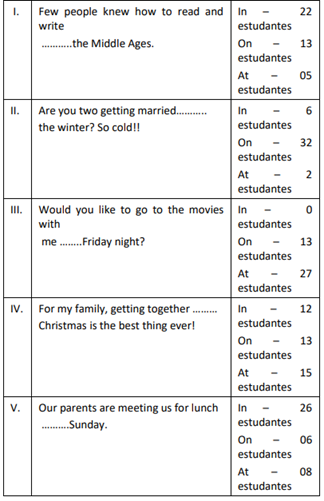
Das intervenções a seguir, que procuram apontar os desvios na execução da tarefa, está correta aquela em que o professor esclarece
Das intervenções a seguir, que procuram apontar os desvios na execução da tarefa, está correta aquela em que o professor esclarece
Ano: 2025
Banca:
FGV
Órgão:
SEDUC-MT
Prova:
FGV - 2025 - SEDUC-MT - Professor de Educação Básica - Habilitação: Inglês |
Q3439616
Inglês
Leia o texto.
Usage and use
The distinction between language use and language usage was first made by Widdowson. He coined the term usage for language which conformed to pre-established paradigms of language. Usage is independent of context, and is related to language correctness.
In contrast, use has to do with the speaker’s intention in producing a particular sentence. For example, the sentence “I don’t know what you mean”, said in a particular context, may imply a request for clarification; the same sentence, said in a different way and in a different context, may be an expression of disbelief.
Most sentences in textbooks and in grammar practices are well-formed sentences. However, can you think of a real-life situation in which a sentence such as “This is my hand” is pronounced?
LEWIS, Michael. The lexical approach. Heinle Cengage, 2010. Adaptado.
Em muitos contextos da escola brasileira permanece forte a herança da tradição estruturalista, focada em usage. Pense em um professor brasileiro formado dentro de tal tradição que, percebendo seus limites para desenvolver a capacidade de o estudante interagir no mundo por meio da língua inglesa, começa a preparar suas aulas sob a ótica de uma abordagem centrada em use. Esse professor, ao final de uma atividade em classe, perguntar-se-ia em primeiro lugar se, em sua aula,
Usage and use
The distinction between language use and language usage was first made by Widdowson. He coined the term usage for language which conformed to pre-established paradigms of language. Usage is independent of context, and is related to language correctness.
In contrast, use has to do with the speaker’s intention in producing a particular sentence. For example, the sentence “I don’t know what you mean”, said in a particular context, may imply a request for clarification; the same sentence, said in a different way and in a different context, may be an expression of disbelief.
Most sentences in textbooks and in grammar practices are well-formed sentences. However, can you think of a real-life situation in which a sentence such as “This is my hand” is pronounced?
LEWIS, Michael. The lexical approach. Heinle Cengage, 2010. Adaptado.
Em muitos contextos da escola brasileira permanece forte a herança da tradição estruturalista, focada em usage. Pense em um professor brasileiro formado dentro de tal tradição que, percebendo seus limites para desenvolver a capacidade de o estudante interagir no mundo por meio da língua inglesa, começa a preparar suas aulas sob a ótica de uma abordagem centrada em use. Esse professor, ao final de uma atividade em classe, perguntar-se-ia em primeiro lugar se, em sua aula,
Ano: 2025
Banca:
FGV
Órgão:
SEDUC-MT
Prova:
FGV - 2025 - SEDUC-MT - Professor de Educação Básica - Habilitação: Inglês |
Q3439615
Pedagogia
Júlia sente-se satisfeita porque, cada vez mais, compreende quais
propostas realizar para que seus estudantes consigam se
comunicar em inglês na sala de aula, e mesmo fora dela. Alcança
alguns sucessos; enfrenta algumas dificuldades... Sua
preocupação agora recai sobre questões de avaliação. Como
enfrentar o “erro” dentro dessa nova concepção sobre ensino de
línguas em que está adentrando? Novamente busca textos e
referências a respeito; suas leituras levam-na a compreender
que, sob a perspectiva do ensino comunicativo de línguas, deverá
Ano: 2025
Banca:
FGV
Órgão:
SEDUC-MT
Prova:
FGV - 2025 - SEDUC-MT - Professor de Educação Básica - Habilitação: Inglês |
Q3439614
Pedagogia
Júlia is a public school teacher who has only recently discovered
an interest in developing her students’ communicative abilities in
the English Language. As she does not know much about
Communicative Language Teaching (CLT), she is always looking
for texts and authors that talk about the approach. One of the
texts she particularly prefers is this short excerpt:
The interest of a soccer game lies of course not in the ball, but in the moves and strategies of the players as they kick, pass, and fake their way along the field. The interest of communication lies similarly in the moves and strategies of the participants. The terms that best represent the collaborative nature of what goes on are interpretation, expression, and negotiation of meaning.
(SAVINGON, Sandra. Communicative language teaching for the twenty-first century. IN: Marianne Celce-Murcia. 3r ed. Teaching English as a second or foreign language. Boston, MA: Heinle&Heinle. 3rd edition. 2002. Adaptado.)
In her search for a better comprehension of CLT, Julia invites the other English teachers in her school to study the topic together and create classroom proposals accordingly. From the five proposals designed by Júlia’s group of teachers, select the one which best reflects the CLT teaching principles.
The interest of a soccer game lies of course not in the ball, but in the moves and strategies of the players as they kick, pass, and fake their way along the field. The interest of communication lies similarly in the moves and strategies of the participants. The terms that best represent the collaborative nature of what goes on are interpretation, expression, and negotiation of meaning.
(SAVINGON, Sandra. Communicative language teaching for the twenty-first century. IN: Marianne Celce-Murcia. 3r ed. Teaching English as a second or foreign language. Boston, MA: Heinle&Heinle. 3rd edition. 2002. Adaptado.)
In her search for a better comprehension of CLT, Julia invites the other English teachers in her school to study the topic together and create classroom proposals accordingly. From the five proposals designed by Júlia’s group of teachers, select the one which best reflects the CLT teaching principles.
Ano: 2025
Banca:
FGV
Órgão:
SEDUC-MT
Prova:
FGV - 2025 - SEDUC-MT - Professor de Educação Básica - Habilitação: Inglês |
Q3439613
Inglês
Leia o texto.
Transfer is a general term referring to the application of prior skills or knowledge to subsequent learning. While positive transfer benefits the learning task, “negative transfer” or “interference” disrupts learning. In language learning, the learner’s mother tongue is an obvious set of previous experiences, and a most common source of interference errors. Observe os pares de frases que seguem. A versão em português foi fornecida pela professora. A tradução foi feita por um dos estudantes. Nas traduções, observa-se a interferência do português.
I. Aconteceu um milagre com o velho casal que finalmente reencontrou seu filho! Happened a miracle with the old couple who finally met their son again!
II. Ele realmente não compreendeu nada do que eu lhe contei.
He really did not understand nothing of what I told him.
III. As informações sobre novos temporais são todas muito preocupantes.
The informations about new storms are all very disturbing.
IV. A menina ficou extremamente feliz com seu novo corte de cabelo!
The girl stayed extremely happy with her new haircut!
V. A mãe comemorou o novo emprego com seu marido e filhos.
The mother celebrated the new job with your husband and friends.
Enquanto corrige a tarefa, a professora escreve um breve comentário ao lado de cada frase traduzida. Assinale a alternativa que contém uma observação correta sobre a tradução realizada pelo estudante.
Transfer is a general term referring to the application of prior skills or knowledge to subsequent learning. While positive transfer benefits the learning task, “negative transfer” or “interference” disrupts learning. In language learning, the learner’s mother tongue is an obvious set of previous experiences, and a most common source of interference errors. Observe os pares de frases que seguem. A versão em português foi fornecida pela professora. A tradução foi feita por um dos estudantes. Nas traduções, observa-se a interferência do português.
I. Aconteceu um milagre com o velho casal que finalmente reencontrou seu filho! Happened a miracle with the old couple who finally met their son again!
II. Ele realmente não compreendeu nada do que eu lhe contei.
He really did not understand nothing of what I told him.
III. As informações sobre novos temporais são todas muito preocupantes.
The informations about new storms are all very disturbing.
IV. A menina ficou extremamente feliz com seu novo corte de cabelo!
The girl stayed extremely happy with her new haircut!
V. A mãe comemorou o novo emprego com seu marido e filhos.
The mother celebrated the new job with your husband and friends.
Enquanto corrige a tarefa, a professora escreve um breve comentário ao lado de cada frase traduzida. Assinale a alternativa que contém uma observação correta sobre a tradução realizada pelo estudante.
Ano: 2025
Banca:
FGV
Órgão:
SEDUC-MT
Prova:
FGV - 2025 - SEDUC-MT - Professor de Educação Básica - Habilitação: Inglês |
Q3439612
Inglês
In order to decide on the objectives for the unit on the blog
“Science News for Students”, the teacher resorts to the following
chart on learning strategies.
Learning Strategies
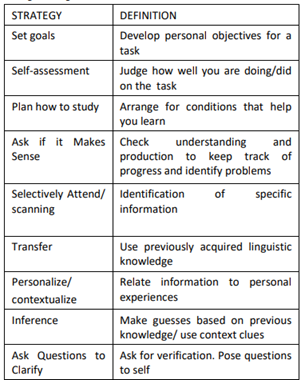
CHAMOT, Anna et al. The learning strategies handbook: creating independent learners. New York: Longman, 1999. Adaptado.
Apart from teaching reading in English, the teacher is also highly concerned with developing their students’ autonomy as learners. Considering that the option for the blog Science News for Students resulted from negotiation between the group and not necessarily from individual interests, the teacher will help promote their students’ autonomy if, for the work with the blog, proposes that they
Learning Strategies
CHAMOT, Anna et al. The learning strategies handbook: creating independent learners. New York: Longman, 1999. Adaptado.
Apart from teaching reading in English, the teacher is also highly concerned with developing their students’ autonomy as learners. Considering that the option for the blog Science News for Students resulted from negotiation between the group and not necessarily from individual interests, the teacher will help promote their students’ autonomy if, for the work with the blog, proposes that they
Ano: 2025
Banca:
FGV
Órgão:
SEDUC-MT
Prova:
FGV - 2025 - SEDUC-MT - Professor de Educação Básica - Habilitação: Inglês |
Q3439611
Inglês
An English teacher asks their group of 16-year-old students to
read the internet post “Top 10 Educational Blogs for Teens” and
decide on one of the blogs to follow during the semester. After
going through the material, the group chooses blog #6 Science
News for Students, which is introduced as follows:
#6 Science News for Students
Created by the Society for Science, this blog is dedicated to promoting a love for science in teenagers by presenting complex topics in a clear and understandable manner. It covers a wide range of scientific subjects, from biology and chemistry to astronomy and environmental science.
What is so special about Science News for Students is its well-written, easy-to-understand content that not only informs but also inspires. It gives young learners the opportunity to stay updated on the latest scientific advancements, encouraging their curiosity and critical thinking.
https://www.nshss.org/resources/blog/blog-posts/top-10-educationalblogs-for-teens. Acesso em 22.04.2025. Adaptado.
The purpose of the teacher to have the students read the whole post and then choose one particular blog to follow is that they develop a more fluent reading in English. The instruction provided – “Quickly go through the blogs in the post to have a general idea of their content and then decide which one you would like to follow” – focuses on the development of the reading ability named.
#6 Science News for Students
Created by the Society for Science, this blog is dedicated to promoting a love for science in teenagers by presenting complex topics in a clear and understandable manner. It covers a wide range of scientific subjects, from biology and chemistry to astronomy and environmental science.
What is so special about Science News for Students is its well-written, easy-to-understand content that not only informs but also inspires. It gives young learners the opportunity to stay updated on the latest scientific advancements, encouraging their curiosity and critical thinking.
https://www.nshss.org/resources/blog/blog-posts/top-10-educationalblogs-for-teens. Acesso em 22.04.2025. Adaptado.
The purpose of the teacher to have the students read the whole post and then choose one particular blog to follow is that they develop a more fluent reading in English. The instruction provided – “Quickly go through the blogs in the post to have a general idea of their content and then decide which one you would like to follow” – focuses on the development of the reading ability named.
Ano: 2025
Banca:
FGV
Órgão:
SEDUC-MT
Prova:
FGV - 2025 - SEDUC-MT - Professor de Educação Básica - Habilitação: Inglês |
Q3439610
Pedagogia
Leia o texto.
You might think of assessing and testing as synonymous terms, but they are not. Let’s differentiate the two concepts.
In educational practice, assessment is an ongoing process that includes a wide range of methodological techniques. Whenever a student responds to a question, offers a comment, or tries a new word or structure, the teacher subconsciously analyses the student’s performance. Written work—from a simple sentence to a formal essay—is a performance that ultimately is “judged” by self, teacher, and possibly other students. Reading and listening activities usually require some sort of productive performance that the teacher observes and then implicitly evaluates. A good teacher never ceases to assess students, whether those assessments are incidental or intended.
Tests, on the other hand, are prepared administrative procedures that occur at identifiable times in a curriculum, when learners know that their responses are being measured and evaluated.
BROWN, H .Douglas. Principles of language learning and teaching. 5th ed. Longman, 2000. Adaptado.
Uma professora de Inglês recém-formada, desejosa de melhor compreender o desempenho de seus estudantes adolescentes no dia a dia de suas aulas, demonstrará ter compreendido adequadamente o conceito de ‘assessment’ proposto no texto se, para alcançar seu objetivo,
You might think of assessing and testing as synonymous terms, but they are not. Let’s differentiate the two concepts.
In educational practice, assessment is an ongoing process that includes a wide range of methodological techniques. Whenever a student responds to a question, offers a comment, or tries a new word or structure, the teacher subconsciously analyses the student’s performance. Written work—from a simple sentence to a formal essay—is a performance that ultimately is “judged” by self, teacher, and possibly other students. Reading and listening activities usually require some sort of productive performance that the teacher observes and then implicitly evaluates. A good teacher never ceases to assess students, whether those assessments are incidental or intended.
Tests, on the other hand, are prepared administrative procedures that occur at identifiable times in a curriculum, when learners know that their responses are being measured and evaluated.
BROWN, H .Douglas. Principles of language learning and teaching. 5th ed. Longman, 2000. Adaptado.
Uma professora de Inglês recém-formada, desejosa de melhor compreender o desempenho de seus estudantes adolescentes no dia a dia de suas aulas, demonstrará ter compreendido adequadamente o conceito de ‘assessment’ proposto no texto se, para alcançar seu objetivo,
Ano: 2025
Banca:
FGV
Órgão:
SEDUC-MT
Prova:
FGV - 2025 - SEDUC-MT - Professor de Educação Básica - Habilitação: Inglês |
Q3439609
Inglês
Texto associado
Leia o seguinte texto que corresponde a uma adaptação de um
excerto da Base Nacional Comum Curricular, Brasil, e responda
à próxima questão.
Na perspectiva do ensino de Inglês como Língua Franca, são
acolhidos e legitimados os usos que dela fazem falantes
espalhados no mundo inteiro, com diferentes repertórios
linguísticos e culturais, o que possibilita, por exemplo, questionar
a visão de que o único inglês “correto” – e a ser ensinado – é
aquele falado por estadunidenses ou britânicos. Mais ainda, o
tratamento do inglês como língua franca o desvincula da noção
de pertencimento a um determinado território e,
consequentemente, a culturas típicas de comunidades
específicas, legitimando os usos da língua inglesa em seus
contextos locais. Esse entendimento favorece uma educação
linguística voltada para a interculturalidade, isto é, para o
reconhecimento das (e o respeito às) diferenças, e para a
compreensão de como elas são produzidas nas diversas práticas
sociais de linguagem, o que favorece a reflexão crítica sobre
diferentes modos de ver e de analisar o mundo, o(s) outro(s) e a
si mesmo.
In a certain school in the state of Mato Grosso, the English coordinator determines all English teachers should prepare lessons and activities that incorporate the theme “interculturality”.
Only one of the teachers seems to have adequately understood what the term means, and what BNCC says about ways in which it could be dealt with in the classroom. Mark the alternative describing the proposal by this particular teacher.
Ano: 2025
Banca:
FGV
Órgão:
SEDUC-MT
Prova:
FGV - 2025 - SEDUC-MT - Professor de Educação Básica - Habilitação: Inglês |
Q3439608
Pedagogia
Texto associado
Leia o seguinte texto que corresponde a uma adaptação de um
excerto da Base Nacional Comum Curricular, Brasil, e responda
à próxima questão.
Na perspectiva do ensino de Inglês como Língua Franca, são
acolhidos e legitimados os usos que dela fazem falantes
espalhados no mundo inteiro, com diferentes repertórios
linguísticos e culturais, o que possibilita, por exemplo, questionar
a visão de que o único inglês “correto” – e a ser ensinado – é
aquele falado por estadunidenses ou britânicos. Mais ainda, o
tratamento do inglês como língua franca o desvincula da noção
de pertencimento a um determinado território e,
consequentemente, a culturas típicas de comunidades
específicas, legitimando os usos da língua inglesa em seus
contextos locais. Esse entendimento favorece uma educação
linguística voltada para a interculturalidade, isto é, para o
reconhecimento das (e o respeito às) diferenças, e para a
compreensão de como elas são produzidas nas diversas práticas
sociais de linguagem, o que favorece a reflexão crítica sobre
diferentes modos de ver e de analisar o mundo, o(s) outro(s) e a
si mesmo.
Qual das seguintes estratégias de ensino aborda de maneira
central a ênfase curricular que se depreende deste texto?

 Conheça nossos planos