Foram encontradas 4.316 questões
Resolva questões gratuitamente!
Junte-se a mais de 4 milhões de concurseiros!


What Swales has stated is seemingly clear that genre has a number of characteristic and features such as a) genre has a particular communication event, b) genre has a specific goal (goal oriented), c) genre is different and various in accordance to its typical features, d) each genre has a matter of limitation and rules including content, physical form, and shape, and e) every genre belongs to a certain discourse community. In line with discourse community, (Widdoson, 2007) adds that genre is shaped or existing due to the existing discourse community. It is a fact that different discourse community has different genre. Talking about discourse community and genre in connection to the discourse community, Swales (1990), as cited by (Ohoiwutun, 1996), clarifies that characteristics of discourse community in terms of the usage of language in social context is a) a certain discourse community has certain communication goals approved, b) the discourse community communicate within its members, c) a certain discourse community use a certain pattern of communication for its members, d) the discourse community tends to have more than one types of genre to communicate , and e) the discourse community, at last gains a number specific register. (p.45)
Dirgeyasa, I Wy. Genre-Based Approach: What and How to Teach and to Learn Writing. English Language Teaching; Vol. 9, No. 9; 2016
"How does TBI (Task Based Instruction) in practice differ from more traditional teaching approaches? Recall our earlier discussion above of the principles of a P-P-P lesson or teaching format: Presentation: The new grammar structure is presented, often by means of a conversation or short text. The teacher explains the new structure and checks students' comprehension of it. Practice: Students practice using the new structure in a controlled context, through drills or substitution exercises. Production: Students practice using the new structure in different contexts often using their own content or information, in order to develop fluency with the new pattern. Advocates of TBI reject this model on the basis that (a) it doesn't work; and (b) it doesn't reflect current understanding of second language acquisition. They claim that students do not develop fluency or progress in their grammatical development through a P-P-P methodology."
"As well as rethinking the nature of a syllabus, the new communicative approach to teaching prompted a rethinking of classroom teaching methodology. It was argued that learners learn a language through the process of communicating in it, and that communication that is meaningful to the learner provides a better opportunity for learning than through a grammar-based approach. [...] "In applying these principles in the classroom, new classroom techniques and activities were needed, and as we saw above, new roles for teachers and learners in the classroom. Instead of making use of activities that demanded accurate repetition and memorization of sentences and grammatical patterns, activities that required learners to negotiate meaning and to interact meaningfully were required."
( ) Make real communication is the focus of language learning. ( ) Provide opportunities for learners to experiment and try out what they know. ( ) Use drills to make students awareness of language grammar. ( ) Be tolerant of learners' errors as they indicate that the learner is building up his or her communicative competence. ( ) Focus on receptive skills more than productive skills. ( ) Provide opportunities for learners to develop both accuracy and fluency. ( ) Link the different skills such as speaking, reading, and listening together, since they usually occur so in the real world. ( ) Use controlled activities for developing students language learning.
Match the elements to their subelements of method according to Richards & Rodgers (1986) in Brown (2000).
(1) Approach (2) Design (3 ) Procedure
( ) a theory of native language. ( ) a theory of the nature of language learning. ( ) the general and the specific objectives of a method. ( ) a syllabus model. ( ) types of learning and teaching activities. ( ) learner roles. ( ) teacher roles. ( ) the role of instructional material. ( ) classrooms techniques, practices, and behaviors observed when the method is used.
Now choose the correct sequence:
Read the text and choose the correct answer.
English learners and the four skills
When it comes to English language skills, reading is the most frequent activity - among those that already study and those that intend to, 76% read frequently. Many however, report difficulties with conversation and listening - even among those that have already studied or are studying English. The respondents' selfassessments show that the greatest difference between those that have studied or are currently studying English and those that intend to in the future is the skill of 'listening'. Those intending to study English considered this the area that they are least proficient in. The perception that their speaking ability is insufficient led the participants to cite speaking (50% of respondents) and listening (37% of respondents) among the skills that are most important to develop in a course. This is perceived to be more important than grammar. The preferred methods of teaching tend to be those that stimulate conversation; respondents prefer classes in English that "force" the development of the students' abilities. Respondents tended to think that this conversation should be stimulated before going in-depth into language and grammar rules. To them, the best way of practicing this is discussing current affairs directly relevant to their professional and personal lives. The reduced importance placed on writing and reading relative to speaking is also attributable to the availability of tools for written communication.
Frequency of use of English skill

BRITISH COUNCIL. Learning English in Brazil: Understanding the aims and expectations of the Brazilian emerging middle classes. 1 st Edition, São Paulo.
2014 (p.22)
Considere M uma matriz quadrada de ordem 4, cujos elementos são números reais. Se det(M) = 0 , ou seja,
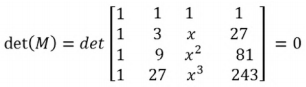
Pode-se afirmar que o resultado da equação é:
Sobre as transformações lineares, considere: V e U dois espaços vetoriais sobre K (K = ℝ ou K = ℂ) e uma transformação linear F :V → U . Analise as seguintes asserções:
I - Um isomorfismo de V sobre U é uma transformação linear bijetora V sobre U;
II - F é singular, se existe v ∈ V sendo v ≠ 0 , mas F(v) = 0;
III - O posto de F, (p (F)), é definido como sendo a dimensão de sua imagem;
IV - Um operador linear sobre V é uma transformação linear de V em V;
V - Se U = V e dim(V) < +∞, temos que: F é inversível ⇔ F é singular ⇔ F é sobrejetora.
Acerca dessas asserções, assinale a afirmativa CORRETA:
Dado o conjunto S ≠ Ø de V , consideremos o conjunto de todas as combinações lineares de vetores de S:
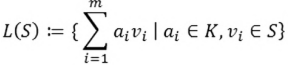
Nessas condições, julgue as seguintes asserções:
I - L(S) é um subespaço de V que contém S;
II - Existe um único subespaço de V que contém S, que contém );
III - L(S) está contido em todo subespaço de V que contém S;
IV- O vetor nulo de V pertence a S.
Acerca dessas asserções, assinale a afirmativa CORRETA:
Sobre a transformação linear T : M (2,2) → ℝ4 , dada por

É CORRETO dizer que:
Considere as asserções:
I. A função ƒ: ℝ → ℝ, definida por ƒ(x) = 2x - 5 tem como função inversa ƒ-1: ℝ → ℝ, definida
por  .
.
II. A função ƒ: ℝ - {3} → ℝ — {-1}, definida por  admite a função inversa ƒ: ℝ - {3} → ℝ — {-1 } por
  .
.
III. A função ƒ: [0, +∞) → [0, +∞), definida por ƒ(x) =x2 tem como inversa a função g: [0, +∞) → [0, +∞), dada por g(x) = √x .
IV. A função ƒ: ℝ → ℝ, definida por y = 2x - 5 tem como inversa a função ƒ-1: ℝ → ℝ , definida por  .
.
Acerca dessas asserções, assinale a afirmativa CORRETA:
Considere n ∈ ℕ , n ≥ 1 . O valor de S pode ser dado por:
S = 1 .12 + 3.22 + 5.32 + 7.42 + ••• + (2. n - 1). n2
Considere as seguintes definições acerca das cônicas A, B e C:
I - Definição da Cônica A: Sejam F1 e F2 dois pontos pertencentes a um plano π. O lugar geométrico do ponto P pertencente a π, cujo módulo da diferença das distâncias de P a F1 e P a F2 é igual a uma constante r, com r menor que a distância entre F1 e F2, é chamado de A de focos F1 e F2, ou seja,
A = {P: |d(P,F1) - d(P,F2)| = r}
II - Definição da Cônica B: Sejam F1 e F2 dois pontos pertencentes a um plano π. O lugar geométrico do ponto P pertencente a π, onde a soma das distâncias de P a F1 e P a F2 é igual a uma constante r, com r maior que a distância entre F1 e F2, é chamado de B de focos F1 e F2, ou seja,
B={P : d(P , F1) + d(P ,F2) = r}
III- Definição da Cônica C: Sejam  uma reta e F um ponto do plano não pertencente a
  . O lugar
geométrico C de foco F e diretriz
. O lugar
geométrico C de foco F e diretriz  é o lugar geométrico dos pontos do plano cuja distância ao ponto
F é igual a sua distância a reta
é o lugar geométrico dos pontos do plano cuja distância ao ponto
F é igual a sua distância a reta  , ou seja,
C ={P : d (P, F) = d(P,  )}
)}
De acordo com as definições acima, é correto dizer que:
Sejam X ⊂ ℝ um conjunto de números reais, ƒ: X → ℝ uma função real cujo domínio é X e a ∈ X ' um ponto de acumulação do conjunto X. Negar que o número real L é limite de ƒ(x) quando x tende para a , equivale a dizer que:
I - ∀ ∈ > 0 ∃δ > 0; x ∈ X, 0 < | x — a| < 8 ⇒ |ƒ(x) — L| < ∈.
II - Existe um número ∈ > 0 com a seguinte propriedade: seja qual for δ > 0, pode-se sempre achar xδ ∈ X tal que 0 < |xδ — a| < δ e |ƒ(xδ) — L| ≥ ∈.
III - ∀∈ ≥ 0 ∃δ ≥ 0; x ∈ X, 0 ≤ |x — a| ≤ δ ⇒ |ƒ(x) — L| ≤ ∈.
IV - Existe um número ∈ ≥ 0 com a seguinte propriedade: seja qual for δ ≥ 0, pode-se sempre achar xδ ∈ X tal que 0 ≤ |xδ — a| ≤ δ e |ƒ(xδ) — L| ≤ ∈.
Pode-se concluir que:
Considere que x = x0 e y = y0 seja a solução do sistema de equações lineares:
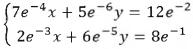
Nesse caso, se x0 e y0 são os dois primeiros termos de uma progressão geométrica crescente, então, o
terceiro termo dessa progressão será igual a:
Numa progressão geométrica de razão q, sabe-se que:
I - A soma dos logaritmos naturais dos três primeiros termos é igual a 36;
II - O produto do logaritmo natural do primeiro termo com o logaritmo natural da razão é 27.
Se  é um número inteiro, então o termo a2.019, vale:

 Conheça nossos planos