Questões de Concurso
Para seduc-ro
Foram encontradas 1.034 questões
Resolva questões gratuitamente!
Junte-se a mais de 4 milhões de concurseiros!


Durante a análise histopatológica de biópsias obtidas de diferentes órgãos de um mamífero adulto, um patologista observou as seguintes características microscópicas:
amostra I: células justapostas, com reduzida matriz extracelular, presença de junções celulares especializadas e repouso sobre uma lâmina basal; ausência de vasos sanguíneos;
amostra II: abundante matriz extracelular rica em fibras colágenas, presença de vasos sanguíneos e células dispersas, incluindo fibroblastos e macrófagos;
amostra III: células alongadas, organizadas em feixes paralelos, com presença de estriações transversais e núcleos periféricos múltiplos;
amostra IV: células ramificadas, com estriações menos evidentes, núcleos centrais e presença de discos intercalares.
Marque a alternativa que identifica corretamente os tecidos correspondentes às amostras analisadas e associa adequadamente suas características estruturais às respectivas funções fisiológicas.
A origem da vida na Terra constitui um dos temas centrais da Biologia e da Ciência moderna, sendo abordada por diferentes hipóteses científicas que buscam explicar a transição da matéria não viva para sistemas capazes de metabolismo, reprodução e evolução. Ao longo do século XX e início do XXI, avanços na química prebiótica, na biologia molecular e na astrobiologia contribuíram para o refinamento dessas hipóteses.
No âmbito das principais hipóteses científicas sobre a origem da vida, bem como de suas bases experimentais, limitações e evidências, assinale a alternativa INCORRETA.
Durante um inventário biológico em uma área de transição entre Mata Atlântica e Cerrado, pesquisadores identificaram quatro organismos (A, B, C e D), cujas principais características evolutivas estão resumidas a seguir.
Com base em análises morfológicas e moleculares, foi proposto o cladograma a seguir, no qual os caracteres derivados (sinapomorfias) surgem na sequência evolutiva correta.
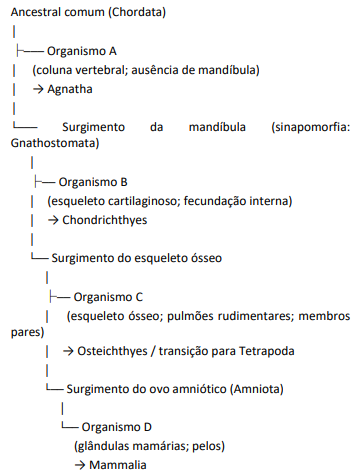
Considerando os princípios da classificação biológica moderna, a leitura de cladogramas, a hierarquia taxonômica e a nomenclatura científica, analise as afirmativas a seguir.
I. O organismo A pertence a um grupo parafilético quando comparado aos demais organismos do estudo.
II. O organismo B compartilha um ancestral comum mais recente com C do que com A, em razão do surgimento da mandíbula como sinapomorfia.
III. O organismo D está inserido em um clado monofilético definido pela presença do ovo amniótico, sendo este caráter compartilhado também com répteis e aves.
IV. Em termos de hierarquia taxonômica, todos os organismos analisados pertencem obrigatoriamente ao mesmo reino, filo e classe.
V. A nomenclatura científica do organismo D deve obedecer ao sistema binomial, sendo escrita em latim, com o gênero iniciado por letra maiúscula e a espécie por letra minúscula.
Estão corretas as afirmativas:
Em uma região caracterizada por intensa atividade agroindustrial, expansão urbana desordenada e uso recorrente de combustíveis fósseis, estudos ambientais de longo prazo identificaram alterações simultâneas em ecossistemas terrestres e aquáticos. Os dados indicaram aumento da concentração atmosférica de gases de efeito estufa, acidificação de corpos hídricos, mudanças na disponibilidade de nutrientes no solo e episódios recorrentes de eutrofização em lagos e reservatórios.
Esses fenômenos foram associados a modificações nos fluxos e reservatórios de diferentes elementos químicos essenciais à vida, evidenciando a natureza interdependente dos ciclos biogeoquímicos e a influência direta das atividades humanas sobre seus equilíbrios dinâmicos.
Nesse contexto, analise as afirmativas a seguir.
I. A intensificação das atividades industriais e do desmatamento altera o ciclo do carbono ao reduzir a taxa de fixação de CO₂ por organismos fotossintetizantes e aumentar sua liberação para a atmosfera, afetando diretamente o balanço energético do planeta.
II. O aumento da aplicação de fertilizantes nitrogenados interfere no ciclo do nitrogênio, ampliando a lixiviação de nitratos para ambientes aquáticos e contribuindo para processos de eutrofização e para a contaminação de aquíferos.
III. Diferentemente do carbono e do nitrogênio, o ciclo do fósforo é classificado como predominantemente sedimentar, não apresentando fase gasosa relevante, o que limita a velocidade de sua circulação entre os compartimentos ambientais.
IV. A emissão de óxidos de enxofre e nitrogênio pela queima de combustíveis fósseis pode resultar na formação de ácidos fortes na atmosfera, intensificando a acidificação de solos e águas, sem, contudo, interferir nos demais ciclos biogeoquímicos.
V. A eutrofização resulta do excesso de nutrientes, sobretudo fósforo e nitrogênio, provocando proliferação de organismos fotossintetizantes, aumento da respiração microbiana e consequente redução do oxigênio dissolvido, com impactos severos sobre a biodiversidade aquática.
Estão corretas as afirmativas:
Durante o acompanhamento pré-natal de uma gestação humana, exames de imagem e análises histológicas revelaram alterações no desenvolvimento embrionário precoce. Observou-se formação adequada do blastocisto e implantação correta no endométrio, porém foram identificadas anormalidades na diferenciação de determinados tecidos, associadas a alterações nos anexos embrionários responsáveis pelas trocas metabólicas materno-fetais.
O esquema a seguir apresenta uma visão integrada do desenvolvimento embrionário:
Fecundação
↓
Segmentação
↓
Blastocisto
↓
Nidação
↓
Gastrulação → Folhetos germinativos
↓
Neurulação
↓
Desenvolvimento dos órgãos
↓
Atuação dos anexos embrionários
Em um laboratório de microbiologia, pesquisadores analisaram a dinâmica de infecção de um bacteriófago em culturas de Escherichia coli submetidas a diferentes condições ambientais. Em condições padrão, observou-se integração estável do genoma viral ao DNA bacteriano, sem morte celular imediata. No entanto, após exposição das culturas à radiação ultravioleta e a agentes químicos que induzem dano ao DNA, ocorreu aumento súbito da produção de partículas virais completas, seguido por lise massiva das células bacterianas.
As partículas virais isoladas apresentavam ácido nucleico de fita dupla envolto por um capsídeo proteico com simetria complexa, além de estruturas especializadas para reconhecimento e penetração na célula hospedeira.
Para auxiliar a interpretação dessa situação, segue a tabela de comparação entre os ciclos:
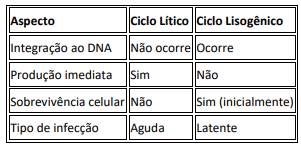
Qual mecanismo explica, de forma mais adequada, a transição observada no ciclo replicativo do vírus e suas consequências para a célula hospedeira?
Em uma família extensa, duas características genéticas humanas independentes são estudadas durante um programa de aconselhamento genético:
Sabe-se que:
1. Um casal (Geração II) é fenotipicamente normal para a doença recessiva, porém ambos têm irmãos afetados, e nenhum dos dois manifesta a característica dominante.
2. Esse casal teve um filho (Geração III) que não apresenta a doença recessiva, mas manifesta a característica dominante.
3. Não há ligação gênica entre os loci analisados, e os genes segregam de forma independente.
Qual é a probabilidade de que, em uma nova gestação, esse casal gere um descendente que seja simultaneamente portador da doença recessiva e fenotipicamente normal para a característica dominante?
Durante a avaliação funcional de células eucarióticas submetidas a diferentes condições fisiológicas e experimentais, observou-se que alterações específicas na disponibilidade de certos componentes químicos celulares resultaram em mudanças estruturais e metabólicas relevantes. Em um experimento hipotético, culturas celulares foram expostas: (i) à redução da concentração intracelular de água e íons essenciais; (ii) à modificação da composição lipídica das membranas; (iii) à inativação de cofatores vitamínicos; e (iv) à interferência na expressão gênica e na síntese proteica. Essas alterações impactaram diretamente processos como reconhecimento celular, transporte transmembranar, atividade enzimática, manutenção do potencial eletroquímico e regulação do metabolismo energético.
Levando em consideração os conhecimentos sobre os componentes químicos da célula na perspectiva na relação indissociável entre estrutura molecular e função biológica, analise as afirmativas a seguir.
I. A diminuição da água intracelular compromete a solubilização de metabólitos e a cinética enzimática, uma vez que a estrutura tridimensional das proteínas e a eficiência das reações bioquímicas dependem do ambiente aquoso e das interações intermoleculares.
II. A alteração na composição de carboidratos de membrana afeta exclusivamente o metabolismo energético, não interferindo em processos de adesão, sinalização ou reconhecimento celular.
III. A modificação na proporção de lipídios saturados e insaturados nas membranas celulares influencia sua fluidez, permeabilidade e funcionalidade de proteínas integrais, evidenciando a relação entre estrutura química lipídica e função celular.
IV. A inativação de vitaminas hidrossolúveis e lipossolúveis pode comprometer reações metabólicas essenciais, pois muitas atuam como cofatores enzimáticos, afetando indiretamente a estrutura e a função de proteínas envolvidas no metabolismo celular.
V. A interferência na expressão gênica impacta apenas os ácidos nucleicos, sem repercussões sobre a síntese proteica ou sobre a organização estrutural da célula.
VI. A redução da disponibilidade de sais minerais pode alterar o potencial eletroquímico das membranas, a contração celular e a atividade enzimática, demonstrando seu papel estrutural e regulador no metabolismo celular.
Estão corretas as afirmativas:
Read the text below and answer the questions:
New beginnings in Wrocław: The refugee students building brighter futures
Eighteen-year-old Daria hopes to begin studying psychology at the university in Wroclaw, Poland in the autumn. She already knows what career she wants to pursue: working with formerly incarcerated individuals to support their reintegration into society.
“I want to help people start a new life after having made mistakes,” Daria says. “I believe everyone deserves a chance to change, and I want to support them.” Three years ago, it wasn’t clear that Daria would be able to study psychology at all – or even graduate from secondary school. In early 2022, with the escalation of the war in Ukraine, she was forced to leave her home of Kryvyi Rih in central Ukraine for Wroclaw, together with her mother and younger brother.
Daria was one of hundreds of Ukrainians who ended up at the same high school in Wroclaw. Wrocław’s multicultural identity has long been a source of pride, and the school is no different: out of its 1,500 students, 500 are from Ukraine. There are also students from Belarus, Kyrgyzstan and Kenya, among other countries.
Still, the transition to life in a different country, while being separated from loved ones who remained in Ukraine, was not easy. In the first few months, Daria herself needed psychological support.
Eighteen-year-old Daria hopes to study psychology at university. If that doesn’t work out, she is also considering game design as a backup plan, inspired by her strong interest in video games.
Eighteen-year-old Daria hopes to study psychology at university. If that doesn’t work out, she is also considering game design as a backup plan, inspired by her strong interest in video games.
Fortunately, she found support from the educators and staff at her school. This included the school psychologist, who is Polish but speaks Ukrainian. Her teachers also helped. “They genuinely do everything they can to help us adapt,” Daria says.
“They show us that they are learning together with us – they’re not pretending to know everything. They make mistakes too, they apologize, and everything feels very natural and supportive.”
For 18-year-old Kamila, who graduated from the same high school this year, the language barrier was the greatest challenge. “You don’t immediately understand what the teachers are saying, and you have to ask several times,” she says. “They couldn’t really explain either, because they didn’t speak Ukrainian. That was very hard for me.”
Kamila recalls that during her first months at the new secondary school, she had little time for her hobbies – she spent nearly all her free time learning Polish and keeping up with school assignments. Kamila recalls that during her first months at the new secondary school, she had little time for her hobbies – she spent nearly all her free time learning Polish and keeping up with school assignments.
Subjects like physics and biology were especially difficult because of the complex technical vocabulary. “I had to learn every term from scratch,” says Kamila, who came from IvanoFrankivsk, western Ukraine, with her family in 2022.
Learning Polish wasn’t only key to succeeding in school, but to feeling connected. “Only after I overcame the language barrier I did start participating in extracurricular activities at school,” Kamila explains. “It was important for me to build friendships with Polish students too.”
Despite these difficulties, Kamila now dreams of becoming a translator and is currently learning English and German in addition to Polish.
Seventeen-year-old Sofia, another graduate of the high school, shares this love of language. She studies English, Polish and German. “Aside from languages, I also love history,” she says.
Seventeen-year-old Sofia, who graduated this year from a secondary school in Wrocław, dreams of a career as a translator. She has applied to several universities in Wrocław to pursue her studies.
Seventeen-year-old Sofia, who graduated this year from a secondary school in Wrocław, dreams of a career as a translator. She has applied to several universities in Wrocław to pursue her studies.
Sofia’s passion for history deepened her connection to Wrocław, one of Poland’s oldest and most culturally rich cities. “I really like Wrocław, and right now I think that if my future is in Poland, it will be in this city,” she says.
Like many of her peers, Sofia’s first steps in a new country were filled with fear and uncertainty.
“At the beginning, it was a bit scary – a different country, a different culture, a different language,” she recalls. “But there were actually many kind people who were ready to help. Thanks to them, I managed to adapt, and now I feel quite good living here.”
As well as graduating with honors from her school in Ukraine, in Wroclaw, Sofia received the red stripe distinction, a special recognition for outstanding academic results in Polish schools. She also earned a scholarship for being the top-performing student in the school last year.
Seventeen-year-old Sofia and her mother, Tetiana. The family plans to stay in Poland, as Sofia sees her future in this country.
Sofia and her mother, Tetiana. The family plans to stay in Poland, as Sofia sees her future in this country.
Her family has recently decided to stay in Poland.
“Our daughter sees her future here, and we are ready to support her decision,” her mother Tetiana says.
These stories are a powerful reminder of the resilience and potential of young people when they are given the right opportunities and support.
As we mark International Youth Day, UNICEF celebrates youth like Daria, Kamila and Sofia – who, despite the trauma of war and displacement, are building their futures through education, courage, and determination.
UNICEF, in partnership with local governments and civil society, remains committed to ensuring that every young person has access to quality education and support, no matter their background or circumstances.
This work for refugee children and caregivers from Ukraine in Poland is made possible thanks to the generous support of the Bureau of Population, Refugees, and Migration of the US Department of State (PRM) and the Government of the Republic of Korea and the Government of Japan.
Source: https://www.unicef.org/eca/stories/new-beginnings-in-Wroclaw
Consider the sentence: "Daria was one of hundreds of Ukrainians who ended up at the same high school in Wroclaw." The highlighted verbal expression carries idiomatic meaning beyond its literal components.
Which alternative correctly interprets the semantic function of this phrasal verb in context?
Read the text below and answer the questions:
New beginnings in Wrocław: The refugee students building brighter futures
Eighteen-year-old Daria hopes to begin studying psychology at the university in Wroclaw, Poland in the autumn. She already knows what career she wants to pursue: working with formerly incarcerated individuals to support their reintegration into society.
“I want to help people start a new life after having made mistakes,” Daria says. “I believe everyone deserves a chance to change, and I want to support them.” Three years ago, it wasn’t clear that Daria would be able to study psychology at all – or even graduate from secondary school. In early 2022, with the escalation of the war in Ukraine, she was forced to leave her home of Kryvyi Rih in central Ukraine for Wroclaw, together with her mother and younger brother.
Daria was one of hundreds of Ukrainians who ended up at the same high school in Wroclaw. Wrocław’s multicultural identity has long been a source of pride, and the school is no different: out of its 1,500 students, 500 are from Ukraine. There are also students from Belarus, Kyrgyzstan and Kenya, among other countries.
Still, the transition to life in a different country, while being separated from loved ones who remained in Ukraine, was not easy. In the first few months, Daria herself needed psychological support.
Eighteen-year-old Daria hopes to study psychology at university. If that doesn’t work out, she is also considering game design as a backup plan, inspired by her strong interest in video games.
Eighteen-year-old Daria hopes to study psychology at university. If that doesn’t work out, she is also considering game design as a backup plan, inspired by her strong interest in video games.
Fortunately, she found support from the educators and staff at her school. This included the school psychologist, who is Polish but speaks Ukrainian. Her teachers also helped. “They genuinely do everything they can to help us adapt,” Daria says.
“They show us that they are learning together with us – they’re not pretending to know everything. They make mistakes too, they apologize, and everything feels very natural and supportive.”
For 18-year-old Kamila, who graduated from the same high school this year, the language barrier was the greatest challenge. “You don’t immediately understand what the teachers are saying, and you have to ask several times,” she says. “They couldn’t really explain either, because they didn’t speak Ukrainian. That was very hard for me.”
Kamila recalls that during her first months at the new secondary school, she had little time for her hobbies – she spent nearly all her free time learning Polish and keeping up with school assignments. Kamila recalls that during her first months at the new secondary school, she had little time for her hobbies – she spent nearly all her free time learning Polish and keeping up with school assignments.
Subjects like physics and biology were especially difficult because of the complex technical vocabulary. “I had to learn every term from scratch,” says Kamila, who came from IvanoFrankivsk, western Ukraine, with her family in 2022.
Learning Polish wasn’t only key to succeeding in school, but to feeling connected. “Only after I overcame the language barrier I did start participating in extracurricular activities at school,” Kamila explains. “It was important for me to build friendships with Polish students too.”
Despite these difficulties, Kamila now dreams of becoming a translator and is currently learning English and German in addition to Polish.
Seventeen-year-old Sofia, another graduate of the high school, shares this love of language. She studies English, Polish and German. “Aside from languages, I also love history,” she says.
Seventeen-year-old Sofia, who graduated this year from a secondary school in Wrocław, dreams of a career as a translator. She has applied to several universities in Wrocław to pursue her studies.
Seventeen-year-old Sofia, who graduated this year from a secondary school in Wrocław, dreams of a career as a translator. She has applied to several universities in Wrocław to pursue her studies.
Sofia’s passion for history deepened her connection to Wrocław, one of Poland’s oldest and most culturally rich cities. “I really like Wrocław, and right now I think that if my future is in Poland, it will be in this city,” she says.
Like many of her peers, Sofia’s first steps in a new country were filled with fear and uncertainty.
“At the beginning, it was a bit scary – a different country, a different culture, a different language,” she recalls. “But there were actually many kind people who were ready to help. Thanks to them, I managed to adapt, and now I feel quite good living here.”
As well as graduating with honors from her school in Ukraine, in Wroclaw, Sofia received the red stripe distinction, a special recognition for outstanding academic results in Polish schools. She also earned a scholarship for being the top-performing student in the school last year.
Seventeen-year-old Sofia and her mother, Tetiana. The family plans to stay in Poland, as Sofia sees her future in this country.
Sofia and her mother, Tetiana. The family plans to stay in Poland, as Sofia sees her future in this country.
Her family has recently decided to stay in Poland.
“Our daughter sees her future here, and we are ready to support her decision,” her mother Tetiana says.
These stories are a powerful reminder of the resilience and potential of young people when they are given the right opportunities and support.
As we mark International Youth Day, UNICEF celebrates youth like Daria, Kamila and Sofia – who, despite the trauma of war and displacement, are building their futures through education, courage, and determination.
UNICEF, in partnership with local governments and civil society, remains committed to ensuring that every young person has access to quality education and support, no matter their background or circumstances.
This work for refugee children and caregivers from Ukraine in Poland is made possible thanks to the generous support of the Bureau of Population, Refugees, and Migration of the US Department of State (PRM) and the Government of the Republic of Korea and the Government of Japan.
Source: https://www.unicef.org/eca/stories/new-beginnings-in-Wroclaw
Examine the sentence: "These stories are a powerful reminder of the resilience and potential of young people when they are given the right opportunities and support." The verb construction reflects a particular voice and grammatical structure.
Which analysis correctly characterizes this construction?
Read the text below and answer the questions:
New beginnings in Wrocław: The refugee students building brighter futures
Eighteen-year-old Daria hopes to begin studying psychology at the university in Wroclaw, Poland in the autumn. She already knows what career she wants to pursue: working with formerly incarcerated individuals to support their reintegration into society.
“I want to help people start a new life after having made mistakes,” Daria says. “I believe everyone deserves a chance to change, and I want to support them.” Three years ago, it wasn’t clear that Daria would be able to study psychology at all – or even graduate from secondary school. In early 2022, with the escalation of the war in Ukraine, she was forced to leave her home of Kryvyi Rih in central Ukraine for Wroclaw, together with her mother and younger brother.
Daria was one of hundreds of Ukrainians who ended up at the same high school in Wroclaw. Wrocław’s multicultural identity has long been a source of pride, and the school is no different: out of its 1,500 students, 500 are from Ukraine. There are also students from Belarus, Kyrgyzstan and Kenya, among other countries.
Still, the transition to life in a different country, while being separated from loved ones who remained in Ukraine, was not easy. In the first few months, Daria herself needed psychological support.
Eighteen-year-old Daria hopes to study psychology at university. If that doesn’t work out, she is also considering game design as a backup plan, inspired by her strong interest in video games.
Eighteen-year-old Daria hopes to study psychology at university. If that doesn’t work out, she is also considering game design as a backup plan, inspired by her strong interest in video games.
Fortunately, she found support from the educators and staff at her school. This included the school psychologist, who is Polish but speaks Ukrainian. Her teachers also helped. “They genuinely do everything they can to help us adapt,” Daria says.
“They show us that they are learning together with us – they’re not pretending to know everything. They make mistakes too, they apologize, and everything feels very natural and supportive.”
For 18-year-old Kamila, who graduated from the same high school this year, the language barrier was the greatest challenge. “You don’t immediately understand what the teachers are saying, and you have to ask several times,” she says. “They couldn’t really explain either, because they didn’t speak Ukrainian. That was very hard for me.”
Kamila recalls that during her first months at the new secondary school, she had little time for her hobbies – she spent nearly all her free time learning Polish and keeping up with school assignments. Kamila recalls that during her first months at the new secondary school, she had little time for her hobbies – she spent nearly all her free time learning Polish and keeping up with school assignments.
Subjects like physics and biology were especially difficult because of the complex technical vocabulary. “I had to learn every term from scratch,” says Kamila, who came from IvanoFrankivsk, western Ukraine, with her family in 2022.
Learning Polish wasn’t only key to succeeding in school, but to feeling connected. “Only after I overcame the language barrier I did start participating in extracurricular activities at school,” Kamila explains. “It was important for me to build friendships with Polish students too.”
Despite these difficulties, Kamila now dreams of becoming a translator and is currently learning English and German in addition to Polish.
Seventeen-year-old Sofia, another graduate of the high school, shares this love of language. She studies English, Polish and German. “Aside from languages, I also love history,” she says.
Seventeen-year-old Sofia, who graduated this year from a secondary school in Wrocław, dreams of a career as a translator. She has applied to several universities in Wrocław to pursue her studies.
Seventeen-year-old Sofia, who graduated this year from a secondary school in Wrocław, dreams of a career as a translator. She has applied to several universities in Wrocław to pursue her studies.
Sofia’s passion for history deepened her connection to Wrocław, one of Poland’s oldest and most culturally rich cities. “I really like Wrocław, and right now I think that if my future is in Poland, it will be in this city,” she says.
Like many of her peers, Sofia’s first steps in a new country were filled with fear and uncertainty.
“At the beginning, it was a bit scary – a different country, a different culture, a different language,” she recalls. “But there were actually many kind people who were ready to help. Thanks to them, I managed to adapt, and now I feel quite good living here.”
As well as graduating with honors from her school in Ukraine, in Wroclaw, Sofia received the red stripe distinction, a special recognition for outstanding academic results in Polish schools. She also earned a scholarship for being the top-performing student in the school last year.
Seventeen-year-old Sofia and her mother, Tetiana. The family plans to stay in Poland, as Sofia sees her future in this country.
Sofia and her mother, Tetiana. The family plans to stay in Poland, as Sofia sees her future in this country.
Her family has recently decided to stay in Poland.
“Our daughter sees her future here, and we are ready to support her decision,” her mother Tetiana says.
These stories are a powerful reminder of the resilience and potential of young people when they are given the right opportunities and support.
As we mark International Youth Day, UNICEF celebrates youth like Daria, Kamila and Sofia – who, despite the trauma of war and displacement, are building their futures through education, courage, and determination.
UNICEF, in partnership with local governments and civil society, remains committed to ensuring that every young person has access to quality education and support, no matter their background or circumstances.
This work for refugee children and caregivers from Ukraine in Poland is made possible thanks to the generous support of the Bureau of Population, Refugees, and Migration of the US Department of State (PRM) and the Government of the Republic of Korea and the Government of Japan.
Source: https://www.unicef.org/eca/stories/new-beginnings-in-Wroclaw
Analyze the modal verb in: "You don't immediately understand what the teachers are saying, and you have to ask several times." The modal construction expresses a specific type of modality.
Which alternative correctly identifies the modal meaning conveyed in this context?
Read the text below and answer the questions:
New beginnings in Wrocław: The refugee students building brighter futures
Eighteen-year-old Daria hopes to begin studying psychology at the university in Wroclaw, Poland in the autumn. She already knows what career she wants to pursue: working with formerly incarcerated individuals to support their reintegration into society.
“I want to help people start a new life after having made mistakes,” Daria says. “I believe everyone deserves a chance to change, and I want to support them.” Three years ago, it wasn’t clear that Daria would be able to study psychology at all – or even graduate from secondary school. In early 2022, with the escalation of the war in Ukraine, she was forced to leave her home of Kryvyi Rih in central Ukraine for Wroclaw, together with her mother and younger brother.
Daria was one of hundreds of Ukrainians who ended up at the same high school in Wroclaw. Wrocław’s multicultural identity has long been a source of pride, and the school is no different: out of its 1,500 students, 500 are from Ukraine. There are also students from Belarus, Kyrgyzstan and Kenya, among other countries.
Still, the transition to life in a different country, while being separated from loved ones who remained in Ukraine, was not easy. In the first few months, Daria herself needed psychological support.
Eighteen-year-old Daria hopes to study psychology at university. If that doesn’t work out, she is also considering game design as a backup plan, inspired by her strong interest in video games.
Eighteen-year-old Daria hopes to study psychology at university. If that doesn’t work out, she is also considering game design as a backup plan, inspired by her strong interest in video games.
Fortunately, she found support from the educators and staff at her school. This included the school psychologist, who is Polish but speaks Ukrainian. Her teachers also helped. “They genuinely do everything they can to help us adapt,” Daria says.
“They show us that they are learning together with us – they’re not pretending to know everything. They make mistakes too, they apologize, and everything feels very natural and supportive.”
For 18-year-old Kamila, who graduated from the same high school this year, the language barrier was the greatest challenge. “You don’t immediately understand what the teachers are saying, and you have to ask several times,” she says. “They couldn’t really explain either, because they didn’t speak Ukrainian. That was very hard for me.”
Kamila recalls that during her first months at the new secondary school, she had little time for her hobbies – she spent nearly all her free time learning Polish and keeping up with school assignments. Kamila recalls that during her first months at the new secondary school, she had little time for her hobbies – she spent nearly all her free time learning Polish and keeping up with school assignments.
Subjects like physics and biology were especially difficult because of the complex technical vocabulary. “I had to learn every term from scratch,” says Kamila, who came from IvanoFrankivsk, western Ukraine, with her family in 2022.
Learning Polish wasn’t only key to succeeding in school, but to feeling connected. “Only after I overcame the language barrier I did start participating in extracurricular activities at school,” Kamila explains. “It was important for me to build friendships with Polish students too.”
Despite these difficulties, Kamila now dreams of becoming a translator and is currently learning English and German in addition to Polish.
Seventeen-year-old Sofia, another graduate of the high school, shares this love of language. She studies English, Polish and German. “Aside from languages, I also love history,” she says.
Seventeen-year-old Sofia, who graduated this year from a secondary school in Wrocław, dreams of a career as a translator. She has applied to several universities in Wrocław to pursue her studies.
Seventeen-year-old Sofia, who graduated this year from a secondary school in Wrocław, dreams of a career as a translator. She has applied to several universities in Wrocław to pursue her studies.
Sofia’s passion for history deepened her connection to Wrocław, one of Poland’s oldest and most culturally rich cities. “I really like Wrocław, and right now I think that if my future is in Poland, it will be in this city,” she says.
Like many of her peers, Sofia’s first steps in a new country were filled with fear and uncertainty.
“At the beginning, it was a bit scary – a different country, a different culture, a different language,” she recalls. “But there were actually many kind people who were ready to help. Thanks to them, I managed to adapt, and now I feel quite good living here.”
As well as graduating with honors from her school in Ukraine, in Wroclaw, Sofia received the red stripe distinction, a special recognition for outstanding academic results in Polish schools. She also earned a scholarship for being the top-performing student in the school last year.
Seventeen-year-old Sofia and her mother, Tetiana. The family plans to stay in Poland, as Sofia sees her future in this country.
Sofia and her mother, Tetiana. The family plans to stay in Poland, as Sofia sees her future in this country.
Her family has recently decided to stay in Poland.
“Our daughter sees her future here, and we are ready to support her decision,” her mother Tetiana says.
These stories are a powerful reminder of the resilience and potential of young people when they are given the right opportunities and support.
As we mark International Youth Day, UNICEF celebrates youth like Daria, Kamila and Sofia – who, despite the trauma of war and displacement, are building their futures through education, courage, and determination.
UNICEF, in partnership with local governments and civil society, remains committed to ensuring that every young person has access to quality education and support, no matter their background or circumstances.
This work for refugee children and caregivers from Ukraine in Poland is made possible thanks to the generous support of the Bureau of Population, Refugees, and Migration of the US Department of State (PRM) and the Government of the Republic of Korea and the Government of Japan.
Source: https://www.unicef.org/eca/stories/new-beginnings-in-Wroclaw
Consider the sentence below:
"Wrocław's multicultural identity has long been a source of pride."
The tense selection conveys temporal and aspectual information about the city's characteristic. Which analysis correctly interprets the temporal-aspectual function of this verb construction?
Read the text below and answer the questions:
New beginnings in Wrocław: The refugee students building brighter futures
Eighteen-year-old Daria hopes to begin studying psychology at the university in Wroclaw, Poland in the autumn. She already knows what career she wants to pursue: working with formerly incarcerated individuals to support their reintegration into society.
“I want to help people start a new life after having made mistakes,” Daria says. “I believe everyone deserves a chance to change, and I want to support them.” Three years ago, it wasn’t clear that Daria would be able to study psychology at all – or even graduate from secondary school. In early 2022, with the escalation of the war in Ukraine, she was forced to leave her home of Kryvyi Rih in central Ukraine for Wroclaw, together with her mother and younger brother.
Daria was one of hundreds of Ukrainians who ended up at the same high school in Wroclaw. Wrocław’s multicultural identity has long been a source of pride, and the school is no different: out of its 1,500 students, 500 are from Ukraine. There are also students from Belarus, Kyrgyzstan and Kenya, among other countries.
Still, the transition to life in a different country, while being separated from loved ones who remained in Ukraine, was not easy. In the first few months, Daria herself needed psychological support.
Eighteen-year-old Daria hopes to study psychology at university. If that doesn’t work out, she is also considering game design as a backup plan, inspired by her strong interest in video games.
Eighteen-year-old Daria hopes to study psychology at university. If that doesn’t work out, she is also considering game design as a backup plan, inspired by her strong interest in video games.
Fortunately, she found support from the educators and staff at her school. This included the school psychologist, who is Polish but speaks Ukrainian. Her teachers also helped. “They genuinely do everything they can to help us adapt,” Daria says.
“They show us that they are learning together with us – they’re not pretending to know everything. They make mistakes too, they apologize, and everything feels very natural and supportive.”
For 18-year-old Kamila, who graduated from the same high school this year, the language barrier was the greatest challenge. “You don’t immediately understand what the teachers are saying, and you have to ask several times,” she says. “They couldn’t really explain either, because they didn’t speak Ukrainian. That was very hard for me.”
Kamila recalls that during her first months at the new secondary school, she had little time for her hobbies – she spent nearly all her free time learning Polish and keeping up with school assignments. Kamila recalls that during her first months at the new secondary school, she had little time for her hobbies – she spent nearly all her free time learning Polish and keeping up with school assignments.
Subjects like physics and biology were especially difficult because of the complex technical vocabulary. “I had to learn every term from scratch,” says Kamila, who came from IvanoFrankivsk, western Ukraine, with her family in 2022.
Learning Polish wasn’t only key to succeeding in school, but to feeling connected. “Only after I overcame the language barrier I did start participating in extracurricular activities at school,” Kamila explains. “It was important for me to build friendships with Polish students too.”
Despite these difficulties, Kamila now dreams of becoming a translator and is currently learning English and German in addition to Polish.
Seventeen-year-old Sofia, another graduate of the high school, shares this love of language. She studies English, Polish and German. “Aside from languages, I also love history,” she says.
Seventeen-year-old Sofia, who graduated this year from a secondary school in Wrocław, dreams of a career as a translator. She has applied to several universities in Wrocław to pursue her studies.
Seventeen-year-old Sofia, who graduated this year from a secondary school in Wrocław, dreams of a career as a translator. She has applied to several universities in Wrocław to pursue her studies.
Sofia’s passion for history deepened her connection to Wrocław, one of Poland’s oldest and most culturally rich cities. “I really like Wrocław, and right now I think that if my future is in Poland, it will be in this city,” she says.
Like many of her peers, Sofia’s first steps in a new country were filled with fear and uncertainty.
“At the beginning, it was a bit scary – a different country, a different culture, a different language,” she recalls. “But there were actually many kind people who were ready to help. Thanks to them, I managed to adapt, and now I feel quite good living here.”
As well as graduating with honors from her school in Ukraine, in Wroclaw, Sofia received the red stripe distinction, a special recognition for outstanding academic results in Polish schools. She also earned a scholarship for being the top-performing student in the school last year.
Seventeen-year-old Sofia and her mother, Tetiana. The family plans to stay in Poland, as Sofia sees her future in this country.
Sofia and her mother, Tetiana. The family plans to stay in Poland, as Sofia sees her future in this country.
Her family has recently decided to stay in Poland.
“Our daughter sees her future here, and we are ready to support her decision,” her mother Tetiana says.
These stories are a powerful reminder of the resilience and potential of young people when they are given the right opportunities and support.
As we mark International Youth Day, UNICEF celebrates youth like Daria, Kamila and Sofia – who, despite the trauma of war and displacement, are building their futures through education, courage, and determination.
UNICEF, in partnership with local governments and civil society, remains committed to ensuring that every young person has access to quality education and support, no matter their background or circumstances.
This work for refugee children and caregivers from Ukraine in Poland is made possible thanks to the generous support of the Bureau of Population, Refugees, and Migration of the US Department of State (PRM) and the Government of the Republic of Korea and the Government of Japan.
Source: https://www.unicef.org/eca/stories/new-beginnings-in-Wroclaw
Examine the verb tenses in: "In early 2022, with the escalation of the war in Ukraine, she was forced to leave her home of Kryvyi Rih in central Ukraine for Wroclaw." The temporal structure and verb choice carry specific aspectual meanings.
Which alternative correctly analyzes the aspectual function of the verb tense employed?
Read the text below and answer the questions:
New beginnings in Wrocław: The refugee students building brighter futures
Eighteen-year-old Daria hopes to begin studying psychology at the university in Wroclaw, Poland in the autumn. She already knows what career she wants to pursue: working with formerly incarcerated individuals to support their reintegration into society.
“I want to help people start a new life after having made mistakes,” Daria says. “I believe everyone deserves a chance to change, and I want to support them.” Three years ago, it wasn’t clear that Daria would be able to study psychology at all – or even graduate from secondary school. In early 2022, with the escalation of the war in Ukraine, she was forced to leave her home of Kryvyi Rih in central Ukraine for Wroclaw, together with her mother and younger brother.
Daria was one of hundreds of Ukrainians who ended up at the same high school in Wroclaw. Wrocław’s multicultural identity has long been a source of pride, and the school is no different: out of its 1,500 students, 500 are from Ukraine. There are also students from Belarus, Kyrgyzstan and Kenya, among other countries.
Still, the transition to life in a different country, while being separated from loved ones who remained in Ukraine, was not easy. In the first few months, Daria herself needed psychological support.
Eighteen-year-old Daria hopes to study psychology at university. If that doesn’t work out, she is also considering game design as a backup plan, inspired by her strong interest in video games.
Eighteen-year-old Daria hopes to study psychology at university. If that doesn’t work out, she is also considering game design as a backup plan, inspired by her strong interest in video games.
Fortunately, she found support from the educators and staff at her school. This included the school psychologist, who is Polish but speaks Ukrainian. Her teachers also helped. “They genuinely do everything they can to help us adapt,” Daria says.
“They show us that they are learning together with us – they’re not pretending to know everything. They make mistakes too, they apologize, and everything feels very natural and supportive.”
For 18-year-old Kamila, who graduated from the same high school this year, the language barrier was the greatest challenge. “You don’t immediately understand what the teachers are saying, and you have to ask several times,” she says. “They couldn’t really explain either, because they didn’t speak Ukrainian. That was very hard for me.”
Kamila recalls that during her first months at the new secondary school, she had little time for her hobbies – she spent nearly all her free time learning Polish and keeping up with school assignments. Kamila recalls that during her first months at the new secondary school, she had little time for her hobbies – she spent nearly all her free time learning Polish and keeping up with school assignments.
Subjects like physics and biology were especially difficult because of the complex technical vocabulary. “I had to learn every term from scratch,” says Kamila, who came from IvanoFrankivsk, western Ukraine, with her family in 2022.
Learning Polish wasn’t only key to succeeding in school, but to feeling connected. “Only after I overcame the language barrier I did start participating in extracurricular activities at school,” Kamila explains. “It was important for me to build friendships with Polish students too.”
Despite these difficulties, Kamila now dreams of becoming a translator and is currently learning English and German in addition to Polish.
Seventeen-year-old Sofia, another graduate of the high school, shares this love of language. She studies English, Polish and German. “Aside from languages, I also love history,” she says.
Seventeen-year-old Sofia, who graduated this year from a secondary school in Wrocław, dreams of a career as a translator. She has applied to several universities in Wrocław to pursue her studies.
Seventeen-year-old Sofia, who graduated this year from a secondary school in Wrocław, dreams of a career as a translator. She has applied to several universities in Wrocław to pursue her studies.
Sofia’s passion for history deepened her connection to Wrocław, one of Poland’s oldest and most culturally rich cities. “I really like Wrocław, and right now I think that if my future is in Poland, it will be in this city,” she says.
Like many of her peers, Sofia’s first steps in a new country were filled with fear and uncertainty.
“At the beginning, it was a bit scary – a different country, a different culture, a different language,” she recalls. “But there were actually many kind people who were ready to help. Thanks to them, I managed to adapt, and now I feel quite good living here.”
As well as graduating with honors from her school in Ukraine, in Wroclaw, Sofia received the red stripe distinction, a special recognition for outstanding academic results in Polish schools. She also earned a scholarship for being the top-performing student in the school last year.
Seventeen-year-old Sofia and her mother, Tetiana. The family plans to stay in Poland, as Sofia sees her future in this country.
Sofia and her mother, Tetiana. The family plans to stay in Poland, as Sofia sees her future in this country.
Her family has recently decided to stay in Poland.
“Our daughter sees her future here, and we are ready to support her decision,” her mother Tetiana says.
These stories are a powerful reminder of the resilience and potential of young people when they are given the right opportunities and support.
As we mark International Youth Day, UNICEF celebrates youth like Daria, Kamila and Sofia – who, despite the trauma of war and displacement, are building their futures through education, courage, and determination.
UNICEF, in partnership with local governments and civil society, remains committed to ensuring that every young person has access to quality education and support, no matter their background or circumstances.
This work for refugee children and caregivers from Ukraine in Poland is made possible thanks to the generous support of the Bureau of Population, Refugees, and Migration of the US Department of State (PRM) and the Government of the Republic of Korea and the Government of Japan.
Source: https://www.unicef.org/eca/stories/new-beginnings-in-Wroclaw
Analyze the conjunctive relationship in: “Despite these difficulties, Kamila now dreams of becoming a translator.” The concessive marker establishes a logical relationship between the concessive phrase and the main clause.
Which statement accurately characterizes the conjunctive function and the semantic relationship expressed?
Read the text below and answer the questions:
New beginnings in Wrocław: The refugee students building brighter futures
Eighteen-year-old Daria hopes to begin studying psychology at the university in Wroclaw, Poland in the autumn. She already knows what career she wants to pursue: working with formerly incarcerated individuals to support their reintegration into society.
“I want to help people start a new life after having made mistakes,” Daria says. “I believe everyone deserves a chance to change, and I want to support them.” Three years ago, it wasn’t clear that Daria would be able to study psychology at all – or even graduate from secondary school. In early 2022, with the escalation of the war in Ukraine, she was forced to leave her home of Kryvyi Rih in central Ukraine for Wroclaw, together with her mother and younger brother.
Daria was one of hundreds of Ukrainians who ended up at the same high school in Wroclaw. Wrocław’s multicultural identity has long been a source of pride, and the school is no different: out of its 1,500 students, 500 are from Ukraine. There are also students from Belarus, Kyrgyzstan and Kenya, among other countries.
Still, the transition to life in a different country, while being separated from loved ones who remained in Ukraine, was not easy. In the first few months, Daria herself needed psychological support.
Eighteen-year-old Daria hopes to study psychology at university. If that doesn’t work out, she is also considering game design as a backup plan, inspired by her strong interest in video games.
Eighteen-year-old Daria hopes to study psychology at university. If that doesn’t work out, she is also considering game design as a backup plan, inspired by her strong interest in video games.
Fortunately, she found support from the educators and staff at her school. This included the school psychologist, who is Polish but speaks Ukrainian. Her teachers also helped. “They genuinely do everything they can to help us adapt,” Daria says.
“They show us that they are learning together with us – they’re not pretending to know everything. They make mistakes too, they apologize, and everything feels very natural and supportive.”
For 18-year-old Kamila, who graduated from the same high school this year, the language barrier was the greatest challenge. “You don’t immediately understand what the teachers are saying, and you have to ask several times,” she says. “They couldn’t really explain either, because they didn’t speak Ukrainian. That was very hard for me.”
Kamila recalls that during her first months at the new secondary school, she had little time for her hobbies – she spent nearly all her free time learning Polish and keeping up with school assignments. Kamila recalls that during her first months at the new secondary school, she had little time for her hobbies – she spent nearly all her free time learning Polish and keeping up with school assignments.
Subjects like physics and biology were especially difficult because of the complex technical vocabulary. “I had to learn every term from scratch,” says Kamila, who came from IvanoFrankivsk, western Ukraine, with her family in 2022.
Learning Polish wasn’t only key to succeeding in school, but to feeling connected. “Only after I overcame the language barrier I did start participating in extracurricular activities at school,” Kamila explains. “It was important for me to build friendships with Polish students too.”
Despite these difficulties, Kamila now dreams of becoming a translator and is currently learning English and German in addition to Polish.
Seventeen-year-old Sofia, another graduate of the high school, shares this love of language. She studies English, Polish and German. “Aside from languages, I also love history,” she says.
Seventeen-year-old Sofia, who graduated this year from a secondary school in Wrocław, dreams of a career as a translator. She has applied to several universities in Wrocław to pursue her studies.
Seventeen-year-old Sofia, who graduated this year from a secondary school in Wrocław, dreams of a career as a translator. She has applied to several universities in Wrocław to pursue her studies.
Sofia’s passion for history deepened her connection to Wrocław, one of Poland’s oldest and most culturally rich cities. “I really like Wrocław, and right now I think that if my future is in Poland, it will be in this city,” she says.
Like many of her peers, Sofia’s first steps in a new country were filled with fear and uncertainty.
“At the beginning, it was a bit scary – a different country, a different culture, a different language,” she recalls. “But there were actually many kind people who were ready to help. Thanks to them, I managed to adapt, and now I feel quite good living here.”
As well as graduating with honors from her school in Ukraine, in Wroclaw, Sofia received the red stripe distinction, a special recognition for outstanding academic results in Polish schools. She also earned a scholarship for being the top-performing student in the school last year.
Seventeen-year-old Sofia and her mother, Tetiana. The family plans to stay in Poland, as Sofia sees her future in this country.
Sofia and her mother, Tetiana. The family plans to stay in Poland, as Sofia sees her future in this country.
Her family has recently decided to stay in Poland.
“Our daughter sees her future here, and we are ready to support her decision,” her mother Tetiana says.
These stories are a powerful reminder of the resilience and potential of young people when they are given the right opportunities and support.
As we mark International Youth Day, UNICEF celebrates youth like Daria, Kamila and Sofia – who, despite the trauma of war and displacement, are building their futures through education, courage, and determination.
UNICEF, in partnership with local governments and civil society, remains committed to ensuring that every young person has access to quality education and support, no matter their background or circumstances.
This work for refugee children and caregivers from Ukraine in Poland is made possible thanks to the generous support of the Bureau of Population, Refugees, and Migration of the US Department of State (PRM) and the Government of the Republic of Korea and the Government of Japan.
Source: https://www.unicef.org/eca/stories/new-beginnings-in-Wroclaw
Consider the prepositional phrase in: "Kamila recalls that during her first months at the new secondary school, she had little time for her hobbies.". The choice of preposition establishes a specific spatial or temporal relationship.
Which analysis correctly explains the prepositional function in this context?
Read the text below and answer the questions:
New beginnings in Wrocław: The refugee students building brighter futures
Eighteen-year-old Daria hopes to begin studying psychology at the university in Wroclaw, Poland in the autumn. She already knows what career she wants to pursue: working with formerly incarcerated individuals to support their reintegration into society.
“I want to help people start a new life after having made mistakes,” Daria says. “I believe everyone deserves a chance to change, and I want to support them.” Three years ago, it wasn’t clear that Daria would be able to study psychology at all – or even graduate from secondary school. In early 2022, with the escalation of the war in Ukraine, she was forced to leave her home of Kryvyi Rih in central Ukraine for Wroclaw, together with her mother and younger brother.
Daria was one of hundreds of Ukrainians who ended up at the same high school in Wroclaw. Wrocław’s multicultural identity has long been a source of pride, and the school is no different: out of its 1,500 students, 500 are from Ukraine. There are also students from Belarus, Kyrgyzstan and Kenya, among other countries.
Still, the transition to life in a different country, while being separated from loved ones who remained in Ukraine, was not easy. In the first few months, Daria herself needed psychological support.
Eighteen-year-old Daria hopes to study psychology at university. If that doesn’t work out, she is also considering game design as a backup plan, inspired by her strong interest in video games.
Eighteen-year-old Daria hopes to study psychology at university. If that doesn’t work out, she is also considering game design as a backup plan, inspired by her strong interest in video games.
Fortunately, she found support from the educators and staff at her school. This included the school psychologist, who is Polish but speaks Ukrainian. Her teachers also helped. “They genuinely do everything they can to help us adapt,” Daria says.
“They show us that they are learning together with us – they’re not pretending to know everything. They make mistakes too, they apologize, and everything feels very natural and supportive.”
For 18-year-old Kamila, who graduated from the same high school this year, the language barrier was the greatest challenge. “You don’t immediately understand what the teachers are saying, and you have to ask several times,” she says. “They couldn’t really explain either, because they didn’t speak Ukrainian. That was very hard for me.”
Kamila recalls that during her first months at the new secondary school, she had little time for her hobbies – she spent nearly all her free time learning Polish and keeping up with school assignments. Kamila recalls that during her first months at the new secondary school, she had little time for her hobbies – she spent nearly all her free time learning Polish and keeping up with school assignments.
Subjects like physics and biology were especially difficult because of the complex technical vocabulary. “I had to learn every term from scratch,” says Kamila, who came from IvanoFrankivsk, western Ukraine, with her family in 2022.
Learning Polish wasn’t only key to succeeding in school, but to feeling connected. “Only after I overcame the language barrier I did start participating in extracurricular activities at school,” Kamila explains. “It was important for me to build friendships with Polish students too.”
Despite these difficulties, Kamila now dreams of becoming a translator and is currently learning English and German in addition to Polish.
Seventeen-year-old Sofia, another graduate of the high school, shares this love of language. She studies English, Polish and German. “Aside from languages, I also love history,” she says.
Seventeen-year-old Sofia, who graduated this year from a secondary school in Wrocław, dreams of a career as a translator. She has applied to several universities in Wrocław to pursue her studies.
Seventeen-year-old Sofia, who graduated this year from a secondary school in Wrocław, dreams of a career as a translator. She has applied to several universities in Wrocław to pursue her studies.
Sofia’s passion for history deepened her connection to Wrocław, one of Poland’s oldest and most culturally rich cities. “I really like Wrocław, and right now I think that if my future is in Poland, it will be in this city,” she says.
Like many of her peers, Sofia’s first steps in a new country were filled with fear and uncertainty.
“At the beginning, it was a bit scary – a different country, a different culture, a different language,” she recalls. “But there were actually many kind people who were ready to help. Thanks to them, I managed to adapt, and now I feel quite good living here.”
As well as graduating with honors from her school in Ukraine, in Wroclaw, Sofia received the red stripe distinction, a special recognition for outstanding academic results in Polish schools. She also earned a scholarship for being the top-performing student in the school last year.
Seventeen-year-old Sofia and her mother, Tetiana. The family plans to stay in Poland, as Sofia sees her future in this country.
Sofia and her mother, Tetiana. The family plans to stay in Poland, as Sofia sees her future in this country.
Her family has recently decided to stay in Poland.
“Our daughter sees her future here, and we are ready to support her decision,” her mother Tetiana says.
These stories are a powerful reminder of the resilience and potential of young people when they are given the right opportunities and support.
As we mark International Youth Day, UNICEF celebrates youth like Daria, Kamila and Sofia – who, despite the trauma of war and displacement, are building their futures through education, courage, and determination.
UNICEF, in partnership with local governments and civil society, remains committed to ensuring that every young person has access to quality education and support, no matter their background or circumstances.
This work for refugee children and caregivers from Ukraine in Poland is made possible thanks to the generous support of the Bureau of Population, Refugees, and Migration of the US Department of State (PRM) and the Government of the Republic of Korea and the Government of Japan.
Source: https://www.unicef.org/eca/stories/new-beginnings-in-Wroclaw
Daria describes the teachers' approach with the statement: "They genuinely do everything they can to help us adapt." Evaluate the following assertions about the adverb genuinely in this context:
I. The adverb functions as a frequency marker, indicating that the teachers' supportive actions occur on a regular, systematic basis rather than sporadically or inconsistently.
II. The adverb operates as an emphasizing element that intensifies the authenticity of the teachers' commitment, suggesting their efforts are sincere rather than performative.
III. The adverb modifies the entire verb phrase "do everything they can to help us adapt," conveying the speakers' perception of the teachers' genuine investment in student adaptation.
IV. The adverb serves to quantify the degree or extent of assistance provided, measuring the intensity of the teachers' helpful interventions on a scalar continuum.
Which combination exclusively contains linguistically accurate statements?
Read the text below and answer the questions:
New beginnings in Wrocław: The refugee students building brighter futures
Eighteen-year-old Daria hopes to begin studying psychology at the university in Wroclaw, Poland in the autumn. She already knows what career she wants to pursue: working with formerly incarcerated individuals to support their reintegration into society.
“I want to help people start a new life after having made mistakes,” Daria says. “I believe everyone deserves a chance to change, and I want to support them.” Three years ago, it wasn’t clear that Daria would be able to study psychology at all – or even graduate from secondary school. In early 2022, with the escalation of the war in Ukraine, she was forced to leave her home of Kryvyi Rih in central Ukraine for Wroclaw, together with her mother and younger brother.
Daria was one of hundreds of Ukrainians who ended up at the same high school in Wroclaw. Wrocław’s multicultural identity has long been a source of pride, and the school is no different: out of its 1,500 students, 500 are from Ukraine. There are also students from Belarus, Kyrgyzstan and Kenya, among other countries.
Still, the transition to life in a different country, while being separated from loved ones who remained in Ukraine, was not easy. In the first few months, Daria herself needed psychological support.
Eighteen-year-old Daria hopes to study psychology at university. If that doesn’t work out, she is also considering game design as a backup plan, inspired by her strong interest in video games.
Eighteen-year-old Daria hopes to study psychology at university. If that doesn’t work out, she is also considering game design as a backup plan, inspired by her strong interest in video games.
Fortunately, she found support from the educators and staff at her school. This included the school psychologist, who is Polish but speaks Ukrainian. Her teachers also helped. “They genuinely do everything they can to help us adapt,” Daria says.
“They show us that they are learning together with us – they’re not pretending to know everything. They make mistakes too, they apologize, and everything feels very natural and supportive.”
For 18-year-old Kamila, who graduated from the same high school this year, the language barrier was the greatest challenge. “You don’t immediately understand what the teachers are saying, and you have to ask several times,” she says. “They couldn’t really explain either, because they didn’t speak Ukrainian. That was very hard for me.”
Kamila recalls that during her first months at the new secondary school, she had little time for her hobbies – she spent nearly all her free time learning Polish and keeping up with school assignments. Kamila recalls that during her first months at the new secondary school, she had little time for her hobbies – she spent nearly all her free time learning Polish and keeping up with school assignments.
Subjects like physics and biology were especially difficult because of the complex technical vocabulary. “I had to learn every term from scratch,” says Kamila, who came from IvanoFrankivsk, western Ukraine, with her family in 2022.
Learning Polish wasn’t only key to succeeding in school, but to feeling connected. “Only after I overcame the language barrier I did start participating in extracurricular activities at school,” Kamila explains. “It was important for me to build friendships with Polish students too.”
Despite these difficulties, Kamila now dreams of becoming a translator and is currently learning English and German in addition to Polish.
Seventeen-year-old Sofia, another graduate of the high school, shares this love of language. She studies English, Polish and German. “Aside from languages, I also love history,” she says.
Seventeen-year-old Sofia, who graduated this year from a secondary school in Wrocław, dreams of a career as a translator. She has applied to several universities in Wrocław to pursue her studies.
Seventeen-year-old Sofia, who graduated this year from a secondary school in Wrocław, dreams of a career as a translator. She has applied to several universities in Wrocław to pursue her studies.
Sofia’s passion for history deepened her connection to Wrocław, one of Poland’s oldest and most culturally rich cities. “I really like Wrocław, and right now I think that if my future is in Poland, it will be in this city,” she says.
Like many of her peers, Sofia’s first steps in a new country were filled with fear and uncertainty.
“At the beginning, it was a bit scary – a different country, a different culture, a different language,” she recalls. “But there were actually many kind people who were ready to help. Thanks to them, I managed to adapt, and now I feel quite good living here.”
As well as graduating with honors from her school in Ukraine, in Wroclaw, Sofia received the red stripe distinction, a special recognition for outstanding academic results in Polish schools. She also earned a scholarship for being the top-performing student in the school last year.
Seventeen-year-old Sofia and her mother, Tetiana. The family plans to stay in Poland, as Sofia sees her future in this country.
Sofia and her mother, Tetiana. The family plans to stay in Poland, as Sofia sees her future in this country.
Her family has recently decided to stay in Poland.
“Our daughter sees her future here, and we are ready to support her decision,” her mother Tetiana says.
These stories are a powerful reminder of the resilience and potential of young people when they are given the right opportunities and support.
As we mark International Youth Day, UNICEF celebrates youth like Daria, Kamila and Sofia – who, despite the trauma of war and displacement, are building their futures through education, courage, and determination.
UNICEF, in partnership with local governments and civil society, remains committed to ensuring that every young person has access to quality education and support, no matter their background or circumstances.
This work for refugee children and caregivers from Ukraine in Poland is made possible thanks to the generous support of the Bureau of Population, Refugees, and Migration of the US Department of State (PRM) and the Government of the Republic of Korea and the Government of Japan.
Source: https://www.unicef.org/eca/stories/new-beginnings-in-Wroclaw
The title "The refugee students building brighter futures" exemplifies common patterns in English nominal phrase construction. Accurate grammatical analysis requires identifying both lexical categories and syntactic functions of each constituent element.
Which analysis accurately identifies the grammatical categories and functional roles of the constituent elements?
Read the text below and answer the questions:
New beginnings in Wrocław: The refugee students building brighter futures
Eighteen-year-old Daria hopes to begin studying psychology at the university in Wroclaw, Poland in the autumn. She already knows what career she wants to pursue: working with formerly incarcerated individuals to support their reintegration into society.
“I want to help people start a new life after having made mistakes,” Daria says. “I believe everyone deserves a chance to change, and I want to support them.” Three years ago, it wasn’t clear that Daria would be able to study psychology at all – or even graduate from secondary school. In early 2022, with the escalation of the war in Ukraine, she was forced to leave her home of Kryvyi Rih in central Ukraine for Wroclaw, together with her mother and younger brother.
Daria was one of hundreds of Ukrainians who ended up at the same high school in Wroclaw. Wrocław’s multicultural identity has long been a source of pride, and the school is no different: out of its 1,500 students, 500 are from Ukraine. There are also students from Belarus, Kyrgyzstan and Kenya, among other countries.
Still, the transition to life in a different country, while being separated from loved ones who remained in Ukraine, was not easy. In the first few months, Daria herself needed psychological support.
Eighteen-year-old Daria hopes to study psychology at university. If that doesn’t work out, she is also considering game design as a backup plan, inspired by her strong interest in video games.
Eighteen-year-old Daria hopes to study psychology at university. If that doesn’t work out, she is also considering game design as a backup plan, inspired by her strong interest in video games.
Fortunately, she found support from the educators and staff at her school. This included the school psychologist, who is Polish but speaks Ukrainian. Her teachers also helped. “They genuinely do everything they can to help us adapt,” Daria says.
“They show us that they are learning together with us – they’re not pretending to know everything. They make mistakes too, they apologize, and everything feels very natural and supportive.”
For 18-year-old Kamila, who graduated from the same high school this year, the language barrier was the greatest challenge. “You don’t immediately understand what the teachers are saying, and you have to ask several times,” she says. “They couldn’t really explain either, because they didn’t speak Ukrainian. That was very hard for me.”
Kamila recalls that during her first months at the new secondary school, she had little time for her hobbies – she spent nearly all her free time learning Polish and keeping up with school assignments. Kamila recalls that during her first months at the new secondary school, she had little time for her hobbies – she spent nearly all her free time learning Polish and keeping up with school assignments.
Subjects like physics and biology were especially difficult because of the complex technical vocabulary. “I had to learn every term from scratch,” says Kamila, who came from IvanoFrankivsk, western Ukraine, with her family in 2022.
Learning Polish wasn’t only key to succeeding in school, but to feeling connected. “Only after I overcame the language barrier I did start participating in extracurricular activities at school,” Kamila explains. “It was important for me to build friendships with Polish students too.”
Despite these difficulties, Kamila now dreams of becoming a translator and is currently learning English and German in addition to Polish.
Seventeen-year-old Sofia, another graduate of the high school, shares this love of language. She studies English, Polish and German. “Aside from languages, I also love history,” she says.
Seventeen-year-old Sofia, who graduated this year from a secondary school in Wrocław, dreams of a career as a translator. She has applied to several universities in Wrocław to pursue her studies.
Seventeen-year-old Sofia, who graduated this year from a secondary school in Wrocław, dreams of a career as a translator. She has applied to several universities in Wrocław to pursue her studies.
Sofia’s passion for history deepened her connection to Wrocław, one of Poland’s oldest and most culturally rich cities. “I really like Wrocław, and right now I think that if my future is in Poland, it will be in this city,” she says.
Like many of her peers, Sofia’s first steps in a new country were filled with fear and uncertainty.
“At the beginning, it was a bit scary – a different country, a different culture, a different language,” she recalls. “But there were actually many kind people who were ready to help. Thanks to them, I managed to adapt, and now I feel quite good living here.”
As well as graduating with honors from her school in Ukraine, in Wroclaw, Sofia received the red stripe distinction, a special recognition for outstanding academic results in Polish schools. She also earned a scholarship for being the top-performing student in the school last year.
Seventeen-year-old Sofia and her mother, Tetiana. The family plans to stay in Poland, as Sofia sees her future in this country.
Sofia and her mother, Tetiana. The family plans to stay in Poland, as Sofia sees her future in this country.
Her family has recently decided to stay in Poland.
“Our daughter sees her future here, and we are ready to support her decision,” her mother Tetiana says.
These stories are a powerful reminder of the resilience and potential of young people when they are given the right opportunities and support.
As we mark International Youth Day, UNICEF celebrates youth like Daria, Kamila and Sofia – who, despite the trauma of war and displacement, are building their futures through education, courage, and determination.
UNICEF, in partnership with local governments and civil society, remains committed to ensuring that every young person has access to quality education and support, no matter their background or circumstances.
This work for refugee children and caregivers from Ukraine in Poland is made possible thanks to the generous support of the Bureau of Population, Refugees, and Migration of the US Department of State (PRM) and the Government of the Republic of Korea and the Government of Japan.
Source: https://www.unicef.org/eca/stories/new-beginnings-in-Wroclaw
The sentence "Their family plans to stay in Poland, as Sofia sees her future in this country" contains multiple pronominal forms that require grammatical analysis. Each pronoun performs specific syntactic and semantic functions within the sentence structure.
Examine the morphosyntactic functions and referential properties of the pronouns in this construction. Which alternative accurately characterizes the grammatical architecture?
Read the text below and answer the questions:
New beginnings in Wrocław: The refugee students building brighter futures
Eighteen-year-old Daria hopes to begin studying psychology at the university in Wroclaw, Poland in the autumn. She already knows what career she wants to pursue: working with formerly incarcerated individuals to support their reintegration into society.
“I want to help people start a new life after having made mistakes,” Daria says. “I believe everyone deserves a chance to change, and I want to support them.” Three years ago, it wasn’t clear that Daria would be able to study psychology at all – or even graduate from secondary school. In early 2022, with the escalation of the war in Ukraine, she was forced to leave her home of Kryvyi Rih in central Ukraine for Wroclaw, together with her mother and younger brother.
Daria was one of hundreds of Ukrainians who ended up at the same high school in Wroclaw. Wrocław’s multicultural identity has long been a source of pride, and the school is no different: out of its 1,500 students, 500 are from Ukraine. There are also students from Belarus, Kyrgyzstan and Kenya, among other countries.
Still, the transition to life in a different country, while being separated from loved ones who remained in Ukraine, was not easy. In the first few months, Daria herself needed psychological support.
Eighteen-year-old Daria hopes to study psychology at university. If that doesn’t work out, she is also considering game design as a backup plan, inspired by her strong interest in video games.
Eighteen-year-old Daria hopes to study psychology at university. If that doesn’t work out, she is also considering game design as a backup plan, inspired by her strong interest in video games.
Fortunately, she found support from the educators and staff at her school. This included the school psychologist, who is Polish but speaks Ukrainian. Her teachers also helped. “They genuinely do everything they can to help us adapt,” Daria says.
“They show us that they are learning together with us – they’re not pretending to know everything. They make mistakes too, they apologize, and everything feels very natural and supportive.”
For 18-year-old Kamila, who graduated from the same high school this year, the language barrier was the greatest challenge. “You don’t immediately understand what the teachers are saying, and you have to ask several times,” she says. “They couldn’t really explain either, because they didn’t speak Ukrainian. That was very hard for me.”
Kamila recalls that during her first months at the new secondary school, she had little time for her hobbies – she spent nearly all her free time learning Polish and keeping up with school assignments. Kamila recalls that during her first months at the new secondary school, she had little time for her hobbies – she spent nearly all her free time learning Polish and keeping up with school assignments.
Subjects like physics and biology were especially difficult because of the complex technical vocabulary. “I had to learn every term from scratch,” says Kamila, who came from IvanoFrankivsk, western Ukraine, with her family in 2022.
Learning Polish wasn’t only key to succeeding in school, but to feeling connected. “Only after I overcame the language barrier I did start participating in extracurricular activities at school,” Kamila explains. “It was important for me to build friendships with Polish students too.”
Despite these difficulties, Kamila now dreams of becoming a translator and is currently learning English and German in addition to Polish.
Seventeen-year-old Sofia, another graduate of the high school, shares this love of language. She studies English, Polish and German. “Aside from languages, I also love history,” she says.
Seventeen-year-old Sofia, who graduated this year from a secondary school in Wrocław, dreams of a career as a translator. She has applied to several universities in Wrocław to pursue her studies.
Seventeen-year-old Sofia, who graduated this year from a secondary school in Wrocław, dreams of a career as a translator. She has applied to several universities in Wrocław to pursue her studies.
Sofia’s passion for history deepened her connection to Wrocław, one of Poland’s oldest and most culturally rich cities. “I really like Wrocław, and right now I think that if my future is in Poland, it will be in this city,” she says.
Like many of her peers, Sofia’s first steps in a new country were filled with fear and uncertainty.
“At the beginning, it was a bit scary – a different country, a different culture, a different language,” she recalls. “But there were actually many kind people who were ready to help. Thanks to them, I managed to adapt, and now I feel quite good living here.”
As well as graduating with honors from her school in Ukraine, in Wroclaw, Sofia received the red stripe distinction, a special recognition for outstanding academic results in Polish schools. She also earned a scholarship for being the top-performing student in the school last year.
Seventeen-year-old Sofia and her mother, Tetiana. The family plans to stay in Poland, as Sofia sees her future in this country.
Sofia and her mother, Tetiana. The family plans to stay in Poland, as Sofia sees her future in this country.
Her family has recently decided to stay in Poland.
“Our daughter sees her future here, and we are ready to support her decision,” her mother Tetiana says.
These stories are a powerful reminder of the resilience and potential of young people when they are given the right opportunities and support.
As we mark International Youth Day, UNICEF celebrates youth like Daria, Kamila and Sofia – who, despite the trauma of war and displacement, are building their futures through education, courage, and determination.
UNICEF, in partnership with local governments and civil society, remains committed to ensuring that every young person has access to quality education and support, no matter their background or circumstances.
This work for refugee children and caregivers from Ukraine in Poland is made possible thanks to the generous support of the Bureau of Population, Refugees, and Migration of the US Department of State (PRM) and the Government of the Republic of Korea and the Government of Japan.
Source: https://www.unicef.org/eca/stories/new-beginnings-in-Wroclaw
Cross-linguistic influence affects how learners process vocabulary in their target language, particularly when surface similarities mask semantic divergence. The text contains terms that may give rise to misleading lexical associations for Brazilian Portuguese speakers.
Select the alternative that correctly identifies the semantic value of the term “scholarship” in the textual context and the lexical association that may interfere with its interpretation.
Read the text below and answer the questions:
New beginnings in Wrocław: The refugee students building brighter futures
Eighteen-year-old Daria hopes to begin studying psychology at the university in Wroclaw, Poland in the autumn. She already knows what career she wants to pursue: working with formerly incarcerated individuals to support their reintegration into society.
“I want to help people start a new life after having made mistakes,” Daria says. “I believe everyone deserves a chance to change, and I want to support them.” Three years ago, it wasn’t clear that Daria would be able to study psychology at all – or even graduate from secondary school. In early 2022, with the escalation of the war in Ukraine, she was forced to leave her home of Kryvyi Rih in central Ukraine for Wroclaw, together with her mother and younger brother.
Daria was one of hundreds of Ukrainians who ended up at the same high school in Wroclaw. Wrocław’s multicultural identity has long been a source of pride, and the school is no different: out of its 1,500 students, 500 are from Ukraine. There are also students from Belarus, Kyrgyzstan and Kenya, among other countries.
Still, the transition to life in a different country, while being separated from loved ones who remained in Ukraine, was not easy. In the first few months, Daria herself needed psychological support.
Eighteen-year-old Daria hopes to study psychology at university. If that doesn’t work out, she is also considering game design as a backup plan, inspired by her strong interest in video games.
Eighteen-year-old Daria hopes to study psychology at university. If that doesn’t work out, she is also considering game design as a backup plan, inspired by her strong interest in video games.
Fortunately, she found support from the educators and staff at her school. This included the school psychologist, who is Polish but speaks Ukrainian. Her teachers also helped. “They genuinely do everything they can to help us adapt,” Daria says.
“They show us that they are learning together with us – they’re not pretending to know everything. They make mistakes too, they apologize, and everything feels very natural and supportive.”
For 18-year-old Kamila, who graduated from the same high school this year, the language barrier was the greatest challenge. “You don’t immediately understand what the teachers are saying, and you have to ask several times,” she says. “They couldn’t really explain either, because they didn’t speak Ukrainian. That was very hard for me.”
Kamila recalls that during her first months at the new secondary school, she had little time for her hobbies – she spent nearly all her free time learning Polish and keeping up with school assignments. Kamila recalls that during her first months at the new secondary school, she had little time for her hobbies – she spent nearly all her free time learning Polish and keeping up with school assignments.
Subjects like physics and biology were especially difficult because of the complex technical vocabulary. “I had to learn every term from scratch,” says Kamila, who came from IvanoFrankivsk, western Ukraine, with her family in 2022.
Learning Polish wasn’t only key to succeeding in school, but to feeling connected. “Only after I overcame the language barrier I did start participating in extracurricular activities at school,” Kamila explains. “It was important for me to build friendships with Polish students too.”
Despite these difficulties, Kamila now dreams of becoming a translator and is currently learning English and German in addition to Polish.
Seventeen-year-old Sofia, another graduate of the high school, shares this love of language. She studies English, Polish and German. “Aside from languages, I also love history,” she says.
Seventeen-year-old Sofia, who graduated this year from a secondary school in Wrocław, dreams of a career as a translator. She has applied to several universities in Wrocław to pursue her studies.
Seventeen-year-old Sofia, who graduated this year from a secondary school in Wrocław, dreams of a career as a translator. She has applied to several universities in Wrocław to pursue her studies.
Sofia’s passion for history deepened her connection to Wrocław, one of Poland’s oldest and most culturally rich cities. “I really like Wrocław, and right now I think that if my future is in Poland, it will be in this city,” she says.
Like many of her peers, Sofia’s first steps in a new country were filled with fear and uncertainty.
“At the beginning, it was a bit scary – a different country, a different culture, a different language,” she recalls. “But there were actually many kind people who were ready to help. Thanks to them, I managed to adapt, and now I feel quite good living here.”
As well as graduating with honors from her school in Ukraine, in Wroclaw, Sofia received the red stripe distinction, a special recognition for outstanding academic results in Polish schools. She also earned a scholarship for being the top-performing student in the school last year.
Seventeen-year-old Sofia and her mother, Tetiana. The family plans to stay in Poland, as Sofia sees her future in this country.
Sofia and her mother, Tetiana. The family plans to stay in Poland, as Sofia sees her future in this country.
Her family has recently decided to stay in Poland.
“Our daughter sees her future here, and we are ready to support her decision,” her mother Tetiana says.
These stories are a powerful reminder of the resilience and potential of young people when they are given the right opportunities and support.
As we mark International Youth Day, UNICEF celebrates youth like Daria, Kamila and Sofia – who, despite the trauma of war and displacement, are building their futures through education, courage, and determination.
UNICEF, in partnership with local governments and civil society, remains committed to ensuring that every young person has access to quality education and support, no matter their background or circumstances.
This work for refugee children and caregivers from Ukraine in Poland is made possible thanks to the generous support of the Bureau of Population, Refugees, and Migration of the US Department of State (PRM) and the Government of the Republic of Korea and the Government of Japan.
Source: https://www.unicef.org/eca/stories/new-beginnings-in-Wroclaw
Daria's testimony provides insight into the teaching practices she encountered at the school in Wrocław. Evaluate the statements regarding the educational practices described:
I. The teachers' performance of epistemic humility—publicly acknowledging knowledge limitations and errors—functions to democratize the classroom power structure and reduce student anxiety about their own imperfect knowledge.
II. Daria's characterization of teacher behavior as "very natural and supportive" following their apologies indicates that pedagogical vulnerability enhances rather than undermines instructional authority.
III. The text implies that this collaborative learning approach was specifically designed as a refugee integration strategy rather than reflecting the school's general pedagogical philosophy.
IV. The bilingual school psychologist's presence represented a sufficient condition for psychological adaptation, rendering the teachers' collaborative approach supplementary rather than essential.
Which combination contains statements supported by the text?

 Conheça nossos planos