Foram encontradas 924 questões
Resolva questões gratuitamente!
Junte-se a mais de 4 milhões de concurseiros!


( ) Empregar, de modo inteligível, as formas verbais em orações condicionais dos tipos 1 e 2 (If-clauses). ( ) Empregar, de modo inteligível, os verbos should, must, have to, may e might para indicar recomendação, necessidade ou obrigação e probabilidade.
Jane called off the wedding minutes before the ceremony.
( ) They don’t have a distinction between singular and plural and cannot be counted because they cannot be easily divided. ( ) Some uncountable nouns are used only in the singular, like information or furniture. News is always plural. ( ) They can use the determiner "a" or "an", and if you want to ask about the their quantity, you ask "How many?".
Would you go out with him? He’s so in love with you. Don’t feel pressured though, Amber.
Crazy Horse
Crazy Horse (Tasunke Witko, 1840-1877) was an Oglala Lakota Sioux warrior and warband leader considered among the greatest defenders of Sioux lands against the forces of the US government in the 19th century. He is one of the most famous Native American figures in history and among the Sioux's most honored heroes. Although he is often referred to as a "chief", Crazy Horse was actually a "Shirt Wearer" – a kind of "subchief" – who carried out the decisions of the council and also served as a war chief of a given band of warriors. Even so, Crazy Horse inspired such devotion in his followers that he was regarded as a "chief" and is referenced as such by others.
His name, Tasunke Witko (Crazy Horse), is accurately translated as "His Crazy Horse" or "His Horse is Crazy" and was his father's and grandfather's name, seemingly referencing a horse that behaved erratically. According to Black Elk, however, the name correlated to Crazy Horse's famous vision in which he saw his horse dancing as though "made only of shadow" in a strange or "crazy" way.
Crazy Horse dedicated himself to opposing the US military as early as 1854 following the Grattan Fight (Grattan Massacre) and the subsequent massacre of Little Thunder's camp in 1855 by Colonel William S. Harney. He continued his resistance over the next eleven years and was named a "Shirt Wearer" in 1865. He fought in the Battle of Plate River Bridge (1865), Red Cloud's War (1866-1868), the Battle of the Rosebud (1876), and the Battle of the Little Bighorn (1876). His last full-scale engagement with US forces was the Battle of Wolf Mountain in January 1877.
World History Encyclopedia. Adaptation.
The artist focused intently ______ capturing the essence of the landscape ______ their painting, while the sun set slowly ______ the horizon.
Crazy Horse
Crazy Horse (Tasunke Witko, 1840-1877) was an Oglala Lakota Sioux warrior and warband leader considered among the greatest defenders of Sioux lands against the forces of the US government in the 19th century. He is one of the most famous Native American figures in history and among the Sioux's most honored heroes. Although he is often referred to as a "chief", Crazy Horse was actually a "Shirt Wearer" – a kind of "subchief" – who carried out the decisions of the council and also served as a war chief of a given band of warriors. Even so, Crazy Horse inspired such devotion in his followers that he was regarded as a "chief" and is referenced as such by others.
His name, Tasunke Witko (Crazy Horse), is accurately translated as "His Crazy Horse" or "His Horse is Crazy" and was his father's and grandfather's name, seemingly referencing a horse that behaved erratically. According to Black Elk, however, the name correlated to Crazy Horse's famous vision in which he saw his horse dancing as though "made only of shadow" in a strange or "crazy" way.
Crazy Horse dedicated himself to opposing the US military as early as 1854 following the Grattan Fight (Grattan Massacre) and the subsequent massacre of Little Thunder's camp in 1855 by Colonel William S. Harney. He continued his resistance over the next eleven years and was named a "Shirt Wearer" in 1865. He fought in the Battle of Plate River Bridge (1865), Red Cloud's War (1866-1868), the Battle of the Rosebud (1876), and the Battle of the Little Bighorn (1876). His last full-scale engagement with US forces was the Battle of Wolf Mountain in January 1877.
World History Encyclopedia. Adaptation.
( ) Crazy Horse is a famous Native American figure in history, especially for the Sioux. ( ) Tasunke Witko inspired many people and earned their devotion through his heroic deeds. ( ) He was named by Black Elk after he had a vision about Crazy Horse.
Crazy Horse
Crazy Horse (Tasunke Witko, 1840-1877) was an Oglala Lakota Sioux warrior and warband leader considered among the greatest defenders of Sioux lands against the forces of the US government in the 19th century. He is one of the most famous Native American figures in history and among the Sioux's most honored heroes. Although he is often referred to as a "chief", Crazy Horse was actually a "Shirt Wearer" – a kind of "subchief" – who carried out the decisions of the council and also served as a war chief of a given band of warriors. Even so, Crazy Horse inspired such devotion in his followers that he was regarded as a "chief" and is referenced as such by others.
His name, Tasunke Witko (Crazy Horse), is accurately translated as "His Crazy Horse" or "His Horse is Crazy" and was his father's and grandfather's name, seemingly referencing a horse that behaved erratically. According to Black Elk, however, the name correlated to Crazy Horse's famous vision in which he saw his horse dancing as though "made only of shadow" in a strange or "crazy" way.
Crazy Horse dedicated himself to opposing the US military as early as 1854 following the Grattan Fight (Grattan Massacre) and the subsequent massacre of Little Thunder's camp in 1855 by Colonel William S. Harney. He continued his resistance over the next eleven years and was named a "Shirt Wearer" in 1865. He fought in the Battle of Plate River Bridge (1865), Red Cloud's War (1866-1868), the Battle of the Rosebud (1876), and the Battle of the Little Bighorn (1876). His last full-scale engagement with US forces was the Battle of Wolf Mountain in January 1877.
World History Encyclopedia. Adaptation.
Crazy Horse
Crazy Horse (Tasunke Witko, 1840-1877) was an Oglala Lakota Sioux warrior and warband leader considered among the greatest defenders of Sioux lands against the forces of the US government in the 19th century. He is one of the most famous Native American figures in history and among the Sioux's most honored heroes. Although he is often referred to as a "chief", Crazy Horse was actually a "Shirt Wearer" – a kind of "subchief" – who carried out the decisions of the council and also served as a war chief of a given band of warriors. Even so, Crazy Horse inspired such devotion in his followers that he was regarded as a "chief" and is referenced as such by others.
His name, Tasunke Witko (Crazy Horse), is accurately translated as "His Crazy Horse" or "His Horse is Crazy" and was his father's and grandfather's name, seemingly referencing a horse that behaved erratically. According to Black Elk, however, the name correlated to Crazy Horse's famous vision in which he saw his horse dancing as though "made only of shadow" in a strange or "crazy" way.
Crazy Horse dedicated himself to opposing the US military as early as 1854 following the Grattan Fight (Grattan Massacre) and the subsequent massacre of Little Thunder's camp in 1855 by Colonel William S. Harney. He continued his resistance over the next eleven years and was named a "Shirt Wearer" in 1865. He fought in the Battle of Plate River Bridge (1865), Red Cloud's War (1866-1868), the Battle of the Rosebud (1876), and the Battle of the Little Bighorn (1876). His last full-scale engagement with US forces was the Battle of Wolf Mountain in January 1877.
World History Encyclopedia. Adaptation.
Crazy Horse
Crazy Horse (Tasunke Witko, 1840-1877) was an Oglala Lakota Sioux warrior and warband leader considered among the greatest defenders of Sioux lands against the forces of the US government in the 19th century. He is one of the most famous Native American figures in history and among the Sioux's most honored heroes. Although he is often referred to as a "chief", Crazy Horse was actually a "Shirt Wearer" – a kind of "subchief" – who carried out the decisions of the council and also served as a war chief of a given band of warriors. Even so, Crazy Horse inspired such devotion in his followers that he was regarded as a "chief" and is referenced as such by others.
His name, Tasunke Witko (Crazy Horse), is accurately translated as "His Crazy Horse" or "His Horse is Crazy" and was his father's and grandfather's name, seemingly referencing a horse that behaved erratically. According to Black Elk, however, the name correlated to Crazy Horse's famous vision in which he saw his horse dancing as though "made only of shadow" in a strange or "crazy" way.
Crazy Horse dedicated himself to opposing the US military as early as 1854 following the Grattan Fight (Grattan Massacre) and the subsequent massacre of Little Thunder's camp in 1855 by Colonel William S. Harney. He continued his resistance over the next eleven years and was named a "Shirt Wearer" in 1865. He fought in the Battle of Plate River Bridge (1865), Red Cloud's War (1866-1868), the Battle of the Rosebud (1876), and the Battle of the Little Bighorn (1876). His last full-scale engagement with US forces was the Battle of Wolf Mountain in January 1877.
World History Encyclopedia. Adaptation.
( ) O professor deve centrar sua ação pedagógica na ampliação das habilidades motoras para que os estudantes busquem o esporte de alto rendimento. ( ) O professor deve utilizar do esporte para construir capacidades físicas que serão necessárias ao aperfeiçoamento da raça humana e mão de obra qualificada. ( ) O professor deve possibilitar ao estudante experimentar, desfrutar, apreciar e criar diferentes esportes valorizando o trabalho coletivo e o protagonismo. ( ) O professor deve buscar enfatizar o ensino do futebol e voleibol, haja vista suas possibilidades de ascensão econômica aos futuros desportistas.
I. Atletismo. II. Natação. III. Tênis de mesa.
Está CORRETO o que se afirma:
I. Nos jogos cooperativos, o objetivo do participante é vencer um adversário. II. Nos jogos cooperativos, o clima de jogo é marcado pela atenção e descontração dos participantes. III. Os sentimentos comuns a quem participa de jogos cooperativos frequentemente são de insegurança, raiva, frustração e medo.
Está CORRETO o que se afirma:
A denominada fase _____________ apresenta as primeiras formas de movimentos voluntários e é observada em bebês desde o nascimento até, aproximadamente, os dois anos de idade.
A figura abaixo tem a representação de três formas de tálipes.
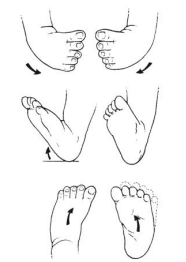
De cima para baixo, as três formas de tálipes são,
respectivamente:
 Conheça nossos planos