Questões de Concurso
Comentadas para if-mt
Foram encontradas 2.849 questões
Resolva questões gratuitamente!
Junte-se a mais de 4 milhões de concurseiros!


( ) It is conducted then a discussion about eating habits. ( ) The teacher instigates the students to identify how to name in the foreign language some typical Brazilian food that is little or unknown in other places, specially in those ones where the target language is used. ( ) Learning is then understood as a source of expansion of cultural horizons. ( ) Together with the Geography teacher, it is conducted a study about the climate and of the place where the target language is used.
The CORRECT sequence is:
Which one of the attitudes below is not mentioned by the document?
Review of the Literature: Importance of Active Learning
Swain (1985) avowed that language learning is more effective ______________________________the target language is used interactively, particularly in regard to understanding the language in general, and improving their reading or listening skills in particular._______________________ Ellis (1993), interaction within the classroom leads to many advantages for language learning such as comprehension checks, language practice and so on. Long and Porter (1985) found that when second language learners worked in groups, they were more motivated, took more initiative, and were less anxious concerning their learning. ______________________________, there may be a relationship between student oral participation and teachers' questioning techniques and types of classroom activities (Wei, 2008). Wei (2008) also found that students oral participation is increased if application and presentation activities are used; appropriate vocabulary is offered when students need it to continue; questions related to students' prior experiences are asked; and an informal and friendly classroom atmosphere is present. Khamwan (2007) found that after training the students to use interactional strategies _____________________ tools for initiating their interaction, their responses to the teacher's questions were longer and more meaningful. ______________________________, the average number of interaction turns was about two turns per three minutes. It was found that the students could comprehend the lesson better. They could ask their teacher when they could not understand something._________________________________, more students could respond to the teacher's questions. All above mentioned studies have supported the significance of learner's participation and interaction. Many research studies discuss the advantages of active learning techniques that can help students to initiate an interaction with their teachers and ultimately clarify unclear points to enhance their understanding of the lessons and improve creativities. [...] GHOLAMI, Valeh. Towards an Interactive EFL Class: Using Active Learning Strategies .Vol.4, No.19, 2014. (pág.190-1 91)
After reading the abstract bellow, choose the INCORRECT alternative:
Abstract: This paper reports the experience of developing teaching materials for public school teachers and students in southern Brazil in a project funded by the Education Department of Paraná State. The materials were intended as resources to be used by teachers according to their needs and those of their local communities, rather than as a textbook per se. The theory underlying this project is based on critical literacy and the idea that language is discourse, i.e. embedded in cultural and ideological values which determine its meaning and establish power relations among texts, among readers and among texts and their readers - Freirean "readers of the wor(l)d". Student-readers are, in this sense, co-constructors of meanings and responsible for making sense of reality. We expect students and teachers who use the materials we designed to become more aware of their possibilities as agents and this way we intend to foster a sense of active citizenship.
Key-word: critical literacy, citizenship, English teaching, public schools.
JORDÃO, Clarissa Menezes & FOGAÇA, Francisco Carlos. CRITICAL LITERACY IN THE ENGLISH LANGUAGE CLASSROOM. D.E.L.T.A., 28:1,2012 (69-84).
According to the abstract, this research was based on critical literacy that understands language as a
discourse.
What Swales has stated is seemingly clear that genre has a number of characteristic and features such as a) genre has a particular communication event, b) genre has a specific goal (goal oriented), c) genre is different and various in accordance to its typical features, d) each genre has a matter of limitation and rules including content, physical form, and shape, and e) every genre belongs to a certain discourse community. In line with discourse community, (Widdoson, 2007) adds that genre is shaped or existing due to the existing discourse community. It is a fact that different discourse community has different genre. Talking about discourse community and genre in connection to the discourse community, Swales (1990), as cited by (Ohoiwutun, 1996), clarifies that characteristics of discourse community in terms of the usage of language in social context is a) a certain discourse community has certain communication goals approved, b) the discourse community communicate within its members, c) a certain discourse community use a certain pattern of communication for its members, d) the discourse community tends to have more than one types of genre to communicate , and e) the discourse community, at last gains a number specific register. (p.45)
Dirgeyasa, I Wy. Genre-Based Approach: What and How to Teach and to Learn Writing. English Language Teaching; Vol. 9, No. 9; 2016
"How does TBI (Task Based Instruction) in practice differ from more traditional teaching approaches? Recall our earlier discussion above of the principles of a P-P-P lesson or teaching format: Presentation: The new grammar structure is presented, often by means of a conversation or short text. The teacher explains the new structure and checks students' comprehension of it. Practice: Students practice using the new structure in a controlled context, through drills or substitution exercises. Production: Students practice using the new structure in different contexts often using their own content or information, in order to develop fluency with the new pattern. Advocates of TBI reject this model on the basis that (a) it doesn't work; and (b) it doesn't reflect current understanding of second language acquisition. They claim that students do not develop fluency or progress in their grammatical development through a P-P-P methodology."
"As well as rethinking the nature of a syllabus, the new communicative approach to teaching prompted a rethinking of classroom teaching methodology. It was argued that learners learn a language through the process of communicating in it, and that communication that is meaningful to the learner provides a better opportunity for learning than through a grammar-based approach. [...] "In applying these principles in the classroom, new classroom techniques and activities were needed, and as we saw above, new roles for teachers and learners in the classroom. Instead of making use of activities that demanded accurate repetition and memorization of sentences and grammatical patterns, activities that required learners to negotiate meaning and to interact meaningfully were required."
( ) Make real communication is the focus of language learning. ( ) Provide opportunities for learners to experiment and try out what they know. ( ) Use drills to make students awareness of language grammar. ( ) Be tolerant of learners' errors as they indicate that the learner is building up his or her communicative competence. ( ) Focus on receptive skills more than productive skills. ( ) Provide opportunities for learners to develop both accuracy and fluency. ( ) Link the different skills such as speaking, reading, and listening together, since they usually occur so in the real world. ( ) Use controlled activities for developing students language learning.
Match the elements to their subelements of method according to Richards & Rodgers (1986) in Brown (2000).
(1) Approach (2) Design (3 ) Procedure
( ) a theory of native language. ( ) a theory of the nature of language learning. ( ) the general and the specific objectives of a method. ( ) a syllabus model. ( ) types of learning and teaching activities. ( ) learner roles. ( ) teacher roles. ( ) the role of instructional material. ( ) classrooms techniques, practices, and behaviors observed when the method is used.
Now choose the correct sequence:
Dada a função real  é dado por:
Na elaboração desta questão, todas as vírgulas foram propositalmente retiradas.
Leia o trecho abaixo, analise-o com relação ao uso adequado da vírgula, e, após, some os números das frases que, obrigatoriamente, contêm vírgulas.
2 - No Brasil com o decorrer dos séculos os
4 - índios foram exterminados ou aculturados pela
6 - ação colonizadora e com isso centenas
8 - de seus idiomas foram extintos.
O resultado da soma das frases que devem, obrigatoriamente, conter vírgulas é:
Considerando a classificação de períodos simples e períodos compostos, observe o período abaixo, bem como as assertivas sobre ele e responda:
"O segurança entrou na sala e pediu que todos saíssem".
I - Trata-se de período simples.
II - Trata-se de período composto.
III - O período contém três orações.

Disponível em:< https://www.google.com/search?q=o+que+tem+de+errado+com+nneii+ nnicroon>. Acesso em: 29/08/2019.
O texto IV traz um exemplo de vocábulo que, em conformidade com a norma padrão da língua portuguesa,
deve ser grafado com hífen. De forma semelhante, devem ser escritas com hífen as palavras:

Disponível em: https://www.google.com/search?q=li+mas+não+entendi+quase+nada&rlz=1C1>. Acesso em: 26/08/2019.
Acerca do texto III, é INCORRETO afirmar que:
Disponível em:<https://www.google.com/search?q=texto+verbal+e+não+verbal+tiras&rlz=> . Acesso em: 26/08/2019.
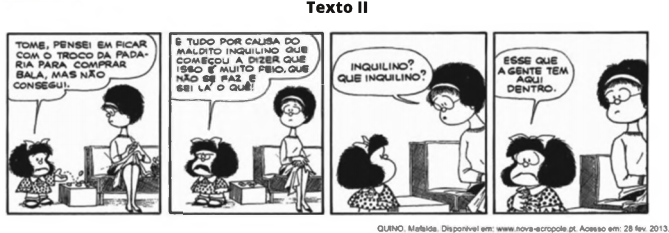
No texto II, em "pensei em ficar" e "começou a dizer", as palavras destacadas atendem adequadamente à
regência dos verbos que as precedem. O mesmo não ocorre em:
Instruções:
I - Na elaboração desta questão, todos os acentos gráficos, se existentes, foram propositalmente retirados.
II - A sílaba tônica proposta encontra-se destacada em letra maiúscula e em negrito.
Tendo em vista as instruções supracitadas, bem como a norma padrão da língua portuguesa, assinale a alternativa em que todas as palavras estão corretas em relação à acentuação tônica.
Lea al poema de Emilia Currás y responda al que se pide.
Tú tienes alas de plata,
alas de ensueño,
de ilusión, de anhelo.
¿Me darás alas de plata?
Calla, calla.
Tú tienes alas de bronce,
alas de pasión,
de amor sin freno.
¿Me darás alas de bronce?
Calla, calla.
Tú tienes alas de hierro,
alas fuertes y seguras,
alas de grandes realidades.
¿Me darás alas de hierro?
Calla, calla.
Tú tienes alas de estaño,
alas de engaño,
alas falsas y amargas.
¿Me darás alas de estaño?
Calla, calla.
No me preguntes tanto.
(Emilia CURRÁS . Fugitiva del tempo. 2ª. edición. De la autora... de Fina Calderón. Prefácio de Malik Najajar. Traducción de Rifaat Atfé. Madrid: Editorial
Betania, 2010. Disponível: em http://www.antoniomiranda.com.br/Iberoamerica/espanha/emilia_ curras.html).
Lea al texto siguiente y contesta a la cuestione
Interlengua (IL)
A lo largo de los años la enseñanza de las lenguas extranjeras hubo el intento de mejorar la adquisición por parte del aprendiente, así, surgieron algunos estudios para que esta adquisición se volviera cada vez más eficaz. Tales estudios fueron la Lingüística Contrastiva basada en el Análisis Contrastivo, alrededor de los años cuarenta, estudio que tenía como eje las similitudes entre dos sistemas lingüísticos con el objetivo de detectar las dificultades del aprendiz en el enseñanza-aprendizaje. Después, surgió el Análisis de Errores donde se examinaba los errores a través de producciones oral bien como de la escrita y fue entonces que se dio el surgimiento de la Interlengua. La teoría de la Interlengua empezó a ser desarrollada en los años setenta, considerada como un modelo metodológico. El modelo de la Interlengua (SELINKER, 1972) concibe el sistema lingüístico del hablante no nativo como un sistema intermedio entre la LM y la L2, viene a completar y a enriquecer al AE pretendiendo dar cuenta de la producción total de los aprendientes, estudiando tanto las producciones idiosincrásicas como las correctas. Diferentemente del modelo Análisis Contrastivo, el modelo de la Interlengua no hace comparaciones entre dos sistemas lingüísticos y si, comparaciones en las etapas en que el aprendiz recorre hasta apropiarse de una lengua meta, durante el trayecto del proceso-aprendizaje de una lengua extranjera, en nuestro caso, el Español. Estas etapas son los estadios que el estudiante pasa y va construyendo una gramática interna hasta evolucionar en un proceso de cercania hacia la L2. El estudio de las etapas fue lo que contribuyó para un mejor entendimiento del sistema lingüístico del aprendiente y del proceso de aprendizaje.
(Bárbara Castro Melendez; Izabel Souza do Nascimento; Rosa Manuelle Santos Xavier. Interferencias de la interlengua en el proceso de aprendizaje del espanol. Texto adaptado. Disponível em: ///C:/Users/NOT%20HP/Downloads/10833-Texto%20do%20artigo-30877-1-10-20161119.pdf).
Teniendo en cuenta el concepto de Interlengua, analice las proposiciones siguientes:
I - El concepto fue creado como un modelo metodológico en el siglo pasado.
II - Concibe el sistema lingüístico del hablante nativo como un sistema intermedio entre la LM y la L2.
III - Viene a completar y a enriquecer al AE pretendiendo dar cuenta de la producción total de los aprendientes.
IV - Hace comparaciones de las etapas que el aprendiz recorre hasta apropiarse de una lengua meta.
Lea al texto siguiente y contesta a la cuestione
Interlengua (IL)
A lo largo de los años la enseñanza de las lenguas extranjeras hubo el intento de mejorar la adquisición por parte del aprendiente, así, surgieron algunos estudios para que esta adquisición se volviera cada vez más eficaz. Tales estudios fueron la Lingüística Contrastiva basada en el Análisis Contrastivo, alrededor de los años cuarenta, estudio que tenía como eje las similitudes entre dos sistemas lingüísticos con el objetivo de detectar las dificultades del aprendiz en el enseñanza-aprendizaje. Después, surgió el Análisis de Errores donde se examinaba los errores a través de producciones oral bien como de la escrita y fue entonces que se dio el surgimiento de la Interlengua. La teoría de la Interlengua empezó a ser desarrollada en los años setenta, considerada como un modelo metodológico. El modelo de la Interlengua (SELINKER, 1972) concibe el sistema lingüístico del hablante no nativo como un sistema intermedio entre la LM y la L2, viene a completar y a enriquecer al AE pretendiendo dar cuenta de la producción total de los aprendientes, estudiando tanto las producciones idiosincrásicas como las correctas. Diferentemente del modelo Análisis Contrastivo, el modelo de la Interlengua no hace comparaciones entre dos sistemas lingüísticos y si, comparaciones en las etapas en que el aprendiz recorre hasta apropiarse de una lengua meta, durante el trayecto del proceso-aprendizaje de una lengua extranjera, en nuestro caso, el Español. Estas etapas son los estadios que el estudiante pasa y va construyendo una gramática interna hasta evolucionar en un proceso de cercania hacia la L2. El estudio de las etapas fue lo que contribuyó para un mejor entendimiento del sistema lingüístico del aprendiente y del proceso de aprendizaje.
(Bárbara Castro Melendez; Izabel Souza do Nascimento; Rosa Manuelle Santos Xavier. Interferencias de la interlengua en el proceso de aprendizaje del espanol. Texto adaptado. Disponível em: ///C:/Users/NOT%20HP/Downloads/10833-Texto%20do%20artigo-30877-1-10-20161119.pdf).

 Conheça nossos planos