Questões de Concurso
Comentadas para cesgranrio
Foram encontradas 32.301 questões
Resolva questões gratuitamente!
Junte-se a mais de 4 milhões de concurseiros!


Ano: 2015
Banca:
CESGRANRIO
Órgão:
Petrobras
Prova:
CESGRANRIO - 2015 - Petrobras - Profissional Júnior - Engenharia Elétrica |
Q486517
Engenharia Elétrica
Considerando-se a estrutura institucional atual do setor elétrico brasileiro, o órgão que, dentre outras funções, tem a de definir as diretrizes para os procedimentos licitatórios e promover as licitações destinadas à contratação de concessionários de serviço público para produção, transmissão e distribuição de energia elétrica é
Ano: 2015
Banca:
CESGRANRIO
Órgão:
Petrobras
Prova:
CESGRANRIO - 2015 - Petrobras - Profissional Júnior - Ciências Contábeis |
Q486393
Auditoria
A partir de 2002, as empresas listadas no mercado americano estão obrigadas a ter na sua estrutura um Comitê de Auditoria, nos termos exigidos pela Seção 301 da Lei Sarbanes-Oxley (SOX).
Com relação a tais comitês no Brasil, há correntes divergentes quanto a isso. Uma corrente entende que as atribuições desse Comitê de Auditoria já estão inclusas nas atribuições do Conselho Fiscal, capitulado na Lei societária, enquanto outra corrente entende que não.
Independentemente dessa polêmica, o Comitê de Auditoria ou a faculdade de sua substituição pelo Conselho Fiscal, a partir de 2005, tornou-se obrigatório às empresas brasileiras
Ano: 2015
Banca:
CESGRANRIO
Órgão:
Petrobras
Prova:
CESGRANRIO - 2015 - Petrobras - Profissional Júnior - Ciências Contábeis |
Q486392
Auditoria
Em termos amplos e gerais, Governança Corporativa diz respeito ao sistema de administrar uma empresa envolvendo processos, costumes, políticas internas e externas, leis e outros, visando a assegurar a confiabilidade dos seus acionistas, criando um conjunto eficiente de mecanismos, que esteja sempre alinhado com eles.
Uma boa Governança Corporativa é fundamentada em valores que contribuam para um desenvolvimento econômico sustentável, melhorias no desempenho da empresa, minimizando abusos de poder, erros e fraudes.
Nesse contexto e no sentido das dimensões dos valores da governança corporativa, a transparência de informações, especialmente das de alta relevância, que impactam os negócios e que envolvem resultados, oportunidades e riscos refere-se ao valor denominado
Ano: 2015
Banca:
CESGRANRIO
Órgão:
Petrobras
Prova:
CESGRANRIO - 2015 - Petrobras - Profissional Júnior - Ciências Contábeis |
Q486389
Direito Tributário
Com relação ao imposto sobre operações relativas à circulação de mercadorias e sobre prestação de serviços de transporte interestadual e intermunicipal e de comunicação é lícito afirmar que ele é um imposto de competência do
Ano: 2015
Banca:
CESGRANRIO
Órgão:
Petrobras
Prova:
CESGRANRIO - 2015 - Petrobras - Profissional Júnior - Ciências Contábeis |
Q486388
Auditoria
De acordo com as determinações do Pronunciamento Técnico CPC 40 (R1), aprovado pela Deliberação CVM n° 684/2012, as entidades devem divulgar informações que permitam aos usuários das demonstrações contábeis a possibilidade de poderem avaliar a natureza e a extensão dos riscos decorrentes de instrumentos financeiros a que estão expostas.
Nesse contexto, de acordo com o aludido CPC 40 (R1), no seu apêndice A, um dos riscos a que os instrumentos financeiros estão sujeitos é o risco de uma das partes contratantes de instrumento financeiro causar prejuízo financeiro à outra parte pelo não cumprimento da sua obrigação perante esta outra.
Tal descrição refere-se ao risco de
Ano: 2015
Banca:
CESGRANRIO
Órgão:
Petrobras
Prova:
CESGRANRIO - 2015 - Petrobras - Profissional Júnior - Ciências Contábeis |
Q486387
Contabilidade Geral
A Escrituração Contábil Digital (ECD) é uma parte do projeto SPED e visa a substituir a escrituração em papel pela escrituração transmitida via arquivo, correspondente à obrigação de transmitir, em versão oficial, os principais livros contábeis.
O aludido projeto SPED, que inclui o ECD, tem como um de seus objetivos:
O aludido projeto SPED, que inclui o ECD, tem como um de seus objetivos:
Ano: 2015
Banca:
CESGRANRIO
Órgão:
Petrobras
Prova:
CESGRANRIO - 2015 - Petrobras - Profissional Júnior - Ciências Contábeis |
Q486385
Direito Tributário
O Código Tributário Nacional define Imposto como o tributo cuja obrigação tem por fato gerador uma situação independente de qualquer atividade estatal específica, relativa ao contribuinte, estabelecendo, também, a competência para a sua respectiva instituição.
Nesse sentido, é da competência da União instituir, dentre outros, imposto sobre
Nesse sentido, é da competência da União instituir, dentre outros, imposto sobre
Ano: 2015
Banca:
CESGRANRIO
Órgão:
Petrobras
Prova:
CESGRANRIO - 2015 - Petrobras - Profissional Júnior - Ciências Contábeis |
Q486375
Auditoria
52 De acordo com a NBC TI 01, que trata da auditoria interna, aprovada pela Resolução do CFC n° 986/2003 com nova numeração dada pela Resolução CFC n° 1.329/2011, a aplicação do procedimento da inspeção consiste em
Ano: 2015
Banca:
CESGRANRIO
Órgão:
Petrobras
Prova:
CESGRANRIO - 2015 - Petrobras - Profissional Júnior - Ciências Contábeis |
Q486365
Contabilidade Geral
Uma companhia apresentou, em reais, as seguintes informações no encerramento de seu exercício social:
Lucro líquido do período 50.000,00
Ajustes de avaliação patrimonial 5.000,00
Reclassificação do ajuste de avaliação patrimonial para o resultado 2.000,00
Alíquota conjunta de IR e CSLL 30%
Considerando-se que o lucro líquido do período já inclui a reclassificação do ajuste de avaliação patrimonial, as in- formações recebidas e as determinações do CPC 26(R1), aprovado pela Deliberação CVM n° 676/2011, elaborada a demonstração do resultado abrangente do período, o seu total, em reais, é
Ano: 2015
Banca:
CESGRANRIO
Órgão:
Petrobras
Prova:
CESGRANRIO - 2015 - Petrobras - Profissional Júnior - Ciências Contábeis |
Q486353
Economia
Uma empresa tem uma aplicação em Letras do Tesouro Nacional (sem risco), remuneradas a 8% ao ano e índice de risco não diversificável (coeficiente Beta) de 0,6.
Sabendo-se que a remuneração do mercado é de 11% ao ano, a taxa de retorno mínimo exigido do ativo, pelo modelo de formação de preços (CAPM), em percentual, é
Sabendo-se que a remuneração do mercado é de 11% ao ano, a taxa de retorno mínimo exigido do ativo, pelo modelo de formação de preços (CAPM), em percentual, é
Ano: 2015
Banca:
CESGRANRIO
Órgão:
Petrobras
Prova:
CESGRANRIO - 2015 - Petrobras - Profissional Júnior - Ciências Contábeis |
Q486351
Matemática Financeira
Foi oferecido a uma empresa um projeto para investimento de R$ 120.000,00 com a seguinte previsão do fluxo de entradas de caixa:
1° ano = R$ 55.000,00
2° ano = R$ 54.450,00
3° ano = R$ 26.620,00
Considerando somente as informações recebidas, a taxa de retorno de 10% ao ano, fixada pela empresa, e o método de análise do Valor Presente Líquido (VPL), o resultado desse investimento, em reais, é
1° ano = R$ 55.000,00
2° ano = R$ 54.450,00
3° ano = R$ 26.620,00
Considerando somente as informações recebidas, a taxa de retorno de 10% ao ano, fixada pela empresa, e o método de análise do Valor Presente Líquido (VPL), o resultado desse investimento, em reais, é
Ano: 2015
Banca:
CESGRANRIO
Órgão:
Petrobras
Prova:
CESGRANRIO - 2015 - Petrobras - Profissional Júnior - Ciências Contábeis |
Q486350
Matemática Financeira
O departamento financeiro de uma grande sociedade anônima está analisando os seguintes projetos de investimento:
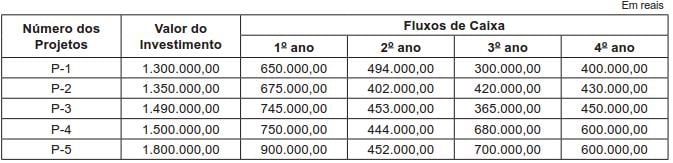
Utilizando o período de payback efetivo, o projeto que permite à companhia recuperar o investimento realizado no menor período de tempo (prazo) é o de número
Utilizando o período de payback efetivo, o projeto que permite à companhia recuperar o investimento realizado no menor período de tempo (prazo) é o de número
Ano: 2015
Banca:
CESGRANRIO
Órgão:
Petrobras
Prova:
CESGRANRIO - 2015 - Petrobras - Profissional Júnior - Ciências Contábeis |
Q486349
Matemática Financeira
O conceito básico de juros, em matemática financeira, é a remuneração paga ou recebida pela utilização de dinheiro numa determinada unidade de tempo. Os juros tanto podem indicar o pagamento por um empréstimo contraído quanto o recebimento por uma aplicação financeira, mas representam sempre o custo de capital, recebido ou pago, considerado como o aluguel pago pelo uso do dinheiro de terceiros.
Nesse enfoque, a maneira de representar os juros para uma unidade de capital é pela taxa
Nesse enfoque, a maneira de representar os juros para uma unidade de capital é pela taxa
Ano: 2015
Banca:
CESGRANRIO
Órgão:
Petrobras
Prova:
CESGRANRIO - 2015 - Petrobras - Profissional Júnior - Engenharia Mecânica |
Q486226
Arquitetura de Computadores
Processadores RISC e CISC são ainda hoje fonte de discussão na hora de se escolher a configuração adequada de um projeto.
Espera-se, normalmente, que processadores RISC
Espera-se, normalmente, que processadores RISC
Ano: 2015
Banca:
CESGRANRIO
Órgão:
Petrobras
Prova:
CESGRANRIO - 2015 - Petrobras - Profissional Júnior - Engenharia Mecânica |
Q486225
Programação
Um engenheiro necessita processar um conjunto de dados coletados diretamente de equipamentos, por meio de vários programas que devem ser aplicados em sequência, em várias ordens possíveis. Cada programa funciona como um filtro, lendo e escrevendo arquivos. Para realizar essa tarefa, o engenheiro decidiu que seria mais fácil fazer um programa adicional que controlasse o fluxo de trabalho dos outros programas. Após pesquisa, optou por utilizar uma linguagem de programação imperativa, que pudesse ser usada como um script e tradicionalmente disponível na forma interpretada.
Entre as linguagens adequadas a esse cenário de uso, o engenheiro poderá escolher entre
Entre as linguagens adequadas a esse cenário de uso, o engenheiro poderá escolher entre
Ano: 2015
Banca:
CESGRANRIO
Órgão:
Petrobras
Prova:
CESGRANRIO - 2015 - Petrobras - Profissional Júnior - Engenharia Mecânica |
Q486221
Meio Ambiente
Há um órgão responsável por estabelecer normas, critérios e padrões relativos ao controle e à manutenção da qualidade do meio ambiente com vistas ao uso racional dos recursos ambientais, principalmente hídricos.
Esse órgão é o
Esse órgão é o
Ano: 2015
Banca:
CESGRANRIO
Órgão:
Petrobras
Prova:
CESGRANRIO - 2015 - Petrobras - Profissional Júnior - Engenharia Mecânica |
Q486220
Engenharia Ambiental e Sanitária
Em relação ao programa de regularização do meio ambiente (PRA), considere as afirmações a seguir.
I – Esse programa permite ao proprietário rural regularizar as áreas de preservação permanente e a reserva legal consolidada.
II – Esse programa se aplica exclusivamente a áreas que não sejam de risco e em que sejam observados critérios técnicos de conservação do solo e da água.
III – Esse programa tem como objetivo solucionar vários passivos ambientais dos produtores rurais.
IV – Esse programa se aplica exclusivamente às regiões de restingas.
É correto APENAS o que se afirma em
Ano: 2015
Banca:
CESGRANRIO
Órgão:
Petrobras
Prova:
CESGRANRIO - 2015 - Petrobras - Profissional Júnior - Engenharia Mecânica |
Q486219
Biologia
Os micro-organismos, na maioria das vezes invisíveis a olho nu, capazes de produzir doenças, deterioração de alimentos e mau cheiro são classificados como agentes
Ano: 2015
Banca:
CESGRANRIO
Órgão:
Banco do Brasil
Prova:
CESGRANRIO - 2015 - Banco do Brasil - Escriturário - 001 |
Q485566
Inglês
Texto associado
Why Millennials Don’t Like Credit Cards
by Holly Johnson
Cheap, easy credit might have been tempting to young people in the past, but not to today’s millennials. According to a recent survey by Bankrate of over 1,161 consumers, 63% of adults ages 18 to 29 live without a credit card of any kind, and another 23% only carry one card.
The Impact of the Great Recession
Research shows that the environment millennials grew up in might have an impact on their finances.
Unlike other generations, millennials lived through economic hardships during a time when their adult lives were beginning. According to the Bureau of Labor Statistics, the Great Recession caused millennials to stray from historic patterns when it comes to purchasing a home and having children, and a fear of credit cards could be another symptom of the economic environment of the times.
And there’s much data when it comes to proving that millennials grew up on shaky economic ground.
The Pew Research Center reports that 36% of millennials lived at home with their parents in 2012. Meanwhile, the unemployment rate for people ages 16 to 24 was 14.2% (more than twice the national rate) in early 2014, according to the BLS. With those figures, it’s no wonder that millennials are skittish when it comes to credit cards. It makes sense that young people would be afraid to take on any new forms of debt.
A Generation Plagued with Student Loan Debt
But the Great Recession isn’t the only reason millennials could be fearful of credit. Many experts believe that the nation’s student loan debt level might be related to it. According to the Institute for College Access & Success, 71% of millennials (or 1.3 million students) who graduated from college in 2012 left school with at least some student loan debt, with the average amount owed around $29,400.
With so much debt already under their belts, millennials are worried about adding any credit card
debt to the pile. After all, many adults with student loan debt need to make payments for years, and even decades.
How Millennials Can Build Credit Without a Credit Card
The fact that millennials are smart enough to avoid credit card debt is a good thing, but that doesn’t mean the decision has its drawbacks. According to Experian, most adults need a positive credit history in order to qualify for an auto loan or mortgage. Even worse, having no credit history is almost as bad as having a negative credit history in some cases.
Still, there are plenty of ways millennials can build a credit history without a credit card. A few tips:
• Make payments on installment loans on time. Whether it’s a car loan, student loan or personal loan, make sure to mail in those payments on time and pay at least the minimum amount required.
• Put at least one household or utility bill in your name. Paying your utility or household bills on time can help you build a positive credit history.
• Get a secured credit card. Unlike traditional credit cards, the funds secured credit cards offer are backed by money the user deposits.
Signing up for a secured card is one way to build a positive credit history without any risk.
The fact that millennials are leery of credit cards is probably a good thing in the long run. After all, not having a credit card is the perfect way to stay out of credit card debt. Even though it might be harder to build a credit history without credit cards, the vast majority of millennials have decided that the plastic just isn’t worth it.
Available at: <http://money.usnews.com/money/blogs/ my-money/2014/11/04/why-millennials-dont-like-credit-cards>
The sentence of the text “With so much debt already under their belts, millennials are worried about adding any credit card debt to the pile” conveys the idea that millenials have
In the sentence of the text “Still, there are plenty of ways millennials can build a credit history without a credit card” (lines 52 – 53), the quantifier plenty of can be replaced, with no change in meaning, by
Ano: 2015
Banca:
CESGRANRIO
Órgão:
Banco do Brasil
Prova:
CESGRANRIO - 2015 - Banco do Brasil - Escriturário - 001 |
Q485565
Inglês
Texto associado
Why Millennials Don’t Like Credit Cards
by Holly Johnson
Cheap, easy credit might have been tempting to young people in the past, but not to today’s millennials. According to a recent survey by Bankrate of over 1,161 consumers, 63% of adults ages 18 to 29 live without a credit card of any kind, and another 23% only carry one card.
The Impact of the Great Recession
Research shows that the environment millennials grew up in might have an impact on their finances.
Unlike other generations, millennials lived through economic hardships during a time when their adult lives were beginning. According to the Bureau of Labor Statistics, the Great Recession caused millennials to stray from historic patterns when it comes to purchasing a home and having children, and a fear of credit cards could be another symptom of the economic environment of the times.
And there’s much data when it comes to proving that millennials grew up on shaky economic ground.
The Pew Research Center reports that 36% of millennials lived at home with their parents in 2012. Meanwhile, the unemployment rate for people ages 16 to 24 was 14.2% (more than twice the national rate) in early 2014, according to the BLS. With those figures, it’s no wonder that millennials are skittish when it comes to credit cards. It makes sense that young people would be afraid to take on any new forms of debt.
A Generation Plagued with Student Loan Debt
But the Great Recession isn’t the only reason millennials could be fearful of credit. Many experts believe that the nation’s student loan debt level might be related to it. According to the Institute for College Access & Success, 71% of millennials (or 1.3 million students) who graduated from college in 2012 left school with at least some student loan debt, with the average amount owed around $29,400.
With so much debt already under their belts, millennials are worried about adding any credit card
debt to the pile. After all, many adults with student loan debt need to make payments for years, and even decades.
How Millennials Can Build Credit Without a Credit Card
The fact that millennials are smart enough to avoid credit card debt is a good thing, but that doesn’t mean the decision has its drawbacks. According to Experian, most adults need a positive credit history in order to qualify for an auto loan or mortgage. Even worse, having no credit history is almost as bad as having a negative credit history in some cases.
Still, there are plenty of ways millennials can build a credit history without a credit card. A few tips:
• Make payments on installment loans on time. Whether it’s a car loan, student loan or personal loan, make sure to mail in those payments on time and pay at least the minimum amount required.
• Put at least one household or utility bill in your name. Paying your utility or household bills on time can help you build a positive credit history.
• Get a secured credit card. Unlike traditional credit cards, the funds secured credit cards offer are backed by money the user deposits.
Signing up for a secured card is one way to build a positive credit history without any risk.
The fact that millennials are leery of credit cards is probably a good thing in the long run. After all, not having a credit card is the perfect way to stay out of credit card debt. Even though it might be harder to build a credit history without credit cards, the vast majority of millennials have decided that the plastic just isn’t worth it.
Available at: <http://money.usnews.com/money/blogs/ my-money/2014/11/04/why-millennials-dont-like-credit-cards>
The sentence of the text “With so much debt already under their belts, millennials are worried about adding any credit card debt to the pile” conveys the idea that millenials have
The sentence of the text “With so much debt already under their belts, millennials are worried about adding any credit card debt to the pile” (lines 38 – 40) conveys the idea that millenials have

 Conheça nossos planos