Questões de Concurso
Sobre inglês
Foram encontradas 25.512 questões
Resolva questões gratuitamente!
Junte-se a mais de 4 milhões de concurseiros!


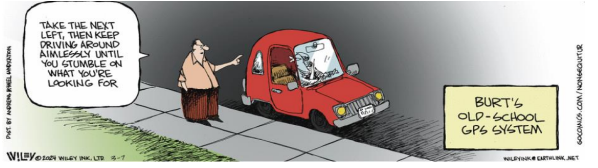
Available at: https://www.gocomics.com/nonsequitur/2024/03/07
Choose the option that best explains the role of the person standing outside the car in the context of the text presented in the image.
Resumos relacionados
Advérbios e conjunções em inglês para concursos públicos
O estudo de advérbios e conjunções na língua inglesa é fundamental para quem deseja se destacar em provas de concursos públicos. Esses elementos desempenham papéis essenciais na construção de frases, influenciando diretamente o sentido e a coesão textual, habilidades bastante exigidas nas questões de interpretação e compreensão de textos em inglês.
Artigos (Articles) em inglês: uso em concursos públicos
Artigos (Articles) são palavras essenciais na gramática da língua inglesa, usadas para indicar se um substantivo está sendo mencionado de forma específica ou geral. Eles desempenham papel fundamental em provas de concursos, pois ajudam na compreensão e interpretação dos textos, além de serem frequentemente cobrados em questões envolvendo uso correto de estruturas gramaticais.

Available at: https://www.gocomics.com/nonsequitur/2006/05/27
The expression "plenty of fish in the sea" is used in the comic to:

Available at: https://www.gocomics.com/pickles/2024/03/08
The phrase "puts out a poisonous gas" in the second panel suggests that the wilted flower releases a substance that is:

Available at: https://www.gocomics.com/peanuts/1969/12/24
In the comic strip provided, the character expresses doubt about an individual's sanity for flying at night in a sleigh pulled by reindeer. To whom is the character most likely referring?
O texto seguinte servirá de base para responder à questão.
Vianden Castle History
(1º§) The rocky outcrop above the modern town of Vianden was first fortified in late antiquity. Excavations at the foot of the castle chapel in 1994 led to the discovery that parts of the crumbling masonry of the Late Antique tower must have existed in Merovingian times and that this square building, the only surviving structure from the period known as Late Antiquity, was incorporated into the first medieval castle.
(2º§) The first fortification was built at the beginning of Late Antiquity on the castle hill at an ancient crossroads, where a branch of the great Roman road Reims-Cologne through the Ardennes and the valley of Our led to the valley of the Sauer and through Echternach to Bitburg and Trier, at that time a thriving metropolis.
(3º§) After the Vianden fort was abandoned around 430/440 AD, the Roman Tower seems to have been sufficiently usable to remain a decisive element in the subsequent periods of castle building up to the High Middle Ages.
(4º§) The first medieval fortification was erected on the rocky spur overlooking Vianden around the year 1000. The main part of this fortification consisted of an oval ring wall. This defensive wall, meticulously reinforced with small slabs of slate, was exactly one meter wide. As with the ancient wall, this special construction technique allowed archaeologists to retrace it virtually its entire length. The old late antique moat also remained in use during this period. The entire inner surface of the fortification was leveled by filling the lower defensive wall with stones and earth. This complex also included a hall, used for administrative purposes, and a chapel, which was installed in the remains of the late antique tower.
(5º§) Vianden Castle was extensively rebuilt around 1170. The remains of the wooden scaffolding found in the new residential tower made it possible to determine the date of construction using the three-ring dating technique.
(6º§) Important architectural contributions were made, in Gothic style, between the 13th and 14th centuries by the Counts of Vianden. In 1417 the castle became a possession of the Orange-Nassau family who made changes in the Renaissance style. The castle was long in the possession of the grand-ducal family until it became state property in 1977. After this date, it was restored and shines in its former glory. Today, Vianden Castle is one of the most important architectural monuments in Europe being one of the largest and most beautiful feudal residences of the Romanesque and Gothic periods. In the entrance area there is a modern interactive visitor center.
https://www.histouring.com/en/historical-places/vianden-castle/
O texto seguinte servirá de base para responder à questão.
Vianden Castle History
(1º§) The rocky outcrop above the modern town of Vianden was first fortified in late antiquity. Excavations at the foot of the castle chapel in 1994 led to the discovery that parts of the crumbling masonry of the Late Antique tower must have existed in Merovingian times and that this square building, the only surviving structure from the period known as Late Antiquity, was incorporated into the first medieval castle.
(2º§) The first fortification was built at the beginning of Late Antiquity on the castle hill at an ancient crossroads, where a branch of the great Roman road Reims-Cologne through the Ardennes and the valley of Our led to the valley of the Sauer and through Echternach to Bitburg and Trier, at that time a thriving metropolis.
(3º§) After the Vianden fort was abandoned around 430/440 AD, the Roman Tower seems to have been sufficiently usable to remain a decisive element in the subsequent periods of castle building up to the High Middle Ages.
(4º§) The first medieval fortification was erected on the rocky spur overlooking Vianden around the year 1000. The main part of this fortification consisted of an oval ring wall. This defensive wall, meticulously reinforced with small slabs of slate, was exactly one meter wide. As with the ancient wall, this special construction technique allowed archaeologists to retrace it virtually its entire length. The old late antique moat also remained in use during this period. The entire inner surface of the fortification was leveled by filling the lower defensive wall with stones and earth. This complex also included a hall, used for administrative purposes, and a chapel, which was installed in the remains of the late antique tower.
(5º§) Vianden Castle was extensively rebuilt around 1170. The remains of the wooden scaffolding found in the new residential tower made it possible to determine the date of construction using the three-ring dating technique.
(6º§) Important architectural contributions were made, in Gothic style, between the 13th and 14th centuries by the Counts of Vianden. In 1417 the castle became a possession of the Orange-Nassau family who made changes in the Renaissance style. The castle was long in the possession of the grand-ducal family until it became state property in 1977. After this date, it was restored and shines in its former glory. Today, Vianden Castle is one of the most important architectural monuments in Europe being one of the largest and most beautiful feudal residences of the Romanesque and Gothic periods. In the entrance area there is a modern interactive visitor center.
https://www.histouring.com/en/historical-places/vianden-castle/
O texto seguinte servirá de base para responder à questão.
Vianden Castle History
(1º§) The rocky outcrop above the modern town of Vianden was first fortified in late antiquity. Excavations at the foot of the castle chapel in 1994 led to the discovery that parts of the crumbling masonry of the Late Antique tower must have existed in Merovingian times and that this square building, the only surviving structure from the period known as Late Antiquity, was incorporated into the first medieval castle.
(2º§) The first fortification was built at the beginning of Late Antiquity on the castle hill at an ancient crossroads, where a branch of the great Roman road Reims-Cologne through the Ardennes and the valley of Our led to the valley of the Sauer and through Echternach to Bitburg and Trier, at that time a thriving metropolis.
(3º§) After the Vianden fort was abandoned around 430/440 AD, the Roman Tower seems to have been sufficiently usable to remain a decisive element in the subsequent periods of castle building up to the High Middle Ages.
(4º§) The first medieval fortification was erected on the rocky spur overlooking Vianden around the year 1000. The main part of this fortification consisted of an oval ring wall. This defensive wall, meticulously reinforced with small slabs of slate, was exactly one meter wide. As with the ancient wall, this special construction technique allowed archaeologists to retrace it virtually its entire length. The old late antique moat also remained in use during this period. The entire inner surface of the fortification was leveled by filling the lower defensive wall with stones and earth. This complex also included a hall, used for administrative purposes, and a chapel, which was installed in the remains of the late antique tower.
(5º§) Vianden Castle was extensively rebuilt around 1170. The remains of the wooden scaffolding found in the new residential tower made it possible to determine the date of construction using the three-ring dating technique.
(6º§) Important architectural contributions were made, in Gothic style, between the 13th and 14th centuries by the Counts of Vianden. In 1417 the castle became a possession of the Orange-Nassau family who made changes in the Renaissance style. The castle was long in the possession of the grand-ducal family until it became state property in 1977. After this date, it was restored and shines in its former glory. Today, Vianden Castle is one of the most important architectural monuments in Europe being one of the largest and most beautiful feudal residences of the Romanesque and Gothic periods. In the entrance area there is a modern interactive visitor center.
https://www.histouring.com/en/historical-places/vianden-castle/

 Conheça nossos planos