Questões de Concurso Público Prefeitura de Bombinhas - SC 2024 para Professor de Língua Inglesa
Foram encontradas 40 questões


Ano: 2024
Banca:
FURB
Órgão:
Prefeitura de Bombinhas - SC
Prova:
FURB - 2024 - Prefeitura de Bombinhas - SC - Professor de Língua Inglesa |
Q3397944
Legislação Municipal
Analise as asserções a seguir e a relação proposta entre
elas:
I.A Lei Orgânica Municipal poderá ser alterada, mediante proposta de um quarto, no mínimo, dos membros da Câmara Municipal; do Prefeito Municipal e da iniciativa popular, subscrita no mínimo, por 10 % (dez por cento) do total de eleitores do Município.
CONTUDO
II. A Lei Orgânica não poderá ser alterada na vigência do estado de sítio ou de intervenção do Município e, suas alterações, serão promulgadas pela Mesa da Câmara, com o respectivo número de ordem.
A respeito dessas asserções, assinale a opção correta:
I.A Lei Orgânica Municipal poderá ser alterada, mediante proposta de um quarto, no mínimo, dos membros da Câmara Municipal; do Prefeito Municipal e da iniciativa popular, subscrita no mínimo, por 10 % (dez por cento) do total de eleitores do Município.
CONTUDO
II. A Lei Orgânica não poderá ser alterada na vigência do estado de sítio ou de intervenção do Município e, suas alterações, serão promulgadas pela Mesa da Câmara, com o respectivo número de ordem.
A respeito dessas asserções, assinale a opção correta:
Ano: 2024
Banca:
FURB
Órgão:
Prefeitura de Bombinhas - SC
Prova:
FURB - 2024 - Prefeitura de Bombinhas - SC - Professor de Língua Inglesa |
Q3397945
Legislação Municipal
A lei complementar n.° 7/2002, que institui o Regime
Jurídico dos Servidores Públicos do Município de
Bombinhas, em seu art. 203, elucida que o processo
disciplinar é o instrumento destinado a apurar
responsabilidade de servidor por infração praticada no
exercício de suas atribuições, ou que tenha relação com
as atribuições do cargo em que se encontre investido. Ao
encontro disso, analise as afirmativas a seguir:
I. A Comissão de Avaliação de Processo Administrativo Disciplinar, de caráter permanente, que conduzirá os processos disciplinares, será composta por 3 (três) servidores efetivos e estáveis, com habilitação de nível superior, designados pela autoridade competente, que indicará, dentre eles, o Presidente.
II. As reuniões e as audiências das comissões terão caráter público.
III. O processo disciplinar se desenvolve nas seguintes fases: instauração, inquérito administrativo e julgamento.
IV. O prazo para a conclusão do processo disciplinar não excederá 30 (trinta) dias, contados da data de publicação do ato que constituir a comissão, admitida a sua prorrogação por igual prazo, quando as circunstâncias o exigirem.
É correto o que se afirma em:
I. A Comissão de Avaliação de Processo Administrativo Disciplinar, de caráter permanente, que conduzirá os processos disciplinares, será composta por 3 (três) servidores efetivos e estáveis, com habilitação de nível superior, designados pela autoridade competente, que indicará, dentre eles, o Presidente.
II. As reuniões e as audiências das comissões terão caráter público.
III. O processo disciplinar se desenvolve nas seguintes fases: instauração, inquérito administrativo e julgamento.
IV. O prazo para a conclusão do processo disciplinar não excederá 30 (trinta) dias, contados da data de publicação do ato que constituir a comissão, admitida a sua prorrogação por igual prazo, quando as circunstâncias o exigirem.
É correto o que se afirma em:
Ano: 2024
Banca:
FURB
Órgão:
Prefeitura de Bombinhas - SC
Prova:
FURB - 2024 - Prefeitura de Bombinhas - SC - Professor de Língua Inglesa |
Q3397946
Legislação dos Municípios do Estado de Santa Catarina
O art. 17, da lei complementar n.° 7/2002, que institui o
Regime Jurídico dos Servidores Públicos do Município
de Bombinhas, elucida que a posse é o ato que completa
a investidura em cargo público. Ao encontro disso,
analise as afirmativas a seguir:
Ano: 2024
Banca:
FURB
Órgão:
Prefeitura de Bombinhas - SC
Prova:
FURB - 2024 - Prefeitura de Bombinhas - SC - Professor de Língua Inglesa |
Q3397947
Legislação Municipal
O art. 119, da Lei Orgânica do Município, afirma que
pertencem a Bombinhas:
I.50% (cinquenta por cento) do produto da arrecadação do imposto da União sobre a propriedade territorial rural, relativamente aos imóveis situados no município.
II. 30 % (trinta por cento) do produto da arrecadação do imposto do Estado sobre a propriedade de veículos automotores licenciados no território municipal.
III. 40 % (quarenta por cento) do produto da arrecadação do imposto do Estado sobre operações relativas à circulação de mercadorias e sobre prestações de serviços de transporte interestadual e intermunicipal de comunicação.
É correto o que se afirma em:
I.50% (cinquenta por cento) do produto da arrecadação do imposto da União sobre a propriedade territorial rural, relativamente aos imóveis situados no município.
II. 30 % (trinta por cento) do produto da arrecadação do imposto do Estado sobre a propriedade de veículos automotores licenciados no território municipal.
III. 40 % (quarenta por cento) do produto da arrecadação do imposto do Estado sobre operações relativas à circulação de mercadorias e sobre prestações de serviços de transporte interestadual e intermunicipal de comunicação.
É correto o que se afirma em:
Ano: 2024
Banca:
FURB
Órgão:
Prefeitura de Bombinhas - SC
Prova:
FURB - 2024 - Prefeitura de Bombinhas - SC - Professor de Língua Inglesa |
Q3397948
Legislação Municipal
A Lei Orgânica do Município de Bombinhas, em seu art.
16, afirma que o município exerce com a união e o
estado as seguintes competências:
I.Proteger os documentos, as obras e outros bens de valor histórico, artístico, cultural e científico, os monumentos, as paisagens naturais notáveis e os sítios arqueológicos.
II.Dispensar às microempresas e às empresas de pequeno porte, assim definidas em lei, tratamento jurídico diferenciado, visando a incentivá-las pela simplificação de suas obrigações administrativas e tributárias, ou pela eliminação ou redução destas por meio de lei.
III.Garantir o acesso a todos de modo justo e igual, sem distinção de origem, raça, sexo, orientação sexual, cor, idade, condição econômica, religião ou qualquer outra discriminação, aos bens, serviços e condições de vida indispensáveis, a uma existência digna, bem como coibir, no seu âmbito de atuação, qualquer discriminação desta ordem, na forma da lei.
IV. Impedir a evasão, a destruição, a descaracterização de obras de artigo e de outros bens de valor histórico, artístico e cultural.
É correto o que se afirma em:
I.Proteger os documentos, as obras e outros bens de valor histórico, artístico, cultural e científico, os monumentos, as paisagens naturais notáveis e os sítios arqueológicos.
II.Dispensar às microempresas e às empresas de pequeno porte, assim definidas em lei, tratamento jurídico diferenciado, visando a incentivá-las pela simplificação de suas obrigações administrativas e tributárias, ou pela eliminação ou redução destas por meio de lei.
III.Garantir o acesso a todos de modo justo e igual, sem distinção de origem, raça, sexo, orientação sexual, cor, idade, condição econômica, religião ou qualquer outra discriminação, aos bens, serviços e condições de vida indispensáveis, a uma existência digna, bem como coibir, no seu âmbito de atuação, qualquer discriminação desta ordem, na forma da lei.
IV. Impedir a evasão, a destruição, a descaracterização de obras de artigo e de outros bens de valor histórico, artístico e cultural.
É correto o que se afirma em:
Ano: 2024
Banca:
FURB
Órgão:
Prefeitura de Bombinhas - SC
Prova:
FURB - 2024 - Prefeitura de Bombinhas - SC - Professor de Língua Inglesa |
Q3397949
Inglês
Texto associado
The Role of the Teacher in Promoting Intercultural
Approaches
Today, it would be an exaggeration to say that cultural
diversity is perceived as a problem within education
systems, since the teachers, in general, accept it and
have positive attitudes towards the contribution of
diversity. However, even if it is not a problem within the
school, one must nevertheless address its complexity.
Cultural diversity is not only an auspicious resource for
extra-curricular activities; it has a social dimension with
an impact on the life of the pupils and their parents. From
this point of view, it seems important to us that teachers
are aware of the issues concerning such themes as
integration, openness, social justice and equality.
Otherwise, it should be said that a certain number of
stereotypes persist and their effects should be thoroughly
examined within the school.
One of the theoretical foundations which seems
productive for us in promoting cultural diversity is
culturally relevant teaching. Indeed, further to exploiting
otherness as a resource, it subjects it to critical analysis
and in this way addresses inequalities connected with
cultural, social or ethnic affiliations. This form of teaching
addresses inequalities, but also takes the form of an
approach to combat them.
Finally, research has demonstrated the advantage of
opening the teaching profession to people from diverse
origins. Indeed, their knowledge and the resemblance
between their own experiences and those of their pupils,
particularly those with cultural minority origins, contribute
an educational added-value. Furthermore, we believe
that the experiences of these teachers may represent a
resource for the educational enterprise, while accepting
its limits: the need for each individual to choose their own
affiliation and not to be assigned an identity that could be
detrimental.
(Based and adapted from AKKARI, Abdeljalil;
RADHOUANE, Myriam. Intercultural approaches to
education: From theory to practice. Springer Nature,
2022.)
Read the following statements about the text "The Role
of the Teacher in Promoting Intercultural Approaches"
and then, classify them as True (T) or False (F):
(__) In the first paragraph, the word 'however' is an adjective and is used to express the idea of addition.
(__) The word 'indeed', used in the second paragraph can be used to emphasize a statement or response confirming something already suggested, and also can be used to introduce a further and stronger or more surprising point.
(__) 'Furthermore' is used in the third paragraph to introduce a subordinate clause which contains a statement which contrasts with the statement in the main clause.
(__) In the first paragraph, the word 'however' is an adjective and is used to express the idea of addition.
(__) The word 'indeed', used in the second paragraph can be used to emphasize a statement or response confirming something already suggested, and also can be used to introduce a further and stronger or more surprising point.
(__) 'Furthermore' is used in the third paragraph to introduce a subordinate clause which contains a statement which contrasts with the statement in the main clause.
Ano: 2024
Banca:
FURB
Órgão:
Prefeitura de Bombinhas - SC
Prova:
FURB - 2024 - Prefeitura de Bombinhas - SC - Professor de Língua Inglesa |
Q3397950
Inglês
Texto associado
The Role of the Teacher in Promoting Intercultural
Approaches
Today, it would be an exaggeration to say that cultural
diversity is perceived as a problem within education
systems, since the teachers, in general, accept it and
have positive attitudes towards the contribution of
diversity. However, even if it is not a problem within the
school, one must nevertheless address its complexity.
Cultural diversity is not only an auspicious resource for
extra-curricular activities; it has a social dimension with
an impact on the life of the pupils and their parents. From
this point of view, it seems important to us that teachers
are aware of the issues concerning such themes as
integration, openness, social justice and equality.
Otherwise, it should be said that a certain number of
stereotypes persist and their effects should be thoroughly
examined within the school.
One of the theoretical foundations which seems
productive for us in promoting cultural diversity is
culturally relevant teaching. Indeed, further to exploiting
otherness as a resource, it subjects it to critical analysis
and in this way addresses inequalities connected with
cultural, social or ethnic affiliations. This form of teaching
addresses inequalities, but also takes the form of an
approach to combat them.
Finally, research has demonstrated the advantage of
opening the teaching profession to people from diverse
origins. Indeed, their knowledge and the resemblance
between their own experiences and those of their pupils,
particularly those with cultural minority origins, contribute
an educational added-value. Furthermore, we believe
that the experiences of these teachers may represent a
resource for the educational enterprise, while accepting
its limits: the need for each individual to choose their own
affiliation and not to be assigned an identity that could be
detrimental.
(Based and adapted from AKKARI, Abdeljalil;
RADHOUANE, Myriam. Intercultural approaches to
education: From theory to practice. Springer Nature,
2022.)
Consider the following statement about the use of modal
verbs in the text:
I. The modal verb 'would', in the first sentence of the text, is used to express a hypothesis.
II. The use of the modal verb 'may', in the last paragraph, expresses something that is likely to happen.
III. Modal verbs do not have any impact in the meaning of this text.
It is correct what is stated in:
I. The modal verb 'would', in the first sentence of the text, is used to express a hypothesis.
II. The use of the modal verb 'may', in the last paragraph, expresses something that is likely to happen.
III. Modal verbs do not have any impact in the meaning of this text.
It is correct what is stated in:
Ano: 2024
Banca:
FURB
Órgão:
Prefeitura de Bombinhas - SC
Prova:
FURB - 2024 - Prefeitura de Bombinhas - SC - Professor de Língua Inglesa |
Q3397951
Inglês
Texto associado
The Role of the Teacher in Promoting Intercultural
Approaches
Today, it would be an exaggeration to say that cultural
diversity is perceived as a problem within education
systems, since the teachers, in general, accept it and
have positive attitudes towards the contribution of
diversity. However, even if it is not a problem within the
school, one must nevertheless address its complexity.
Cultural diversity is not only an auspicious resource for
extra-curricular activities; it has a social dimension with
an impact on the life of the pupils and their parents. From
this point of view, it seems important to us that teachers
are aware of the issues concerning such themes as
integration, openness, social justice and equality.
Otherwise, it should be said that a certain number of
stereotypes persist and their effects should be thoroughly
examined within the school.
One of the theoretical foundations which seems
productive for us in promoting cultural diversity is
culturally relevant teaching. Indeed, further to exploiting
otherness as a resource, it subjects it to critical analysis
and in this way addresses inequalities connected with
cultural, social or ethnic affiliations. This form of teaching
addresses inequalities, but also takes the form of an
approach to combat them.
Finally, research has demonstrated the advantage of
opening the teaching profession to people from diverse
origins. Indeed, their knowledge and the resemblance
between their own experiences and those of their pupils,
particularly those with cultural minority origins, contribute
an educational added-value. Furthermore, we believe
that the experiences of these teachers may represent a
resource for the educational enterprise, while accepting
its limits: the need for each individual to choose their own
affiliation and not to be assigned an identity that could be
detrimental.
(Based and adapted from AKKARI, Abdeljalil;
RADHOUANE, Myriam. Intercultural approaches to
education: From theory to practice. Springer Nature,
2022.)
Choose the alternative that is considered correct
according to the text:
Ano: 2024
Banca:
FURB
Órgão:
Prefeitura de Bombinhas - SC
Prova:
FURB - 2024 - Prefeitura de Bombinhas - SC - Professor de Língua Inglesa |
Q3397952
Inglês
Texto associado
The Role of the Teacher in Promoting Intercultural
Approaches
Today, it would be an exaggeration to say that cultural
diversity is perceived as a problem within education
systems, since the teachers, in general, accept it and
have positive attitudes towards the contribution of
diversity. However, even if it is not a problem within the
school, one must nevertheless address its complexity.
Cultural diversity is not only an auspicious resource for
extra-curricular activities; it has a social dimension with
an impact on the life of the pupils and their parents. From
this point of view, it seems important to us that teachers
are aware of the issues concerning such themes as
integration, openness, social justice and equality.
Otherwise, it should be said that a certain number of
stereotypes persist and their effects should be thoroughly
examined within the school.
One of the theoretical foundations which seems
productive for us in promoting cultural diversity is
culturally relevant teaching. Indeed, further to exploiting
otherness as a resource, it subjects it to critical analysis
and in this way addresses inequalities connected with
cultural, social or ethnic affiliations. This form of teaching
addresses inequalities, but also takes the form of an
approach to combat them.
Finally, research has demonstrated the advantage of
opening the teaching profession to people from diverse
origins. Indeed, their knowledge and the resemblance
between their own experiences and those of their pupils,
particularly those with cultural minority origins, contribute
an educational added-value. Furthermore, we believe
that the experiences of these teachers may represent a
resource for the educational enterprise, while accepting
its limits: the need for each individual to choose their own
affiliation and not to be assigned an identity that could be
detrimental.
(Based and adapted from AKKARI, Abdeljalil;
RADHOUANE, Myriam. Intercultural approaches to
education: From theory to practice. Springer Nature,
2022.)
Understanding the sounds of phonemes in English is
fundamental to teaching pronunciation and explore the
theme of communication in the classroom and outside of
it. About the text, choose the correct sentence about the
sounds of the words:
Ano: 2024
Banca:
FURB
Órgão:
Prefeitura de Bombinhas - SC
Prova:
FURB - 2024 - Prefeitura de Bombinhas - SC - Professor de Língua Inglesa |
Q3397953
Inglês
Texto associado
The Role of the Teacher in Promoting Intercultural
Approaches
Today, it would be an exaggeration to say that cultural
diversity is perceived as a problem within education
systems, since the teachers, in general, accept it and
have positive attitudes towards the contribution of
diversity. However, even if it is not a problem within the
school, one must nevertheless address its complexity.
Cultural diversity is not only an auspicious resource for
extra-curricular activities; it has a social dimension with
an impact on the life of the pupils and their parents. From
this point of view, it seems important to us that teachers
are aware of the issues concerning such themes as
integration, openness, social justice and equality.
Otherwise, it should be said that a certain number of
stereotypes persist and their effects should be thoroughly
examined within the school.
One of the theoretical foundations which seems
productive for us in promoting cultural diversity is
culturally relevant teaching. Indeed, further to exploiting
otherness as a resource, it subjects it to critical analysis
and in this way addresses inequalities connected with
cultural, social or ethnic affiliations. This form of teaching
addresses inequalities, but also takes the form of an
approach to combat them.
Finally, research has demonstrated the advantage of
opening the teaching profession to people from diverse
origins. Indeed, their knowledge and the resemblance
between their own experiences and those of their pupils,
particularly those with cultural minority origins, contribute
an educational added-value. Furthermore, we believe
that the experiences of these teachers may represent a
resource for the educational enterprise, while accepting
its limits: the need for each individual to choose their own
affiliation and not to be assigned an identity that could be
detrimental.
(Based and adapted from AKKARI, Abdeljalil;
RADHOUANE, Myriam. Intercultural approaches to
education: From theory to practice. Springer Nature,
2022.)
Complete the sentence with the appropriate phrasal verb:
"Teachers, in general, ____________ cultural diversity
within education systems, demonstrating positive
attitudes towards its contribution":
Ano: 2024
Banca:
FURB
Órgão:
Prefeitura de Bombinhas - SC
Prova:
FURB - 2024 - Prefeitura de Bombinhas - SC - Professor de Língua Inglesa |
Q3397954
Inglês
Texto associado
The Role of the Teacher in Promoting Intercultural
Approaches
Today, it would be an exaggeration to say that cultural
diversity is perceived as a problem within education
systems, since the teachers, in general, accept it and
have positive attitudes towards the contribution of
diversity. However, even if it is not a problem within the
school, one must nevertheless address its complexity.
Cultural diversity is not only an auspicious resource for
extra-curricular activities; it has a social dimension with
an impact on the life of the pupils and their parents. From
this point of view, it seems important to us that teachers
are aware of the issues concerning such themes as
integration, openness, social justice and equality.
Otherwise, it should be said that a certain number of
stereotypes persist and their effects should be thoroughly
examined within the school.
One of the theoretical foundations which seems
productive for us in promoting cultural diversity is
culturally relevant teaching. Indeed, further to exploiting
otherness as a resource, it subjects it to critical analysis
and in this way addresses inequalities connected with
cultural, social or ethnic affiliations. This form of teaching
addresses inequalities, but also takes the form of an
approach to combat them.
Finally, research has demonstrated the advantage of
opening the teaching profession to people from diverse
origins. Indeed, their knowledge and the resemblance
between their own experiences and those of their pupils,
particularly those with cultural minority origins, contribute
an educational added-value. Furthermore, we believe
that the experiences of these teachers may represent a
resource for the educational enterprise, while accepting
its limits: the need for each individual to choose their own
affiliation and not to be assigned an identity that could be
detrimental.
(Based and adapted from AKKARI, Abdeljalil;
RADHOUANE, Myriam. Intercultural approaches to
education: From theory to practice. Springer Nature,
2022.)
Read the sentence taken from the previous text: "From
this point of view, it seems important to us that teachers
are aware of the issues concerning such themes as
integration, openness, social justice and equality",
observe the following statements, then, classify them as
True (T) or False (F):
(__) The sentence does not have any types of articles.
(__) There are a total of eleven words classified as nouns in the sentence.
(__) In the sentence, it is possible to find four different pronouns.
(__) The sentence does not have any types of articles.
(__) There are a total of eleven words classified as nouns in the sentence.
(__) In the sentence, it is possible to find four different pronouns.
Ano: 2024
Banca:
FURB
Órgão:
Prefeitura de Bombinhas - SC
Prova:
FURB - 2024 - Prefeitura de Bombinhas - SC - Professor de Língua Inglesa |
Q3397955
Inglês
Texto associado
The Role of the Teacher in Promoting Intercultural
Approaches
Today, it would be an exaggeration to say that cultural
diversity is perceived as a problem within education
systems, since the teachers, in general, accept it and
have positive attitudes towards the contribution of
diversity. However, even if it is not a problem within the
school, one must nevertheless address its complexity.
Cultural diversity is not only an auspicious resource for
extra-curricular activities; it has a social dimension with
an impact on the life of the pupils and their parents. From
this point of view, it seems important to us that teachers
are aware of the issues concerning such themes as
integration, openness, social justice and equality.
Otherwise, it should be said that a certain number of
stereotypes persist and their effects should be thoroughly
examined within the school.
One of the theoretical foundations which seems
productive for us in promoting cultural diversity is
culturally relevant teaching. Indeed, further to exploiting
otherness as a resource, it subjects it to critical analysis
and in this way addresses inequalities connected with
cultural, social or ethnic affiliations. This form of teaching
addresses inequalities, but also takes the form of an
approach to combat them.
Finally, research has demonstrated the advantage of
opening the teaching profession to people from diverse
origins. Indeed, their knowledge and the resemblance
between their own experiences and those of their pupils,
particularly those with cultural minority origins, contribute
an educational added-value. Furthermore, we believe
that the experiences of these teachers may represent a
resource for the educational enterprise, while accepting
its limits: the need for each individual to choose their own
affiliation and not to be assigned an identity that could be
detrimental.
(Based and adapted from AKKARI, Abdeljalil;
RADHOUANE, Myriam. Intercultural approaches to
education: From theory to practice. Springer Nature,
2022.)
In reported speech, how is the correct form of rephrasing
the following statement from the excerpt: "Their
knowledge and the resemblance between their own
experiences and those of their pupils, particularly those
with cultural minority origins, contribute an educational
added-value?"
Ano: 2024
Banca:
FURB
Órgão:
Prefeitura de Bombinhas - SC
Prova:
FURB - 2024 - Prefeitura de Bombinhas - SC - Professor de Língua Inglesa |
Q3397956
Inglês
Associate the second column according to the first, which
relates methodological approaches to language teaching
with their definitions:
First column: Methodological approaches
(1) Situational Language Teaching (SLT)
(2) CLT - Communicative Language Teaching (The Communicative Approach)
(3) CLIL - Content and Language Integrated Learning
Second column: definitions
(__) The goal of this approach is to develop learners' communicative competence across all four skills. It has been the dominant approach in mainstream language education for many decades.
(__) This is an approach that combines the learning of a specific subject matter with learning the target language.
(__) This approach views language as a purposeful means of achieving goals in real-life situations.
Choose the alternative that presents the correct association between the columns:
First column: Methodological approaches
(1) Situational Language Teaching (SLT)
(2) CLT - Communicative Language Teaching (The Communicative Approach)
(3) CLIL - Content and Language Integrated Learning
Second column: definitions
(__) The goal of this approach is to develop learners' communicative competence across all four skills. It has been the dominant approach in mainstream language education for many decades.
(__) This is an approach that combines the learning of a specific subject matter with learning the target language.
(__) This approach views language as a purposeful means of achieving goals in real-life situations.
Choose the alternative that presents the correct association between the columns:
Ano: 2024
Banca:
FURB
Órgão:
Prefeitura de Bombinhas - SC
Prova:
FURB - 2024 - Prefeitura de Bombinhas - SC - Professor de Língua Inglesa |
Q3397957
Inglês
Read the following comics where Calvin and Hobbes
raise awareness about language characteristics in
English:
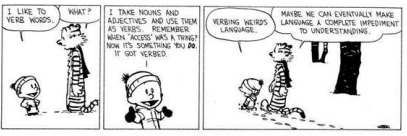
Based on that, choose the correct alternative:
Based on that, choose the correct alternative:
Ano: 2024
Banca:
FURB
Órgão:
Prefeitura de Bombinhas - SC
Prova:
FURB - 2024 - Prefeitura de Bombinhas - SC - Professor de Língua Inglesa |
Q3397958
Inglês
In accordance with the Brazilian National Curriculum
Base (BNCC), the integration of plurilingualism and the
recognition of English as a lingua franca are essential
components of language education in Brazil, reflecting
the nation's commitment to fostering communicative
competence and cultural diversity in the English
classroom. About plurilingualism and English as a lingua
franca, observe the following statements and choose the
correct one:
Ano: 2024
Banca:
FURB
Órgão:
Prefeitura de Bombinhas - SC
Prova:
FURB - 2024 - Prefeitura de Bombinhas - SC - Professor de Língua Inglesa |
Q3397959
Pedagogia
Analise as afirmações a seguir e registre V, para
verdadeiras, e F, para falsas:
(__) Os estudos contemporâneos no campo da educação apontam que o uso de Tecnologias da Informação e da Comunicação (TICs) por si só, ou seja, independentemente do contexto escolar, da turma, da relação entre professor e estudante e da metodologia a ser utilizada, é capaz de revolucionar o processo de ensino e aprendizagem, tornando-o mais significativo.
(__) Dentre as teorias de aprendizagem e desenvolvimento, aquela que hoje predomina nos documentos norteadores da educação brasileira é a Teoria Histórico-Cultural, a qual tem nos estudos de Vygotsky sua ancoragem mais importante.
(__) A escola brasileira ainda é muito marcada por práticas pedagógicas vinculadas ao que se costuma chamar hoje de Pedagogia Tradicional - baseada na transmissão do conhecimento e que parte da percepção de estudante passivo no processo de ensino-aprendizagem - e ao Behaviorismo pedagógico - relacionado a atividades de repetição e treinamento baseadas na relação estímulo-resposta.
(__) As diretrizes educacionais brasileiras, quando se referem na contemporaneidade à educação básica, insistem em práticas avaliativas formais, sobretudo na realização de provas bimestrais classificatórias, que permitam separar bons e maus estudantes.
Assinale a alternativa que apresenta a sequência correta:
(__) Os estudos contemporâneos no campo da educação apontam que o uso de Tecnologias da Informação e da Comunicação (TICs) por si só, ou seja, independentemente do contexto escolar, da turma, da relação entre professor e estudante e da metodologia a ser utilizada, é capaz de revolucionar o processo de ensino e aprendizagem, tornando-o mais significativo.
(__) Dentre as teorias de aprendizagem e desenvolvimento, aquela que hoje predomina nos documentos norteadores da educação brasileira é a Teoria Histórico-Cultural, a qual tem nos estudos de Vygotsky sua ancoragem mais importante.
(__) A escola brasileira ainda é muito marcada por práticas pedagógicas vinculadas ao que se costuma chamar hoje de Pedagogia Tradicional - baseada na transmissão do conhecimento e que parte da percepção de estudante passivo no processo de ensino-aprendizagem - e ao Behaviorismo pedagógico - relacionado a atividades de repetição e treinamento baseadas na relação estímulo-resposta.
(__) As diretrizes educacionais brasileiras, quando se referem na contemporaneidade à educação básica, insistem em práticas avaliativas formais, sobretudo na realização de provas bimestrais classificatórias, que permitam separar bons e maus estudantes.
Assinale a alternativa que apresenta a sequência correta:
Ano: 2024
Banca:
FURB
Órgão:
Prefeitura de Bombinhas - SC
Prova:
FURB - 2024 - Prefeitura de Bombinhas - SC - Professor de Língua Inglesa |
Q3397960
Pedagogia
Associe a segunda coluna de acordo com a primeira,
que relaciona a descrição do documento à sua
nomenclatura:
Primeira coluna: descrição do documento
(1). Documento que deve nortear a unidade escolar e seus profissionais no desenvolvimento de suas ações e atividades, o qual deve ser redigido de forma participativa e com o olhar voltado ao contexto específico de cada escola e sua comunidade escolar.
(2). Documento elaborado coletivamente no âmbito do município, com olhar voltado às particularidades de cada rede de ensino, e que deve ser uma trilha a ser perseguida pelos professores no planejamento do processo de ensino e aprendizagem, uma vez que aponta habilidades e conhecimentos a serem construídos em cada etapa do processo educativo.
(3). Documento elaborado pelo professor para concretizar o planejamento das atividades que irá realizar no âmbito de cada turma e que deve ser elaborado observando, de um lado, o currículo do município e, de outro, as especificidades dos estudantes e do contexto escolar.
Segunda coluna: nomenclatura
(__) Projeto Político Pedagógico
(__) Plano de ensino
(__) Proposta Curricular do Município
Assinale a alternativa que apresenta a correta associação entre as colunas:
Primeira coluna: descrição do documento
(1). Documento que deve nortear a unidade escolar e seus profissionais no desenvolvimento de suas ações e atividades, o qual deve ser redigido de forma participativa e com o olhar voltado ao contexto específico de cada escola e sua comunidade escolar.
(2). Documento elaborado coletivamente no âmbito do município, com olhar voltado às particularidades de cada rede de ensino, e que deve ser uma trilha a ser perseguida pelos professores no planejamento do processo de ensino e aprendizagem, uma vez que aponta habilidades e conhecimentos a serem construídos em cada etapa do processo educativo.
(3). Documento elaborado pelo professor para concretizar o planejamento das atividades que irá realizar no âmbito de cada turma e que deve ser elaborado observando, de um lado, o currículo do município e, de outro, as especificidades dos estudantes e do contexto escolar.
Segunda coluna: nomenclatura
(__) Projeto Político Pedagógico
(__) Plano de ensino
(__) Proposta Curricular do Município
Assinale a alternativa que apresenta a correta associação entre as colunas:
Ano: 2024
Banca:
FURB
Órgão:
Prefeitura de Bombinhas - SC
Prova:
FURB - 2024 - Prefeitura de Bombinhas - SC - Professor de Língua Inglesa |
Q3397961
Pedagogia
Analise as afirmativas a seguir e registre V, para
verdadeiras, e F, para falsas:
(__) A Base Nacional Comum Curricular (BNCC) é um documento norteador da Educação Básica em todo o Brasil e, como tal, determina, de forma inflexível, o currículo em todos os estados e municípios.
(__) Os termos Interdisciplinaridade e Transdisciplinaridade podem ser tomados como sinônimos, pois ambos se referem ao mesmo tipo de relação entre as disciplinas escolares ou componentes curriculares.
(__) Uma das diretrizes que está presente em todos os documentos norteadores da educação brasileira é a importância da formação continuada dos profissionais de educação. Esta precisa se efetivar em coerência com o contexto de atuação desses profissionais, mas também levando em conta a necessidade de se pensar o estudante, na contemporaneidade, como sujeito singular.
Assinale a alternativa que apresenta a sequência correta:
(__) A Base Nacional Comum Curricular (BNCC) é um documento norteador da Educação Básica em todo o Brasil e, como tal, determina, de forma inflexível, o currículo em todos os estados e municípios.
(__) Os termos Interdisciplinaridade e Transdisciplinaridade podem ser tomados como sinônimos, pois ambos se referem ao mesmo tipo de relação entre as disciplinas escolares ou componentes curriculares.
(__) Uma das diretrizes que está presente em todos os documentos norteadores da educação brasileira é a importância da formação continuada dos profissionais de educação. Esta precisa se efetivar em coerência com o contexto de atuação desses profissionais, mas também levando em conta a necessidade de se pensar o estudante, na contemporaneidade, como sujeito singular.
Assinale a alternativa que apresenta a sequência correta:
Ano: 2024
Banca:
FURB
Órgão:
Prefeitura de Bombinhas - SC
Prova:
FURB - 2024 - Prefeitura de Bombinhas - SC - Professor de Língua Inglesa |
Q3397962
Gestão de Pessoas
Analise as afirmativas a seguir e registre V, para
verdadeiras, e F, para falsas:
(__)As relações interpessoais interferem de forma positiva no desenvolvimento e resultado dos trabalhos, de modo consuetudinário.
(__)As relações interpessoais manifestam-se em consequência do processo de interação.
(__)As relações interpessoais são uma vertente exígua à administração participativa.
Assinale a alternativa que apresenta a sequência correta:
(__)As relações interpessoais interferem de forma positiva no desenvolvimento e resultado dos trabalhos, de modo consuetudinário.
(__)As relações interpessoais manifestam-se em consequência do processo de interação.
(__)As relações interpessoais são uma vertente exígua à administração participativa.
Assinale a alternativa que apresenta a sequência correta:
Ano: 2024
Banca:
FURB
Órgão:
Prefeitura de Bombinhas - SC
Prova:
FURB - 2024 - Prefeitura de Bombinhas - SC - Professor de Língua Inglesa |
Q3397963
Filosofia
Analise as afirmativas a seguir e registre V, para
verdadeiras, e F, para falsas:
(__) A ética é um ramo da filosofia que estuda o que é bom ou mau.
(__) Na base etimológica, as palavras ética e moral possuem o mesmo significado.
(__) A ética como expressão do pensamento filosófico nos conduz à ideia de uma forma universal do comportamento humano, que é expresso em princípios válidos para todo o pensamento moral e sadio.
(__) A ética é um ramo do ideal libertário que estuda o que é certo ou errado.
Assinale a alternativa que apresenta a sequência correta:
(__) A ética é um ramo da filosofia que estuda o que é bom ou mau.
(__) Na base etimológica, as palavras ética e moral possuem o mesmo significado.
(__) A ética como expressão do pensamento filosófico nos conduz à ideia de uma forma universal do comportamento humano, que é expresso em princípios válidos para todo o pensamento moral e sadio.
(__) A ética é um ramo do ideal libertário que estuda o que é certo ou errado.
Assinale a alternativa que apresenta a sequência correta:

 Conheça nossos planos